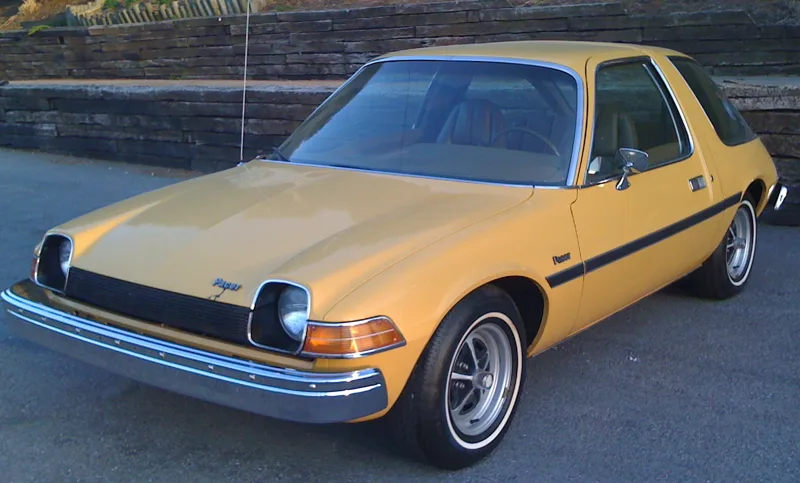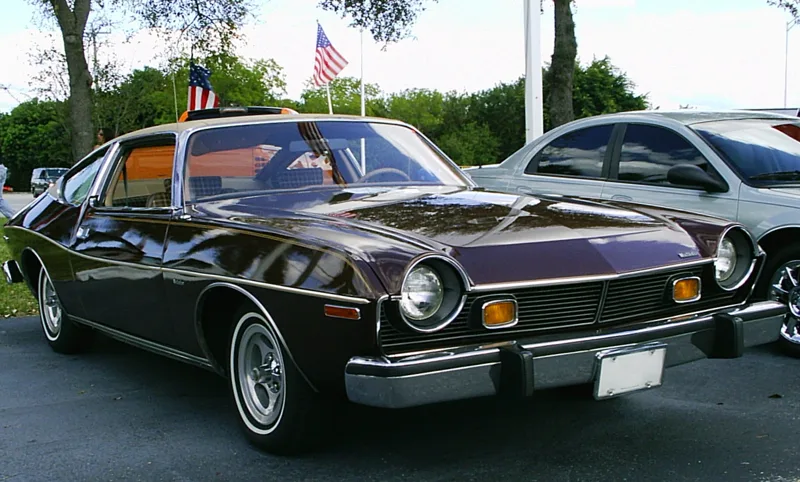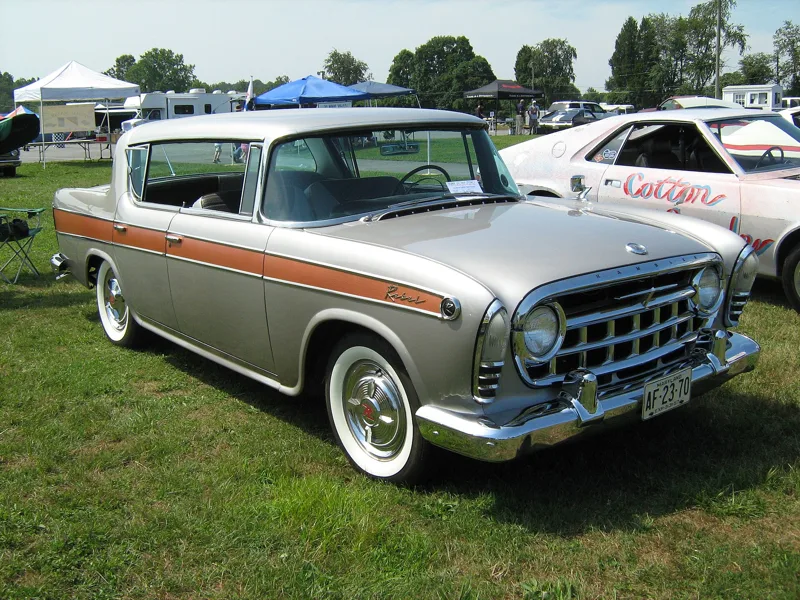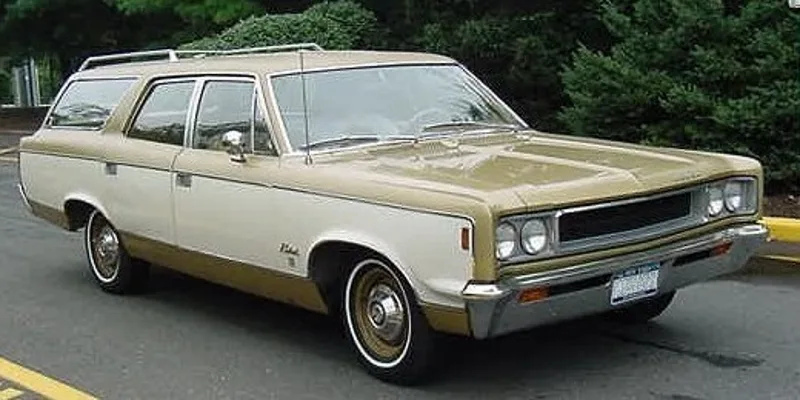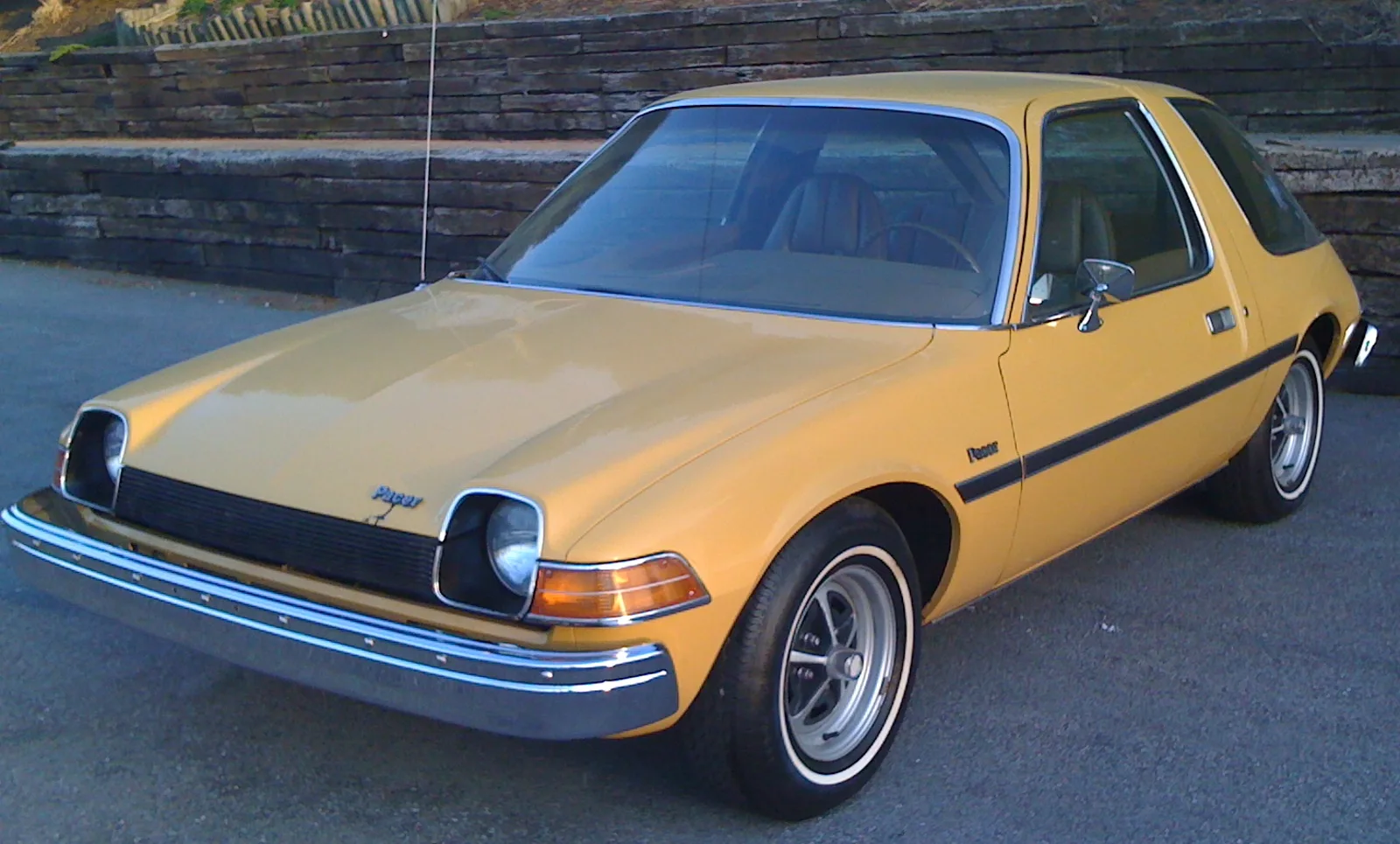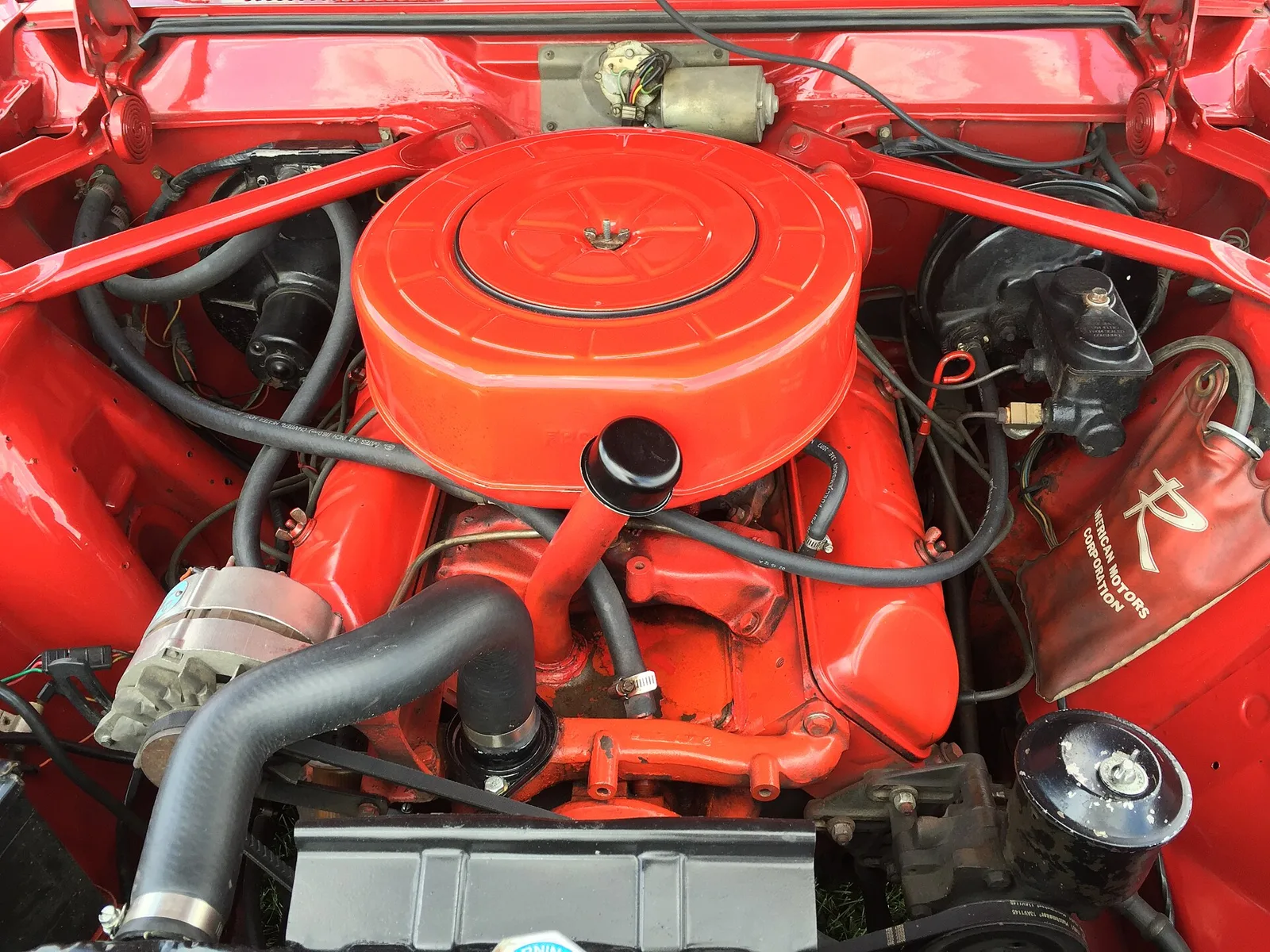
Two overhead valve V8 generations from American Motors, from the Rambler 250 and 327 of 1956 to the tall-deck 360 that outlived the company's independence.
American Motors built its own overhead valve eights in two generations between 1956 and 1991. They powered AMC, Kaiser and International Harvester vehicles, and the 360 cu in version lasted longest of the family. Their story spans the Rambler era, the Electrojector experiment and the tall-deck Jeep engines that followed.
The AMC V8 was American Motors' own overhead valve eight, and the company used it exclusively from 1956 until Chrysler acquired AMC in 1987. It came in two generations, the second of which ran in several capacities, and the tall-deck 360 remained in production until 1991.
What was the AMC V8?
The AMC V8 refers to two distinct overhead valve V8 designs developed and built by American Motors from 1956. The engines went into AMC, Kaiser and International Harvester vehicles, and they were also used in marine and stationary applications. The later generation grew out of the first, so the two share a family resemblance.
From 1956 through 1987 the company equipped its vehicles only with AMC-designed V8s. After Chrysler's takeover, the 360 cu in version continued for the Jeep Grand Wagoneer until 1991.
One company, two generations of overhead valve V8s, and a 327 that tried to be the first electronic injection car.
Why did American Motors build its own V8?
American Motors had once bought Packard V8s, which it fitted to the 1955 Nash Ambassador and Hudson Hornet. Those engines carried extra-thick head gaskets to reduce their power, and they were mated only to Packard's Ultramatic transmission. Packard's bids for further supply were also judged too expensive, which pushed AMC toward its own engine.
After the death of AMC's president, George W. Mason, in 1954, his successor George W. Romney decided against further dealings with Packard. Romney reportedly ordered an in-house V8 as quickly as possible, and design work on the first engine began that same year.
Earlier research from Kaiser-Frazer, on engines that never reached production, gave the team a head start. The programme was led by Meade F. Moore, and the clean-sheet V8 reached production in less than 18 months.
What were the first-generation engines?
Three displacements made up the first generation, which ran from 1956 to 1967: the 250 (4.1 L, 1956 to 1961), the 287 (4.7 L, 1963 to 1966) and the 327 (5.4 L, 1956 to 1966). All three shared most external dimensions and a stroke of 82.6 mm.
Bore size set the displacement. The 250 had an 88.9 mm bore, the 287 had a 95.3 mm bore, and the 327 had a 101.6 mm bore. The engine weighed about 270 kg (600 lb), and the bore size was cast into the block above the flywheel housing so it could be identified.
The block used a deep skirt that extended below the crankshaft centreline, giving a rigid crankcase. Oil travelled first to the cam and crank through a central gallery, then divided at the front toward the two lifter galleries, and finally reached the rocker shafts that served as valvetrain galleries.
How did the 250 and 287 differ from the 327?
The 250 was the first in-house AMC V8, and it was the start of a long line of American Motors engines. It debuted in the 1956 Nash Ambassador and Hudson Hornet Specials, which were built on the shorter wheelbase and carried the top trim. It used solid lifters and was offered with two- or four-barrel carburettors.
The 287 arrived in mid-model year 1963 for the mid-size Rambler, after dealers complained about the lack of a V8. It had hydraulic lifters and two-barrel carburettors only, because it was positioned as the economy V8.
The 327 was the high-performance member. It debuted in 1957 in the Rambler Rebel, of which about 1,500 were built, and its appearance made it an early American muscle car. The Rebel was the high-performance model of that range.
What was the Electrojector 327?
The 327 was meant to pioneer electronic fuel injection in production, through a Bendix-developed system called the Electrojector. It is one of the earliest attempts at electronic injection in an American production car. In March 1957 AMC priced the Electrojector option for the Rambler Rebel at US$395.
Supplier troubles slowed the programme, leaving just a handful of engineering and press cars. Power for the injected 327 was 288 hp (215 kW; 292 PS), compared with 255 hp (190 kW; 259 PS) for the carburettor model. It ran well when warm but was hard to start in cooler weather, and the Rebel was the car that carried it.
At Daytona Beach's Speed Week a pre-production Rebel placed just behind a Corvette with mechanical injection, making it the second-quickest car present. Early electronics could not manage fast engine control, and the system was replaced with carburettors before sale.
Bosch later licensed the Bendix patent and developed it into the D-Jetronic system, first used in 1967. The AMC version, however, was never sold in quantity.
Where did the first-generation V8 go beyond cars?
From 1965 to 1967 Kaiser-Jeep purchased the 327 for the Wagoneer and Gladiator. Jeep named it the Vigilante V8, and two-barrel carburation was standard on these models. A four-barrel high-compression version was offered in the Super Wagoneer from 1966 to 1968.
Gray Marine sold the 250 and 327 as the Fireball marine engine from 1958, with outputs running from 135 hp to 238 hp. A 220 hp marine version appeared in 1967, the final year of AMC V8 marine use.
Compression varied by year. Low-compression 327s from 1960 used two-barrel carburettors, while the high-compression models received four-barrel carburettors and different pistons.
What changed with the second-generation engine?
The Gen-2 engine appeared in 1966 with the same 4.75 in (121 mm) bore centres as the first generation, although almost everything else was re-engineered. The distributor and oil pump moved to the front of the engine, and the aluminium housing that carried them also carried the water pump.
The block was thinner-walled and had a deck height of 9.165 in (232.8 mm), which made it much closer in size to a small-block V8. The first version was a 290 cu in (4.8 L) Typhoon in a mid-1966 Rogue hardtop, offered with 200 hp as a two-barrel or 225 hp as a four-barrel.
The 343 cu in (5.6 L) followed for 1967 with 235 hp in two-barrel form and 280 hp with a four-barrel. In mid-1968 the AMX 390, at 6.4 L (390 cu in), became the range's performance option. The 290 used smaller valves, while the 343 and 390 shared the larger heads.
The AMX 390 carried forged steel crankshafts and connecting rods, which AMC used because it had not had time to test cast parts for durability. It produced 315 hp in 1968 and 1969.
What was the third-generation tall-deck engine?
In 1970 all three blocks gained deck height and a new head design, which made them the third generation. The 290 and 343 grew into the 304 (5.0 L) and 360 (5.9 L), and the 390 was stroked into the 401 in 1971. The 360 ended up as the final AMC V8 built, outlasting the rest of the family.
The dog-leg heads flowed about 20 percent better on the exhaust side than the rectangular-port heads. The change in the port floor from concave to convex reduced turbulence, and the centre intake bolts were moved to stop Gen-2 and Gen-3 intakes being mixed up.
Compression fell in 1971, when the combustion chambers grew from 50 to 52 cc to 58 to 59 cc. The apparent power drop in 1972 reflected the move from gross to net ratings rather than any engine change.
How did the 304, 360 and 401 perform?
The 304 was rated at 210 hp (157 kW; 213 PS) gross in 1970 and 1971, and then fell to 150 hp (112 kW; 152 PS) from 1972 to 1975. It was in cars until 1979 and in Jeeps into the early 1980s, and the International Harvester Comanche V8 of the same displacement is unrelated.
The 360 was the longest-running member. Its two-barrel versions made 235 to 245 hp in 1970, and the four-barrel gave 285 to 295 hp. It powered the Matador, the Jeep J-series and Wagoneer, and the Bricklin SV-1 in 1974, and it stayed in the Grand Wagoneer until 1991.
The 401 was the most powerful Gen-3 engine. It was rated at 330 hp gross in 1971, then at 255 hp net from 1972 to 1975, and it was last built in 1978. International Harvester sold it as the V-400 in its light-line trucks.
What about the racing blocks and Indy 209?
The SR block was a heavy-duty racing block that appeared in 1970 for the 1971 Trans-Am season. TRACO prepared the Penske cars with it, and Mark Donohue was the main driver. It did not need homologation because it was a standard factory part.
From 1976 to 1979 Jerry Grant drove the most powerful Indy car of its era, a turbocharged two-valve 209 cu in V8 that produced 1,100 hp. The engine used a 95.3 mm bore and a 59.9 mm stroke, and it was fitted to an Eagle 74 chassis. On the straights the Eagle 74 was quick, although the engine's mass made the corners harder work.
What were the main AMC V8 specifications?
| Engine | Displacement | Bore and stroke | Output |
|---|---|---|---|
| 250 (first generation) | 250 cu in (4.1 L) | 88.9 mm bore, 82.6 mm stroke | Two- and four-barrel carburettors |
| 327 (first generation) | 327 cu in (5.4 L) | 101.6 mm bore, 82.6 mm stroke | 255 hp (190 kW; 259 PS) carburettor |
| 327 Electrojector | 327 cu in (5.4 L) | 101.6 mm bore, 82.6 mm stroke | 288 hp (215 kW; 292 PS) |
| 290 Typhoon | 290 cu in (4.8 L) | 95.3 mm bore, 83.3 mm stroke | 225 hp four-barrel |
| 343 | 343 cu in (5.6 L) | 103.6 mm bore, 83.3 mm stroke | 280 hp four-barrel |
| AMX 390 | 390 cu in (6.4 L) | 105.8 mm bore, 90.8 mm stroke | 315 hp (235 kW; 319 PS) |
| 304 (1970 to 1975) | 304 cu in (5.0 L) | Not known | 210 hp gross in 1970 and 1971 |
| 360 (1970 to 1991) | 360 cu in (5.9 L) | Not known | 160 hp from 1978 to 1991 |
| 401 (1971 to 1978) | 401 cu in (6.6 L) | Not known | 330 hp gross in 1971 |