From a meteor filmed by drivers in Russia to trackers that price an insurance policy, a guide to what in-car cameras and vehicle trackers capture and the laws that govern them.
A dash cam records the view through the windscreen and often speed, GPS position and g-forces, while a GPS tracker reports a vehicle's location and sensor data to a server. Insurers, police, fleets and owners use the results, and privacy laws differ widely by country.
When a meteor broke up over Chelyabinsk in February 2013, most of the footage that reached the world came from windscreens. Russian drivers had fitted cameras as a guard against police corruption and insurance fraud, and the recordings showed the event from at least a dozen angles.
That accident of coverage shows what a dash cam is for. It keeps running when nobody is watching, it stamps the time on what it sees, and later it becomes evidence. A GPS tracker for a car works from the opposite direction, reporting where a vehicle is rather than what it can see. In commercial fleets the two have merged into a single box, and the rules on who may use the results change sharply from one country to the next.
What does a dash cam record?
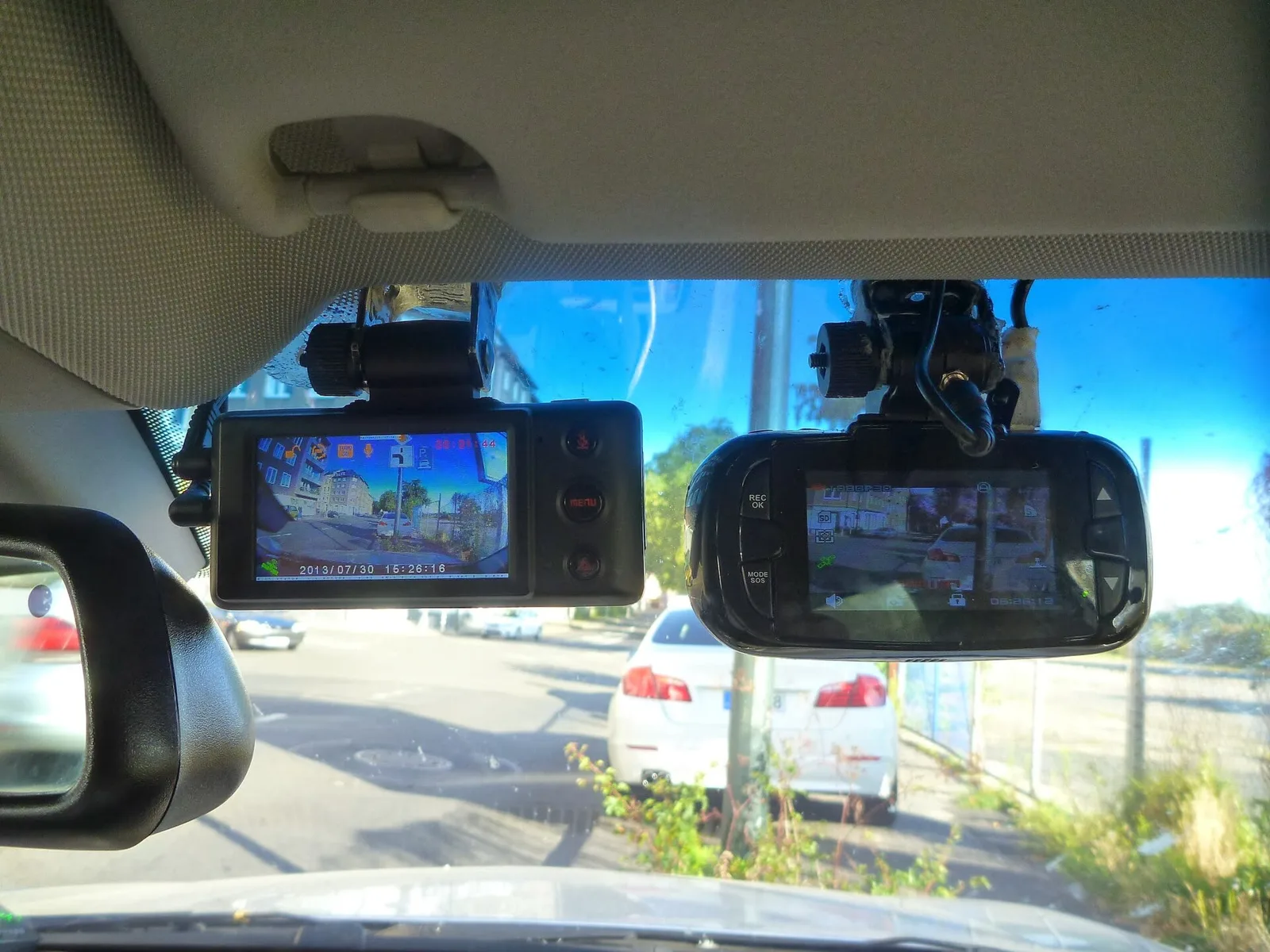
A dash cam is an onboard camera that films the road through the front windscreen without a break, and sometimes the rear or side windows as well. The same device is sold as a car digital video recorder or a driving recorder, and in some markets as an event data recorder. The better ones log more than pictures. Acceleration and braking forces, speed, steering angle, GPS position and the voltage of the car's electrical system can all be written down beside the video.
Picture quality comes down mostly to resolution. Full HD, at 1920 by 1080 pixels, is the usual standard for the front lens. Some makers go to 1296p, a figure common on Chinese-made cameras, or to 1440p and beyond, while a rear camera is often content with 720p. An f/1.8 aperture and a night mode are the usual answers to poor light.
Where the camera sits and what it points at varies. A front lens with a field of view of 130 or 170 degrees or more clips to the inside of the windscreen, to the rear-view mirror or to the top of the dashboard, held by a suction cup or adhesive tape. A rear camera tends to live in the back window or in the registration plate, sending video to a monitor over an RCA connection. Cabin-facing versions, sometimes called taxicams, film the people inside, and some use a ball-shaped lens that sees 360 degrees and can push pictures and video out over a mobile connection. A growing number of 4G triple-lens sets pair two front cameras with a rear one: a 170-degree lens for the road, a 360-degree lens for the sides and doors.
The same cameras that protect a driver can intrude on everyone else, and national laws disagree.
What to look for in the best dash cam
Memory is the first practical question. Footage is normally saved to a microSDHC or microSDXC card rated class 10 or above, usually 16 GB or larger, though some units rely on internal memory. To stop anyone altering a clip after the event, a camera can apply trusted timestamping, which marks the file in a way that exposes later tampering.
Features have piled up. Modern units add GPS tracking, speed recording, Wi-Fi and Bluetooth transfer, cloud backup, smartphone apps and voice control, and most stamp GPS coordinates onto the footage. Some need an external antenna on a micro USB or 3.5 mm connection; others have the receiver built in, and a few include online and offline navigation. A built-in microphone handles voice commands and sound recording.
Power is where cheap and expensive cameras part company. The car's 13.8V supply is stepped down to a 5V USB feed. That feed can come from the cigarette-lighter socket or from a hardwired connection, which leaves the socket free. When the ignition goes off, the camera still has to close its file and format the card properly, and it does that on a small reserve of stored power. Less expensive cameras use a lithium polymer battery for this. Dearer ones use a capacitor.
The difference matters over the years. A lithium polymer cell has an estimated life of two to three years, or roughly 300 to 500 charge cycles. As the material inside degrades it gives off gas, and the case swells. A camera in that state may switch itself on and off at random, or throw format errors because it cannot shut down cleanly. Capacitors last much longer and cope better with high temperatures, but they cost more and need extra hardware or software support.
How does dash cam parking mode work?
Round-the-clock recording strains both power and storage. The usual answer is a motion detector, so the unit films only when a person or vehicle approaches, saving power and storage. Some cameras can also record where the car was parked.
Mobile connectivity adds a second layer. Where a camera carries a 4G link, it can send messages, calls, pictures and video from the parked car, and it can send a message when the car battery runs low. A second 360-degree lens is often used for the sides, the front doors and the windows.
What does a GPS tracker for a car actually do?
A vehicle tracking system pairs a device in the car, normally a GPS tracking unit, with a software platform that shows its position and other data close to real time. Inside the unit sits a satellite receiver. It is called GPS in everyday speech, but modern receivers often listen to GLONASS and Galileo as well, which improves accuracy and reliability. A cellular modem, on 4G or 5G, carries the position to a server; a satellite modem does the job where there is no mobile coverage.
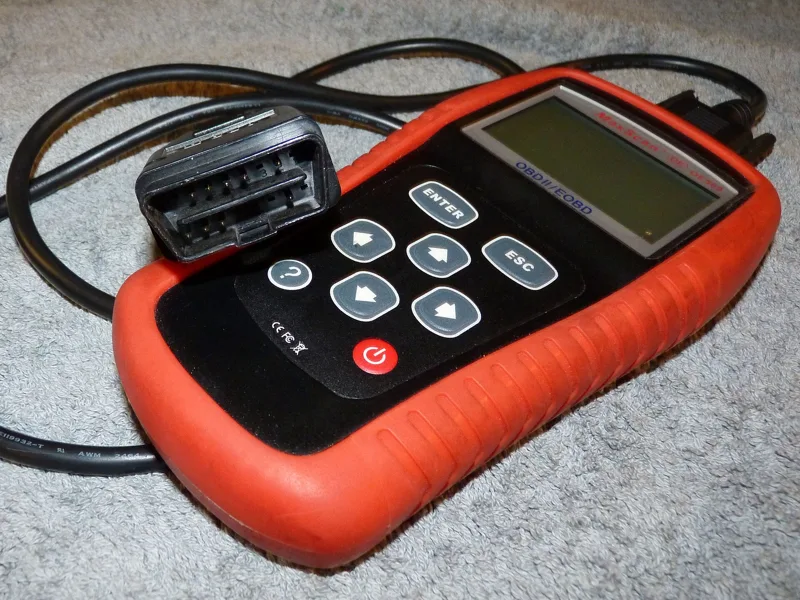
A processor runs the unit, and its memory holds readings while the car is out of range, to be sent when the signal returns. An accelerometer picks up harsh braking, hard acceleration and impacts. Inputs and outputs let the tracker watch a door, read a temperature sensor or trigger a starter interrupt that stops the engine being restarted. Plugged into the car's computer through the CAN bus or the OBD-II port, it can also read fuel level, engine speed and fault codes. Some units add a camera, which is how video telematics got its name.
The software side has three parts. A backend server receives and stores the data. A web application gives fleet managers live maps, route playback, alerts and reports, and phone apps give the same view to people on the move. A programming interface passes mileage and usage figures straight into accounting, payroll or maintenance software. In India, tracking by SIM card needs no device in the vehicle at all, and platforms follow millions of trucks by querying mobile network location signals.
Which tracker suits which job?
| Type | Power | What it can read or do | Typical use |
|---|---|---|---|
| Hardwired | Vehicle electrical system, constant supply | Ignition status, starter interrupt, fuel level, cargo temperature, tyre pressure, CAN bus data | Professional commercial fleets |
| OBD plug-in | OBD-II port | Engine speed, fuel level, diagnostic trouble codes | Maintenance monitoring, fitted without tools |
| Battery-powered | Own long-life battery | Position, placed anywhere without wiring | Trailers, containers, covert security |
Smaller portable trackers cover people and animals. They are carried by children, elderly relatives with dementia, lone workers and pets, and often carry an SOS button that sends an alert and a location. The commercial vehicle segment is the largest buyer of tracking devices, and suppliers such as CalAmp, ORBCOMM, Queclink and Teltonika lead the hardware side.
Who gets to use what these devices capture?
Owners come first. In stolen vehicle recovery a covertly fitted tracker hands the car's location to the owner or to police, and better systems warn of unauthorised movement, such as a tow, and can immobilise the engine. Demand is strongest where vehicle crime is a serious problem.
Insurers use the data differently. Usage-based policies, sold as pay-as-you-drive or pay-how-you-drive, set the premium from mileage, time of day, speed and braking. Manufacturers fit their own telematics too, for emergency calls, remote diagnostics and concierge services, and they use what they collect for research and to predict maintenance.
Governments are another customer. Electronic tolling records where a vehicle is and how far it travels on a toll road. Some places charge heavy goods vehicles for the specific roads and times they use, and in some sectors tracking is a legal requirement for loads that are hazardous or valuable.
Fleets get the broadest benefit. Tracking cuts down on fuel theft, supports route planning and customer arrival times, and logs hours worked by drivers. Dispatchers send the nearest technician to a job. Construction firms watch excavators and bulldozers and schedule servicing by engine hours. Transit authorities publish live arrivals, and waste collectors prove every stop on a route was visited. The dash cam version used in fleets has no screen and carries its own GPS unit and sensors. These units record incidents, help recover stolen vehicles, and feed driver coaching and scoring, with software that flags risky behaviour. Trucks and buses often run several cameras into one central recorder.
Police use dash cams too, in patrol cars, to gather evidence at traffic stops and during chases. Some systems start themselves when the emergency lights or siren come on. Freedom of information laws allow footage to be released in some circumstances. The record is patchy, though: a report in 2016 found that 80% of Chicago's police dash cams did not work properly, because officers had destroyed antennas, hidden microphones or removed batteries and recording media.
Do dash cams help with insurance?
In the United States, around 16% of drivers use a dash cam, and 20% of owners have used their footage in an insurance claim. Britain saw sales rocket in 2015, up 395% and the fastest growth of any consumer electronic that year. Russian drivers adopted cameras as a guard against insurance fraud, and courts there almost always treat a recorder attached to an accident analysis as evidence of guilt or innocence.
Footage has also reached well beyond insurance. Dash cams recorded National Airlines Flight 102 in 2013, TransAsia Airways Flight 235 and the Shoreham Airshow crash in 2015, the engine failure on United Airlines Flight 328 in 2021 and the crash of UPS Airlines Flight 2976 in 2025.
What do the privacy laws say?
The same cameras that protect a driver can intrude on everyone else, and national laws disagree.
- Austria bans use where the main purpose is surveillance, with fines of up to 25,000 euros, though telling surveillance from other uses can be difficult.
- Switzerland strongly discourages recording in public space because it may breach data protection principles.
- Germany allows small personal cameras but forbids posting footage on social media unless personal data is blurred. In 2018 the Federal Court of Justice ruled that permanent recording breaches national data protection law, yet recordings may still serve as evidence in civil proceedings after the interests involved are weighed.
- Luxembourg allows ownership but makes it illegal to capture video or stills in a public place, a vehicle on a public road included, and recording can bring a fine or imprisonment.
- Australia permits recording on public roads provided it does not intrude on personal privacy in a way a court would find inappropriate.
- The United States protects the filming of public events at federal level through the First Amendment. Sound recording, the venue and manner of filming, and whether the camera blocks the windscreen are matters for each state.
- Russia explicitly allows cameras under Ministry of the Interior regulations issued in 2009.
Tracking is regulated separately. In the European Union the General Data Protection Regulation treats location data as personal data, so collecting it needs a valid legal basis. An employer who tracks a vehicle that staff also use in their own time typically needs explicit consent. The alternative is to argue legitimate interest, which demands a careful balance: the monitoring must be proportionate and necessary, for safety or logistics, without unduly intruding on the driver. In the United States, United States v. Jones in 2012 established that placing a GPS tracker on a suspect's vehicle without a warrant is an unlawful search under the Fourth Amendment.
Where are dash cams and trackers heading?
Cameras are moving into the factory. Dashboard cameras are described as the top feature wanted by future vehicle buyers, and more car makers are fitting camera systems of their own.
The tracking business is forecast to keep growing. The global market for commercial vehicle telematics was valued at over $85 billion in 2024 and is projected to pass $150 billion by 2028, with Geotab, Gurtam, Verizon Connect and MiX Telematics among the leading names. Hardware alone is a smaller pool: GPS tracking units were worth over $2.5 billion in 2022, with growth of over 13% a year projected to take them to $4.76 billion by 2027.
The installed base is uneven. At the end of 2023 Europe had an estimated 25.5 million active units and North America 30.1 million. Latin America is projected to reach 16.6 million by 2029. Southeast Asia had over 2.7 million at the end of 2023 and is expected to reach 5.4 million by 2028. Many new cars already carry a factory telematic control unit, and aftermarket devices fill the gap for mixed fleets and for vehicles without one.