A team owner who sold Minardi to Red Bull, a bidder for Force India, a widow whose watch became a collector's nickname and a priest who ran onto the track at Silverstone.
Paul Stoddart owned Minardi from 2001 to 2005, Dmitry Mazepin bid for Force India in 2018 and fathered Haas driver Nikita Mazepin, Nina Rindt was the wife of 1970 champion Jochen Rindt, and Neil Horan ran onto the track at the 2003 British Grand Prix.
On 20 July 2003 a man in an orange skirt ran onto the Hangar Straight at Silverstone, where Formula One cars were travelling at around 200 mph (320 km/h), waving a banner that read "Read the Bible. The Bible is always right". Several drivers swerved, and the safety car came out to protect him and the field. Neil Horan, the intruder, is one of four people who made their mark on Formula One from outside the cockpit. The others are Paul Stoddart, who ran the Minardi team, Dmitry Mazepin, the businessman whose son raced for Haas, and Nina Rindt, a model whose trackside chronograph gave a watch its nickname.
Neil Horan: the Grand Prix Priest
Cornelius Neil Horan, born on 22 April 1947, is an Irish former Roman Catholic priest, nicknamed the Grand Prix Priest, the Dancing Priest and the Armageddon Priest. He is the second of 13 children and a native of Scartaglen in County Kerry. He was ordained in 1973 and now lives in London. He is known for interrupting major sporting events to promote his belief that the end times are near.
Silverstone, 2003
At the British Grand Prix he ran across the track in an orange skirt, carrying that Bible banner. The protest took place on the Hangar Straight. Track marshal Stephen Green tackled him and removed him from the circuit before he was arrested. Horan was charged with aggravated trespass, pleaded guilty and was sentenced to two months in prison.
The Derby, Athens and later arrests
At the Epsom Derby on 5 June 2004, police spotted him and shoved him to the ground moments before they believed he would run in front of the horses. He was released without charge, but police circulated information about him to other sporting events, and a court order the following year kept him two miles from the racecourse.
On 29 August 2004 he got onto the course of the Athens Olympic men's marathon, near the 35 km (22 mi) mark, despite tight security, and pushed the race leader, Brazil's Vanderlei de Lima, into the crowd. A Greek spectator, Polyvios Kossivas, pulled Horan off and helped de Lima back to the road. De Lima lost about 10 seconds of a 25-second lead and was passed by Stefano Baldini and Mebrahtom Keflezighi at the 38 km (24 mi) mark, finishing third. The head of the Brazilian Athletics Confederation asked for de Lima to receive a gold medal as well, but the request was denied. A Greek court gave Horan a 12-month suspended sentence and a fine of 3,000 euros.
In 2005 the Archbishop of Southwark laicised Horan on 20 January. During the 2006 FIFA World Cup in Germany he was arrested before staging a planned protest, spent two months in custody and was released on 15 September 2006 when the judge discharged the case. On 13 April 2007 he was served with an Anti-Social Behaviour Order barring him on London Marathon day from the boroughs the course passes through. In May 2009 he danced an Irish jig on Britain's Got Talent and went through to the second round, though not to the live semi-finals.
Several drivers had to swerve to avoid him, and the safety car was deployed.
Paul Stoddart: the airline owner who ran Minardi
Paul Gerard Stoddart, born on 26 May 1955, is an Australian businessman and airline owner who once ran the Minardi Formula One team. He was born in Coburg, a suburb of Melbourne, and attended Preston Technical School and St Joseph's College. His first business was a car dealership, and after moving to England he became the Yugo car distributor for the UK and ran a hire-car detailing business in Manchester.
From Yugos to aeroplanes
In late 1989 he bought two BAC 1-11 airliners and three Falcon 20 business jets, plus a large stock of spares, from the Royal Australian Air Force's VIP squadron. He formed European Aviation, hired Trevor Whetter from British Aerospace as managing director and sold the BAC 1-11s to Okada Air in Nigeria. After talks with British Airways he bought 16 aircraft, and once Dan Air had been taken into British Airways the airline itself came into being in 1994. In the COVID-19 pandemic, A340 airliners that his business had acquired from Etihad Airways flew protective equipment from China and Malaysia back to the UK.
In 2005 he formed OzJet, an all-business-class Australian airline intended to challenge Qantas on a luxury domestic product. It flew three Boeing 737s with 60 seats. It was not a commercial success, and in March 2006 he cancelled the commercial service and made it a charter airline. It was sold to Air Australia in 2009.
Tyrrell, Arrows and Jordan
In 1996 Stoddart bought a 1990 Tyrrell 019 Formula One car and got to know Tyrrell team manager Rupert Mainwaring. In 1997 European Aviation sponsored the team, with its name on the front wing, and on the rear wing in 1998. Stoddart and Ken Tyrrell discussed building a wind tunnel at Stoddart's base at Bournemouth Airport, and in 1997 a $25 million sale of the team to Stoddart was nearly agreed. British American Tobacco bought Tyrrell instead and entered the 1999 season as British American Racing. Stoddart bought a quantity of Tyrrell cars and equipment and moved them to Ledbury in Herefordshire.
In 1999 European Aviation sponsored Jordan, with speculation that he would buy a minority stake from Eddie Jordan. It moved to Arrows in 2000, where his European Racing became the Arrows Junior Team with driver Mark Webber.
Running Minardi
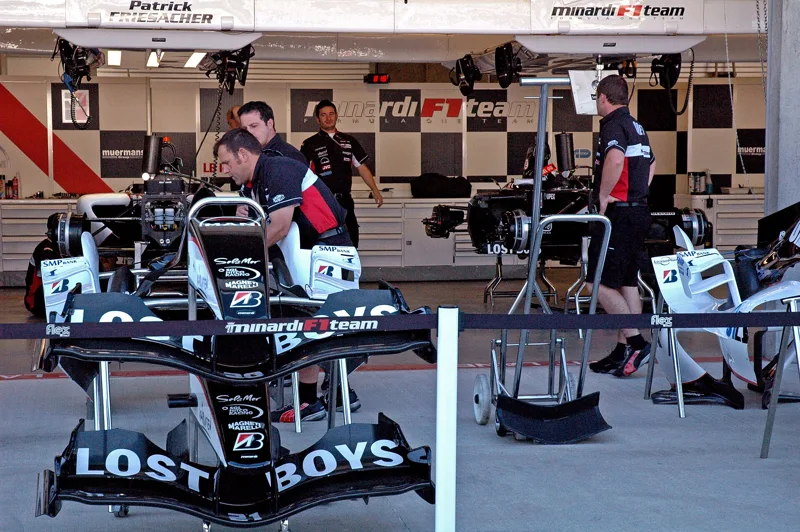
In 2001 Gabriele Rumi sold Minardi to Stoddart before the season. The team built its PS01 in six weeks, painted it with European Aviation branding and fitted an uprated version of the 2000 Minardi Fondmetal V10. Minardi were perennial backmarkers, but future world champion Fernando Alonso drove for them in 2001 and was highly rated. In 2002 Stoddart hired Webber, who scored points on his debut at the Australian Grand Prix.
Finances and sponsorship were a constant struggle. In 2003 Bernie Ecclestone invested $4 million in the team. Wilux became lead sponsor in 2004 but ended its agreement when the team ran without logos at the British Grand Prix, a decision Stoddart took after the death of Minardi sporting director John Walton. In 2005 the sponsor was another of his firms, OzJet. One of the team's biggest successes under his ownership came at the 2005 United States Grand Prix, where only six cars started and Minardi scored 7 points with both cars finishing.
Throughout his ownership, Stoddart campaigned for budget caps and more financial incentives for small teams, including in a public battle with McLaren's Ron Dennis. After Eddie Jordan sold Jordan Grand Prix to Alex Shnaider in 2005, Stoddart voiced concern for his own team's future. On 12 September 2005 he announced that he had sold Minardi to Red Bull's Dietrich Mateschitz, who rebranded it Toro Rosso. In March 2006, less than a year later, he lodged an entry with the FIA to bring the Minardi name back for 2008, but Prodrive won the twelfth and last place on the grid, which it did not use.
He bought the CTE-HVM ChampCar team in December 2006 and renamed it Minardi Team USA. It was successful, with Robert Doornbos third overall and Rookie of the Year, but ChampCar was absorbed by the Indy Racing League a month before the 2008 season. Stoddart chose not to enter, fearing the former ChampCar teams could not compete, though the half of the team owned by Keith Wiggins continued as HVM Racing. Since the 2017 Spanish Grand Prix he has also offered fans rides in one of his Minardi Fx2 cars.
Dmitry Mazepin: the Force India bid and the Haas link
Dmitry Arkadievich Mazepin, born on 18 April 1968 in Minsk, is a Belarusian-Russian businessman and the former owner and chief executive of the fertiliser group Uralchem. Forbes has listed him among Russia's 200 wealthiest businesspeople, estimating his fortune at $800 million in 2021. His son Nikita raced in Formula One for the Haas F1 Team.
He graduated from the Suvorov Military Academy in Minsk in 1985, served as a military interpreter in Afghanistan from 1986 to 1988 and graduated in economics from MGIMO University in 1992. In 2007 the assets under his control were consolidated into Uralchem. In December 2013 he paid about $2.9 billion for 20 per cent of Uralkali, the world's largest potash producer, funded by a $4.5 billion loan from VTB, and he won a board seat in March 2014. In October 2024 he was appointed head of the Russian Aquatics Federation.
Charity has a car link. According to Forbes and Ria Novosti, he gave $700,000 to charitable causes in 2012, most of it for a project that buys cars for large low-income families in the Kirov region, and Forbes listed him among the most charitable Russian billionaires in 2013.
The Force India bid
After Force India entered administration in July 2018, Mazepin and Uralkali bid for the Formula One team. They lost out to a Canadian consortium led by Lawrence Stroll. Mazepin criticised the bidding process openly, saying the administrators had never contacted him about his offer.
Sanctions and Nikita Mazepin
On 24 February 2022 Mazepin attended a general meeting of Russian business representatives with President Vladimir Putin. On 11 March 2022 he sold his controlling stake in Uralchem, reducing his holding to 48 per cent, and stepped down as chief executive. Dmitry and Nikita Mazepin were added to the European Union sanctions list after Russia's invasion of Ukraine, and the United Kingdom added both on 15 March 2022. Switzerland followed on 16 March, Australia on 6 April and New Zealand on 12 October 2022. Ukraine had sanctioned Dmitry by presidential decree on 24 June 2021. Nikita's multi-year contract with Haas was terminated after the invasion.
The European Union's General Court lifted the sanctions on Nikita Mazepin in March 2024. Its ruling held that the association criterion needs a connection beyond family ties, and that this was no longer satisfied once he had stopped racing in Formula One.
Nina Rindt: the model with the trackside chronograph
Nina Madeline Rindt, born in 1943 as Nina Lincoln, is a Finnish former fashion model and Formula One personality. She is best known as the wife, and later widow, of Jochen Rindt, who died in a practice crash the day before the 1970 Italian Grand Prix and was posthumously awarded the World Drivers' Championship that year.
Her father, Curt Lincoln, raced cars and played tennis, a wealthy Finn who made one Davis Cup appearance for his country. She went to boarding school in Montreux and began a haute couture course in Brussels, which she dropped when her relationship with Jochen Rindt became official. She chose a modelling career in London, Paris and New York, partly to keep her independence, and appeared in Vogue, Life and Look. Her friends in fashion included Twiggy.
Jochen, the pit lane and the watch
Jochen Rindt met Curt Lincoln through Formula Junior racing, and first met Nina in 1963 at the ski resort of Zurs in Austria. He was twenty-one and she was twenty. When his Formula One career began at the 1964 Austrian Grand Prix, she was often seen and photographed in the pit lane. Amanda McLaren, daughter of Bruce McLaren, has observed that in the 1950s and 1960s the wives and girlfriends made tea, coffee and sandwiches for the team and did the time keeping and lap scoring, since there was no corporate hospitality.
Nina Rindt is now synonymous with the Universal Geneve Compax chronograph she wore trackside, which had a panda dial, a white main dial with black sub-dials, and a Bund-type strap. She was also photographed with a bright orange Omega stopwatch. She kept to herself, never posed for trackside photographs and rarely gave interviews. The couple married in 1967, lived on the shores of Lake Geneva and had a daughter, Natasha, in 1968.
At the end of the 1970 season there was no official trophy for a posthumous champion. In November, Jackie Stewart, the 1969 champion, handed Nina Rindt the Champion Challenge Trophy, the piece traditionally awarded to the winning driver. Oliver Owen of The Observer called the presentation one of motor racing's most poignant moments.
Later years and legacy
Rindt married twice more, to Phillip Martyn, a New Zealand-born professional backgammon player and friend of Stewart, and on 5 December 1979 to Alexander Nelson Hood, the 4th Viscount Bridport. That marriage ended in divorce in 1999. Since then she has largely stayed out of the public eye. She attended the unveiling of a bronze plaque at Jochen's childhood home in Graz in 2000, a Vienna photo exhibition called Formula 1's first rock star in 2010, and the opening of Jochen-Rindt-Platz in the Reininghaus district of Graz on 7 October 2021.
In 2011 La Gazzetta dello Sport named her the most beautiful Formula One wife of all time. In Helsinki, the restaurant Kosmos listed a chilled chocolate cheesecake in her honour, Nina Lincoln's style, on its dessert menu in 2014 and again in 2024, with the recipe previously published in a 1987 Finnish baking book. English-language writers in the 2010s and 2020s have called her a secret, underrated and forgotten style icon.
The Compax model has become known as the Nina Rindt watch, and its reverse panda counterpart, with a black main dial and white sub-dials, picked up the nickname Evil Nina among collectors. As of 2020 she still owned her own Compax, with non-standard main hands.
Four names at a glance
| Name | Born | Known in Formula One for |
|---|---|---|
| Paul Stoddart | 26 May 1955 | Owning Minardi from 2001 until its sale to Red Bull in 2005 |
| Dmitry Mazepin | 18 April 1968 | Bidding for Force India in 2018; father of Haas driver Nikita Mazepin |
| Nina Rindt | 1943 | Wife of Jochen Rindt, the 1970 champion; trackside Compax chronograph |
| Neil Horan | 22 April 1947 | Running onto the track at the 2003 British Grand Prix |