Buried tanks, metered pumps and a card that replaced the paper receipt: how the whole forecourt works, piece by piece.
A filling station buys fuel from refineries by tanker, stores it in underground tanks and sells it through pumps that meter every litre with a piston meter and encoder. Fuel cards, usually charge cards, let drivers and fleets pay on account, with real-time reports and limits on volume, time and fuel grade.
Bertha Benz bought the fuel for her first long drive in 1888 at a pharmacy in Wiesloch, because motor fuel was then sold the way any solvent was. The petrol station, the pump that measures the fuel and the card that pays for it all grew out of that awkward start.
A filling station is a retail site where motorists buy fuel and oil from underground tanks through metered pumps. Today a card, rather than cash and a paper receipt, often settles the bill, especially for businesses running fleets.
What is a petrol station and how does it operate?
A filling station takes deliveries from refineries by tanker truck, holds the fuel in tanks that are usually buried, and sells it to drivers at a price that changes from day to day. Many also run a shop, and some supermarkets and warehouse clubs have added pumps to their own sites.
Petrol in several octane grades and diesel are the staples, but autogas (LPG), compressed natural gas, hydrogen, kerosene, alcohol fuels and biofuels turn up at some sites. The dispensers pump the fuel, gauge the volume and work out the price.
Most of the plumbing is out of sight. A tanker empties into each tank by gravity through a capped opening on the perimeter, and underground pipes carry the fuel to the dispensers. Every tank has to stay reachable at all times. Older stations run a separate pipe for each fuel and each dispenser, whereas newer ones may use a single pipe per dispenser with smaller pipes bundled inside.
Volumes can be startling. In the United States a big outlet may sell as much as 30,000 US gallons (110,000 L) in one day, and since most deliveries arrive in tank trucks of 8,000 to 16,000 gallons, two drops in 24 hours are common. There are far fewer retail outlets there now than in 1980.
What happens on the forecourt?
Pumps sit on concrete plinths to guard against a collision. Because fuel spills, runoff goes into a channel drain and then a petrol interceptor, which captures hydrocarbon pollutants before the rainwater drains away. Vapour is handled too, and in the United Kingdom a new forecourt expected to handle more than 500 cubic metres a month must have active vapour recovery.
Where customers pay at the dispenser, data travels from the pump to the till over RS-232, RS-485 or Ethernet. The till can usually do little more than let staff switch pumps on and off. A separate system with sensors inside each tank reports the level to a back-room terminal.
Motor fuel began as a pharmacy purchase in 1888; the card that pays for it now reports every litre in real time.
Why is it a gas station in one country and a servo in another?
Because North America calls the fuel gasoline, or gas, while most of the English-speaking world says petrol. The United States and Canada therefore have gas stations and service stations, and the United Kingdom has petrol stations and petrol pumps.
Local habits add variety. Parts of Canada say gas bar, Ireland, New Zealand and South Africa still say garage and forecourt, Australians shorten service station to servo, and in India, Pakistan and Bangladesh it is a petrol bunk.
Petrol itself began as a brand. Carless, Capel and Leonard of Hackney Wick in London had made a petroleum distillate with a specific gravity of 0.68 as a solvent since the 1860s. In the 1890s Frederick Simms found it ideal for Daimler's engines and suggested the firm sell it as Petrol. Carless could not defend the name as a trademark: John Scott Montagu said in 1902 that motorists always called it petrol, and Gottlieb Daimler said the word had been used in England in the 1860s.
When did the first petrol station open?
The first filling station as people now understand the term appears to have opened in 1905 at 420 South Theresa Avenue in St. Louis, Missouri. A second followed in 1907, built by Standard Oil of California in Seattle at what is now Pier 32.
Before that, drivers pulled up at general stores, hardware stores and even blacksmiths. Checking oil and water and selling tyres came later, which is where the service station comes from. Early filling stations often washed windscreens for nothing.
Britain took a different route. Under the Petroleum Acts of 1871 and 1879, premises dealing in petroleum spirit needed a licence, so early motorists installed licensed tanks of their own. From 1900 the Home Office allowed unlicensed sale in metal containers of up to 2 gallons, and a motorist could have a case of three 2-gallon cans sent by rail to the nearest station and collect it, or send the chauffeur.
Filling station firsts at a glance
| Year | Place | Milestone |
|---|---|---|
| 1888 | Wiesloch, Germany | Bertha Benz buys Ligroin at a pharmacy |
| 1905 | St. Louis, Missouri | Purpose-built station at 420 South Theresa Avenue |
| 1907 | Seattle, Washington | Standard Oil of California station |
| 1911 | Russia | First filling stations appear |
| 1912 | Columbus, Ohio | First US drive-in, Standard Oil of Ohio |
| 1913 | Pittsburgh, Pennsylvania | Gulf drive-in sells 30 US gallons on day one |
| 1919 | Aldermaston, England | Automobile Association drive-through, first in the UK |
| 1920 | Santos, Brazil | First station in South America |
| 2003 | San Diego, California | First alternative fuel station |
| 2019 | Takoma Park, Maryland | First US station to convert to EV charging, say state officials |
How did the drive-in change things?
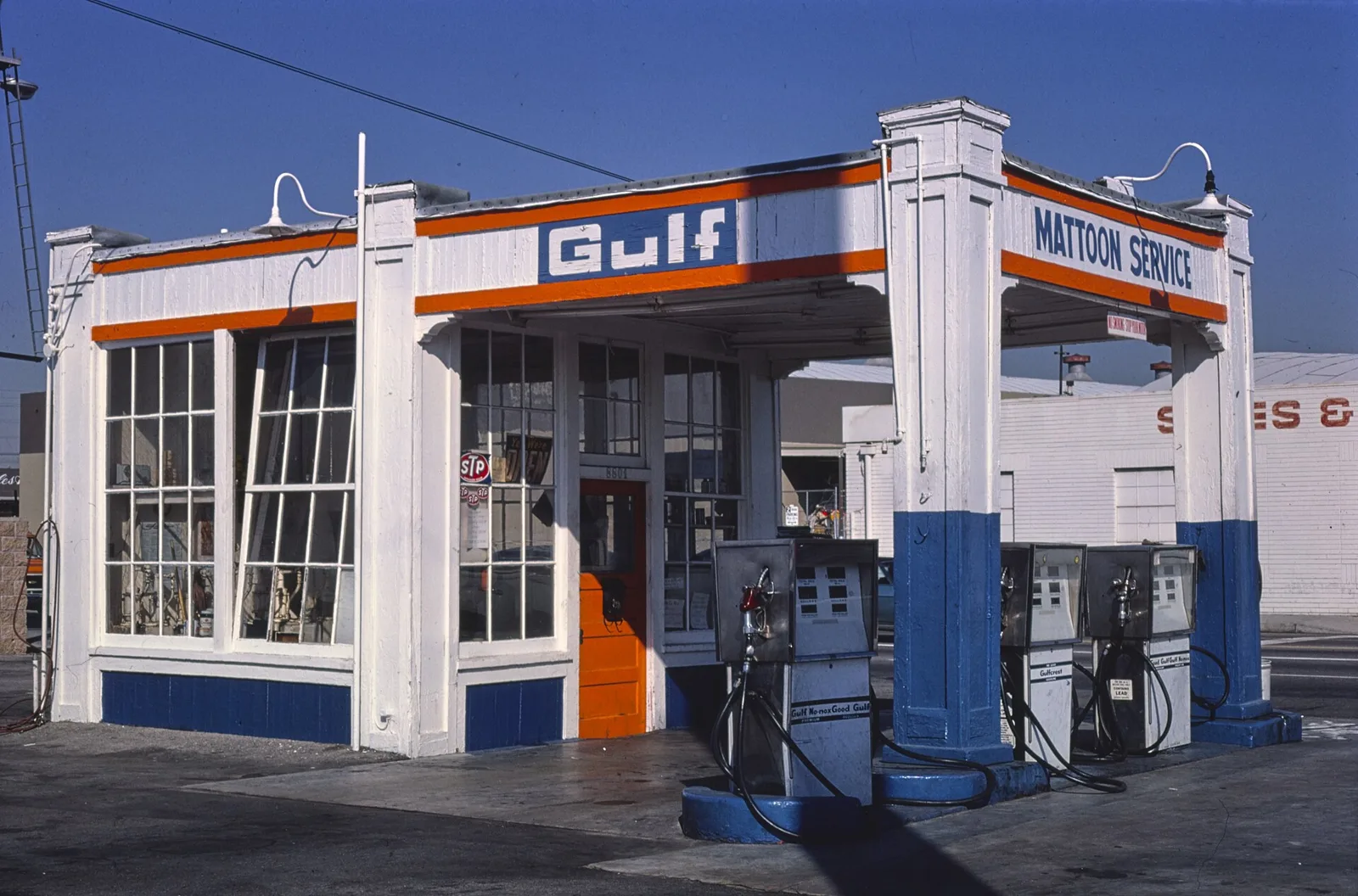
The first US drive-in was a Standard Oil of Ohio station in Columbus in 1912, where the motorist entered through the front door, took on fuel and left by the back. A year later, on 1 December 1913, the first Gulf drive-in opened in Pittsburgh and sold 30 US gallons (110 L) at 27 cents a gallon (7 cents a litre) on its first day. It was also the first station designed by an architect and the first to hand out free road maps.
Britain's first station was a drive-through, opened by the Automobile Association in 1919 on the Bath Road at Aldermaston. Russia's first appeared in 1911, and about 440 were working in its major cities by 1914.
Who invented the petrol pump?
Sylvanus Bowser sold the first fuel pump in Fort Wayne, Indiana, on 5 September 1885, pre-dating the car industry, and it dispensed kerosene for lamps and stoves. A Norwegian, John J. Tokheim, patented the first gasoline pump in 1901.
Bowser later added safety features and a hose to fill cars directly, and his surname became a word for a vertical pump. It survives in Australia and New Zealand.
Early pumps carried a calibrated glass cylinder on top: the operator pumped fuel up to the mark, then let it drain into the customer's tank by gravity. Metering pumps added a small glass globe holding a turbine, so the customer could see fuel flowing. Gilbarco's first measured pump in 1911 had no globe, and customers had to trust that the owner had calibrated it properly.
How do petrol and gas pumps work?
A modern pump has two halves. The electronic head holds an embedded computer that runs the pump, drives the displays and talks to the shop's sales system. The mechanical half does the physical work with valves, pulsers, meters, a pumping unit and an electric motor.
Sometimes the pumping unit is sealed and sunk inside the underground tank as a submersible pump, a choice that suits hotter countries in Europe, where suction pumps can struggle with warm fuel.
Flow rate depends on the vehicle. A light passenger car takes up to about 50 litres a minute, with the United States capping it at 10 US gallons (38 L), while trucks can take up to 130 litres a minute in the UK and 40 US gallons (150 L) in the US. The limit is the diameter of the filler pipe. Faster flow could overload the vapour recovery equipment that US vehicles have been required to carry since 1996.
Why do diesel and petrol nozzles look different?
Colour is the usual clue, but it varies. In most of Europe a black hose and handle means diesel and green means unleaded, while the US reverses that: diesel is usually green and E85 yellow, and petrol grades come in black, white, red or blue depending on the station.
Size is meant to help too. A diesel nozzle is supposed to be too big for a petrol car's filler, yet nothing requires it and many diesel pumps carry ordinary petrol nozzles. The leaded nozzle was wider than the unleaded one, and cars built for unleaded-only fuel got a narrower filler pipe to keep the old fuel out.
What stops a pump overflowing a tank?
An automatic cut-off valve in the handle. A sensing tube runs from just inside the nozzle mouth to a Venturi pump in the handle, and when fuel reaches the tube the pressure changes, a mechanical valve detects it and closes.
Richard C. Corson of Olean, New York, came up with it in 1939. He watched a worker fill a barrel at a loading dock, thought the method inefficient, and the sound of a toilet flushing gave him the idea of a butterfly float. He built a prototype with his assistant Paul Wenke.
Squeezing in extra litres after the click may flood the vapour trap. A breakaway valve on the hose adds protection of another kind: if a driver pulls away with the nozzle still in the filler, the hose detaches and the flow stops.
How does a pump measure the fuel you buy?
Almost always with a four-stroke piston meter linked to an electronic encoder. In older pumps the meter drives reeled number displays, wheels or cylinders with figures on their sides, while newer pumps use a rotary encoder to turn the meter's motion into electrical pulses.
Selling petrol by volume is awkward because it expands and contracts with temperature. Its coefficient of thermal expansion at 20 degrees Celsius is roughly 4.5 times that of water. The reference temperature for measuring petrol volume is 60 degrees Fahrenheit, or 15 degrees Celsius.
Ten US gallons at three temperatures
| Temperature | Volume of petrol that measures 10 US gallons at 60 degrees Fahrenheit |
|---|---|
| 30 degrees Fahrenheit (-1 degrees Celsius) | About 9.83 US gal (37.2 L) |
| 60 degrees Fahrenheit (15 degrees Celsius) | 10 US gal |
| 85 degrees Fahrenheit (29 degrees Celsius) | About 10.15 US gal (38.4 L) |
All three volumes hold the same theoretical energy, so a gallon bought at 30 degrees Fahrenheit carries about 3.2% more than one bought at 85. In practice the swing is small, because fuel sits in underground tanks where temperature barely moves.
Compensation for this is routine in wholesale trade. At retail level Canada has gone over to automatic compensation, the UK is part-way there, and the US has not moved. It can add about 0.1% of uncertainty to the reading.
Who checks that pumps are accurate?
In the United States the National Institute of Standards and Technology puts the standard accuracy at 0.3%, though states set their own legal limits. On a 10-gallon (37.9 L) purchase that allows anything from 9.97 to 10.03 US gallons (37.7 to 38.0 L).
In 2007 Arizona found 9% of its pumps out by 2.5% or more, the level at which fines apply, split evenly between overcounting and undercounting.
Canada requires inspection dates and results on a sticker on the pump, and the 2011 Fairness at the Pumps Act allows fines of up to $50,000. Nearly every pump that fails there does so through calibration drift from years of use, and deliberate tampering is extremely rare, as are prosecutions.
How do pumps and tills talk to each other?
Through a patchwork of wiring standards and proprietary software protocols. For years that locked retailers into their pump maker's own till systems, because only the maker understood the language.
Card security forced a bigger overhaul in the United States. By October 2017 every pump with a card reader had to support EMV chip payments, yet a year earlier a third of the country's 750,000 pumps still needed upgrading, at $6,000 to $17,000 each plus new point-of-sale equipment. The conversion was forecast to run until 2021.
What is a fuel card and how does it work?
A fuel card, also called a fleet card, is a payment card used mainly for petrol, diesel and other fuels at filling stations. Most are charge cards, and fleet managers get real-time reports and can set purchase controls, so they see business expenses as they happen.
Cards can also pay for maintenance and other costs if the fleet owner allows it, and some cover lubricants, hotel stays and diesel exhaust fluid. Oil brands issue them, as do companies that specialise in nothing else.
How is a fuel card different from a credit card?
It looks the same and uses similar technology, but payment terms are often shorter and easier to negotiate with the issuer. No rolling balance is carried from month to month, and the price can be lower because the system is designed to sidestep credit card interchange fees.
A card can be limited to chosen fuel grades, and fraud systems can block whole nations, states or postcodes. Liability for fraudulent transactions usually remains with the user, depending on the agreement.
Why do businesses use fuel cards?
Savings and paperwork. Haulage, courier and transport companies depend on vehicles daily, and a typical arrangement gives them one weekly invoice settled by direct debit instead of the paper receipts that, at a larger organisation, could number in the hundreds a week.
Most cards also supply fuel at a wholesale price rather than retail, with no need to buy in bulk, and fleets of thousands of vehicles gain from the tighter management and security. Bunkered cards go further: the provider builds a fuel reserve on one network to win a discount, then sells it on with a mark-up, for instance 2.5 pence a litre on diesel bought in bulk.
How have fuel cards changed over time?
The first British cards carried just a company name, a registration number and a strip for a signature on the back. No electronic data was stored. A site checked the registration on the forecourt against the card, then compared the signed receipt with the signature on the reverse.
Networks were tiny: in 1983 Keyfuels had only seven stations, on truck routes and main haulage roads, so cards were aimed at haulage and delivery firms. Embossed cards replaced printed ones, which heavy use rubbed bare, and each purchase was stamped onto a manual sheet with the date, time, volume, grade and registration written in by hand.
Magnetic strips arrived in the mid to late 1980s, letting a retailer process cards electronically and cutting transcription errors. PINs could be encoded into the card, and with outdoor terminals they became compulsory to refuel.
Strips were then overtaken by chips. A magnetic strip could be cloned onto a dummy card, and fuel cards were used far more heavily than debit or credit cards, so strips wore out faster. By 2007 only about half of fuel cards used smartchip technology, which resists cloning, lasts longer, and cannot be damaged by magnets, speakers or mobile phones.
A chip also lets limits be programmed into the card:
- Caps on volume per transaction, per day and per week
- Limits on how many purchases are allowed each day and week
- Permitted days and hours of use
- How many wrong PINs are tolerated, and how long the card then stays locked
In the United States the story starts with key stops and card locks in the 1960s and 1970s, which independent marketers used to dodge the credit card interchange fee. Computers in the 1980s then speeded the industry along.
Where filling stations are heading
The fuel list is already widening. Pearson Fuels opened the first alternative fuel station in San Diego in 2003, hydrogen is sold by weight at stations that stock it, and in 2019 a Maryland station became the first in the United States to convert to EV charging.
The card is following, with a new category of electric fuel cards emerging. The UK, meanwhile, is part-way through converting its retail pumps to automatic temperature compensation.