How banned refuelling, single-crew rules and mandatory tyre compounds shaped the stop, and what it takes to turn a car around in under two seconds.
A Formula One pit stop is a pause for tyres and minor repairs, typically about 3 seconds, with a crew of up to twenty mechanics. Refuelling was allowed until 1983 and from 1994 to 2009, and McLaren holds the 1.80-second record from the 2023 Qatar Grand Prix.
The fastest Formula One pit stop on record lasted 1.80 seconds, when McLaren turned around Lando Norris at the 2023 Qatar Grand Prix. A car at 100 mph (160 km/h) covers about 150 feet (45 m) every second, so every tenth matters. The history of the Formula One pit stop covers what happens in the pit lane, how refuelling came and went, and how tyre rules shaped each stop.
What happens in an F1 pit stop?
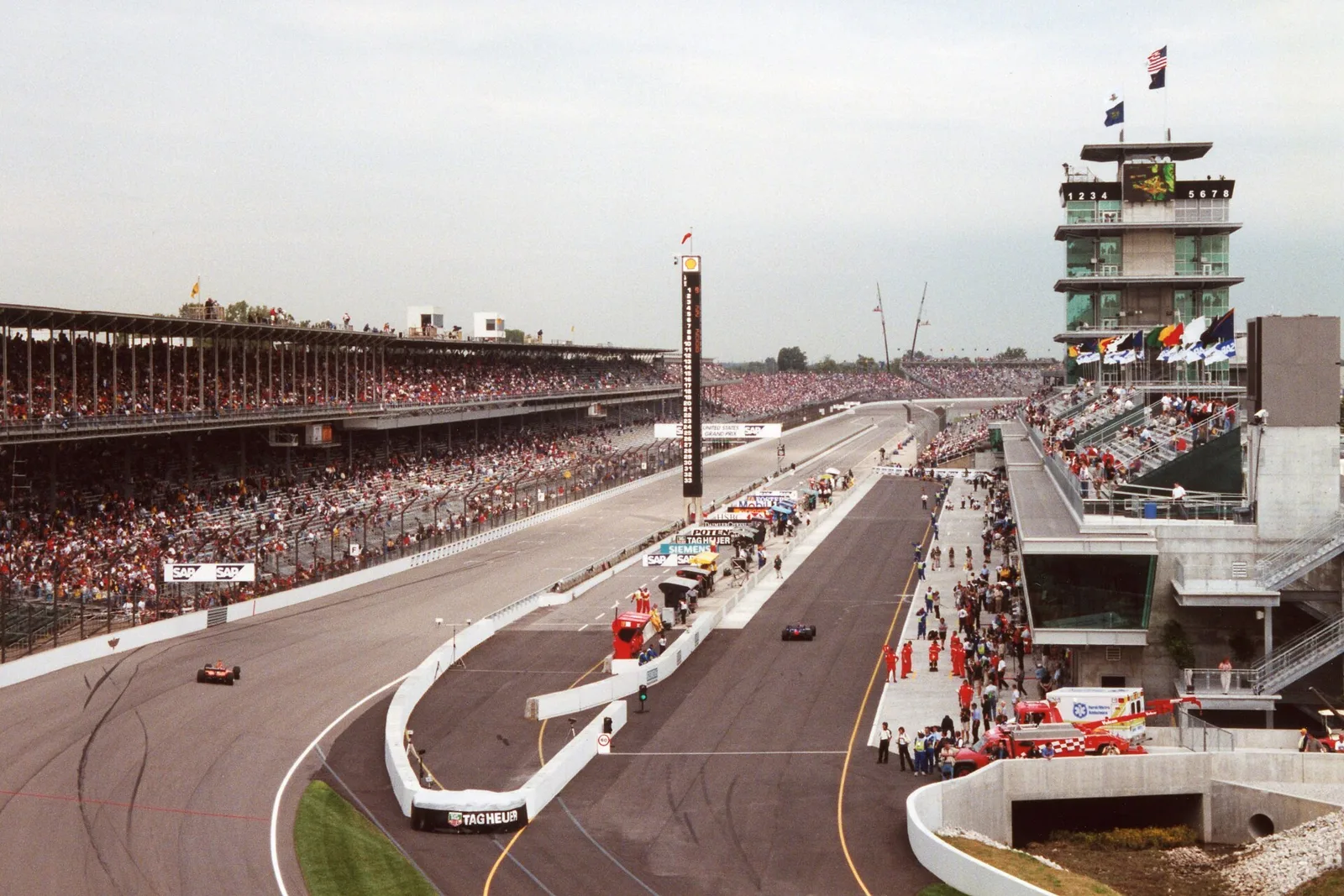
A pit stop is a pause during a race for tyres, repairs, adjustments, refuelling where it is allowed, a driver change or a penalty. It takes place in the pits, usually reached by a pit lane that runs alongside the start and finish straight. In Formula One the work is done outside the team's garage in a pit box, by a crew of up to twenty mechanics, while the driver waits in the car.
The most common jobs are fuel, where permitted, and tyres. Crews also clear debris from the radiator air intakes, clean the windscreen and adjust tyre pressures, suspension settings and aerodynamic parts. An unscheduled stop adds emergency repairs and replacement parts. A penalty stop is different: the team must send the car through the pit lane at the maximum permitted speed, or hold it in its box for a set time, and no work is done meanwhile.
The language changes across the Atlantic. In American English the lane is the "pit road" and a team's space is a "pit stall", whereas British English always says "the pit lane" and "pit box". In Formula One the garages usually open directly onto the pit lane through the team's assigned box.
In a ten-second stop, rivals gain about a quarter of a mile.
How long does an F1 pit stop take?
A Formula One stop typically takes about 3 seconds, and tyres are often changed in under three. McLaren holds the world record at 1.80 seconds, set on Norris at the 2023 Qatar Grand Prix. In the refuelling years, stops generally lasted six to twelve seconds.
Speed matters because the clock never stops for rivals. A car travelling at 100 mph covers roughly 150 feet (45 m) each second, so in a ten-second stop its competitors gain about a quarter of a mile (450 m). That is like a runner stopping to tie a lace while everyone else keeps jogging. A long stop, whether for a repair or a crew error, can ruin a driver's chances, which is why crews train intensively on tyre changes.
Preparation begins before the car arrives. When a car is about a lap from its stop, the pit crew set out fresh tyres and the equipment they need. With an overhead pneumatic rig, the team can have every mechanic in place before the car arrives, except the rear jack man.
Why do Formula One cars need to pit at all?
Because fuel and tyres run out. Carrying fuel slows a car, and tanks are often limited in size, so races have often needed more than one stop. Tyres wear so fast that they may not last the distance. Softer rubber grips better but wears faster, harder rubber lasts longer at a cost in speed, and dry slick tyres and wet-weather tyres suit different conditions.
A stopped car does lose ground, but it is not all loss. The car that makes the extra stop runs faster afterwards, since it carries less fuel and has fresher tyres, giving more traction and higher speeds in corners. Fresher tyres may even allow a softer compound that would otherwise fail if stretched too far. Teams therefore plan a strategy before every race, balancing time given away in the pits against time gained on track.
The plan is a schedule built on fuel consumption, fuel weight, cornering speed on each compound, tyre wear, the length of the pit lane and its speed limit, and even expected changes in weather and light. It is not fixed. If dry weather turns to rain, teams must make an unscheduled stop for wet-weather tyres and recalculate. Safety car periods often bring mass stops, because the slowed pace reduces the ground lost, and some teams stay out instead, since cars running slowly burn less fuel and wear their tyres less, which could save them a stop.
What are the undercut and the overcut?
In the undercut, the chasing car stops first. If it works, fresh tyres let it cut the gap to the leader, and when the leader pits, it can emerge behind the car that stopped earlier, provided the gap has shrunk to less than the time lost in the pits. The move works best when the leader is stuck in traffic and the chaser has a clear road.
The overcut is the less common reverse. The leader stays out on old tyres, and if they are still in good shape, it can lap quickly enough to hold or extend its advantage when the chaser stops. It can also succeed if the chasing car emerges into traffic and cannot use its fresher rubber.
Formula One adds a twist, because a team may use only one pit crew for its two cars, unlike most series, where each car has its own stall and crew. Teams must stagger their stops or one car waits for the other. In special conditions, such as right after a safety car, they can pit both on the same lap without losing significant time. This is called a double stack, and it gives both drivers equally fresh tyres and keeps rivals from judging the relative pace of the two cars.
When was refuelling allowed in Formula One?
Refuelling was permitted until 1983, dropped, then allowed again from 1994 to 2009. It has been banned since 2010, when every car began to start with a full fuel load. Stops in the refuelling era needed about twenty mechanics and lasted six to twelve seconds, depending on how much fuel went in.
Fuel flowed at more than 12 litres per second through a fairly complex closed system that pumped air out of the tank as fuel went in. A problem such as a failed pump, a stalled engine or a repair could stretch a stop far longer. Because fuel is a big share of a car's weight, teams chose the load at each stop and so the number of stops. One-stop and two-stop plans were most common: two stops for speed to catch cars ahead, one stop to gain track position. Ferrari and Michael Schumacher showed an unorthodox option at the 2004 French Grand Prix, making four stops and still winning.
The work was hazardous, so mechanics wore multi-layer fire-resistant suits with gloves, long underwear, balaclavas, socks and shoes that met FIA Standard 8856-2000. When the ban came in 2010, the cars grew about 22 cm longer than the 2009 cars to make room for a larger fuel tank.
How did the refuelling era compare with today?
| Feature | Refuelling years (1994 to 2009) | Today (since 2010) |
|---|---|---|
| Refuelling | Permitted | Banned |
| Typical stop | Six to twelve seconds | About 3 seconds |
| Crew | About twenty mechanics | Up to twenty mechanics |
| Common plans | One-stop and two-stop | One or two scheduled stops |
| Fastest known stop | Not applicable | 1.80 seconds, 2023 Qatar Grand Prix |
How did tyre rules change the pit stop?
Tyre regulations have shaped stops almost as much as refuelling. Formula One has used a single tyre supplier since 2007, and Pirelli since 2011. These tyres are built to last less than one race distance, whereas a road tyre can last up to 80,000 km (50,000 mi).
In 2005, tyre changes were disallowed, so teams used harder compounds to last the full race of around 300 km (200 miles). Changes returned in 2006 after the 2005 United States Grand Prix. There Ralf Schumacher crashed in practice in turn 13 after a tyre failure, and Michelin said its tyres were unsafe for extended high-speed use on that banked corner. Michelin's seven teams did not race, and only the three Bridgestone runners, Ferrari, Jordan and Minardi, took the start. Michael Schumacher won.
From 2007 each driver had to use both of the two compounds offered, a harder prime and a softer option. Slicks returned in 2009, with green sidewalls on the softer tyre at first. The modern system dates from 2016, when Pirelli brought three dry compounds to each race and teams received 13 sets of dry tyres. Since 2019 they have been labelled soft, medium and hard, with red, yellow and white markings, plus green for intermediate and blue for full wet.
Cars must race on at least two different dry compounds unless wet or intermediate tyres are used, which in practice builds a tyre stop into a dry race. Teams may only use heaters on the outside of the tyres, and weekend allocations are limited to 13 sets of dry, 4 of intermediate and 3 of wet tyres, or 12 dry sets with a sprint race. In extremely wet conditions, such as the 2021 Belgian Grand Prix, a race can be red flagged for up to 3 hours.
How have Formula One tyres changed over the decades?
Through the 1950s and 1960s, Formula One tyres came from Dunlop, Englebert, Firestone, Continental and Goodyear. In 1958 Dunlop's R5 swapped the cotton fabric of earlier tyres for nylon, saving a reported 12 lb. During the 1960s came better nylon casings, lower profiles, much wider tyres and synthetic rubber. Slicks, with no tread at all, were introduced by Firestone at the 1971 Spanish Grand Prix.
Competition between suppliers drove progress. Bridgestone joined Goodyear in 1997, starting a tyre war, and Goodyear left after 1998, leaving Bridgestone alone for two seasons. Grooved tyres arrived in 1998, and from 1999 to 2008 rules demanded four 14 mm (0.55 in) grooves, meant to slow the cars because a slick gives the most dry grip. Michelin's arrival in 2001 started another tyre war. Bridgestone then became the sole supplier in 2007. Pirelli was named sole partner for 2011 on a three-year contract, after Bridgestone announced it would leave at the end of 2010.
What do the colours on an F1 tyre mean?
Since 2019 each dry compound is shown as soft, medium or hard at a race, with a coloured band on the sidewall: red for soft, yellow for medium and white for hard. Green marks the intermediate and blue marks the full wet tyre. Earlier systems varied: in 2011 the lettering itself changed colour, silver for hard, white for medium, yellow for soft and red for super-soft.
Wet tyres have their own rules. Before qualifying they may be used only if the race director judges the track wet, and a start behind the safety car because of heavy rain means wet tyres until the first pit stop. From 2014 to 2021, drivers reaching the third part of qualifying had to start on the tyres used for their fastest lap in the second part, a rule removed before 2022.
Where this goes next
For 2026 the technical regulations brought slightly smaller tyres to reduce aerodynamic drag, with front tyres sized 280/705 R18 and rears 375/710 R18. The 18-inch rims date from 2022, when rolling diameter grew from 670 to 720 mm. The regulations also require fuel from entirely sustainable sources from 2026.