Exhaust gas recirculation lowers combustion temperature to starve nitrogen oxides of heat. The mechanism, the history and the trade-offs in petrol and diesel engines.
Exhaust gas recirculation sends part of the exhaust back to the cylinders, displacing air and lowering peak combustion temperature so less nitrogen oxide forms. Petrol engines typically recirculate 5% to 15%. The cost is clogged valves, and in diesels more soot, filter maintenance and engine wear.
In 2002, American regulations that led to the introduction of cooled exhaust gas recirculation were linked to a 3% fall in engine efficiency, at a time when efficiency had been rising by 0.5% every year. Engine makers have declined to release details of what the technique does to fuel economy. The figure sums up the bargain: sending burnt gas back into the engine helps with one of the worst pollutants in a car's exhaust, and the engine pays for it elsewhere.
What are nitrogen oxides?
NOx is the collective name for two gases, nitrogen dioxide (NO2) and nitric oxide (NO), the nitrogen oxides of greatest concern for air quality. They help form smog and acid rain, and they affect ozone in the lower atmosphere. They do not include nitrous oxide, a fairly inert gas that contributes less severely to air pollution.
Nitrogen and oxygen make up most of the air, and at ordinary temperatures they leave each other alone. Heat changes that. Inside a car engine, or a power station boiler, or a lightning flash, the temperature is high enough to force them into an endothermic reaction that produces nitrogen oxides. In an engine the process is called thermal NOx. Its rate depends mainly on temperature and on how long the nitrogen stays hot, and above roughly 1300 C (2600 F) the molecules in the combustion air split into atoms and take part in a chain of reactions.
Transport is a big contributor. Transportation fuels are estimated to cause 54% of human-caused NOx, and where traffic is heavy, in big cities for instance, vehicle NOx can be a major source of pollution. Nature adds its own share: lightning is estimated to produce about 8.6 million tonnes a year, against 28.5 million tonnes from burning fossil fuels.
What NOx does to people
When NOx and volatile organic compounds react in sunlight they form photochemical smog, which is worse in summer when the sunshine is stronger. The people most exposed to lung tissue damage and reduced lung function are children, asthmatics and others with lung disease, and anyone working or exercising outdoors. NO2 is also oxidised into nitric acid, which contributes to acid rain.
There is strong evidence that breathing NOx can trigger and worsen asthma, and may even bring on the disease over longer periods. Links to heart disease, diabetes, birth outcomes and death from all causes have been reported, but these are less well established. NOx also reacts with volatile organic compounds in sunlight to make ozone, which can be carried by wind and cause health effects far from the original source. By the American Lung Association's estimate, close to half of Americans, nearly 50 percent, live in counties that fail ozone compliance.
Burnt gas in the intake means a cooler flame, and a cooler flame means less NOx. The engine pays elsewhere.
How does exhaust gas recirculation work?
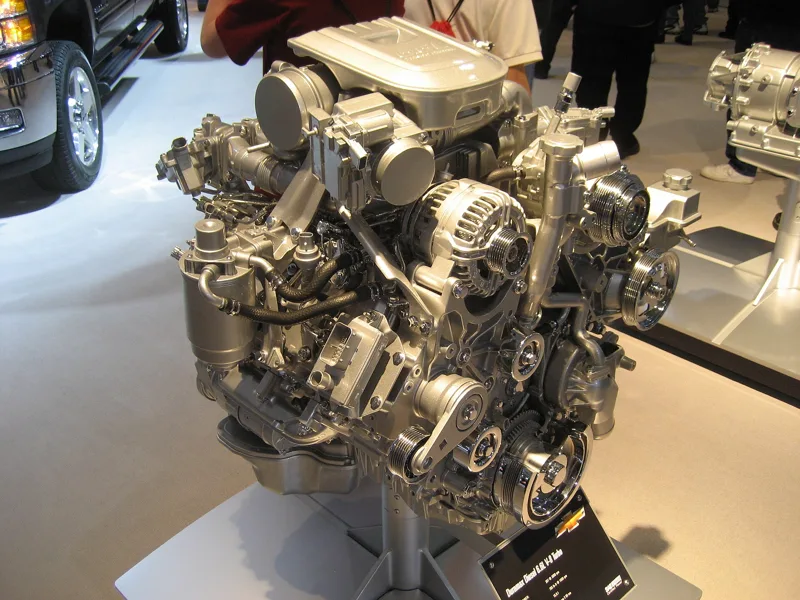
EGR is a technique for cutting NOx that is used in petrol and diesel engines and in some hydrogen engines. It sends a portion of the exhaust back to the cylinders. That exhaust takes the place of some atmospheric air, so there is less oxygen in the combustion chamber. With less oxygen, less fuel can burn in each cycle, and peak temperatures inside the cylinder fall. Since NOx forms where hot nitrogen and oxygen meet, usually around peak cylinder pressure, a cooler peak means less of it. The amount of gas returned changes with engine operating conditions.
An everyday comparison helps. A fire burns fiercely in fresh air and more gently when part of that air has already been used up. Burnt exhaust is the used-up part, and the engine breathes a measured amount of it.
The chemistry adds a second effect. Exhaust contains water vapour and carbon dioxide, both with a lower heat capacity ratio than air. Mixing them in lowers the pressure and temperature reached during compression in the cylinder, and with it the theoretical flame temperature. The returned gas also carries NOx and carbon monoxide at near-equilibrium levels, and the small fraction already in the chamber inhibits further net production of these pollutants over time. Different fuels tolerate different amounts: methanol is more tolerant of EGR than petrol.
In a petrol engine
In a typical spark-ignition car engine, 5% to 15% of the exhaust is routed back to the intake. The ceiling comes from the flame itself, because the mixture must sustain a continuous flame front through each burn. Push EGR too far in a poorly set up application and the engine misfires or burns only part of its charge. EGR does measurably slow combustion, but advancing the spark timing can largely make up for that.
Here the cost can turn into a benefit. A properly working system can, in certain situations, raise the efficiency of a petrol engine in three ways:
- Less throttling loss. Inert exhaust in the intake means the throttle plate has to be opened further for a given power output, which raises manifold pressure and cuts pumping losses.
- Less heat rejection. Lower peak temperatures mean less thermal energy escapes to the chamber surfaces, leaving more for useful work on the power stroke.
- Less chemical dissociation. Cooler peaks leave more of the released energy as heat near top dead centre rather than locked up in the splitting of combustion products. Of the three, this one counts for least.
The effect on efficiency depends on the engine design and sometimes forces a compromise between efficiency and NOx.
EGR is typically not used at high load, because it would reduce peak power by thinning the intake charge. It is also left out at idle, because it would make combustion unstable and the idle rough.
The valve that gets clogged
The part owners meet is the EGR valve. Because it handles a share of the exhaust, carbon deposits can build up inside it over time and stop it working properly. A clogged valve can sometimes be cleaned, but a faulty one has to be replaced.
How did EGR systems develop?
Early systems were crude; the simplest was a small orifice linking exhaust to intake that let exhaust through whenever the engine ran. The side effects were almost guaranteed: hard starting, a lumpy idle, weaker performance and worse economy. By 1973 a valve operated by manifold vacuum opened and closed to admit exhaust only under certain conditions.
Control grew more refined as the carmakers learned. A good example is Volkswagen's 1973 system, called Coolant Controlled Exhaust Gas Recirculation: a sensor on the coolant cut off the vacuum supply to the valve until the engine had warmed to its normal running temperature, which prevented driveability problems, because NOx forms under conditions of elevated temperature that a cold engine generally does not have. Vacuum drawn from the carburettor venturi also helped hold EGR flow to the load conditions in which NOx is likely to form. Backpressure transducers came later to tailor flow to engine load further.
Today most engines need EGR to meet NOx standards. Recent innovations have, however, produced engines that do not require it, and the 3.6 Chrysler Pentastar is one example.
Why is EGR different in a diesel?
A diesel lights its fuel with the heat of compression, so it differs fundamentally from a spark-ignition engine. Its fuel burns most completely at the highest temperatures, and that is exactly when NOx production climbs. EGR aims to cut NOx by lowering the combustion temperature.
A diesel has no flame front to protect, since it always runs with excess air, and so it benefits from EGR rates as high as 50%. That rate suits idle only, when there is a large surplus of air. In modern diesels a heat exchanger usually cools the recirculated gas, which lets a greater mass of it be introduced. Uncooled designs do exist and are often called hot-gas recirculation, or HGR. Cooled EGR components endure repeated, rapid swings in temperature, which can cause coolant leaks and catastrophic engine failure.
Diesels with a throttle gain the same reduction in throttling loss as petrol engines do. In a naturally aspirated diesel, less throttling also eases the problem of oil being drawn past the piston rings into the cylinder, where it causes oil-derived carbon deposits.
The price paid in a diesel
In diesels, EGR comes with serious drawbacks. The first is engine wear. The recirculated exhaust goes into the intake without any filtering, so it carries carbon particulates, and those tiny particles are abrasive. They blow by the piston rings and wear the piston-cylinder interface on the way, then reach the crankcase oil. They are small enough to slip through ordinary oil filters, so they circulate and cause wear throughout the engine until the next oil change.
Efficiency suffers too. Exhaust gas, mostly nitrogen, carbon dioxide and water vapour, has a higher specific heat than air and so still lowers peak combustion temperatures, but it also reduces the specific heat ratio of the gases in the power stroke. The piston can extract less power, and thermodynamic efficiency drops. EGR also tends to leave combustion less complete, and particulate emissions rise as EGR rises.
Unburned soot is wasted energy, and tighter limits on particulate matter meant that the soot-raising effect of EGR called for extra emission controls. The most common is the diesel particulate filter, or DPF, fitted downstream in the exhaust. It captures soot, but the back pressure it creates costs fuel efficiency.
What the DPF needs
A DPF has maintenance demands of its own. As it traps soot, which EGR makes far more plentiful, it fills up, and the soot must be burned off either passively or actively. In passive regeneration, the nitrogen dioxide component of NOx oxidises the trapped soot at sufficiently high temperatures. This is only partly effective, and at high EGR rates it is less effective still. That makes periodic active regeneration necessary, in which diesel fuel is burned directly in the oxidation catalyst to raise exhaust temperatures through the filter until the particulates are incinerated by the oxygen left in the exhaust.
Burning soot leaves ash behind, since metallic and mineral impurities in diesel fuel and engine oil cannot burn. After repeated regenerations the filter eventually has to come out for specialist cleaning elsewhere, or be replaced.
Tar, oil vapour and cold starts
EGR has nothing to do with the oil vapour that a positive crankcase ventilation system routes back to the intake, which exists only to cut oil vapour emissions and can be fitted with or without EGR. Put the two together, though, and the blend of exhaust, fresh air and oil vapour can lay down sticky tar in the intake manifold and on the valves, and can upset parts such as swirl flaps. The trouble feeds on itself and gets worse with age: as piston rings wear, more crankcase oil reaches the exhaust, while more fuel and soot reach the engine oil. The result is again more soot, which the DPF collects and burns, converting it to carbon dioxide and water vapour.
There are upsides. By replacing some fresh intake air with inert gas, EGR lets a diesel inject less fuel at low load, such as when coasting or cruising, without upsetting the mixture ratio, and so use less of it. Power is never cut by EGR, because it is not used at high load, so the engine can still deliver its maximum when asked, yet burn less when a partial load will do.
Cooled EGR helps warm-up as well. Heat recovered from the recirculated gas warms the coolant and the engine block faster, which reduces wear and trims the period after a cold start in which the engine controller has to inject extra fuel to offset condensation on the cylinder walls. Lower combustion temperatures also slow the oxidation of engine oil, since heat exposure is the biggest factor in that.
Petrol and diesel EGR compared
| Aspect | Petrol (spark ignition) | Diesel |
|---|---|---|
| Typical exhaust share | 5% to 15% | As high as 50%, suitable only at idle |
| What limits the rate | The need for a continuous flame front | No flame front limit; excess air always present |
| Used at idle? | No, combustion becomes unstable | Yes, this is when high rates suit |
| Used at high load? | No, it would cut peak power | No, so full power remains available |
| Efficiency effect | Can rise through lower throttling and heat losses | Thermodynamic efficiency falls in the power stroke |
| Main side effect | Misfires if set up badly | Engine wear, more soot and a particulate filter to maintain |
What this means for a driver
For someone behind the wheel, the practical points are few. A petrol engine with a clogged EGR valve is carrying a carbon problem that cleaning may fix or a replacement may be needed to cure. On a diesel, the trade-offs show up in the filter and in wear: the more EGR the engine uses, the more soot the DPF must trap, the more active regeneration it needs and the more ash it eventually collects, while abrasive particles that pass the oil filters circulate until the oil is changed. Cooled EGR parts live with fast temperature swings, and a coolant leak there can end in catastrophic engine failure.
Where this goes next
EGR remains in wide use, and most modern engines still depend on it to meet NOx standards. Against that, engines such as the 3.6 Chrysler Pentastar have shown that a design can meet the standards without it. Modern cooled systems are also being used for a second purpose, warming the engine quickly after a cold start. Hydrogen engines are among the types already listed as using the technique.