From a British police research branch in 1976 to toll gantries, patrol cars and red-light cameras: the software, lenses and lighting that turn a plate into text.
ANPR uses cameras and optical character recognition to read vehicle registration plates. The software finds and normalises the plate, extracts the characters and, at the roadside, finishes in about 250 milliseconds. Police, toll operators and highways agencies use it, and red-light cameras use related roadside hardware.
When the Netherlands changed the style of its registration plates in 2002, it redrew the font so that letters such as P and R carry small gaps. The reason was not looks but machines: the gaps make the letters easier for recognition software to tell apart.
That software is automatic number-plate recognition, or ANPR, which runs optical character recognition on camera images to turn a plate into text and a location. Police use it to check whether a vehicle is registered or licensed, road operators use it to charge tolls and count traffic, and red-light enforcement cameras can feed the same kind of software.
How does ANPR read a number plate?
The software first detects the plate in the image, then straightens, normalises and sharpens it, and finally applies optical character recognition to pull out the letters and digits. When all of that happens at the roadside, a plate, a date and time and a lane number are captured in approximately 250 milliseconds.
Behind that quick answer sit seven separate algorithms, each with a narrow job:
- Plate localisation finds the plate and isolates it from the rest of the picture.
- Orientation and sizing correct the skew of the plate and bring it to a standard size.
- Normalisation adjusts brightness and contrast.
- Character segmentation locates each individual character.
- Optical character recognition identifies the characters.
- Syntactical and geometrical analysis checks the characters and their positions against the rules of the country concerned.
- Averaging combines the reading from several images, because any single frame may suffer from a flare of reflected light or a partly hidden plate.
How well each stage is built decides how accurate the whole system is. In the normalisation stage some systems use edge detection to widen the visual gap between the characters and the plate background, and a median filter can reduce noise in the picture.
The software itself is modest: it runs on ordinary PC-class hardware and can connect to databases and other applications. Where the work happens is a design choice. One approach does everything at the lane in real time, while the alternative sends pictures from many lanes to a distant machine to be read later. The second needs large banks of PCs, as in the London congestion charge scheme, and more bandwidth to carry the pictures.
The Dutch redrew the letters P and R with small gaps so that cameras would stop confusing them.
What does a camera need to capture a clear plate?
Good light and a fast shutter. The first picture matters most: as the old computing principle of garbage in, garbage out suggests, the imaging hardware will often decide how well the whole system performs.
Dedicated plate cameras usually carry infrared illumination to cope with darkness, headlight glare and shiny plates. Many countries now use retroreflective plates that throw light straight back at its source, which sharpens contrast, and in some of them the characters are not reflective at all, so they stand out against the bright background. A camera with an infrared illuminator beside the lens and a normal colour filter over it benefits greatly. A full-colour picture of the car as well requires one infrared camera and one ordinary colour camera working as a pair.
Shutter speed must match the traffic. A dedicated camera ideally runs at 1/1000 of a second with a global shutter instead of a rolling one, so the image comes out free of distortion. Slower settings blur a moving car beyond what the software can read, especially when the camera is mounted much higher than the vehicle.
Shutter speed and traffic speed
| Shutter speed | Suited to |
|---|---|
| 1/1000 s | The ideal setting for a dedicated camera |
| 1/500 s | Up to 65 km/h (40 mph) |
| 1/250 s | Up to 8 km/h (5 mph) |
Plate capture cameras can still produce usable images from vehicles travelling at 190 km/h (120 mph).
Why is a number plate hard for a machine to read?
Because real plates are messy. Software has to cope with low resolution, motion blur, shadows and glare, a tow bar or dirt hiding part of the plate, and changes of lane while the picture is taken.
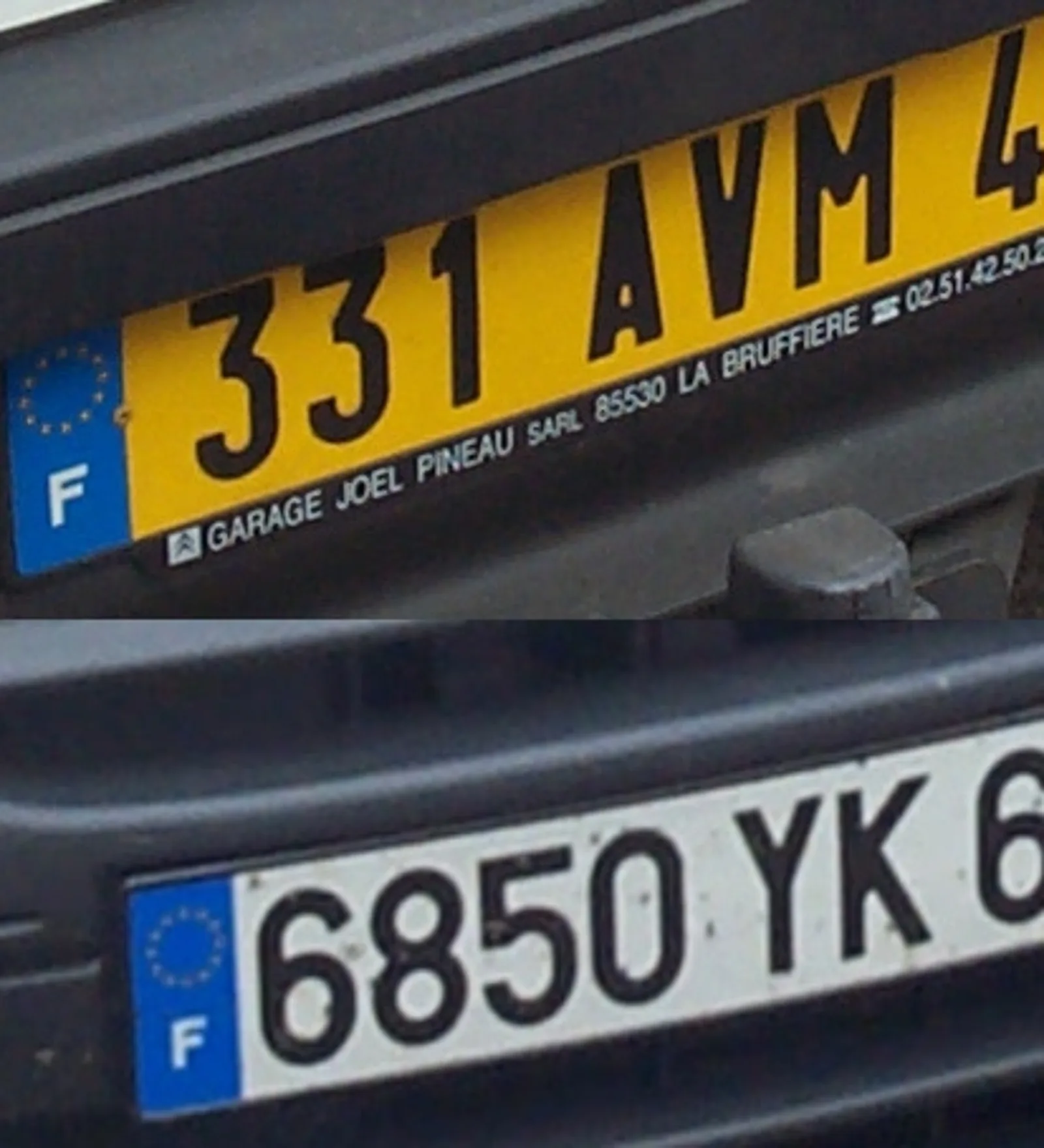
Plate design causes trouble too. Font sizes and positions vary between places, so many programs are tailored to a single country, and a vanity font can confuse the reader. A car from one country and a car from another may share a number yet look quite different. Trailers and campers may bear a plate that differs from the car's own. Bikes on a rack can hide the number, which is why Victoria, Australia, expects a separate bike plate.
Raising the camera helps with obstruction by other vehicles but increases the skew of the plate. Most of these problems are left to the hardware to solve rather than the software. Tolerance varies by task: for opening a barrier at a private site, a one-character error may be accepted, because an unauthorised car with a plate that similar is considered unlikely, but that would not be acceptable in most uses.
When was ANPR invented?
Britain's Police Scientific Development Branch created it in 1976. Prototypes were working by 1979, and the first arrest made by detecting a stolen car followed in 1981.
EMI Electronics won the first contracts to build industrial systems, followed by Computer Recognition Systems of Wokingham, now part of Jenoptik. Early trials took place on the A1 and at the Dartford Tunnel.
Wide use had to wait for the 1990s, when cheaper and easier software appeared. Collecting plate data for future use, in order to solve crimes that were not yet identified, was documented in the early 2000s. In November 2005 a murder investigation in Bradford became the first documented case in which ANPR helped locate and convict the killers.
Where is ANPR used on the road?
Police forces everywhere use it, among other things to confirm that a car is registered and licensed. Road operators use it to bill drivers on roads that charge by use, and highways agencies use it to log how traffic moves.
How did patrol cars get plate readers?
In the 1990s the technology moved from costly fixed installations that took time to set up to simple point-and-shoot mobile units. Software on cheaper, ordinary PC hardware no longer needed to be told the angle, direction, size or speed at which plates would pass. Smaller cameras and tougher, smaller processors that fit in a patrol car's boot let officers read plates continuously while driving and react at once.
Mobile units face tough conditions. Processor and cameras must keep up with closing speeds above 160 km/h (100 mph) when traffic is oncoming, draw power from the vehicle electrical system and take up little space. Camera layout depends on the job: highway patrol needs forward-looking cameras spanning several lanes, city patrol wants shorter-range lenses with a lower focal length to read parked cars, and car parks with cars parked at right angles call for a very short focal length. Advanced systems take one to four cameras, and in states with rear-only plates one camera may be turned backwards.
What about tolls, parking and access?
For tolls, the cameras identify vehicles on pay-per-use roads. Parked cars can be read by patrol units, and private sites can use plate reading to give chosen vehicles access to a barricaded area. New software techniques also let any IP-based surveillance camera take on the job, which widens the use of ANPR for perimeter security.
Contemporary systems go beyond reading text. Weigh-in-Motion uses ANPR cameras with artificial intelligence to estimate a vehicle's weight and raise an alert if it exceeds what suits that vehicle and the conditions.
Does ANPR raise privacy concerns?
The concerns are well documented. Systems can store the images and the plate text, and some can be configured to store a photograph of the driver as well.
Critics point to government tracking of citizens' movements, misidentification, high error rates and rising public spending, and some describe ANPR as a form of mass surveillance.
How does a red-light camera work?
It takes a picture of a vehicle that drives into a junction once the signal has gone red, normally triggered as the car crosses the stop bar. A sensor detects the vehicle, and in some systems measures its speed to predict whether it can stop in time.
Detection can rely on one or two inductive loops, piezoelectric strips, lasers, radar or video analysis. Some systems take two or more photographs: one just before the vehicle enters the junction with the light red, and a second a second or two later showing it inside. The camera sits in a protective metal box on a pole, or is built into the traffic light, often at intersections chosen for their crash or violation history.
The system can record the date and time, the location, the speed, the time since the light turned red and the time since it turned yellow. A police official or clerk reviews the images and decides whether a violation took place, and a citation is typically mailed to the owner of the vehicle, who may challenge it.
Rules on responsibility vary. If the driver cannot be identified, some jurisdictions send the owner a notice asking for the driver's details so a ticket can follow. Others simply fine the owner, leaving the owner to collect from whoever was driving, and they generally attach no demerit points.
How are red-light cameras linked to ANPR?
Through the hardware. ANPR can run on existing road-rule enforcement cameras, which means a camera installed for red-light enforcement can double as a plate reader. Computer Recognition Systems, an early builder of industrial ANPR, is now part of Jenoptik, which is also the leading supplier of red-light cameras worldwide.
Do red-light cameras make roads safer?
Evidence is mixed. Authorities say safety is the reason for installing them, while opponents argue the real motive is revenue. A review of 38 studies found that cameras reduce right-angle crashes and related injuries, and total injuries, but increase rear-end crashes.
The Insurance Institute for Highway Safety reports that red-light running killed 6,000 people from 1992 to 1998, around 850 a year in the United States alone, and injured 1.4 million. In Australia, between 15% and 21% of crashes at signalised intersections from 1994 to 1998 were related to it.
Some studies confirm that rear-end collisions rise where cameras are used, while side collisions fall, though the overall collision rate has been mixed. Drivers worried about a ticket may brake harder. In some areas the yellow phase has been lengthened, and there is a concern that the international formula used to set its length ignores the laws of physics and may lead drivers to run the red inadvertently.
Timing matters because most violations come early. Studies show 38% of violations happen in the first 0.25 seconds after the light goes red, and 79% inside a second. A handful of systems forgive up to half a second. Ohio and Georgia require one second to be added to the yellow at any intersection with a camera, and tickets have since fallen by 80%. New Jersey sets yellow times from the speed at which 85% of traffic moves instead of the posted limit.
Where did red-light cameras start?
Gatso of the Netherlands is credited with developing them. The first system, introduced in 1965, used tubes stretched across the road to detect a violation and trigger the camera, and Israel was using red-light cameras for enforcement by 1969.
Germany dates its first red-light camera earlier still, to 15 November 1960 in Frankfurt am Main, producing black and white pictures. Early systems used film that was delivered to local authorities for review. The first digital system arrived in Canberra in December 2000.
The United States paid serious attention in the 1980s after a widely publicised crash in New York City in 1982, and New York's programme began in 1993. Poltech equipped Hong Kong, the Netherlands, Taiwan, South Africa, Britain and Australia. Australia expanded on a wide scale in the 1980s, Singapore began in 1986, the UK installed its first cameras in the 1990s at eight rail crossings in Scotland, and Hong Kong started in 1993. More than 75 countries now use them.
What does running a red light cost?
| Place | Penalty |
|---|---|
| Germany | 90 euros and one point; 200 euros, two points and a one-month licence suspension if red for more than one second |
| United Kingdom | 100 pounds and 3 points |
| France | Removal of 4 points from the licence |
| Hong Kong | A first offence brings HK$5,000 and three months in jail |
Counts have grown. A report in December 2005 found 612 red-light cameras in England, of which 225 were in London. Hong Kong had 96 by 2006 and 195 by 2016, and cameras there helped reduce violations by 43 to 55%.
Where this goes next
The French multipurpose camera Mesta Fusion 2 combines a red-light camera, a level-crossing camera and a speed camera in one unit. Such devices might in future also catch phone use, unfastened seat belts and failure to keep a safe distance.
Reliability is part of the picture. In south-east France the MESTA 3000 cameras have an availability rate of 95%, allowing for road works and vandalism, a figure a French National Assembly report rates above that seen in Germany, Switzerland, the Netherlands, Spain or Great Britain.