One stops things reaching the head, the other stops the head whipping forward. How each works, how they were forced into racing and what happened in the crashes that followed.
The HANS device is a U-shaped carbon-fibre collar anchored to the helmet that stops a driver's head whipping forward in a crash. The halo is a titanium bar above the cockpit that deflects objects. Together they cover motion of the head and impacts from outside.
In a simulation using data from 40 real incidents, the FIA found the halo raised a driver's survival rate by 17%. For a device that drivers and fans openly disliked, and that several teams questioned, when it arrived, that is a hard number to argue with.
What is the halo in F1?
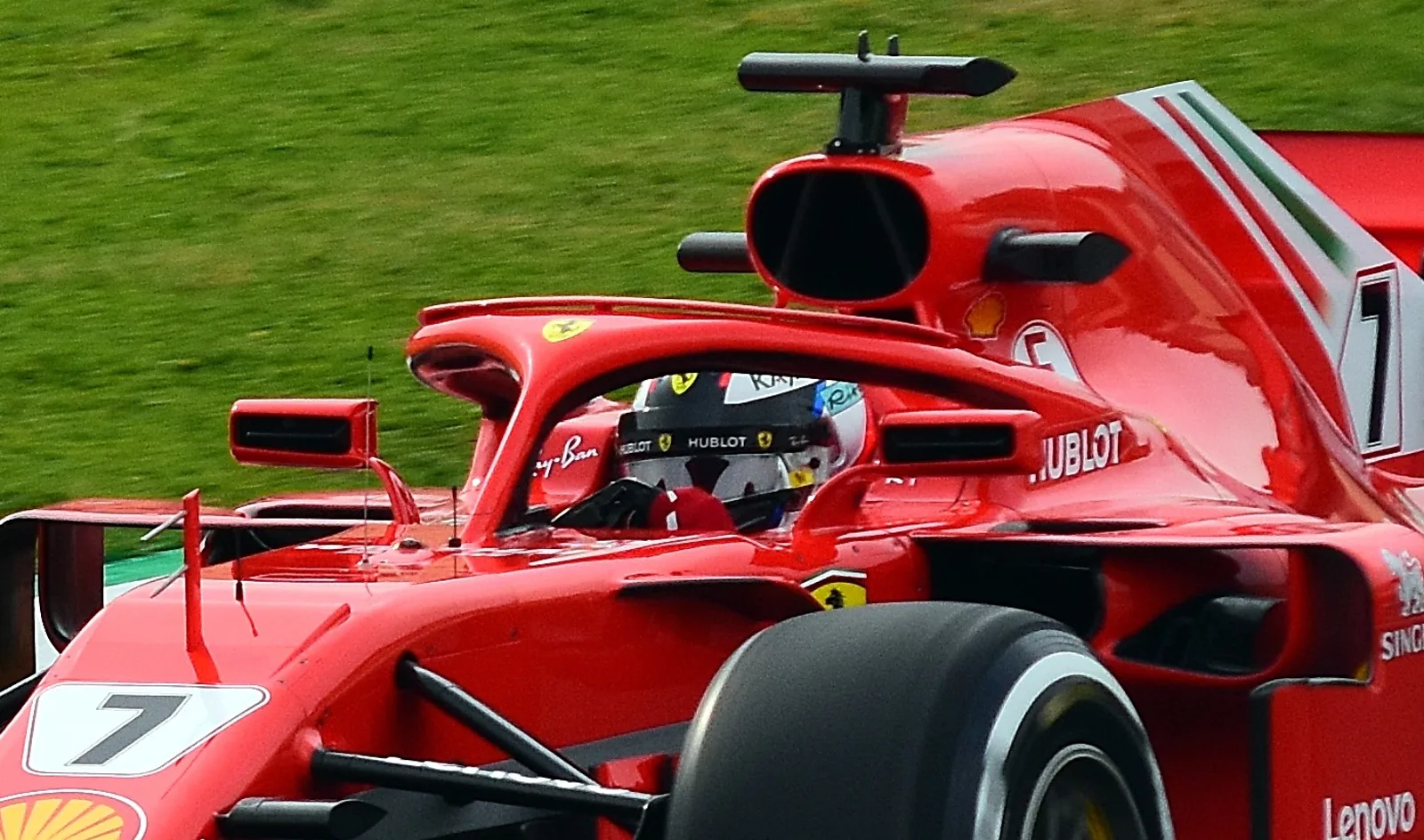
The halo is a crash-protection system for open-wheel cars: a curved bar sitting above the driver's head. It surrounds the head and is joined to the car at three points. It is made of titanium and weighed around 7 kg (15 lb) in the version presented in 2016, rising to 9 kg (20 lb) in 2017.
Testing began in 2016 and continued into July 2017. From 2018 onward the FIA has demanded it on every car across the F1, F2, F3 and F4 ladder, plus Formula Regional and Formula E. Other open-wheel series use it too, among them Australian S5000, Euroformula Open, Super Formula and its Lights category, Indy NXT and the IndyCar Series. In IndyCar the halo acts as the structural frame for the aeroscreen.
Teams do not design their own. In FIA series three approved outside manufacturers, chosen by the FIA, build it to one specification for all cars. A single halo costs between 13,000 and 24,000 euro, and both cars run by a team must carry one.
Without the HANS the head is stopped by the neck; without the halo, the head can meet whatever arrives first.
Why did Formula 1 adopt cockpit protection?
Two accidents in 2009 set the process moving. Henry Surtees was killed at Brands Hatch in a Formula 2 round, and Felipe Massa was hurt in qualifying for the Hungarian Grand Prix. Calls for more cockpit protection followed.
The FIA first explored closed cockpits, visors and roll structures placed in front of the driver. Screens modelled on fighter-jet canopies were judged the least effective early on, because they flexed too much or shattered, depending on the material.
While developing the halo, the FIA examined three fundamental scenarios: two cars colliding, a car striking its surroundings such as barriers, and cars meeting debris. Tests showed the halo could cut the risk of injury significantly, and in many past accidents it would have kept the helmet from touching a barrier. It could also deflect large objects and gave better protection against smaller debris.
The Dallara F2 2018 was presented in August 2017 and was the first car to carry the halo. The SRT05e Formula E car followed in January 2018, and the 2019 FIA Formula 3 car, unveiled in Abu Dhabi in November 2018, had one as well. From 2021 the Indy Lights IL-15 used it.
What were the alternatives to the halo?
Red Bull Advanced Technologies built the transparent Aeroscreen, a design similar to a small fairing that drew little interest from the FIA. In 2019 it was reworked to use the halo as its structural frame for IndyCar.
Drivers objected to the halo, so the FIA came up with Shield, a clear PVC screen. Only one Formula 1 driver ever tried it: Sebastian Vettel, in practice for the 2017 British Grand Prix. He did a single lap before calling a halt, complaining of distorted and blurred vision. With no guarantee the problems could be solved in time for 2018, Shield was dropped.
Was the halo popular when it arrived?
No, and the criticism came before any incident. Niki Lauda argued it spoiled the essence of racing cars. Fans called it ugly, contrary to the idea of an open cockpit, and a blocker of the driver's view. Teams including Ferrari and Mercedes raised safety concerns, and some drivers said it would make escape harder. Others, including Jackie Stewart, welcomed it and compared it with seat belts, which had been criticised in the same way before becoming standard in racing and road cars.
When did the halo prove itself?
At the 2018 Formula 2 race in Spain, Nirei Fukuzumi's car landed on Tadasuke Makino's halo. At the 2018 Belgian Grand Prix, Fernando Alonso's airborne McLaren struck Charles Leclerc's halo, and both halos showed visible damage. Makino and Leclerc both credited it with possibly saving their lives. Toto Wolff, who had criticised it earlier in the season, said protecting Leclerc made it worth the price of its looks.
A Formula 3 event at Monza on 7 September 2019 followed, where the halo potentially saved Alex Peroni after his car went airborne.
At the 2020 Bahrain Grand Prix, Romain Grosjean went into the barriers nose-first. The halo pushed aside the upper part of the barrier and shielded his head. Early worries that it would slow evacuation proved unfounded: he climbed out largely unassisted despite the fire. Grosjean said he had not backed the halo some years earlier, but now thought it the best thing brought to Formula 1.
The list continues:
- 2021 Italian Grand Prix: Max Verstappen's wheel landed on the halo above Lewis Hamilton, who later said it saved his neck.
- 2022 British Grand Prix: Zhou Guanyu credited the halo with saving his life when his Alfa Romeo flipped and went over the tyre barrier, its roll hoop having collapsed on first contact. Earlier in the day it potentially protected Roy Nissany in Formula 2, when Dennis Hauger's car landed on his.
- 2022 Seoul ePrix: after a multi-car crash on the opening lap, Nyck de Vries praised the halo and said he would be even smaller without it.
- 2022 Spa Formula 3: Oliver Goethe's car flipped and landed on Zane Maloney's. Maloney suffered only minor bruises to his hands.
- 2023 Baku Formula 2: Jehan Daruvala's car went under Victor Martins' during a restart, and he said he was glad the halo was there.
- 2023 Indianapolis 500: Kyle Kirkwood's car flipped and slid upside down after contact with Felix Rosenqvist's. Video shows the aeroscreen keeping him from touching the track and barrier. Neither driver was injured.
- 28 June 2025, Red Bull Ring Formula 2: Sami Meguetounif's car rolled over Arvid Lindblad's and Luke Browning's cars. Commentator Alex Brundle credited the halo with stopping the roll hoop reaching Browning's cockpit. Nobody was hurt.
What is the HANS device?
HANS stands for head and neck support. It is a head restraint, and most major sanctioning bodies require one. It lowers the chance of head or neck injury, including basilar skull fracture, in a crash. Rivals such as the Hutchens device, now called the Simpson Hybrid Device, exist, but HANS is the original and the most common name.
How does the HANS device work?
The device is mostly carbon fibre reinforced polymer, shaped like a U. The back of the U rests behind the nape, while its two arms lie flat across the upper chest above the pectoral muscles. It rests on the shoulders and fixes only to the helmet, with an anchor on each side, never to the belts, the body or the seat.
A correctly fitted 5- or 6-point racing harness passes straight over the device and buckles at the middle of the abdomen, so the driver's own body holds it in place.
The physics is simple. In any crash an unprotected driver's body is slowed by the belts while the head keeps travelling until the neck stops it. That sudden pull is what causes the worst injuries. The HANS keeps the head in its place relative to the body and transfers energy into the much stronger chest, torso, shoulders, belts and seat as the head slows.
Normal movement is untouched, since the head can still turn freely. What the device blocks is motion beyond the natural range of the neck, the sort that causes severe injury.
Who developed the HANS device?
Dr Robert Hubbard (1943-2019), who taught biomechanical engineering at Michigan State University, designed it in the early 1980s. After the death of a mutual friend, Patrick Jacquemart, in a testing accident at Mid-Ohio, he spoke to his brother-in-law, the road racer Jim Downing. IMSA officials had concluded some protection was needed against sudden stops, and violent head movement was a major cause of driver deaths, as the body stays held by the belts while the head carries on forward.
Hubbard had worked on General Motors' safety programme. His first prototype came in 1985. The 1989 crash tests were the first to put race harnesses on dummies riding crash sleds, and they cut the energy on the head and neck by about 80%. Earlier work had put the point of basilar fracture at 700 lbs of forward neck shear or 740 lbs of vertical neck tension. The HANS cut both loads to 210 lbs, and neck compression fell by about 28 mm.
Established safety firms declined to make it, so Hubbard and Downing formed Hubbard Downing Inc. in 1990. US patent 6,371,510, issued on 16 April 2002, lists them as inventors.
Why did it take until the 2000s to become standard?
The product languished until 1994, when Formula One took an interest following the loss of Roland Ratzenberger and Ayrton Senna. The NHRA adopted it in 1996, after Top Fuel driver Blaine Johnson died, though it did not become mandatory there until 2004. Mercedes carried out research for the FIA, deciding the HANS did better than its own airbag project.
Drivers pushed back. Many called the devices uncomfortable and restrictive, feared they would cause fresh injuries, or said they made the belts feel less secure or rubbed the collar bone. Dale Earnhardt compared the tethers to a noose.
The turning point came when Earnhardt died on the last lap of the Daytona 500 on 18 February 2001, the fourth NASCAR driver killed by a basilar skull fracture in eight months. His death involved several safety failures, including a broken seat belt and no head and neck restraint, but it turned attention to HANS. Resistance did not vanish at once: a week later, Mark Martin said he would not wear one for anything. After a long investigation ended in August 2001 NASCAR made no immediate changes, and then ARCA's Blaise Alexander died at Charlotte on 4 October 2001. NASCAR required the HANS in its top three series on 17 October 2001.
Other series moved in turn. CART made it compulsory on ovals in 2001 and on all circuits the following season. Formula One mandated it in 2003, after Mercedes testing from 1996 to 1998 whose results were shared with other FIA affiliates. NASCAR accepted either the HANS or the Hutchens device from October 2001 and the HANS alone from 2005. The World Rally Championship and the Australian V8 Supercar Series required it in 2005.
Quick-release shackles, developed by Ashley Tilling and borrowed from the marine industry, where they hold sailboat rigging, helped drivers accept the device, letting them release it with a single pull. Scott Pruett of PPI Motorsports was the first driver to use them. From July 2007 many bodies approved any restraint passing SFI Foundation Specification 38.1, which covers the HANS, Moto-R Sport, R3, Hutch-II, Hutchens Hybrid and Hybrid X. The FIA has required head and neck restraints at every international-level event since the start of 2009.
Halo against HANS, how do they compare?
| Detail | HANS device | Halo |
|---|---|---|
| What it guards against | Head whipping and basilar skull fracture | Impacts, debris and barriers reaching the head |
| Material | Carbon fibre reinforced polymer | Titanium |
| Fixed to | The helmet only, held by the driver's body and belts | The car, at three points |
| First prototype or test | Prototype 1985 | Tests in 2016 and July 2017 |
| Made compulsory | F1 in 2003; all FIA international events from 2009 | F1 and other FIA series from 2018 |
| Cost or weight | No figure quoted | 13,000 to 24,000 euro; about 9 kg (20 lb) in 2017 |
How do the halo and HANS work together?
They guard against different things. The halo stands between the driver and whatever arrives from outside: a wheel, a barrier, another car. The HANS controls what the driver's own head does once the car decelerates sharply. One keeps objects away from the helmet, and the other limits how far the helmet can move relative to the shoulders.
Their histories also differ. The HANS took from the early 1980s to 2009 to become compulsory at international level, partly because of driver resistance. The halo went from first tests to mandatory F1 use within a couple of years, and drivers' complaints faded after crashes such as Leclerc's, Grosjean's and Zhou's.
What does this mean for a driver or a fan?
For anyone strapping into a car on a circuit, the practical point is fit. A HANS device only does its job inside a properly installed 5- or 6-point harness, with the belts passing over it. A driver choosing a restraint can look for one that meets the SFI 38.1 standard, since many sanctioning bodies approve any such device. For fans, the halo is the visible half of the system, and the run of interventions since 2018 is what has turned grumbling into acceptance.