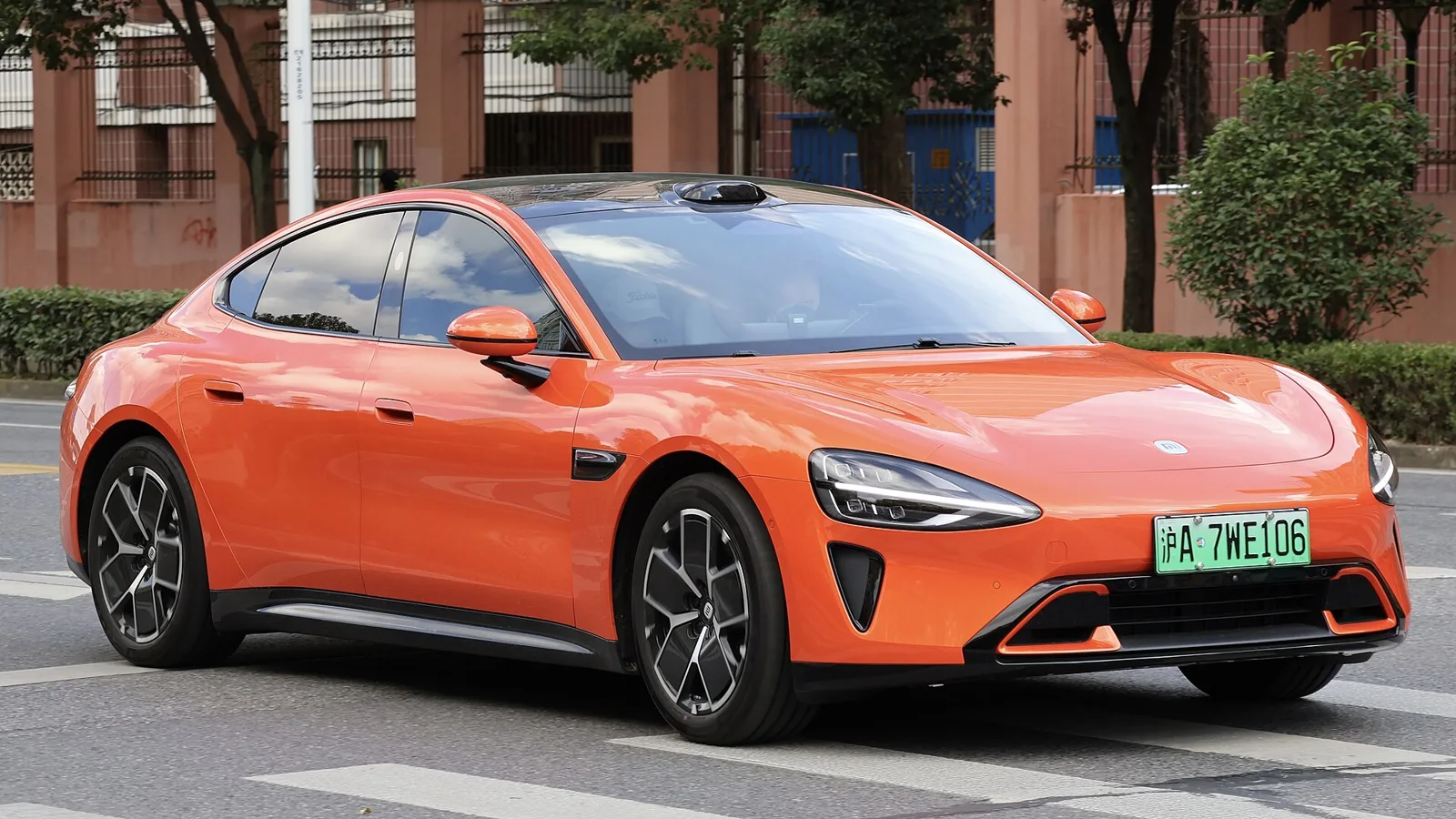
How a Beijing start-up retired its first SUV, built a petrol-assisted family around the L9 and L7, then launched a battery-electric seven-seater with 10.5-minute charging.
Li Auto is a Beijing carmaker known for range-extender SUVs, where a petrol engine only charges the battery. It moved from the Li One to the six-seat L9 and five-seat L7, then to the seven-seat Mega, its first fully electric model, introduced in November 2023.
In October 2022, Li Auto stopped building the first car it had ever sold. The Li One, a range-extended SUV that took the company from an April 2019 reveal to a Nasdaq debut in July 2020, was retired, and owners who had only just taken delivery of one reacted badly. What replaced it was a new design language and a bigger line-up led by the Li L9, with the Li L7 close behind and, in November 2023, a car that broke the company's own habit altogether: the all-electric Li Mega.
That path, from petrol-assisted SUVs to a large battery-electric people carrier, is the clearest way to understand what Li Auto is and where its cars are heading.
What is a Li Auto range extender?
Li Auto is a Chinese manufacturer based in Beijing, with its factories in Changzhou, and it is best known for electric vehicles that carry a petrol engine as a range extender. The phrase is easy to misread. In these cars the engine never turns the wheels directly. Electric motors do all the driving, and the engine works as a generator that tops up the battery when it runs low.
Picture a bucket with a tap at the bottom and a small pump refilling it from a stream. You draw from the bucket whenever you like, and the pump only matters when the water drops. The bucket is the battery, the tap is the motors and the pump is the engine. Engineers call the layout a series hybrid, and the L7 is described in exactly those terms: an engine with no mechanical link to the wheels.
The payoff is two ranges rather than one. A driver can cover the daily commute on battery alone, then lean on the petrol tank for a long trip. The L9 shows how wide the gap can be: Li Auto claims 1,315 kilometres (817 mi) on the NEDC test cycle in total, but only 215 kilometres (134 mi) on electric power alone.
A range extender is a bucket with a pump: the motors drain the battery, and the engine only refills it.
How Li Auto went from Chehejia to the Li One
Li Xiang, who had already founded the websites PCPop and Autohome.com.cn, began the business in 2015 as Beijing Chehejia Information Technology, a name that translates as "Car and Home". Its first idea was low-speed electric cars for car-sharing and ride-hailing fleets. A joint venture with the largest ride-hailing company in China was agreed in 2018 and fell apart soon afterwards, and in the first half of that year the low-speed project was dropped because the central government was not backing the legalisation of that class of vehicle.
The Li One was unveiled in April 2019 and went into production at Changzhou that November, with deliveries starting in early 2020. By then the holding company had been renamed Leading Ideal Inc, and in 2020 it became Li Auto, or Lixiang in Chinese, meaning "ideal". Its drivetrain was a 1.2-litre three-cylinder turbocharged engine acting as the range extender, feeding a 40 kWh lithium-ion battery. In July 2020 the company floated on the Nasdaq under the code "LI" and raised US$1.1 billion in its first round of financing, with Meituan and Source Code Capital among its investors. The first round closed at only 70 per cent of the value that had been anticipated, as Li Auto struggled to secure enough investment in its first year on the exchange. In October 2021 it began building a second plant in Beijing's Shunyi District, on a site sold by Beijing Hyundai after a long slide in that company's sales.
The 2022 reset and the L-series
Within a single year Li Auto changed from a one-model company into a three-model company, and gave the whole range a new design language. The flagship L9 debuted in March 2022. September brought the L8, a cut-down version of the L9, and the L7, which shrinks the body and drops the third row of seats. The Li One was taken out of production the following month.
The L9 was the second vehicle the company had made and the first of the L-series, a family that also includes the L8, the L7 and the L6. At its presentation the L7, the fourth vehicle overall, was the cheapest and smallest car Li Auto sold.
Li Auto L9: the three-row flagship
The first-generation L9 was unveiled online on 8 March 2022, launched officially on 21 June and delivered to customers in China from August. It is a full-size luxury crossover with six seats in three rows.
Its mechanical layout is the range-extender recipe in textbook form. A 130 kW motor drives the front axle and a 200 kW motor drives the rear. Under the bonnet sits a 1.5-litre turbocharged four-cylinder petrol engine with a 65-litre tank (55 litres on the facelifted car), and its only job is to generate electricity. Combined, the system delivers 240 kW (322 hp; 326 PS) and 530 N m (391 lb ft), which gets the L9 to 100 km/h in 5.3 seconds. Charging to 80 per cent takes 40 minutes on a fast charger, and a full charge from a 200V supply needs about six hours. Quoted battery capacity for the early car is 40.6 kWh, of which 37.2 kWh is usable, and a 52.3 kWh pack weighing 282.3 kg (622 lb) replaced it in 2024.
The 2025 update
The L9 was revised on 8 May 2025, with pre-orders opening that day and deliveries starting the following week. The biggest changes were in the driver-assistance hardware. Every car now carries a new ATL LiDAR unit, a laser scanner that builds a three-dimensional picture of the road, which is 60 per cent smaller than before and uses 55 per cent less power. The Pro moved to a Horizon Robotics Journey 6M chip rated at 128 TOPS, a measure of trillions of operations per second, while the Ultra took a single Nvidia Thor-U chip rated at 700 TOPS.
Li Auto says the new system can brake for stopped traffic on an unlit road at night from up to 120 km/h, and steer around a child stepping into the road in the dark at up to 130 km/h (81 mph). A dual-chamber air suspension cut body roll by 24 per cent, and the rear screen grew from 15.7 inches to a 21.4-inch 3K LCD.
The second generation
The second-generation L9 was unveiled on 6 February 2026, alongside a higher-end L9 Livis with a duotone paint scheme. Its public debut came at the Beijing Auto Show on 24 April, and it went on sale in China on 15 May with deliveries beginning the same day. Many had expected a facelift rather than a new generation. The new car is larger in every dimension, with a longer wheelbase, an extended D-pillar and a redesigned rear.
Li Auto claims 2,560 TOPS of computing power from two in-house 5-nanometre M100 Ultra chips, paired with four LiDAR units giving 360-degree coverage. The chassis uses an 800V fully active independent suspension that removes the need for anti-roll bars, plus steer-by-wire and four-wheel steering for a tighter turning circle.
Petrol power remains. A new 1.5-litre turbocharged four-cylinder makes 150 hp (112 kW; 152 PS), and Li Auto says its low-pressure exhaust gas recirculation system, which it calls a world first, brings fuel use down to 6.3 L/100 km from 7.6 L/100 km. The 72.7 kWh NMC battery is rated for up to 340 kilometres (211 mi) of electric driving on the WLTP cycle and accepts 5C charging at up to 420 kW.
Li Auto L7: the smaller, lower sibling
The L7 was presented in September 2022 on the same wheelbase as the longer L8. It launched in three trims, Air, Pro and Max, with an Ultra added in 2024. Deliveries of the Pro and Max began on 1 March 2023, and the Air followed in early April.
It wears the same "Future Avant-Garde" design language as its bigger relatives but sits lower and looks sleeker. Unlike the L8 and L9 it is a two-row, five-seat car. Second-row legroom is quoted at 1,160 mm (45.7 in), the seatback reclines between 25 and 40 degrees, and there are 26 storage spaces. Fold the headrests away and a Double Bed Mode turns the cabin into a place to sleep, with a Camping Mode alongside.
The Pro, Max and Ultra get an air suspension called Li Magic Carpet, with five ride heights and comfort, standard and sport modes, while the Air makes do with continuous damping control. The Air and Pro run the Li AD Pro driver-assistance system on a 128 TOPS chip, and the Max uses Li AD Max with dual Orin-X chips at 508 TOPS.
The powertrain is an all-wheel-drive range extender with a 1.5-litre petrol engine. Peak system power is 330 kW (443 hp; 449 PS), peak torque is 620 N m (457 lb ft) and the sprint to 100 km/h takes 5.3 seconds.
Running changes to the L7
The March 2024 update revised the trims to Pro, Max and Ultra. The Ultra received a 52.3 kWh battery, lifting electric range to 240 km (149 mi) on the WLTC cycle. The number plate moved from the bumper to the tailgate after customer feedback, and the cabin gained a refrigerator.
The 2025 update, revealed on 8 May, mirrored the L9's: a new LiDAR and fresh driver-assistance chips. The air suspension became dual-chamber, with 20 per cent less body roll. The Max now gets the 52.3 kWh battery, which leaves the Pro as the only version on the smaller 42.8 kWh pack.
Li Auto Mega: the first battery-electric Li
The Mega was introduced in November 2023 at Auto Guangzhou, where pre-orders opened, and has been built since 2024. It is a seven-seat MPV, and it is the first Li Auto with no petrol engine at all. Its body is also its calling card: a drag coefficient of 0.215 Cd, a measure of how easily a shape slips through the air, which is reported as the lowest of any MPV in production.
Underneath, the Mega has double-wishbone front suspension, a multi-link rear and an air system that can alter ride height by up to 70 mm (2.8 in). The dashboard puts a small touchscreen on the steering-wheel hub and adds an augmented-reality head-up display. Seating is 2+2+3, and every seat except the middle one in the third row is heated. A 17-inch display hangs from the ceiling, and the armrest conceals a refrigerator. The AD Max driver-assistance system uses 25 sensors, including a LiDAR, a millimetre-wave radar and 11 cameras.
Power and charging
There is one drivetrain: dual-motor all-wheel drive on an 800 V electrical architecture. A permanent magnet motor drives the rear wheels and an induction motor the front, with 400 kW (536 hp; 543 PS) combined and torque of 542 N m (400 lb ft). The Mega reaches 100 km/h in 5.5 seconds and tops out at 180 km/h (112 mph).
The 102.7 kWh Qilin NMC battery comes from CATL and supports 5C fast charging, rated at 400 kW with a peak of 520 kW. That allows a 10 to 80 per cent charge in 10.5 minutes. Range is rated at 710 kilometres (441 mi) on the Chinese CLTC cycle and 575 kilometres (357 mi) on WLTP.
The 2025 Home trim
Li Auto showed an updated Mega at Auto Shanghai in April 2025, with production starting on 20 May and deliveries on 23 May. The new Home trim sits above the Ultra and is mostly about the second row. Those seats can swivel up to 180 degrees to face backwards, with room for a round table accessory. They turn 45 degrees on their own when the doors open to help with entry, or 90 degrees to face the doorway. Owners of older Megas can buy the new seat design as a paid upgrade.
The 2026 facelift
A facelifted Mega was unveiled on 2 September 2026. It is marketed as a new generation, yet most of its components and almost all of its dimensions come from the car it replaces. The exterior gains a tricolour front light bar called the Star Ring and lower taillights, and semi-hidden mechanical handles take over from the old hidden ones.
Inside, a 396-LED ceiling light called the Home Light runs from the second row to the third and splits the sunroof into two parts, each with its own shade. One continuous 29-inch 6K OLED display replaces the separate central and passenger screens.
The chassis picks up an active anti-roll system and rear-wheel steering that turns the rear wheels by as much as 7 degrees, giving a 5.5 m (18 ft) turning radius. A feature named Elephant Welcome lowers one side of the car by 30 mm (1.2 in) in two seconds to make getting in and out easier. The facelift is sold only in the flagship Home trim.
Power rises, too. A 155 kW front motor and a 258 kW rear motor give 413 kW (554 hp; 562 PS), cutting the 0-100 km/h time to 4.9 seconds. Range and charging stay the same.
Li Auto models compared
| Model | Powertrain | Battery | Total output | 0-100 km/h |
|---|---|---|---|---|
| Li L7 | Range extender, all-wheel drive | 42.8 kWh (Pro) or 52.3 kWh (Max, Ultra) | 330 kW | 5.3 s |
| Li L9 (2022) | Range extender | 52.3 kWh from 2024 | 240 kW | 5.3 s |
| Li Mega (original) | Battery electric, all-wheel drive | 102.7 kWh | 400 kW | 5.5 s |
| Li Mega (2026 facelift) | Battery electric, all-wheel drive | Charging and range unchanged | 413 kW | 4.9 s |
How do the L7, L9 and Mega differ in seats, power and range?
The three cars are sized for different jobs. The L7 seats five in two rows, the L9 seats six in three, and the Mega seats seven. Only the Mega is a pure battery car, and it is the one with the headline charging figure: 10 to 80 per cent in 10.5 minutes at a rated 400 kW.
Range figures need careful reading. Li Auto quotes NEDC for the first L9, WLTC for the L7 Ultra, WLTP for the second-generation L9 and both CLTC and WLTP for the Mega. The tests are not the same, so a 340 km WLTP number cannot sit directly beside a 215 km NEDC one. For the Mega, the WLTP figure of 575 km is the one to hold against the CLTC 710 km.
Early quality problems and a mercury scare
In spring 2020 media reports carried complaints from Li One owners about the braking system and the smell of smoke inside the car, and Li Auto denied that the risk extended to other versions. In July 2021 a video on the Chinese social network Weibo showed an owner finding small balls of mercury, a substance banned from car production in China, in a Li One seat. Li Auto began an investigation as soon as the video appeared and confirmed that it was genuine.
What came after the Mega, and could a sedan follow?
In 2025 the company brought in the i Series, an all-electric range styled after the Mega. The first, the Li i8, was launched in February 2025, and the Li i6 followed in September.
On an earnings call in May 2025, chief executive Li Xiang said the company would consider launching sedans once it had maximised revenue from the L-series range extenders and the Mega. According to the company, any sedan would depend on demand from future markets overseas, in Europe and Asia.
For now the L-series continues with a second-generation L9 on sale in China since May 2026 and a Mega facelift unveiled in September 2026, both pointing at the same idea: larger cars, more computing power and, in the Mega's case, a drivetrain with no engine at all.