Who mines and refines the metals behind electric cars, why Western Australian rock matters, and how cobalt supply has been disrupted before.
Most EV battery lithium is mined as hard-rock spodumene in Western Australia, which supplied 53% of the world's lithium in 2023, or as brine in Chile and Argentina. Most cobalt is a by-product of copper and nickel mining in the Congo, which produced over 80% in 2024.
In 2023, 53% of the world's yearly lithium supply was mined in Australia, and 96% of that was exported to China to be processed. The rest of the story runs through Chile, the copper belt of the Congo and a handful of mines in Western Australia.
Why does an EV battery need lithium and cobalt?
Lithium is the least dense metal, at 0.534 g/cm3, and batteries alone use more than three-quarters of the lithium produced. Cobalt is used primarily in lithium-ion batteries, and also in magnetic, wear-resistant and high-strength alloys. Rapid growth in the electric vehicle sector has surged demand for lithium in particular.
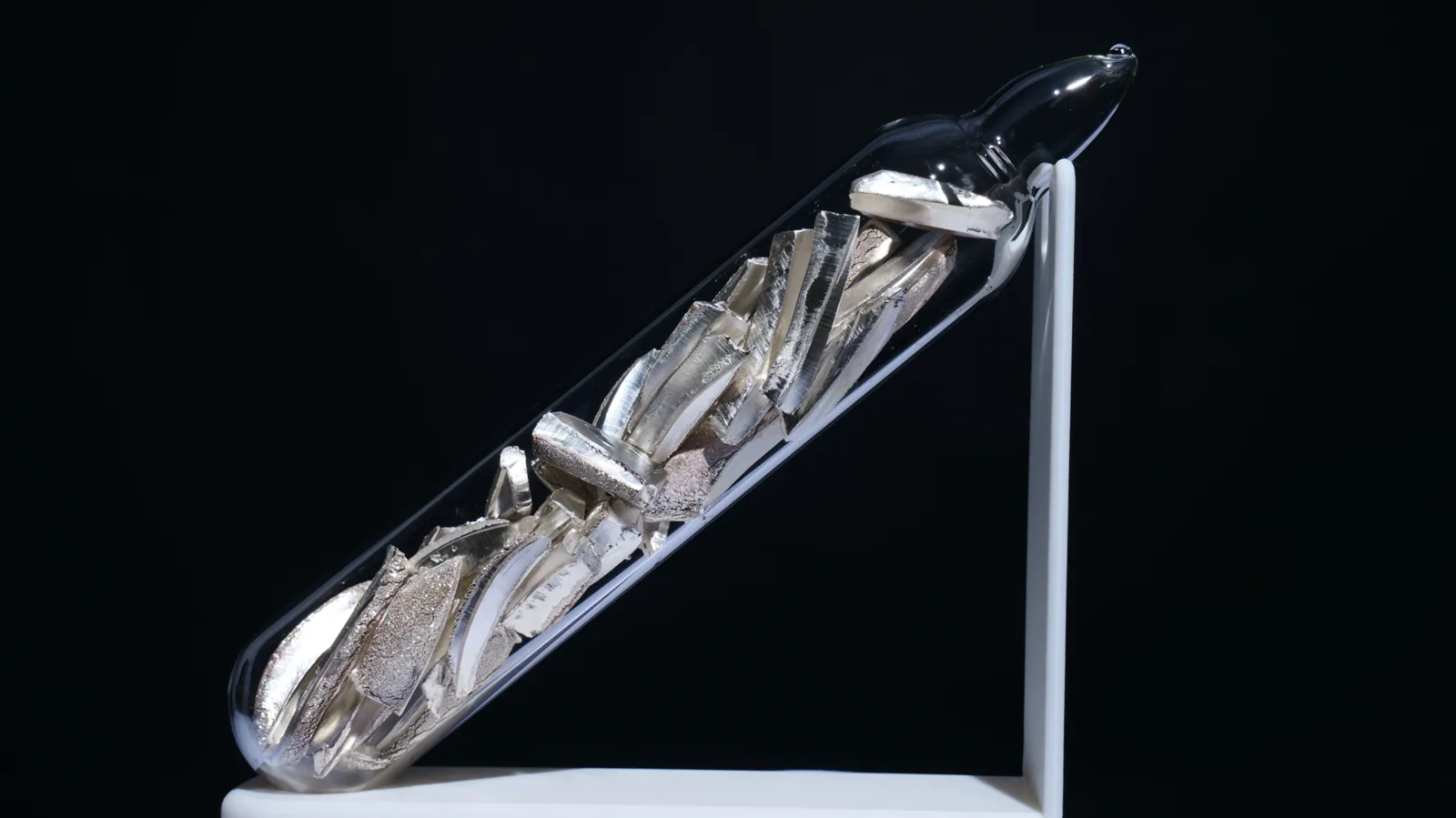
Lithium is a soft, silvery-white alkali metal that is highly reactive and flammable. It never occurs as a free metal in nature, and in its pure form it must be stored in a vacuum, in an inert atmosphere or under an inert liquid such as kerosene or mineral oil. Producers separate the metal electrolytically from a mixture of lithium and potassium chlorides. Outside batteries, it goes into heat-resistant glass and ceramics, grease lubricants and additives used in smelting.
Cobalt is a hard, lustrous, somewhat brittle grey metal that turns up in the Earth's crust only in combination with other elements. Its blue compounds have coloured glass and pottery since the Bronze Age, and it is used as a catalyst in refining crude oil to remove sulfur. Battery demand is the newer chapter: cobalt demand has accelerated this century as a key ingredient in rechargeable batteries, superalloys and catalysts.
Australia digs up most of the world's lithium, and most of it goes to China to be processed.
Where does the lithium in EV batteries come from?
Lithium comes from two kinds of source: hard rock and brine. Granite pegmatites hold the minerals spodumene and petalite, which are the most commercially viable. Brines, including salt lakes, supply the rest. Australia mines the most by weight, mostly from spodumene, while Chile holds the largest estimated reserves.
The element is widely spread across the planet but thinly. Seawater holds an estimated 230 billion tonnes at a nearly constant 0.14 to 0.25 parts per million, and the Earth's crust holds 20 to 70 parts per million by weight, which makes lithium the 31st most abundant element. The Handbook of Lithium and Natural Calcium calls it comparatively rare, with many deposits too small or too low in grade to be worth working. Hectorite clay is another source, although the only active development is by Western Lithium Corporation in the United States.
On the reserve side, Chile was estimated in 2020 to have the largest, at 9.2 million tonnes. The Salar de Uyuni area of Bolivia holds one of the biggest reserve bases, at 5.4 million tonnes, and Argentina and China are other major suppliers. Further prospects keep appearing. The Czech Geological Survey regards the Ore Mountains as a lithium province, with a deposit near Cinovec of 160 thousand tonnes seen as potentially economic. In Finland, Keliber Oy reported proven and probable ore reserves of 5.280 million tonnes at its Rapasaari deposit in December 2019. In Cornwall, England, private investors have tested whether lithium-rich brine can be extracted. In 2010 American geologists were surveying dry salt lakes in western Afghanistan, and the US Department of Defense dubbed the country a potential Saudi Arabia of lithium, although those estimates rested largely on old Soviet data.
Why is Australia the world's biggest lithium producer?
Australia has one of the largest reserves and mines most of its lithium as hard-rock spodumene in Western Australia. In 2017 it overtook Chile as the top producer after a threefold increase in spodumene output, and by 2023 it supplied 53% of the world's annual lithium. A 2023 estimate expects it to stay on top to 2030 with a smaller share.
The difference with South America is the geology. Argentina, Chile and China take lithium mainly from salt lakes, whereas Australia digs it from rock. That has a cost: more capital is needed for hard-rock spodumene than for lithium brines, which matters when companies decide whether a project is worth building.
Figures differ by source and year. One estimate had Australia producing 40,000 tonnes in 2020, while another gives 330,000 tonnes of lithium carbonate equivalent in the 2021-2022 financial year, with Chile producing 45,000 tonnes in 2018 and China 38,000. The measures are not the same, but the ranking is consistent. The US Geological Survey reports that production is concentrated in a few places: five hard-rock operations in Australia, plus two brine operations in each of Argentina and Chile, made up most of the world total. Worldwide production grew 74% from 2016 to 2017.
Australian lithium mines side by side
| Mine | Operator or owner | Key facts |
|---|---|---|
| Greenbushes | Tianqi Lithium, Talison Lithium, IGO | World's largest hard-rock lithium mine; opened 1984; 1.03 million tonnes of spodumene concentrate in the year to July 2022 |
| Mount Marion | Mineral Resources and Ganfeng, equal shares | Operating since 2017; estimated 71 million tonnes of spodumene |
| Pilgangoora | Pilbara Minerals | Construction began January 2017; first concentrate in 2018; assets of Altura Mining bought for A$201 million |
| Mt Cattlin | Allkem (formerly Galaxy Resources) | Opened 2010; 192,000 dry tonnes of spodumene in 2019; suspended 2013 to 2016 |
| Wodgina | Albemarle and Mineral Resources | Theoretical capacity 750,000 tonnes a year; inactive 2019 to 2021 |
| Finniss | Core Lithium | Opened 2022 in the Northern Territory, the only mine outside Western Australia |
| Mount Holland | Covalent Lithium | Operations from late 2023; expansion put on hold in September 2025 |
Which Australian lithium mines matter most?
Greenbushes, in the southwest of Western Australia, is the oldest and biggest. It supplied 40% of Australia's lithium in 2021 and is co-operated by China's Tianqi Lithium with the Australian companies Talison Lithium and IGO. Mount Marion, near Kalgoorlie, holds what is described as the second-largest high-grade lithium resource anywhere.
Greenbushes began life as a tin mine. Greenbushes Tin found major lithium deposits there while exploring for tantalum and opened the mine in 1984, four years later. Talison Minerals bought it in 2007. Mount Marion started as a partnership of Mineral Resources with Neometals, and Ganfeng Lithium bought Neometals' share in 2018.
Pilgangoora lies 120 km (75 mi) from Port Hedland. Pilbara Minerals started building it in January 2017, finished in late July 2018 and produced its first concentrate a month later. By 2018 it had attracted potential customers including POSCO, Great Wall Motor Company, General Lithium and Ganfeng Lithium. At Finniss in the Northern Territory, Tesla contracted for 110,000 tonnes of spodumene concentrate over four years. Mount Holland, developed by Covalent Lithium, a venture between Sociedad Quimica y Minera and Wesfarmers, plans to feed a refinery at Kwinana that is meant to make 50,000 tonnes of lithium hydroxide a year.
How much of the supply chain runs through China?
Most refining of Australian lithium happens in China. In 2023, 96% of the lithium mined in Australia was exported there for processing, and Chinese companies also hold stakes in the mines: Tianqi at Greenbushes and Ganfeng at Mount Marion. China also produced 38,000 tonnes itself in 2018, from salt lakes.
That shipping matters for the carbon footprint. Australian lithium extraction has a higher footprint than mining elsewhere, mainly because mines use extremely carbon-intensive power, especially diesel, and because most output is sent on to China for more processing, which also relies on carbon-intensive fuels. Two Australian projects aim at the processing end: the Mount Holland refinery planned for Kwinana, and a lithium research centre run from Curtin University in Perth, backed with A$53 million of federal and state funding agreed in April 2019 and operating from 2019 to 2025.
Where does the cobalt in EV batteries come from?
Mostly from the Democratic Republic of the Congo. The Copperbelt in the DRC and Zambia yields most of the world's cobalt, usually recovered alongside copper and nickel. The DRC alone made more than 80% of global output in 2024, when production exceeded 300,000 tons, up from over 50% of 116,000 tonnes in 2016.
Cobalt began as a nuisance. Sixteenth-century German silver miners had a corrosive ore that would not yield silver or copper and gave off poisonous gas, possibly because of arsenic, and the name may derive from their word for the goblins they blamed. Georg Brandt showed around 1735 that it was a new element, the first metal discovered since prehistoric times.
Where it is mined has shifted with the discoveries. Mining in Europe declined after ore turned up in New Caledonia in 1864, moved again after deposits were found in Ontario in 1904, and shifted again with larger deposits in Katanga Province, in the Congo, in 1914. After the Second World War the United States searched for its own cobalt, and found a supply in Idaho near Blackbird canyon.
Has cobalt supply been disrupted before?
It has. When fighting broke out in the Shaba region in 1978, Katanga's copper mines nearly ceased output. The effect on the world cobalt economy was smaller than expected. The reasons given are that cobalt is a rare metal, that the pigment is highly toxic, and that industry already had effective ways of recycling cobalt materials. In some cases industry moved to cobalt-free alternatives.
The geopolitics is argued over. In one view, cobalt will be a prime object of geopolitical rivalry as the world comes to run on renewable energy and batteries. Critics say that view underrates how much economic incentives can lift production.
What happens to lithium mines when prices fall?
Mines pause or hold back. Rising electric vehicle demand raised revenue for producers, but the Australian Financial Review has reported that as supply grows, the value of existing companies falls. Mt Cattlin and Wodgina were both idled by weak prices, and the Mount Holland expansion was paused in 2025.
Mt Cattlin was suspended in 2013 after a drop in lithium prices and restarted in 2016. Wodgina was inactive from 2019 to 2021 because low prices made it unprofitable. In September 2025 the expansion of Mount Holland was paused because lithium prices were low. Meanwhile a settlement by the Chilean producer SQM allows it to more than triple its production over seven years, and federal forecasts say Western Australia will mine a record 419,000 tonnes of spodumene without earning the same high prices as before. Ken Brinsden, chief executive of Pilbara Minerals, has said demand for higher quality battery materials put Western Australia in the driver's seat.
What does lithium mining do to the land?
Like all mines, lithium mines affect their surroundings. Most Australian lithium mines are surface mines, so the most immediate impact is the removal of plants, soil and wildlife at the site, and the process produces dust that can be inhaled.
Where this goes next
A 2023 estimate suggests Australian output will hit a cap of 1.2 million tonnes of lithium carbonate equivalent by 2030, with the country still the top producer but with a smaller share of world supply than in 2023. Mount Holland plans 380,000 tonnes of spodumene concentrate for its refinery, although its expansion is on hold, and Finniss is to be developed in stages, beginning with open pits near Grants and Hang Gong plus underground workings at Grants, BP33 and Carlton.
Beyond Australia, the Ore Mountains deposit near Cinovec in the Czech Republic is seen as potentially economic, Finland's Rapasaari deposit has estimated reserves, and in Cornwall private investors have tested whether lithium can be extracted from brine.