From the 2016 concept to the 2026 EQS facelift: how the electric Mercedes line-up is laid out and what the 1,202 km EQXX proved.
Mercedes-EQ is the electric series of Mercedes-Benz, previewed in 2016. The EQS is its full-size luxury liftback, rated at up to 926 km WLTP after the 2026 facelift, the EQA is the compact crossover, and the Vision EQXX concept drove 1,202 km on one charge.
A concept car that Mercedes-Benz has no intention of selling drove 1,202 km from Stuttgart to Silverstone on a single charge, averaging 8.3 kWh per 100 km. The 2026 EQS 450+, the best of the updated range, is rated at up to 926 km on the WLTP test. That gap between a showpiece and a showroom sits behind everything in the Mercedes-EQ story.
The range itself was laid out in 2016 as a family of electric cars, and its naming and platforms are already changing, with the EQS and EQA at either end of the size scale and the EQXX as the research car.
How is the Mercedes EQ range laid out?
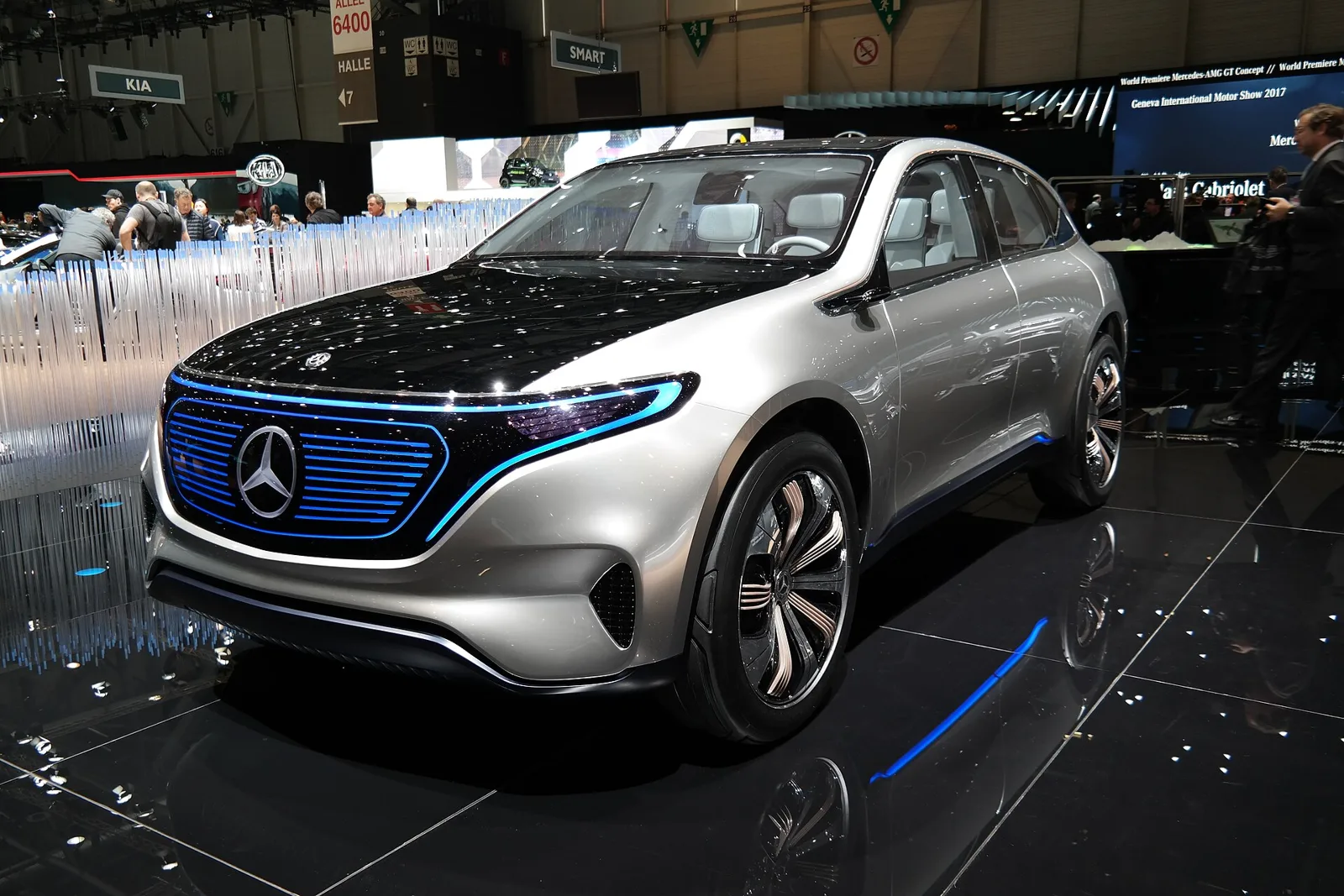
Mercedes-EQ is the battery-electric series of Mercedes-Benz. It began with the Generation EQ concept at the 2016 Paris Motor Show, and the first production member, the EQC, was presented at an event in Stockholm in 2018. The line-up since then has covered the EQC, EQV, EQA, EQB, EQS, EQE, the EQS and EQE SUVs and the EQT. In March 2018 the three electric Smart models were rebadged with the EQ name too, and the label was stretched to hybrids: EQ Boost for 48-volt mild hybrids and EQ Power for third-generation plug-in hybrids, which pair a nine-speed automatic with the electric motor and promised up to 49 km of electric range.
The ambitions announced around the launch were large. The company said it would offer ten EQ models by 2022, three of them Smart, and chairman Dieter Zetsche set a goal of 15 to 25 per cent of global sales by 2025, dependent on infrastructure and customer preferences. Director Jurgen Schenk said Mercedes expected battery energy density to improve by about 14 per cent a year until 2025. Behind that sat 1 billion euros for battery capacity, half of it for the Deutsche ACCUmotive plant at Kamenz, within a wider investment of up to 10 billion euros in electric-vehicle development. Charging would be through the Combined Charging System, a home wall unit, or optionally a wireless inductive pad.
Even the name had to be fought for. In March 2017 Chery complained to the Chinese trademark office, because since 2015 it had sold an electric QQ3 city car under the "eQ" name. The row ended in July 2017: Chery kept "eQ" for numbered models and Mercedes took "EQ" for lettered ones. In May 2018 Mercedes trademarked EQA, EQB, EQE, EQG and EQS.
The platforms underneath
The early cars were not designed as electric cars first. The EQC, like the later EQA and EQB, was constructed on a platform designed for combustion engines. In October 2020 Mercedes introduced two dedicated electric platforms, the Electric Vehicle Architecture, aimed at larger vehicles for big saloons and SUVs, and the Mercedes-Benz Modular Architecture, or MMA, for smaller ones. The EQS was the first EQ model on a platform made specifically for electric cars, which is variously named EVA and MEA.
That gap between a showpiece and a showroom sits behind everything in the Mercedes-EQ story.
How do the Mercedes EQS, EQA and Vision EQXX compare?
| Feature | EQS | EQA | Vision EQXX |
|---|---|---|---|
| Type | Full-size luxury liftback | Subcompact luxury crossover | One-off concept car |
| Reveal | Production debut 15 April 2021 | Concept September 2017; on sale 2021 | Digital debut 3 January 2022 |
| Drag coefficient | As low as 0.20 | 0.28 | 0.17 |
| Battery | 107.8 kWh (original EQS 450+) | 69.7 kWh gross (EQA 250) | 100 kWh design basis |
| Headline range | More than 638 km at launch; up to 926 km WLTP in 2026 | 540 km WLTP (EQA 250+) | 1,202 km demonstrated |
| DC charging | Peak above 200 kW at launch; 350 kW in 2026 | Up to 100 kW | Claimed 300 km in 15 minutes |
Mercedes EQS: how far does it go and how does it work?
The EQS is a full-size luxury liftback. It was previewed as the Vision EQS at the 2019 IAA, made its production debut on 15 April 2021 and reached customers in Germany in September 2021 and in the United States in the fourth quarter. Its calling card was drag: a coefficient as low as 0.20, the lowest of any production car when it was introduced, though drag coefficient is not the same as total air drag, which also depends on frontal area.
The EQS 450+ has a single Valeo Siemens motor, a water-cooled permanent-magnet synchronous unit rated at 245 kW (329 hp), and the 580 4MATIC has two. A one-speed reduction gearbox carries the power to the wheels. Braking power from the motor is 186 kW (249 hp), enough for a deceleration of 5 m/s2 without touching the friction brakes. Alexander Bloch of the German magazine Auto Motor und Sport recorded energy use of 150 to 160 Wh/km at 130 km/h and an average of 158 Wh/km. With the 107.8 kWh battery that gives a range of more than 638 km, and the car recharges at an average of 163 kW with a peak above 200 kW, reaching 79 per cent in roughly half an hour.
The Mercedes-AMG EQS 53 4Matic+, shown in Munich in September 2021, is the first all-electric AMG: two motors, 560 kW (751 hp) and 1,020 Nm, with handling and cooling upgraded to suit.
Technology in the cabin
Higher-end EQS models carry the MBUX Hyperscreen, two OLED screens plus an LCD instrument cluster covering nearly the full width of the dashboard, powered by eight processor cores and 24 gigabytes of RAM. Standard equipment includes rear-wheel steering, remote software updates and a 360-degree camera, and options include massage seats, an augmented-reality head-up display and automatically opening doors.
The EQS was also the stage for a world first. Until January 2026 it could be ordered with Drive Pilot, a level 3 system that let drivers take hands off the wheel and eyes off the road in slow-moving traffic, up to 60 km/h, on 13,191 km of German motorway. Mercedes dropped the level 3 feature in January 2026, saying a level 2 capability is coming instead. The EQS also introduced a level 4 automated valet system called Intelligent Park Pilot.
The 2024 and 2026 updates
A first facelift was released on 10 April 2024, with a free-standing bonnet ornament, a new front fascia and bigger batteries for some variants. The second, unveiled on 14 April 2026, changes the grille, headlights and tail-lights, adds heated seatbelts and an optional yoke steering wheel for steer-by-wire cars, a system offered from late 2026. The EQS 400, 450+, 500 4MATIC and 580 4MATIC move to an 800-volt architecture with 112 or 122 kWh batteries and a maximum charging speed of 350 kW, which Mercedes says is enough to add up to 198 miles of range in 10 minutes. The 450+ is rated at up to 926 km (575 mi) on the WLTP and 15.4 to 19.3 kWh/100 km.
Mercedes EQA: the small electric crossover
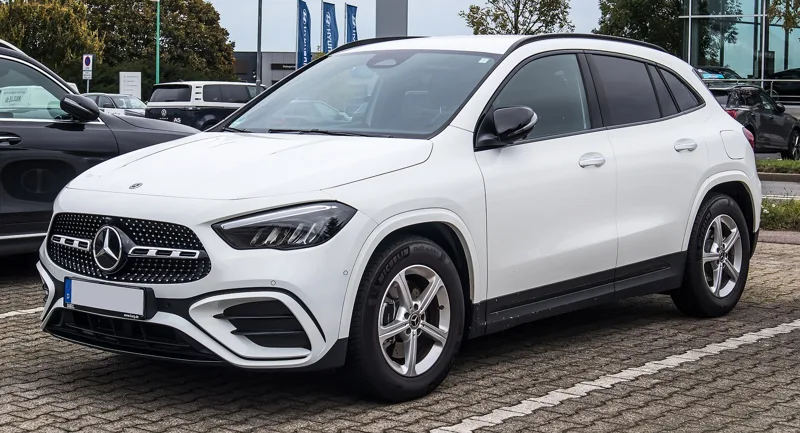
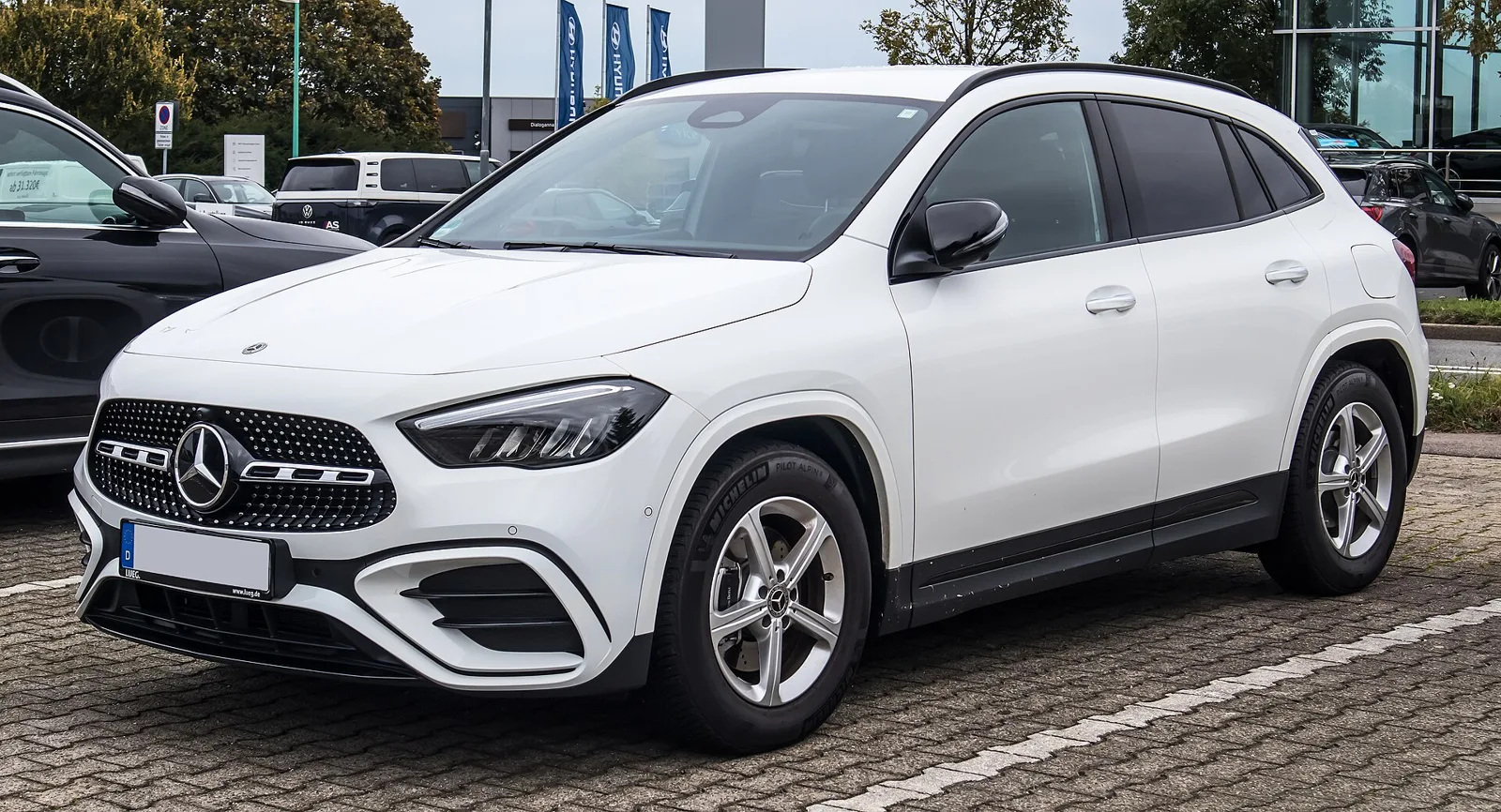
The EQA is the smallest EQ crossover, a subcompact luxury SUV built on the MFA2 front-wheel-drive platform that it shares with the second-generation GLA, and in 2021 it joined the line-up alongside the larger EQB. The name joins EQ with the letter A, for the smallest of its class. The concept shown in September 2017 was in fact a small hatchback with two motors and 200 kW, but the production car grew to 4,463 mm in length, a little longer than its combustion twin. It was designed by a team under Balazs Filczer, who also designed the GLS and G-Class.
At launch only the front-wheel-drive EQA 250 was offered, with a 190 hp (142 kW) motor. All-wheel-drive 300 and 350 versions followed using the 4matic system, and the EQA 250+ arrived in March 2022 with a larger battery, better aerodynamics and a 140 kW permanent-magnet motor, giving 540 km on the WLTP. The EQA 250 carries a 69.7 kWh gross battery, while the 250+ has a larger one quoted at 70.5 kWh, or 73.9 kWh gross in a later specification. In May 2022 the standard EQA 250 range went up to 490 km. The 300 4MATIC makes 228 hp (168 kW) and 390 Nm, and the 350 4MATIC 292 hp (215 kW) and 520 Nm. Weight runs from 1,965 kg to 2,105 kg depending on the battery. ZF Friedrichshafen supplies the motors, the battery sits beneath the floor, and the car offers one-pedal driving.
The boot holds 340 L, about 100 L fewer than the GLA, and 1,320 L with the rear seats folded. Charging takes about 6 hours 30 minutes on an 11 kW AC point and 33 minutes for 10 to 80 per cent at up to 100 kW DC. Euro NCAP gave the all-wheel-drive car five stars, with 97 per cent for adult occupants, 90 per cent for children, 81 per cent for pedestrians and 75 per cent for safety assistance.
In Australia the EQA was released in April 2021, with a Progressive trim on 19-inch AMG twin-spoke wheels and an AMG Line model with 20-inch wheels. The European price started at 37,970 euros, and production for China began in November 2021 at the Beijing Benz factory. Mercedes revealed a 2024 facelift in August 2023, with a new grille, 3D tail-light signatures and Plug and Charge, which lets the car start charging without human authentication; the 250+ gained a further 60 km (37 mi) of range.
What does the Mercedes Vision EQXX prove?
The Vision EQXX is a proof of concept, unveiled at the 2022 Consumer Electronics Show with a goal of using under 10 kWh per 100 km, or more than 10 km per kWh, in real conditions. Design started in June 2020, after the company board asked for an electric car with 1,000 km of range. An earlier internal target had been more than 1,200 km from a 100 kWh pack; it was revised to 1,000 km. Work on the powertrain and battery was shared with Mercedes AMG High Performance Powertrains, the Formula One engine business, and Ola Kallenius, the company chairman, said the car shows how Mercedes imagines the future of electric cars.
Think of range as a sum of two things: how much energy you carry, and how little you waste. The EQXX attacked both. Its battery uses cell-to-pack construction, meaning cells go straight into the pack without being grouped into modules, an approach familiar from Formula One. Mercedes says it cut pack weight by 30 per cent and size by half compared with a contemporary EQS, and raised cell energy density by 20 per cent. A 150 kW (204 PS) radial-flux motor drives the rear axle through a single-speed direct-drive transmission, the inverter uses silicon carbide parts from Onsemi, and the architecture runs at 900 volts, which lowers current and therefore the heat lost in the copper. Parasitic loss is said to be only 5 per cent, so 95 per cent of battery energy reaches the wheels. Mercedes claims DC charging can add 300 km of range in 15 minutes.
The shape does the rest. With a drag coefficient of 0.17, the lowest of any battery-electric vehicle, the EQXX uses a teardrop outline first popularised by Talbot-Lago in 1937, a Kammback tail, a rear axle track 50 mm narrower than the front and semi-transparent wheel covers. Its frontal area is 2.12 square metres, 0.39 square metres smaller than the EQS 450+. It keeps conventional wing mirrors, since cameras would drain too much power, and its roof carries 117 solar panels developed with the Fraunhofer Institute that run ancillary systems from a separate lithium iron phosphate battery. Tyres are bespoke Bridgestone 185/65 R20s on forged magnesium wheels.
Inside, neuromorphic computing developed with the Australian firm BrainChip cuts power use for functions like voice control, a 1,206 mm 8K screen spans the dashboard, the carpet is bamboo fibre, the seats use mycelium faux leather and cactus fibre, and door straps are made from a vegan silk produced with AMSilk.
The long drives
The EQXX has beaten its own 1,000 km target on the road. It travelled 1,008 km from Sindelfingen in Germany to Cassis in France at an average of 8.7 kWh per 100 km, and then 1,202 km from Stuttgart to Silverstone at 8.3 kWh per 100 km, or 12.1 km per kWh. The charging port was sealed during these runs to prevent tampering. Eva Grenier, chief engineer of the drive system, said the car should score even higher on the WLTP. In March 2024 it covered about 1,010 km from Riyadh to Dubai at 13.5 km per kWh in temperatures up to 34 degrees Celsius.
What it means if you are buying a Mercedes electric car
The EQA is the compact choice, with a 340 L boot and 100 kW charging, while the EQS offers 800-volt, 350 kW charging only in its 2026 form. Early EQ models sit on combustion-based platforms, whereas later cars use ones designed for electric drive. Official range figures and demonstration drives differ: the EQXX's 1,202 km was achieved by a one-off concept, not a car that can be bought.
Where this goes next
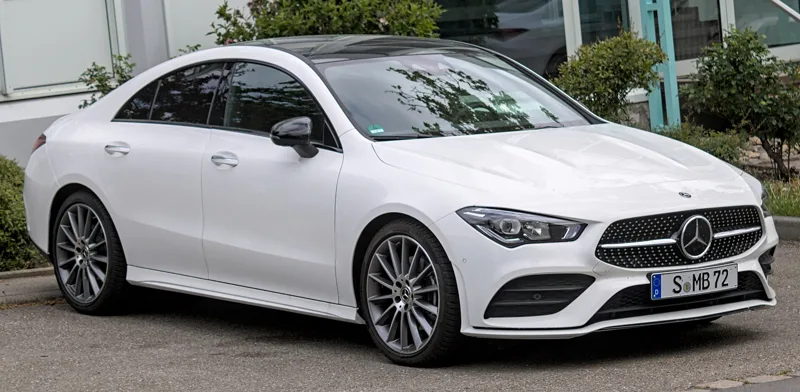
Mercedes-Benz has said it plans to go fully electric by 2030, and the EQXX is only a one-off concept. Its technology, however, is moving into production: the first car to take it on was the electric version of the 2026 CLA, on the new MMA platform, which Kallenius called the EQXX on the road.
The EQ brand itself is being phased out. After the first-generation models reach the end of their life cycles, electric Mercedes cars will carry a "with EQ Technology" suffix, and the battery-electric G580 marked the start of that strategy. The electric CLA is first on MMA, and a CLA Shooting Brake and replacements for the EQA and EQB will follow on the same platform. The large MB.EA platform that was to underpin successors to the EQE and EQS was cancelled, with the EVA2 platform evolved instead, while the MB.EA Medium remains in development. An all-electric GLC is the first model on it and an indirect replacement for the EQC, while electric C-Class, E-Class and S-Class models are being developed.