In 1900 Michelin gave away nearly 35,000 copies of a motorist's guide to sell more tyres. Today its stars, keys and grapes rate restaurants, hotels and wine estates.
Michelin, a French tyre maker, began publishing its guide in 1900 to encourage driving and so boost tyre sales. Anonymous inspectors later awarded stars to restaurants from 1926. The mascot Bibendum, the Michelin Man, dates from the 1894 Lyon Exhibition and is also called Bib.
France had fewer than 3,000 cars in 1900. A tyre company with a problem, too few customers, decided to print a book. The Michelin brothers, Edouard and Andre, gave away nearly 35,000 copies of a first guide for motorists, packed with maps, tyre-changing instructions and lists of mechanics, hotels and petrol stations. It was a sales tool for rubber. It would also become a worldwide reference for eating out and travel.
The guide's stars, its newer awards and the company's mascot, Bibendum, all grew out of that tyre business, and the guide has since expanded with money from the destinations it covers.
Why did a tyre maker begin publishing a guide?
Michelin, the French tyre company, has published its guide since 1900. Motorists in France were the first readers, and over time the book spread to a global audience. The brothers' reasoning was simple. More cars on the road meant more demand for tyres, and a guide might persuade owners to drive further and more often. More driving would mean more tyre wear and, in turn, more replacement sales.
The first, free edition covered all of France. The brothers followed it with a guide to Belgium in 1904, then Algeria and Tunisia in 1907, the Alps and the Rhine in 1908, Germany, Spain and Portugal in 1910, and the British Isles in 1911. An English translation of the France guide appeared in 1909, and in 1911 a volume called The Countries of the Sun covered northern Africa, southern Italy and Corsica.
From free handout to paid guide
Publication was suspended during the First World War. Afterwards, revised editions were still given away until 1920. Then Andre Michelin visited a tyre merchant and saw copies of the guide wedged under a wobbling workbench. It reminded him of a principle, that people value only what they pay for. From 1922 Michelin charged for the guide, at 7 francs, equal to about 9 euros in 2025.
The guide changed in other ways at the same time. Restaurants were listed in categories, hotel listings were added (at first for Paris only) and advertisements were removed. The restaurant section was proving popular, so the brothers hired a team of anonymous inspectors to eat in restaurants and write them up.
More driving meant more tyre wear, and more tyre wear meant more sales.
How the Michelin stars began
Michelin started awarding stars to superior restaurants in 1926, a habit borrowed from Murray's travel handbooks and the Baedeker guides. At first there was only one star, for the best restaurants. In 1931 the guide introduced a ladder of zero, one, two and three stars, and the same year it switched the cover colour from blue to red, which every later edition has kept.
In 1936 Michelin published the criteria for its rankings. One star meant a very good restaurant in its category. Two stars meant excellent cooking, worth a detour. Three stars meant exceptional cuisine, worth a special journey.
War interrupted the guide again. During the Second World War publication was suspended, and in 1944 the Allied Forces asked for the 1939 France guide to be reprinted for military use, since its maps were the best up-to-date ones available. Annual publication restarted on 16 May 1945, just a week after Victory in Europe Day. Post-war shortages made Michelin cap restaurants at two stars, and by 1950 the French edition named 38 establishments at that level. In 1954 the guide cost 750 francs, equal to about 20 euros in 2025.
How do Michelin stars work?
Michelin inspectors visit restaurants anonymously, and their meals and expenses are paid by Michelin, never by a restaurant under review. The company has gone to great lengths to preserve their anonymity. Many of its senior executives have never met an inspector, inspectors are advised not to tell even their parents what they do, and Michelin has never let them talk to journalists.
Their reports are boiled down at annual stars meetings in the guide's national offices into a ranking of three, two or one star, or none. A place that Michelin considers not worth a visit is left out of the guide altogether.
Michelin's own description of the awards is more specific than the old shorthand. One star goes to restaurants that use top quality ingredients and prepare dishes with distinct flavours to a consistently high standard. Two stars are given where the personality and talent of the chef shine through in expertly made dishes that are refined and inspired. Three stars are Michelin's top award, for chefs at the height of their profession whose superlative cooking has become an art form and whose dishes may become classics.
In France the annual release sparks a media frenzy that has been likened to the Academy Awards, with speculation about which restaurant might lose, keep or gain a star. The French chef Paul Bocuse, a pioneer of nouvelle cuisine, said that Michelin is the only guide that counts. The guide also gives Rising Stars to restaurants with the potential to earn a star, or an extra one.
The Red Guide format
Historically the Red Guides have listed far more restaurants than their rivals, describing each in as little as two lines through a system of symbols. Starred restaurants also get two or three named specialities. Summaries of two or three lines arrived around 2002 and 2003, written in each country's own language, though the symbols never change between editions.
Bib Gourmand, keys, grapes and other Michelin awards
The star ladder is only part of the system. Michelin has built a family of distinctions around it.
| Award | Introduced | What it recognises |
|---|---|---|
| Stars (one to three) | 1926; ladder of zero to three from 1931 | Restaurants from very good to exceptional |
| Bib Gourmand | 1997 | Exceptionally good food at moderate prices |
| The Plate, later Selected Restaurants | 2016; renamed 2022 | Restaurants that simply serve good food |
| Green star | 2020 | Sustainable gastronomy; due to be phased out by the end of 2026 |
| Keys | 2024 | Hotels, after anonymous stays |
| Grapes | July 2026 | Wine estates, rated one to three |
The Bib Gourmand, named for Bib, the company's nickname for the Michelin Man, honours restaurants where a combination of menu items stays under a ceiling set by local economic standards. In Canada in 2022 the limit was $60 CAD per person for two courses and either a dessert or a glass of wine. In France the benchmark rose from 32 euros nationally and 36 euros in the Paris region in 2016 to 40 euros and 45 euros in 2025. Some Bib Gourmand places move up: the Chicago restaurant and bakery Kasama earned a star in 2022 after holding a Bib Gourmand the year before.
Hotels get keys, introduced in 2024 after anonymous stays, and judged against five criteria. They cover design, service, personality, value for money and what the hotel contributes to its surroundings. The guide recommends over 6,000 hotels worldwide. The newest award, grapes, arrived in July 2026 to rate wine estates, rather than specific bottles or vintages, as very good, excellent or exceptional with one, two or three grapes. It began with Burgundy.
How the guide went global, and who pays for it
Michelin published its first Italian guide in 1956, with no stars at all in that edition, and in 1974 the first British guide since 1931, which awarded twenty-five. In 2005 it produced its first American guide, covering 500 restaurants in New York City's five boroughs and 50 hotels in Manhattan. A Tokyo guide followed in 2007, and Hong Kong and Macau in 2008. By 2013 the guide appeared in 14 editions across 23 countries. Also in 2008 Juliane Caspar, a German restaurateur, became the first woman and first non-French national to edit the French edition.
Later growth has often involved money from destinations. The Korea Tourism Organization commissioned the inclusion of South Korea in 2016 for 3.2 billion won (over US$1 million), although officials were unhappy with errors in the result. Thailand agreed in 2017 to pay 144 million baht (US$4.4 million) over five years. In 2022 the guide arrived in Canada, with Toronto and Vancouver, for undisclosed payments, and in Florida, where tourism boards agreed to pay up to US$1.5 million in total. The first Florida list had a single two-star restaurant, fourteen one-star restaurants and 29 Bib Gourmands.
Late 2022 brought Vietnam, Malaysia, Estonia and the United Arab Emirates, again for undisclosed payments. Israel's Ministry of Tourism announced in February 2023 a bid of 1.5 million euros. Several Colorado cities, among them Aspen, Boulder, Denver and Vail, paid between US$70,000 and US$100,000 each on top of a state contribution, while four others chose not to take part. Atlanta paid US$1 million over three years. In the early 2020s Michelin began requiring some countries that had previously been reviewed to pay for continued coverage, and Hungary, Slovenia and the Czech Republic agreed.
Where this goes next
Michelin ended printed copies in most markets in 2021, after 121 years, and moved to digital publication with its own app, which widens its audience and costs readers nothing. As of 2024, only France, Italy, Japan and Spain still had a printed edition.
The plans start with the American South edition, set for 2025, which takes in Alabama, Louisiana, Mississippi, the Carolinas, Tennessee and the Atlanta guide. On 12 May 2025 Michelin said it would add Boston and Philadelphia to a Northeast Cities edition that also covers Chicago, New York City and Washington. The Boston tourism board is reported to have paid over $1 million for three years, raised through hotel surcharges. A move into the Philippines, around Greater Manila and Cebu, was planned for 2026.
In May 2026 Michelin said it would phase out the Green Star gradually by the end of 2026, replacing it with an editorial platform called Mindful Voices.
Where does the Michelin Man fit?
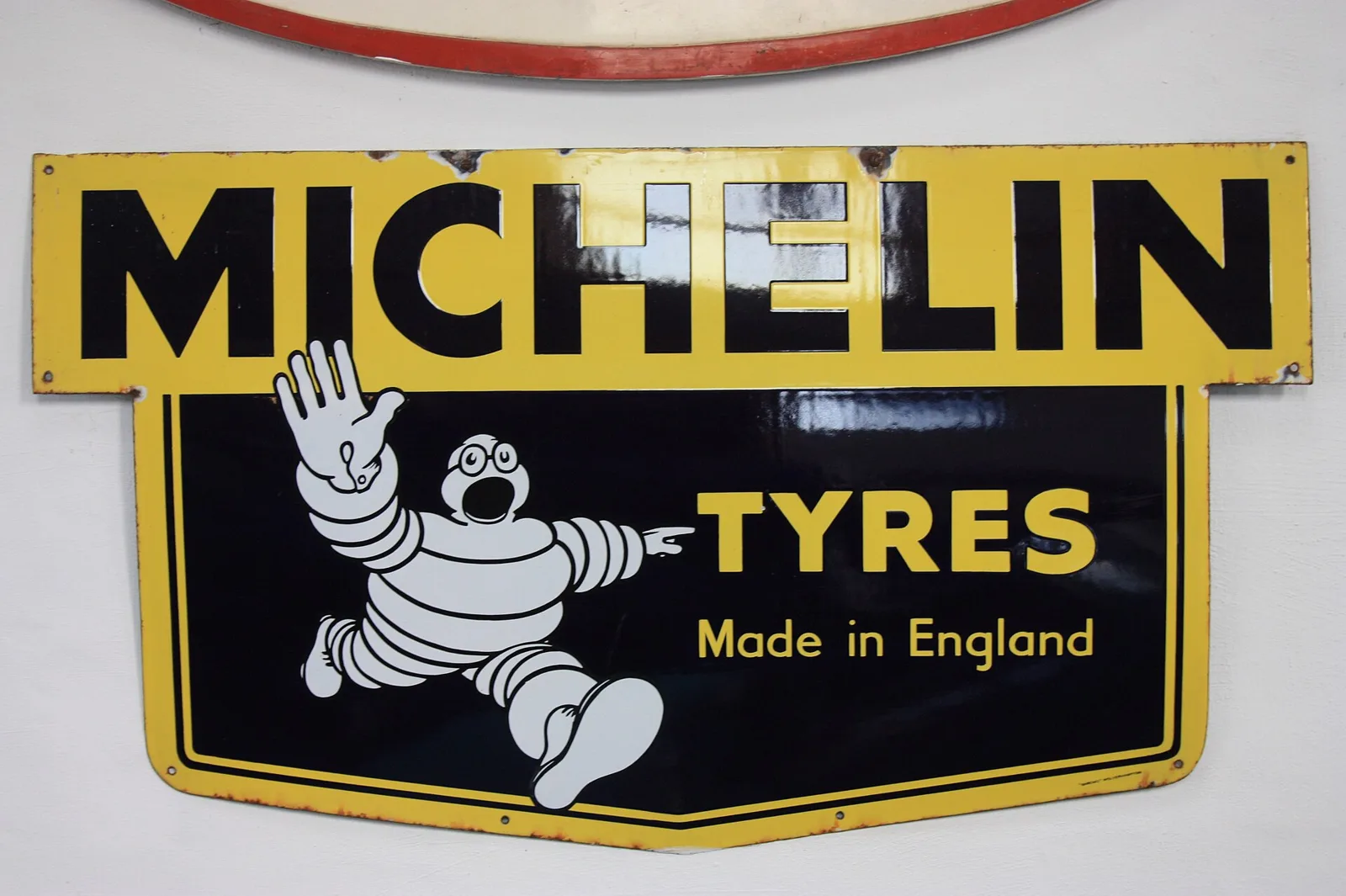
The Michelin Man, officially Bibendum and sometimes called Bib, is the company's mascot, a humanoid figure made of stacked white tyres. He was introduced at the Lyon Exhibition of 1894, and he is one of the oldest trademarks still in active use. His slogan, Nunc est bibendum, or now is the time to drink, comes from an ode by Horace.
The idea came at the Lyon exposition of 1894, where Edouard Michelin noticed a pile of tyres that looked like a man with no arms. Four years later Andre met the cartoonist Marius Rossillon, known as O'Galop, who showed him a design a Munich brewery had turned down: a regal figure holding an enormous glass of beer and quoting Horace. Andre at once proposed swapping the man for a figure of tyres, and O'Galop reworked the picture.
The 1898 poster showed the figure toasting his scrawny rivals with a glass full of nails and broken glass. The caption said the Michelin tyre drinks up the obstacle, a promise that its tyres would swallow road hazards. Michelin kept using that poster format for 15 years, adding new products to the table in front of him. When the name Bibendum was adopted is unclear, but it was no later than 1908, when Curnonsky wrote a newspaper column under that name. A contest in 1922 to name the character in the United States was won by Old 1895, after the year Michelin introduced the first pneumatic car tyre, though the judges said no entry fully satisfied them.
How Bibendum has changed
Tyres began as gray-white or translucent beige. They turned black in 1912 when carbon was added to preserve and strengthen the rubber, and the mascot briefly turned black in print adverts too. Michelin reverted, citing printing and aesthetic reasons rather than racial concerns, as is often believed.
The original, based on bicycle tyres, wore pince-nez glasses and smoked a cigar. By the 1960s Bibendum ran, often while rolling a tyre, and the cigar had gone. For his centenary in 1998 he was slimmed down and lost his glasses, echoing the smaller, lower-profile tyres on modern cars. According to Michelin, a study found that 90% of the world's population could recognise him instantly, and he represents the company in over 170 countries.
In the 1920s he was drawn as a lord of industry and a patriotic champion of the French spirit, urging Frenchmen to take up America's superior factory methods and then beat its products. As cars reached the middle classes, the company's advertising followed, and its restaurant and hotel guides broadened to cover more price categories.
Bibendum has turned up in popular culture, from the Bibendum chair designed by Eileen Gray in 1925 to the 2009 animated film Logorama, and in the French dub of Ghostbusters the Stay Puft Marshmallow Man is called Bibendum Chamallow.
What this means for a traveller
For anyone using the guide today, the history explains its habits. It began as a motorist's companion, so it still lists hotels as well as restaurants, and it still values the kind of journey the stars describe: a stop, a detour or a special journey. Inspectors' meals are paid by Michelin, never by the restaurant, although destinations may pay to be covered. And because Bib Gourmand price ceilings are set locally, the same award means a different bill in Canada than in France.