A snowstorm, a shared microphone and a mistaken call at the German Grand Prix: the careers of four commentators who called racing from Daytona to Indianapolis and Monaco.
Murray Walker called Formula One for the BBC and ITV from 1976 to 2001. Ken Squier gave the first lap-by-lap Daytona 500 commentary in 1979, Bob Jenkins was the Voice of the Indianapolis 500, and Leigh Diffey has led NBC's Formula One, IndyCar and NASCAR coverage.
When CBS put the whole of the 1979 Daytona 500 on air, flag to flag, a big snowstorm on the East Coast kept millions of viewers indoors, and the ratings were high. The man calling it, Ken Squier, had argued that viewers would sit through an entire stock car race. Squier is one of four commentators whose voices defined how Formula One, NASCAR and IndyCar sounded to millions of viewers: Murray Walker, Ken Squier, Bob Jenkins and Leigh Diffey.
Ken Squier: the voice of NASCAR on CBS
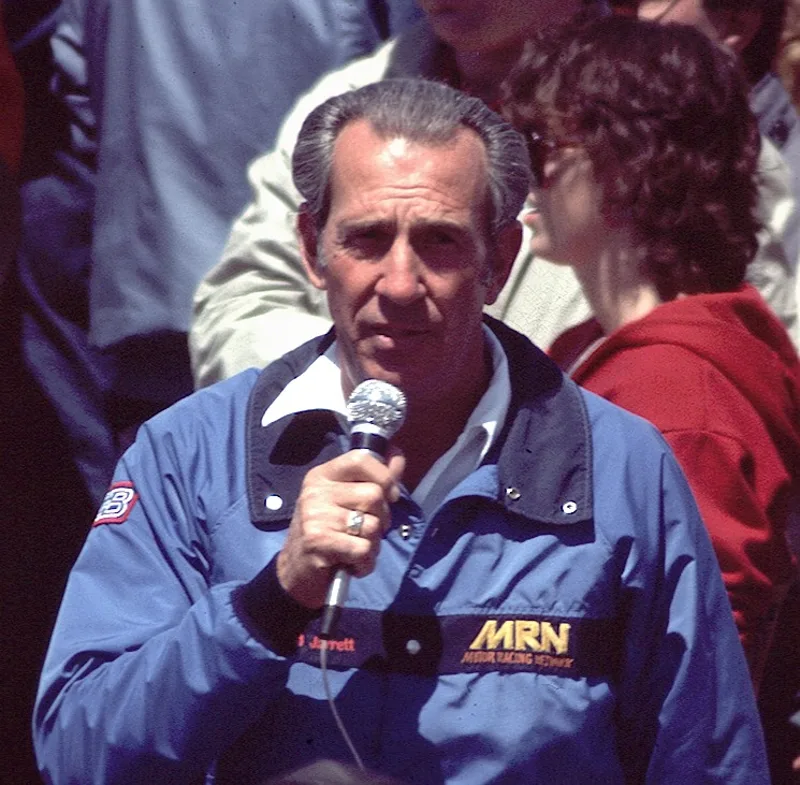
Kenley Dean Squier was born on 10 April 1935 and died on 15 November 2023 in Stowe, Vermont, aged 88. From 1979 to 1997 he was the lap-by-lap commentator for NASCAR on CBS, and from 1983 to 1999 he did the same for TBS. He was the first announcer to give lap-by-lap commentary of the Daytona 500, in 1979. He coined the phrase The Great American Race for the event and helped introduce the Australian-developed in-car camera at the 1982 running.
His route began in Vermont radio. His father Lloyd owned WDEV in Waterbury, and Ken started on air at 12. At 14 he called his first stock car race from the bed of an old logging truck, at a small dirt track. In 1960 he opened Thunder Road International SpeedBowl, a quarter-mile oval in Barre. In 1970 he co-founded the Motor Racing Network with Bill France Sr.
The 1979 Daytona 500
In 1971 he reported from the pits for ABC's first live flag-to-flag broadcast, the Greenville 200, and he moved to CBS Sports a year later. Getting a full race on national television was, in his words, a tough sell, because many people regarded it as a novelty that would not work. On 18 February 1979 CBS aired the Daytona 500 flag to flag. Richard Petty won, but the headlines went to a fight between Donnie Allison and Cale Yarborough.
Across the next two decades NASCAR's rights moved between several networks, and Squier worked for CBS and TBS. He stepped down as lap-by-lap announcer for CBS in 1997, replaced by Mike Joy, having called every Daytona 500 since 1979. He stayed as lead commentator at TBS until 1999, when Allen Bestwick replaced him, and was studio host for both networks until 2000.
On 13 July 2014 he signed off NASCAR on TNT at New Hampshire, ending a 32-year run for Turner Sports. In September 2015 he came back for a throwback Southern 500 weekend with Ned Jarrett and Dale Jarrett, and the trio repeated it in 2016 and 2017.
How Ken Squier sounded
Squier's style ran to grand words and colourful metaphors. He liked to describe NASCAR drivers of his era as common men doing uncommon things. Wrecks went side over side, end over end, and wrecked cars were all torn up. A big pack of cars looked like an Oklahoma land rush, and drivers racing together ran door handle to door handle or knuckle to knuckle.
He could also swing between radio and television styles. When the video feed failed with a few laps left at the 1981 Talladega 500, he described Ron Bouchard's upset win in words alone, likening three cars out of the tri-oval to a squadron of P-51s from the Second World War.
Away from NASCAR he announced CBS's occasional CART broadcasts in the 1990s, fronted its live coverage of American Formula One races in Detroit and Dallas with David Hobbs and Chris Economaki, and called the 1992 and 1994 Winter Olympics. He also acted, in The Cannonball Run in 1981 and Rad in 1986.
Business ran alongside broadcasting. His company World Sports Enterprises was the first television producer to specialise in motorsports, and he founded the American Canadian Tour late model series. His honours include the Smokey Yunick Award in 2003 and the NASCAR Hall of Fame class of 2018.
Ken Squier was the first announcer to give lap-by-lap commentary of the Daytona 500.
Murray Walker: the BBC and ITV voice of Formula One
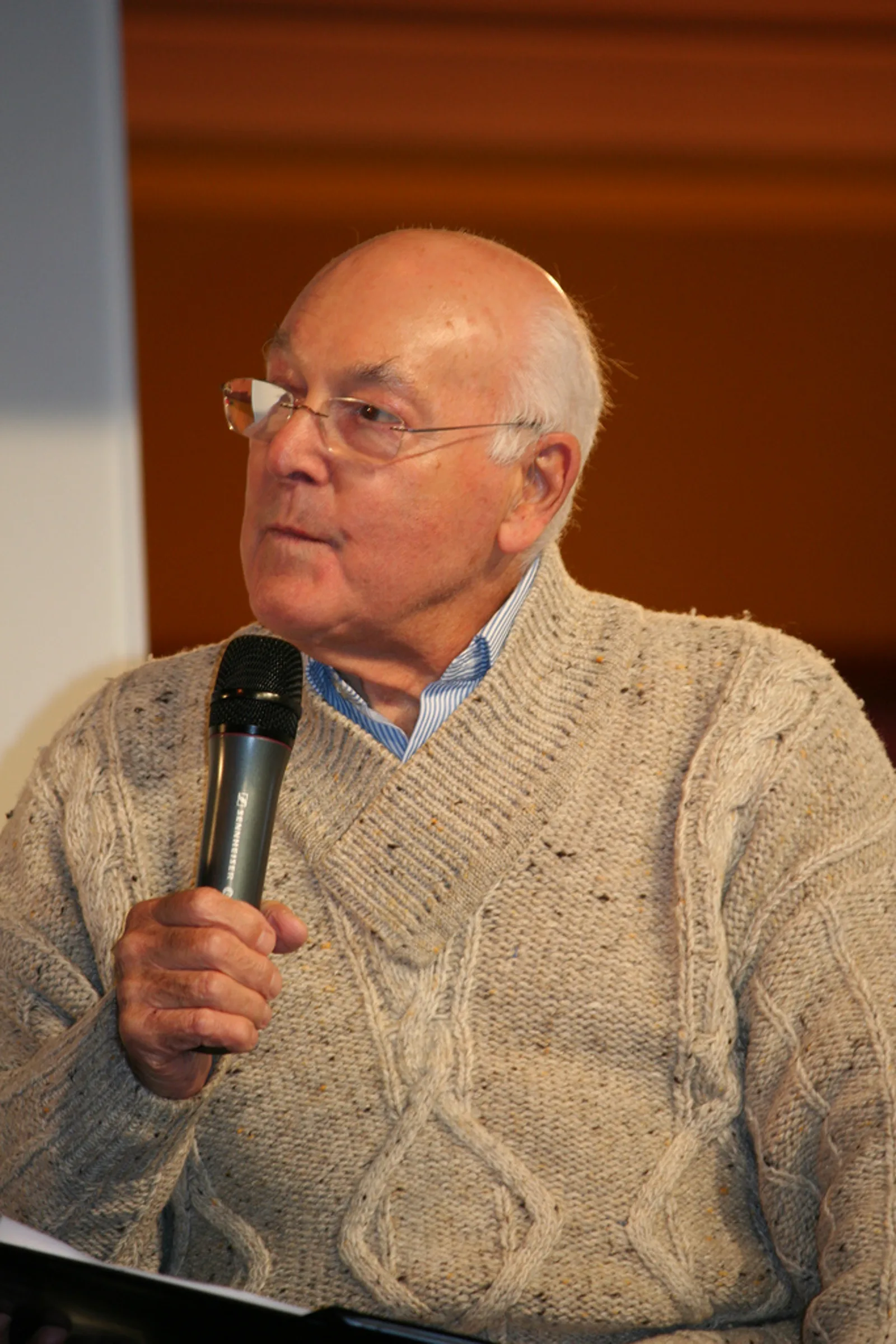
Graeme Murray Walker was born in Birmingham on 10 October 1923 and died on 13 March 2021. He gave live television commentary on Formula One for the BBC from 1976 to 1996 and for ITV from 1997 to 2001. Over a 23-year run as full-time commentator he became known for animated enthusiasm, an authoritative voice and a string of blunders that fans labelled Murrayisms. One description likened his voice to a 500cc engine being revved.
His father Graham was a works motorcyclist for Norton who rode in the Isle of Man TT. Murray was commissioned into the Royal Scots Greys on 16 April 1944, with General Dwight D. Eisenhower taking the salute, and commanded a Sherman tank in the Battle of the Reichswald before leaving the Army in 1946 as a captain. A brief spell of motorcycle racing against a young John Surtees gave way to trials, where he won gold at the International Six Days Trial. Then came advertising, at Dunlop, Aspro, McCann Erickson and the Masius agency, and he wrote the Opal Fruits slogan. He is credited with naming the late-1960s Vauxhall Ventora, and did not leave the business until 1982.
From Shelsley Walsh to full-time Formula One
Walker made his first public broadcast at the Shelsley Walsh hillclimb in 1948 and had a recorded audition for the BBC at Goodwood on Easter Monday 1949. His first radio broadcast was that year's British Grand Prix, where he and the tennis commentator Max Robertson worked from Stowe corner. Regular work came on radio coverage of the Isle of Man TT beside his father, the BBC's only father-and-son commentary pair from 1949 to 1962. When his father died, Walker took over as chief motorcycling commentator.
He did occasional Formula One commentary in the 1970s before going full time for the 1978 season. Elsewhere he covered the 24 Hours of Le Mans in 1967, rallycross, the British Touring Car Championship for the BBC (1969 to 1971 and 1988 to 1997), the Macau Grand Prix nine times for Hong Kong television, and the Bathurst 1000 for Channel 7 in 1997 and 1998.
Walker and Hunt, Palmer and Brundle
From the 1980 Monaco Grand Prix to the 1993 Canadian Grand Prix, Walker formed a successful double act with 1976 World Champion James Hunt. At first they did not get on, since Hunt's personality and private life seemed to have little in common with Walker's, but they became good friends. Walker supplied the animated commentary and Hunt the expertise, with pit lane information often drawn from his old team McLaren and a good dose of opinion.
They had to share one microphone. In the early days, when Walker refused repeated requests to hand it over, Hunt stood and snatched it, and the normally cool Walker grabbed the former champion by the collar and raised a fist before a producer stepped in. Hunt died of a heart attack two days after the 1993 Canadian Grand Prix, aged 45.
Former driver and pit lane reporter Jonathan Palmer then joined Walker until the end of 1996. When the UK television rights moved to ITV, Walker followed, and from 1997 until retirement his partner was another former driver, Martin Brundle.
Retirement and honours
The end came in stages. Walker broke his hip at the 2000 Goodwood Festival of Speed, and pit lane reporter James Allen covered the French Grand Prix in his place. At the 2000 German Grand Prix he said that Rubens Barrichello had crashed when it was his Ferrari teammate Michael Schumacher. The Daily Mail criticised his frequent errors the next day, and Walker told ITV's head of sport, Brian Barwick, that he would retire. Barwick suggested one more season to wind down. Walker announced his retirement from Formula One commentary in December 2000, and in 2001 commentated on 12 Grands Prix, skipping Brazil, Europe, France, Germany and Japan. Bernie Ecclestone suggested he could commentate on the world feed, but he declined. His final full-time commentary was the 2001 United States Grand Prix, and track president Tony George gave him an original brick from the Brickyard.
He returned to the microphone part-time in 2005 and made occasional appearances for the BBC, Channel 4, Network 10 and Sky Sports F1. In October 2005 the BBC announced him as voice of the new Grand Prix Masters series, and in March 2006 the Honda Racing F1 Team named him its ambassador for half of the 2006 season's 18 Grands Prix. In May 2003 he navigated Colin Bond at Targa Tasmania, finishing second in class and 44th overall.
Walker was appointed OBE in 1996 and was the subject of This Is Your Life in November 1997. He won the Royal Television Society Lifetime Achievement Award in 2000 and a BAFTA Special Award in 2002, and his autobiography, Unless I'm Very Much Mistaken, appeared in late 2002.
Bob Jenkins: the Voice of the Indianapolis 500
Robert Francis Jenkins was born on 4 September 1947 in Richmond, Indiana, and died on 9 August 2021, aged 73. He was an American television and radio announcer, primarily calling IndyCar and NASCAR for ESPN and ABC and later Versus and NBCSN. He spoke as the radio Voice of the Indianapolis 500 for the IMS Radio Network between 1990 and 1998, and then in the same role on ABC television from 1999 to 2001.
A music fan who wanted to be a disc jockey, he found work as a radio news reporter instead. His friend Paul Page of WIBC invited him to work as a pit reporter at Indy car races on radio and television.
Bob Jenkins at ESPN and ABC
Jenkins was one of ESPN's first anchors when it launched in 1979, and he stayed until 2003. Despite his seniority he rarely visited the Bristol, Connecticut studios, working almost always at the track. His main duty was anchoring NASCAR on ESPN from 1979 to 2000, first beside Larry Nuber and later with Ned Jarrett and Benny Parsons, a trio regarded as one of the most popular announcing crews in the sport. The crew, without Jarrett, who was under contract to CBS, also covered the Brickyard 400 on ABC from 1994 to 2000.
He also called CART, IMSA, Formula One and drag racing for the two networks, and hosted the weekly magazine show SpeedWeek. On radio he worked the IMS Radio Network from 1979 to 1998.
ESPN and ABC lost NASCAR after the 2000 season, and the split between the IRL and CART reshaped the booths. Jenkins became chief announcer for IRL and Indianapolis 500 broadcasts, until Page's return in 2002 moved him to a host role in a crowded booth. In 2003, during closing minutes of Bump Day coverage, he made an impassioned defence of the Indianapolis 500 against critics who mocked the race for struggling to fill the field. At the end of that season ABC and ESPN released him.
Later years at Indianapolis
Jenkins joined the Indianapolis Motor Speedway staff as public address announcer and emcee, and in 2008 filled in for Marty Reid in the ESPN booth for a pair of IndyCar events, at Edmonton and the Gold Coast. In 2009 the IndyCar Series began a new contract with Versus, which signed him as chief announcer, his first full-time Indy car work since 2001. NBC Sports Group bought Versus in 2011, turning it into NBCSN, and kept him as lead IndyCar announcer.
He announced in 2012 that he would retire at the end of the season to care for his wife Pam, who died shortly after. In 2013 he worked the public address system at the Speedway and returned once to NBCSN on Carb Day, when Leigh Diffey was away covering the Monaco Grand Prix. He entered the Indianapolis Motor Speedway Hall of Fame in 2019.
His voice reached beyond racing. Days of Thunder used the real ESPN crew of the time as its announcers, so Jenkins voiced several scenes, and he played the Speed anchor in Talladega Nights in 2005. He also appears in the EA Sports NASCAR games from NASCAR 98 to NASCAR 2001. He attended every Indianapolis 500 from 1960 to 2021 except two, in 1961 and 1965.
Leigh Diffey: from Queensland to NBC
Leigh Diffey, born on 3 March 1971, is an Australian-American commentator who became lead play-by-play announcer for much of NBC Sports' motorsport coverage. He took American citizenship in 2011. He grew up in Queensland and briefly raced motorcycles with his friend Daryl Beattie, later a professional rider. While teaching physical education at Ipswich Grammar School he started broadcasting, calling Ipswich Motorcycle Club races at Tivoli Raceway in 1990, aged 19. He left teaching in 1995.
Network Ten, the BBC and Speed
After two years on Network Ten's Super Touring broadcasts, he became V8 Supercars lead announcer in 1997, alongside Greg Rust and the former motorcycle champion Barry Sheene among others. He also called the 12 Hours of Sebring for ten years. In 2000 he moved to the UK as lead commentator for the Superbike World Championship and presented the World Rally Championship for the BBC beside Steve Parrish and Suzi Perry.
He covered CART in the US in 2001 while still at the BBC and moved to Speed Channel full time in 2003. There he called the American Le Mans Series, Rolex Sports Car Series and Trans-Am, filled in for Bob Varsha on Formula One and worked the 24 Hours of Daytona and the 24 Hours of Le Mans. For Network Ten he also hosted the nightly Sports Tonight. In 2011 alone he covered sixteen divisions of motorsport on Speed.
Formula One, IndyCar and NASCAR on NBC
In November 2012 NBC Sports announced that Diffey would be play-by-play announcer for both Formula One and IndyCar from 2013, with David Hobbs and Steve Matchett as Formula One analysts. On two days he covered both series: after the Belgian Grand Prix on 23 August 2015, called from Stamford, Connecticut, he flew to Pocono for the ABC Supply 500, and in September 2017 he paired the Italian Grand Prix with Watkins Glen. His open-wheel focus narrowed to IndyCar in 2018, when US Formula One rights went to ESPN, which chose to use Sky Sports commentary.
His NASCAR play-by-play debut came on 15 August 2015 at the Xfinity Series race at Mid-Ohio. He led NBCSN's Hot Pass coverage of the championship race at Homestead-Miami with Dale Jarrett in 2015, with Parker Kligerman in 2016 and again with Jarrett from 2017 to 2019. In August 2017 he led NBC's Cup Series coverage for two races while Rick Allen was in London. On 13 March 2024 it was reported that he would replace Allen in the Cup Series booth, and NBC confirmed this on 20 August, with the Coke Zero Sugar 400 at Daytona as his first race. Kevin Lee filled in for him in the IndyCar booth.
He returned to sports cars in 2019 as lead announcer for IMSA's WeatherTech SportsCar Championship, starting with the 24 Hours of Daytona. He began calling AMA Supercross in 2020 and took the lead role in 2021 beside Ricky Carmichael, Daniel Blair and Will Christien. Earlier he called Red Bull Global Rallycross until its final round in 2017, and did the Dakar Rally highlights for NBCSN.
Olympics and the Paris slip
Diffey covered luge, skeleton and bobsled at the 2014 Sochi Games and rowing at the 2016 Rio Games. In 2021 he took over as NBC's track and field commentator for the US Olympic trials and the Tokyo Games. At the 2024 Paris Olympics he called the men's 100 metres final wrongly, declaring Jamaica's Kishane Thompson the winner when a photo finish gave the gold to American Noah Lyles. He took responsibility the following day. He also appears in the film F1 (2025), commentating on its opening scene at the 24 Hours of Daytona.
Four voices at a glance
| Commentator | Lived | Home series | Key years |
|---|---|---|---|
| Murray Walker | 1923 to 2021 | Formula One on the BBC and ITV | BBC 1976 to 1996, ITV 1997 to 2001 |
| Ken Squier | 1935 to 2023 | NASCAR on CBS and TBS | CBS 1979 to 1997, TBS 1983 to 1999 |
| Bob Jenkins | 1947 to 2021 | NASCAR and IndyCar on ESPN, ABC and NBCSN | Indianapolis 500 chief announcer 1990 to 2001 |
| Leigh Diffey | Born 1971 | Formula One, IndyCar, NASCAR and IMSA on NBC | NBC from 2013 |