From Virginia's $10 premium to Abu Dhabi's record plate, the way each country builds its registration system sets the price and the rules.
A personalised number plate is a registration plate where the owner pays for a chosen combination. Governments sell them: Virginia charges $10 extra, Norway 9000 kroner and the UK has sold more than 4.2 million since 1989. The ordinary plate rules and banned-word lists limit what can be chosen.
A single plate, the number one from Abu Dhabi, fetched 52.2 million Dirhams (US$14 million), which is the record. At the other end of the scale, Virginia charges only $10 more than for a standard plate, and Britain's licensing agency sold more than 4.2 million of them in the first 25 years. Price and wording both follow from how a country builds its plate system.
What is a vanity plate?
A vanity plate is a vehicle registration plate where the owner pays extra to choose the numbers or letters. The choice usually forms a recognisable phrase, slogan or abbreviation. In North America the sales regularly bring provincial and state licensing agencies serious money. British Columbia gives its vanity plates a different colour scheme and design from ordinary ones.
The names change with the country. In the United Kingdom the same product is called a personalised registration, a private number plate or a cherished number plate. Some jurisdictions use the phrases "personal" or "cherished mark" in their rules on plates.
A personal plate costs what the underlying plate system lets a government charge for it.
Who is allowed to make a registration plate?
A registration plate is the metal or plastic tag a vehicle or trailer carries so that officials can identify it. Its registration identifier is a numeric or alphanumeric code that singles out the vehicle or its owner within the issuing region. In some countries the code is unique nationwide, and in others only within a state or province.
Almost everywhere, only the government decides who makes plates. Either an agency or a private firm with an express contract does the work. For a private citizen to make and fit their own would be the equivalent of forging an official document, so it is normally illegal. In a few places the government merely assigns a number and the owner finds an approved supplier. Custom plates can also be created, provided they meet rules laid down by a national body, the DVLA in Britain being one.
Behind the number sits a national database. It links the number to details such as the colour, make and model, the age of the car, its engine, its fuel and its chassis number, plus the name and address of the registered owner or keeper.
Plate for life, or plate for the owner
Some jurisdictions fix a plate to a vehicle for its whole life. If the vehicle is destroyed or exported, the number is retired or reissued. Others follow a "plate-to-owner" policy. The seller takes the plates off when the car is sold, and the buyer must get new ones or fit plates already held. A person who sells one car and buys another can usually apply to move the old plates onto the new vehicle.
How common are vanity plates in North America?
All US states and the District of Columbia issue them, and the only Canadian province without them is Newfoundland and Labrador. A 2007 survey, the first of its kind across the continent, came from the American Association of Motor Vehicle Administrators (AAMVA) working with Stefan Lonce, who wrote License to Roam. It counted 9.7 million vehicles with personalised vanity plates.
Jurisdictions were ranked by a "penetration rate", meaning the share of registered vehicles wearing vanity plates.
| Jurisdiction | Share of vehicles with vanity plates |
|---|---|
| Virginia | 16.19% |
| New Hampshire | 13.99% |
| Illinois | 13.41% |
| Nevada | 12.73% |
| Ontario | 4.59% |
| Saskatchewan | 2.69% |
| British Columbia | 0.59% |
| Texas | 0.5% |
Price explains part of the gap. Virginia's high rate was put down to its low yearly premium: a Virginia driver pays $10 over the standard rate, while the premium is $50 in Maryland and Texas and $100 in Washington, D.C. Across the whole country, according to the Federal Highway Administration's 2005 count of 242,991,747 registered vehicles, 3.83% of eligible US vehicles carry vanity plates. In Canada, using Statistics Canada's 2006 figure of 14,980,046 registered vehicles across the issuing provinces and territories, the share is 2.94%.
Beyond Ontario and Saskatchewan, the rest of the Canadian top five was Manitoba at 1.96%, the Yukon at 1.79% and the Northwest Territories at 1.75%. In the US, Montana followed Nevada at 9.8%, and Vermont, North Dakota, New Jersey, Connecticut and Maine rounded out the leading ten.
What can you not put on a plate?
Every US state and Canadian province that issues vanity plates keeps a "blue list" of banned words, phrases and letter or number combinations. New York, for instance, turns down FDNY, NYPD and GOD, among other strings. The aim is frequently to avoid mix-ups with government vehicles and other plate classes.
The list is not definitive. The agent handling an application can reject a plate considered offensive even when it matches no banned word exactly, and a state motor vehicle department can revoke a plate it previously approved. Authorities do not have unlimited discretion, though: some US motorists have successfully sued their state governments under the First Amendment.
The blue list may also miss accidents created by design. Florida's famous A55 RGY plate, with the orange illustration set between its characters, reads as a rude phrase once the graphic is taken for a space.
How does Britain sell personalised registrations?
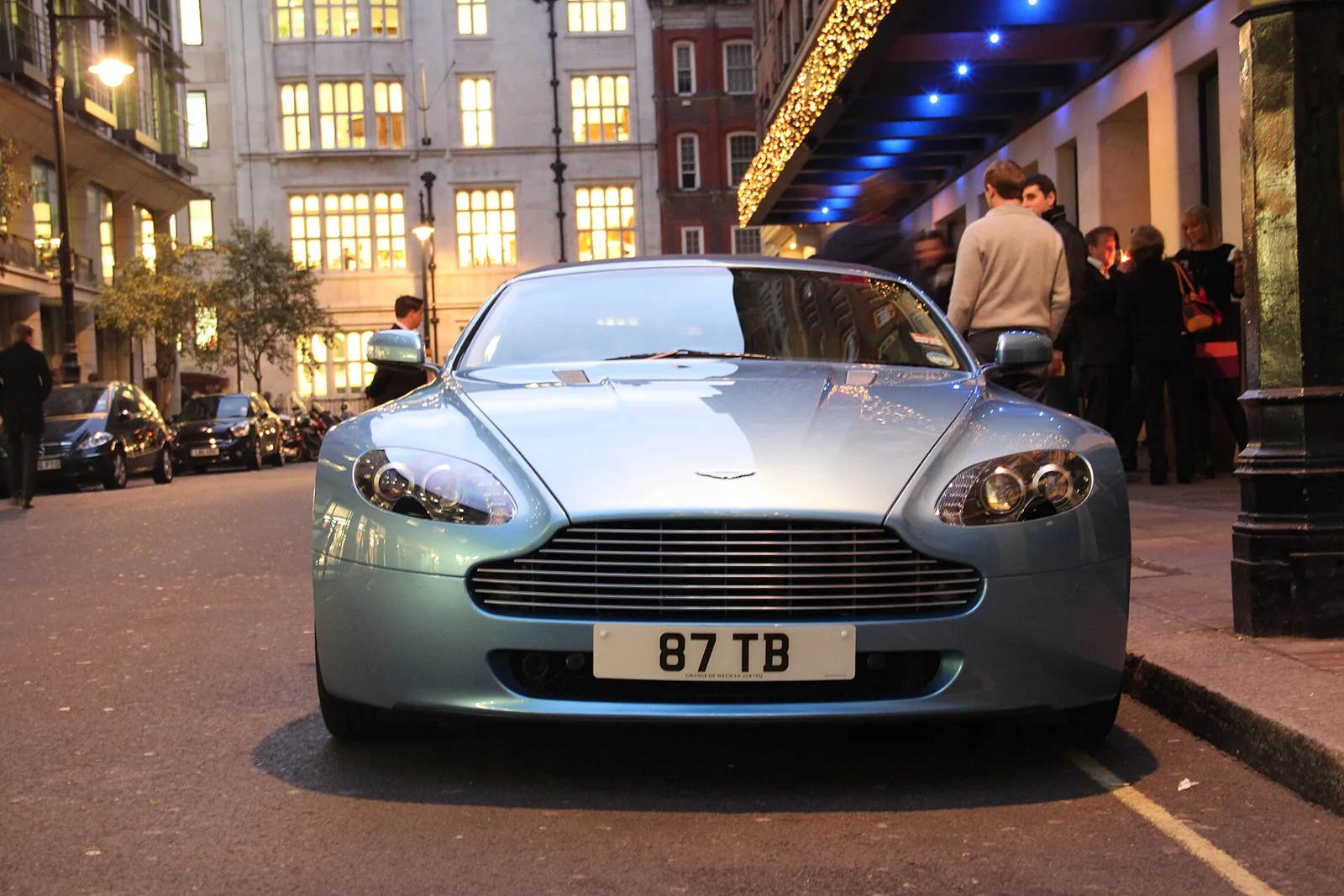
The Driver and Vehicle Licensing Agency (DVLA) issues UK plates. It will not approve a personalised registration containing words that are offensive in any widely used language, although PEN 15 slipped through. More recently it has released a growing number of formerly banned combinations, such as SEX and DAM. Every UK plate must follow a very strict letter and number pattern.
A trade in the numbers began with private dealers who spotted demand. The DVLA joined in during 1989, selling registrations that bore no relation to local registration districts. During the first 25 years of that initiative it sold more than 4.2 million and raised over 2 billion pounds for the UK Treasury.
Moving a number between cars
Numbers can change hands or pass between vehicles, within limits. A DVLA retention document can also hold one, which suits dealers or an owner between vehicles. Only the registered owner or keeper can be awarded the V778 Retention Document through an online application. The postal V317 form allows the number to be kept in someone else's name, as the new Grantee, on the V778, so the seller can pass the plate to the person receiving it. The agent brokering the sale commonly takes care of it all.
The screws that break the law
Some owners bend the rules to say more than the pattern allows. They use numbers that look like letters, such as 5 for S, or large black, yellow or white screw heads to close a gap or create one, for example in the middle of an H so that it reads as two 1s. Font style, size and spacing are fixed by law, which makes the trick illegal. Every new plate is set in the Charles Wright 2001 cut of the Mandatory typeface, which arrived in September 2001.
How do other countries handle personalised plates?
In Australia the individual states run their own schemes, and some charge a yearly fee to keep a cherished number. Victoria and Queensland put the money from custom plates into road safety work. As of 2022 a long list of other countries also allowed such plates, including Austria, Belgium, Croatia, Denmark, Finland, Hong Kong, Norway, Poland, Sweden and South Africa. Turkey lets drivers pay to add a blue section showing personalised text, though that section is not part of the plate number.
| Country | How it works | Price or detail |
|---|---|---|
| Norway | Online application from 15 June 2017, approved by an employee | 9000 Norwegian kroner (about US$1058) |
| Czech Republic | Request plates since January 2016, 8 characters on a car plate | CZK 5000 for one plate, CZK 10000 for the pair |
| Germany | Two letters after the district code and up to four numbers | A small fee |
| Poland | District letter, one number, up to five free letters | An extra charge |
| United Arab Emirates | Distinguished plates sold at public auction | Record 52.2 million Dirhams, with profits going to charity |
| Netherlands | Not allowed; plates are linked to cars, not owners | Proposed in 2007 and again in 2024 |
Germany's law does not allow free choice, but owners commonly register their initials and a year that matters to them. A Berliner called Jonathan Walter who was born in 1966, for instance, could ask for B-JW 1966, provided nobody holds it. Japan and Brazil work in a comparable way. German law blocks letter pairs standing for National Socialist organisations: SS, SA and HJ.
Reports say demand in Norway brought the Public Roads website down within minutes of the launch. If the applicant does not pay in time, the application is denied and the combination goes back into the pool for others to reserve. In the Czech Republic a preliminary reservation costs CZK 500 for up to three months, and a lost plate cannot be duplicated. In Dubai, the car of its ruler, Sheikh Mohammed, carries plate number one.
How does the underlying plate system limit what you can type?
The rules of the ordinary system leave their mark on every personalised plate. Czech request plates cannot contain G, O, Q or W, they must hold at least one digit, and they may not carry vulgar or defamatory expressions or the names of authority offices. Dutch plates leave out vowels, precisely so that a plate cannot spell a word by accident. Paul de Krom, the Member of Parliament who proposed vanity plates on 19 November 2007 after seeing them in the United States, faced that barrier, along with the fact that the RDW links plates to cars and not to their owners.
Length matters too. Virginia allows up to 7.5 characters on a standard plate, counting a space or hyphen as half a character, but only 6 on many optional plates. New Jersey's ordinary plates carry six alphanumeric characters, yet its drivers can order vanity plates with seven. Czech request plates have 8 characters, in a 3+5 split, against 7 for a standard car plate, and 7 against 6 on motorcycles.
Why O and 0 cause trouble
Plates that mix letters and digits freely run into trouble with the letter O and the digit 0. Someone copying the plate down may not know which symbol is which, so the owner of EM6F9VO could be blamed for something done by the owner of EM6F9V0. The pairs I and 1 are risky to a lesser degree.
Shapes, sizes and typefaces
Plate dimensions were standardised in 1957, when manufacturers agreed with governments and international standards bodies. Four basic sizes dominate worldwide: 520 by 110 mm (20.5 by 4.3 inches) in most of Europe, 400 by 130 mm (15.7 by 5.1 inches) in the Mercosur countries, 300 by 150 mm (11.8 by 5.9 inches) across most of North and Central America, and 372 by 135 mm (14.6 by 5.3 inches) in Australia and several Pacific Rim neighbours.
A 1960 University of Illinois study recommended plates readable at about 125 feet (38 m) in daylight and a standard size of 6 by 14 inches (15 by 36 cm) across the United States, replacing 6 by 12 inches, so longer numbers would not be squeezed. From the 1920s some jurisdictions developed anti-fraud typefaces so that characters could not be repainted to look like others, and since the 1990s many have adopted FE-Schrift.
How did number plates begin?
France was first, with the Paris Police Ordinance of 14 August 1893, followed by Germany in 1896. The Netherlands introduced the first national plate, called a driving permit, in 1898, numbered in sequence from 1 until a change in 1906. Spain's first plate, PM-1, went on a Clement-Talbot on 31 October 1900 in Palma de Mallorca, and 256 vehicles were registered between 1901 and 1905.
In the United States, New York has required plates since 1903, in black on white, after asking in 1901 only that owners' initials be clearly visible on the back. Motorists at first had to make their own in most jurisdictions. Massachusetts was the first state to issue plates, also in 1903, and Idaho put the first logo on one in 1928, the Idaho Potato.
The first plates were enamelled metal or ceramic without a backing, so they broke easily. Later experiments used cardboard, leather, plastic and, in wartime shortages, copper and pressed soybeans. Most plates now are aluminium, either embossed between dies or built by riveting individual letters on.
What does this mean for someone who wants one?
The route differs by place. In some US states a motorist can check online whether a combination is free. Where an optional plate doubles as a vanity plate, the character limit can be lower than on a standard one. A plate approved today can still be revoked later if the authority decides it is offensive, and in some Australian states a yearly fee keeps a cherished number alive. In the UK, a transfer between cars goes through the DVLA retention paperwork, which a Cherished Number Agent usually handles.
What is changing for personalised plates?
The Netherlands remains the clearest open question: after the 2007 proposal, the PVV put forward vanity plates again on 25 January 2024. Technology is shifting too. Michigan legalised electronic plates in 2018 through Public Act 656, and the DVLA has lately been releasing more of its previously banned combinations.