A technique designed to stop police cars crashing now sits behind a 90-minute civilian test with a pass rate of around 75% and no expiry date.
Roadcraft is the UK police driving handbook, and IAM RoadSmart is a charity that teaches its techniques to civilians. Associates train with volunteer observers, then take a roughly 90-minute test with a police-qualified examiner. About 75% pass, and a pass never expires.
Pass the IAM advanced driving test once and you are an advanced driver for life. There is no re-test, even if the government later suspends your licence, though relevant motoring convictions have to be declared when membership is renewed each year. A rival award from RoSPA asks for a fresh test every three years.
The test is run by a British charity, IAM RoadSmart, and its techniques come from the handbook the police use to train drivers. A system built in 1937 to stop pursuit cars crashing has become a civilian course that around 400,000 people have attempted.
What is Roadcraft, the police driving handbook?
Roadcraft: The Police Driving Manual is a book from the UK Police Foundation, and it has a two-wheeled sibling, Motorcycle Roadcraft: The Police Rider's Handbook. Between them they supply the techniques that the IAM's advanced driving and riding tests are built on.
Behind the books sits a method of car and motorcycle control used by British police. The racing driver Mark Everard Pepys, the 6th Earl of Cottenham, devised it in 1937 with a single aim: fewer crashes when police cars gave chase. The charity that now teaches the method to civilians sets out to lift standards of driving and riding and to make the roads safer.
Pass once and you are an advanced driver for life.
What is IAM RoadSmart?
IAM RoadSmart is the trading name of the Institute of Advanced Motorists Limited, a British charity. It dates from March 1956, when it was incorporated as a company limited by guarantee. There are no shareholders, and it is registered as a charity in England, Scotland and Wales. Its stated purpose is to raise driving standards and promote road safety for the public benefit, chiefly through an advanced driving test.
Membership stands above 77,000, and every one of those members has passed an advanced test, whether in a car, a commercial vehicle or on a motorcycle. The charity lists three aims: fewer deaths and serious injuries on the road, a higher standard of driving, and administration of the test itself.
How the name and the organisation changed
In 2006 the charity took over the AA Motoring Trust's work; the Automobile Association had founded that body four years earlier. A modernisation programme followed in 2015, and on 4 April 2016 every activity was gathered under the single IAM RoadSmart banner, with no change to its charitable status. The old title had been judged unappealing to younger drivers by market research, which prompted the rebrand.
Demand created a bottleneck: by 2011, shortening the wait for the advanced test had become a priority. A commercial arm supplies risk management products and services to firms whose staff drive for work. Cycling is a side story. The IAM published a book on being a better cyclist in 2010 but no longer trains cyclists; Bikeability fills that role. The cycling book was the third in an IAM series, following titles for drivers and for riders. A separate Institute of Advanced Motorcyclists was registered in 2006, though it rarely appears in IAM publications.
How does an advanced driving course work?
Delivery is through local groups. A head office in Welwyn Garden City oversees around 180 groups across the UK, with further groups in Australia, Bermuda, Hong Kong and Cyprus, as well as Kenya, New Zealand, Portugal and Turkey. Each group is largely independent, deciding its own fees, meeting days and venues. Some welcome every kind of vehicle; others are for cars or motorcycles alone.
Trainees are known as associates and their instructors as observers. Observers are volunteers drawn from the local group, and lessons are fixed at times that suit both people. The IAM says six lessons may be enough to get through the test, but the time needed varies and nobody sets a ceiling. Associates read a textbook, How to be a Better Driver, which boils down the police manual. Some people criticise it for being too simple.
Nobody pays observers for their time, although motorcycle associates may cover the cost of fuel, since each rider uses their own bike. The charity trains its observers internally and an outside body accredits them. Uneven quality was a recognised complaint, and in 2013 and 2014 the charity moved to strengthen observer training and to have the IMI accredit observers externally. A number of observers are career instructors, and some hold the RoSPA Diploma in Advanced Instruction; each group has senior instructors called National Observers.
The driver stays responsible for the legal side, including licence, insurance and vehicle inspection. Motorcycle observers are told to confirm that their cover extends to this activity, because they ride their own machine.
What happens in the advanced driving test?
The drive takes about 90 minutes and covers roughly 48 to 64 km (30 to 40 miles). The route mixes city and country roads with motorway or dual carriageway sections, giving the candidate a spread of conditions and hazards. An examiner who is a serving or retired police officer, holding either a Police Advanced Driving Certificate or the Home Office's Police Driving Instructor Certificate, sits alongside.
The atmosphere is gentler than the standard test run by the DVSA, because the result has no effect on the driver's licence. Nothing is at stake beyond pride and the fee, which suits people who want honest feedback on habits formed over years. What the candidate takes away is an assessment, advice and pointers from someone with a police pursuit background. Outcomes are fail, pass or F1RST. The test can be taken again as often as wanted, and people who pass sometimes return to chase the top grade.
Tougher than the ordinary driving test, but achievable for most drivers who get decent coaching: that is how the charity pitches it. People enter for better skills, for safety, or just for the fun of it. The test stands apart from the licensing system of the associate's own country and does not touch the licence it issued. Branded as Skills for Life, it is meant to stress prevention of deaths and sharper skills.
| Award | What it takes | Standing and re-testing |
|---|---|---|
| IAM advanced test, pass | About 90 minutes on the road with a police-qualified examiner | None; advanced driver for life |
| IAM F1RST | A pass with a score of 1 in virtually every category | None; at least the standard of RoSPA Gold |
| IAM Masters (from 2014) | One-to-one mentoring towards the highest civilian standard | Sits above the F1RST level |
| RoSPA Advanced Drivers and Riders (RoADAR) | Advanced test | Re-test every 3 years |
Who can join an advanced driving group, and what does it cost?
Anyone holding a full driving licence can become an associate. Full membership follows a pass in the advanced test, with exemptions for holders of suitable emergency services or military driving qualifications. Despite the word Advanced in the name, an associate needs only a few months behind the wheel, or one year in Northern Ireland, where newly qualified drivers face speed restrictions. Many people say joining early in a driving career paid off, since it helped them sidestep the accidents typical of new drivers.
Money goes to two places. An associate pays 149 pounds once to head office, which covers the first attempt at the test. Full membership then renews annually at 38 pounds to head office, and many local groups add around 20 pounds a year. Since groups set their own fees, that figure is typical rather than fixed, and the head office payments are the constant.
The four levels
Membership has four rungs. The entry level is a foundation that most people can reach, requiring just a basic grasp of the police method. An F1RST goes to those who pass the advanced test and score a 1 in virtually every category, a standard regarded as at least equal to a RoSPA Gold. Above that sit Masters, and Masters with distinction.
The Masters programme, launched in 2014, offers one-to-one mentoring aimed at the highest civilian driving standard in the country, as the charity puts it. Before it appeared, the RoSPA Gold and the DIAmond Special Test were seen as the top civilian driving awards in the UK.
Does advanced driver training make you safer?
Crash frequency differs between those who pass the test and those who do not, the charity says, and it cites studies in support. Researchers at Brunel University examined advanced drivers trained in the IAM system of car control and found them nearly 70% better across the board, steering and the judging of distance and speed included. The Transport Research Laboratory had earlier concluded that a measurably higher standard of driving makes a crash less likely. Research is also said to show better fuel efficiency among advanced drivers.
Insurance data is cited as well. Unpublished research by IAM Surety, the associated insurer, found that members' claims cost far less than those of comparable non-members, because members seldom had big accidents. The Association of Motor Insurers is reported to have found fewer claims for four years after a driver passes. Insurers normally allow a small premium discount for a pass, typically 10%, and the discount is usually larger through the IAM's own company. Some drivers like another point: an individual assessment lets them avoid being judged on the statistics for their age or group.
About 400,000 people have attempted the advanced test, and around 75% pass.
Does an advanced pass ever run out?
Not on the IAM side. A passed driver keeps the title for good, and a licence suspension by the authorities does not trigger a retest. The one obligation is honesty: relevant motoring convictions must be reported each year when membership is renewed. The contrast with RoADAR, the RoSPA scheme, is stark, since its drivers and riders return for a retest every three years. For people who want to keep climbing, a retake aimed at the F1RST grade, or the Masters programme, offers the next step.
Is there a check for experienced drivers?
DriveCheck and RideCheck, introduced in 2006, let a driver or rider be assessed by an IAM observer. Neither is a test, so nobody passes or fails. The IAM later added DriveCheck55, which gave people over 55 a chance to have their driving looked at and to pick up tips from a police Class 1 driver; it was later renamed the Mature Driver Review. Paddy Hopkirk, a former World Rally Championship winner, championed the assessment and became the charity's Mature Driver Ambassador.
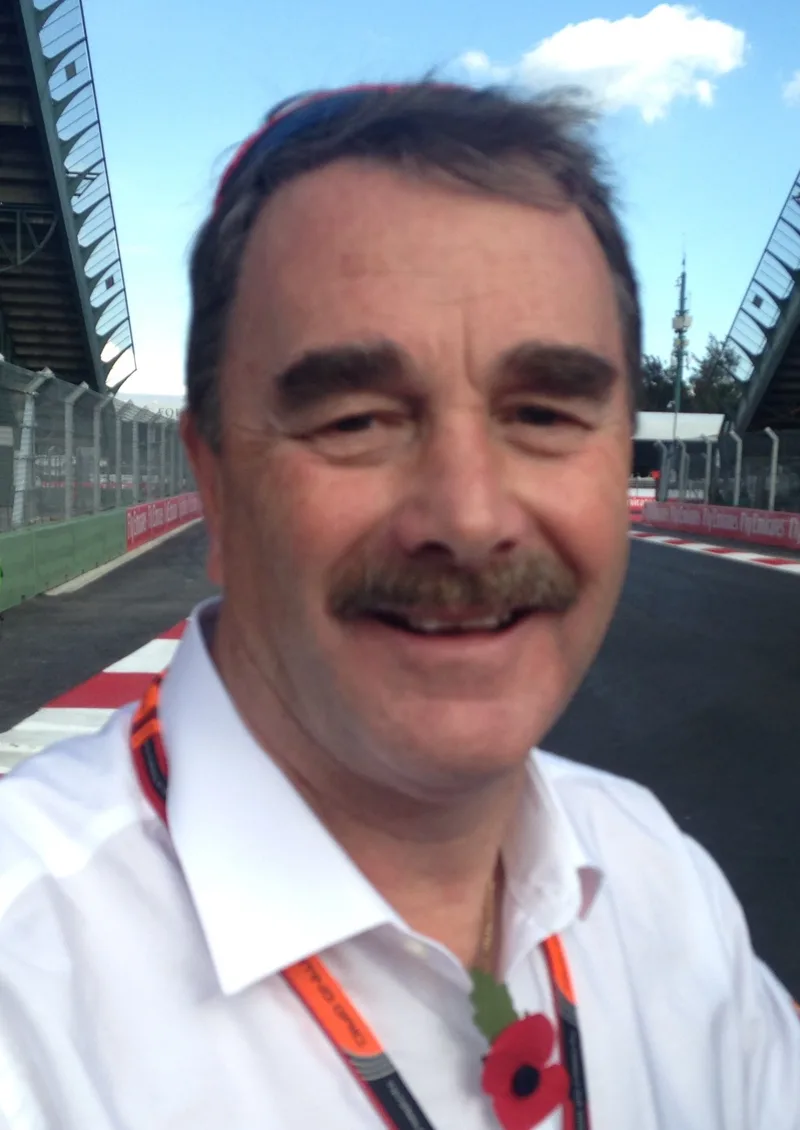
The membership list includes famous names: Nigel Mansell, president since 2006, Hopkirk, the land speed record holder Andy Green, the motorcycle racer Maria Costello, and the touring car champions John Cleland and Colin Turkington.
Where this goes next
The charity has kept adjusting to demand. The waiting list for the test became a priority in 2011, observer training was reinforced in 2013 and 2014, the Masters level arrived in 2014, a modernisation programme began in 2015, and the single IAM RoadSmart brand followed in 2016.