From Aldwych in 1925 to the Belgian town that scrapped priority to the right: the design, the safety record and the rules behind the circle.
A modern roundabout gives priority to traffic already circulating, and its curved approaches force entering drivers to slow. That cuts the likelihood and severity of collisions compared with stop signs and signals. Rules still differ: some countries add priority to the right, while others rely on yield-at-entry signs.
Carmel, Indiana, built so many roundabouts that by the mid-2010s the city held about 3% of all the modern ones in the United States, and injuries from car accidents there fell by 80% after 1996.
How does a modern roundabout work?
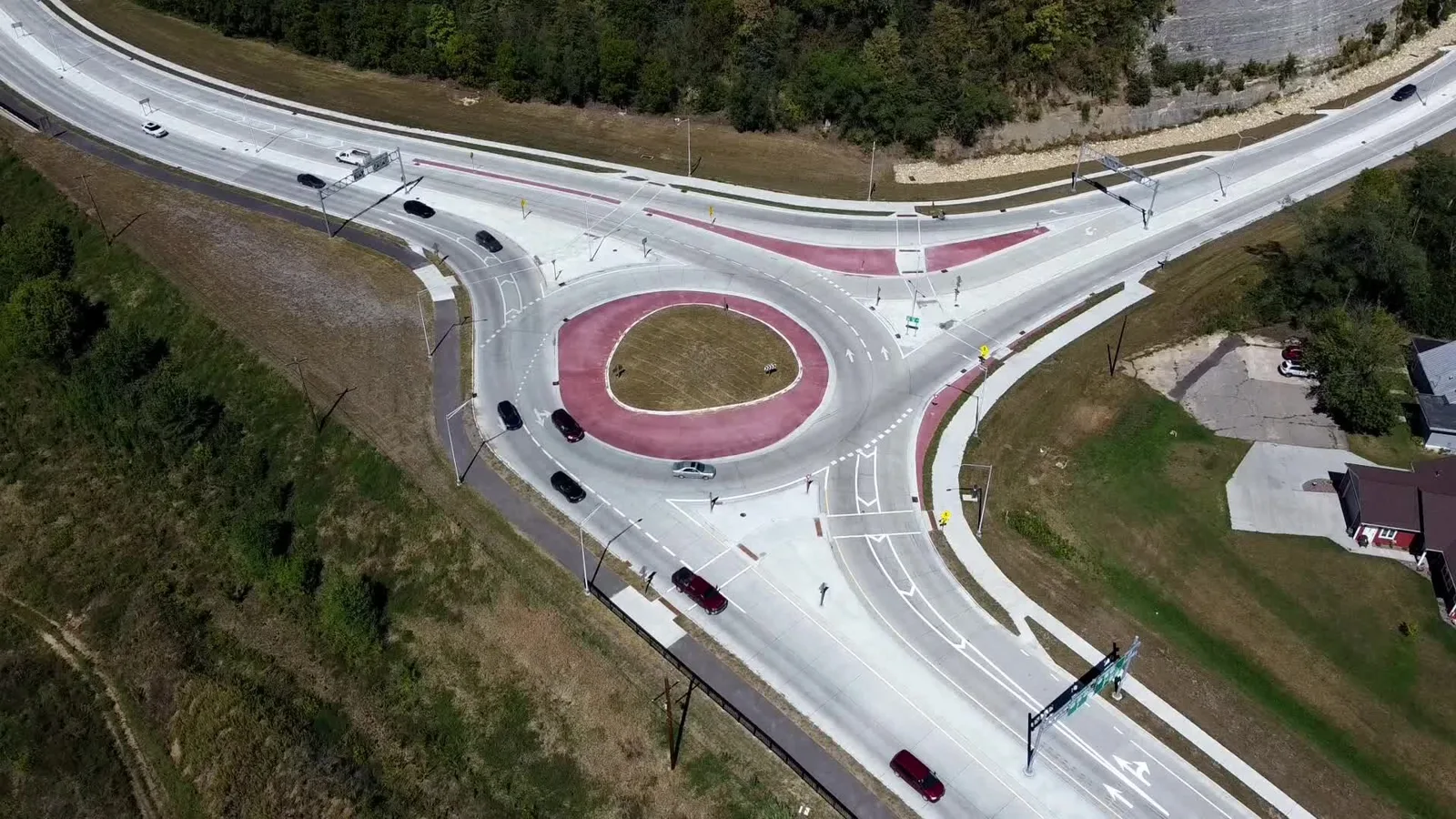
A modern roundabout is a looping junction where traffic travels one way around a central island and priority goes to vehicles already circulating. Signs tell entering drivers to slow and give way. Design does the rest: the approach is bent so that cars must turn into the direction of flow, which cuts speed before they ever reach the circle.
Two features separate it from older circular junctions. One is the priority rule, which makes joiners give way to the traffic on the circle. The other is deflection, the slight sideways kink in the approach. Roads meet the circle head-on, or radially, so a driver cannot sweep in at full tilt. Older traffic circles often did the reverse, with tangential entries built to keep vehicles moving fast.
Because entering vehicles only have to give way, they do not always stop. It also means you will rarely meet one on a controlled-access highway, where the low speeds a roundabout needs would be out of place.
Entering vehicles only have to give way, so they keep their momentum and the engine works less.
Why do roundabouts cut serious crashes?
They take away the crashes that do the most damage. Compared with stop signs and traffic signals, modern roundabouts greatly reduce both the likelihood and the severity of collisions. Deflection holds speeds down, and the layout all but removes T-bone and head-on impacts, the two types most likely to hurt someone badly.
Pedestrians gain too. A person crossing at a standard junction faces traffic from three directions, but at a roundabout the vehicles leaving the circle arrive from one. Cars are moving slowly enough for eye contact, which encourages drivers to defer. Drivers have less to puzzle over than at a perpendicular junction, and queues are shorter than behind a red light. U-turns also become part of normal flow.
The evidence from Carmel gives the idea scale. Its mayor, James Brainard, promoted roundabouts actively, and car-accident injuries in the city fell by 80% after 1996. In the Netherlands, single-lane roundabouts turned out to have even more capacity than signalled intersections, so after a cautious start in the north and east they were built in large numbers across the west. Trials in Britain in 1963 found that the priority rule alone improved traffic flow by up to 10%.
Are roundabouts better than traffic lights?
On the figures available, yes on several counts: safety, queuing, emissions and noise. Vehicles with combustion engines usually idle less at a roundabout than at a signal. Entering drivers who only need to give way keep their momentum, so the engine has less work to do getting back up to speed, and emissions fall.
Noise falls as well: research finds that traffic creeping round a roundabout is quieter than traffic forced to stop, start, speed up and brake. Signals still have a place. British roads still use them at big roundabouts carrying heavy flows, and some old American circles have been turned into signalled intersections instead. The Drum Hill Rotary in Chelmsford, Massachusetts, is now six lanes wide and run by four separate intersections.
Where did the roundabout come from?
Circular junctions came long before cars. The Circus in Bath was finished in 1768 for architectural reasons, not traffic. The Place de l'Etoile around the Arc de Triomphe in Paris dates from about 1780, Columbus Circle in Manhattan from 1905, and Letchworth Garden City had Britain's first circular junction in 1909.
The architect H.V. Lanchester put forward one-way gyratory control for London's squares and complex junctions in 1924. Aldwych got it first, on 12 October 1925, and by early 1926 it had reached Parliament Square, Trafalgar Square and Hyde Park Corner. With no priority rule, those junctions did not flow freely, and police still had to direct traffic at busy times until signals took over.
The breakthrough came from the priority rule. From about 1956 several English authorities, among them Poole, Newcastle and Swindon, began making entering vehicles give way. Official trials followed in 1963, Britain adopted the rule in 1966 with road markings requiring entering traffic to yield, and the design became mandatory for all new British roundabouts in November 1966. Engineers at the Transport Research Laboratory standardised it, and Frank Blackmore, who led that work, also invented the mini-roundabout.
Meanwhile, the old American-style rotaries went the other way. Many were large, built for high-speed merging and weaving, and entry was either unrestricted or required a stop followed by a 90-degree turn. They caused a lot of collisions, so construction of traffic circles and rotaries stopped in the 1950s and some were taken out.
Why do give-way rules differ between countries?
Because two older principles meet at the roundabout. One says the vehicle already on the circle goes first. The other, priority to the right, says a driver must give way to traffic approaching from the right, and the Vienna Convention on Road Traffic spells it out for countries that drive on the right, including at roundabouts, wherever no sign overrides it.
Priority to the right is common across most of Europe, though countries differ in how often junctions are left uncontrolled. France is the standout, applying it even at the Place de l'Etoile and on the Paris ring road. Across most American states and Canadian provinces it governs uncontrolled four-way crossings, though only for drivers who reach the junction together. Some left-hand-traffic countries use it too. Australia applies it at four-way intersections where every road has equal priority, with specific rules at T-junctions, and Singapore and New Zealand follow it as well.
The roundabout swung the balance the other way. On its national routes France made drivers yield at entry in 1983. Norway put yield signs at every roundabout entrance in 1985, and Switzerland brought in the same principle in 1987. After that, the three countries all saw their roundabouts multiply. The sign that makes it work is the yield or give way sign, an inverted triangle with a red border, the international standard set by the Vienna Convention on road signs.
How do roundabout and junction rules compare in practice?
| Place | Rule for the circle | Related priority rule |
|---|---|---|
| United Kingdom | Priority rule since 1966; entering traffic gives way, marked on the road | Signs and markings at give-way junctions under the Road Traffic Act |
| France | Yield at entry on national routes since 1983 | Priority to the right still applied in places, even at the Place de l'Etoile |
| Norway | Yield signs at all entries since 1985 | - |
| Switzerland | Yield at entry since 1987 | - |
| Australia | Give way sign with a roundabout version since the 1980s | Priority to the right at four-way junctions of equal priority |
| United States | Modern roundabout requires entering drivers to give way | Priority to the right at uncontrolled four-way junctions for simultaneous arrivals |
What does the US call a roundabout?
Several things, which is part of the confusion. American dictionaries treat roundabout, traffic circle, road circle and rotary as synonyms. Engineers disagree and stress the difference between a modern roundabout and a nonconforming traffic circle. The US Department of Transportation adopted the phrase modern roundabout for the type where entering drivers must give way.
In practice, engineers use rotary for large junctions between expressways, with high speeds inside the circle. In New England, though, rotary is the general word for every kind of roundabout, and state law there gives priority to vehicles already in the rotary. Many old traffic circles remain in the northeast. Some have been rebuilt as modern roundabouts: the former Kingston traffic circle in New York is one, and New Jersey has several.
What went wrong when priority to the right met modern traffic?
Belgium offers the most vivid data. Experts at the Flemish Automobile Association argue for abolishing priority to the right, calling it outdated, because people assume they have priority and therefore that crossing is safe. In 2017 more than 15,000 collisions occurred at such junctions across the country, 42 a day on average, close to 5% of all damage claims, according to the insurers' federation Assuralia.
Several Flemish municipalities responded in the 2010s by designating more priority roads with inverted-triangle give-way signs and stop signs. Glabbeek went furthest, scrapping every priority-to-the-right junction in December 2017. Over the first six months of 2018 only two of its nine accidents came down to ignoring a yield or stop sign. A year earlier, 18 of 22 accidents had been tied to right of way.
How fast did roundabouts spread?
| Country | Then | Later |
|---|---|---|
| Norway | 15 in 1980 | 350 in 1990; 500 in 1992 |
| Switzerland | 19 in 1980 | 220 in early 1992, with 500 more under consideration |
| Netherlands | About 400 built in six years in the late 1980s | An estimated 1,500 to 1,800 by 2001 |
| France | 1,000 built a year in 1991 | More than 30,000 in 2010 |
| United Kingdom | Mandatory design from 1966 | Around 25,000 in 2015 |
| United States | First modern roundabout in 1990 | About 3,000 by 2011; about 8,800 by 2022 |
| Canada | First modern roundabout in 1999 | About 400 by 2014 |
The American road was the hardest. Modern roundabouts arrived in the 1990s after years of campaigning by Frank Blackmore and Leif Ourston. The first was built in Summerlin, Nevada, in 1990, and residents were dismayed. The film European Vacation poked fun at American confusion over how to enter and leave one. Public resistance echoed what Britain experienced in the 1960s.
Opinion turned once people used them. A 1998 survey of municipalities found the public 68% opposed before construction and 73% in favour afterwards. A 2007 survey found support of 22% to 44% before construction and 57% to 87% several years later. Seattle, which began installing small traffic circles inside existing intersections in 1973 to calm traffic, had more than 1,200 by 2021.
What should a driver know before using one?
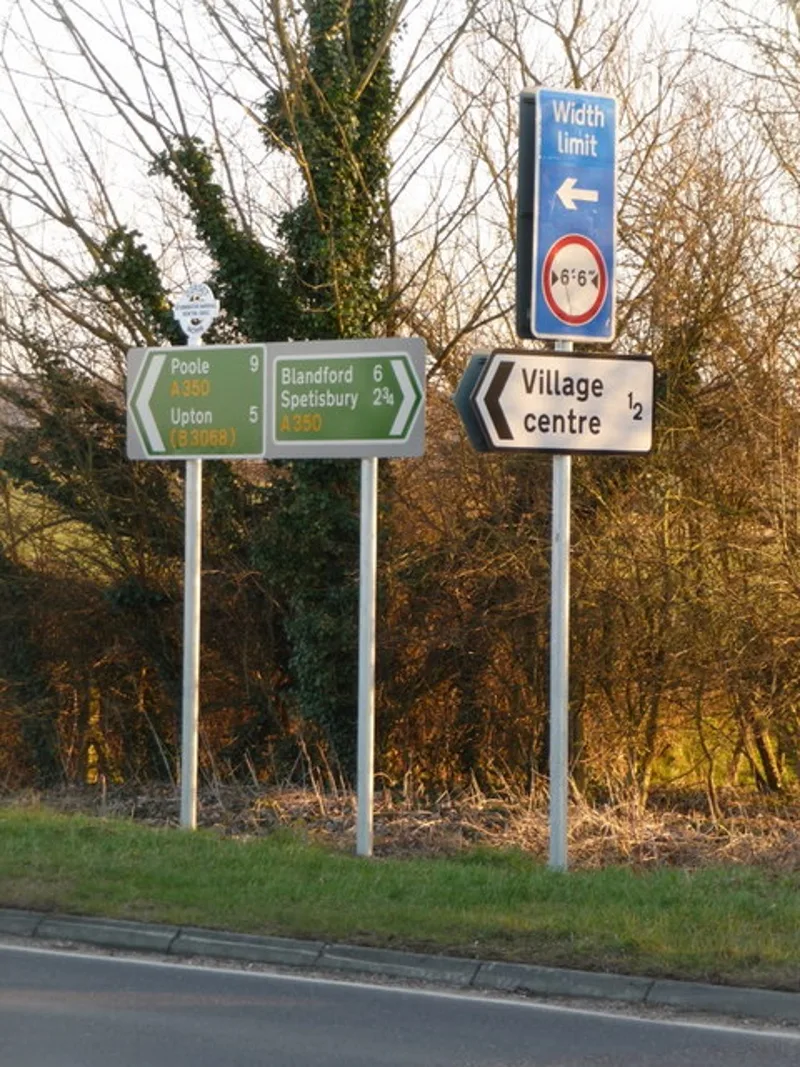
Look at the sign. In most countries it is a red-bordered inverted triangle with no text, in Britain and much of the Commonwealth it says give way, and in the United States it says yield. Latin American countries mostly use ceda el paso. The sign is a promise that the circle has priority, though in places that run priority to the right, you need to know the local rule for the junctions around the roundabout too.
Road markings reinforce the message. The British Road Traffic Act calls for a large inverted triangle painted before the point where drivers must give way, with broken white lines across the carriageway. New Zealand's give way sign is always matched on sealed roads by a white line, so the rule stays clear if the sign is hidden or missing. Australia has used a roundabout version of the give way sign since the 1980s.
The layout itself sets the pace. Entry is slow by design, and the gain for pedestrians depends on drivers leaving the circle slowly enough to make eye contact. Give way to what is already circulating, and take the exit you want.
Where this goes next
The count is still rising. Japan first met roundabouts in September 2014, with the aim of heading off serious accidents and congestion. In the United States the total went from about 3,000 in 2011 to about 8,800 in 2022, and one estimate puts it at 15,269 in July 2026. Canada reckoned one roundabout for every 90,000 people in 2014, against one for every 84,000 in the United States.