From a butchers' picnic at Amaroo in 1998 to the cancelled last meeting at Oran Park in 2010, the story of Sydney's race tracks and the one that survives at Eastern Creek.
Sydney Motorsport Park at Eastern Creek is the only one of Sydney's three big circuits still racing. Oran Park Raceway closed in January 2010 and was redeveloped as housing, while Amaroo Park shut after its last meeting on 23 August 1998. The Australian Racing Drivers Club ran Amaroo and now operates Sydney Motorsport Park.
Oran Park Raceway's final race meeting was meant to run on 23-24 January 2010, but it was cancelled for lack of entries, so a small event on 16 January quietly ended 48 years of motorsport at the track. Two of Sydney's three big circuits have now gone: Oran Park is housing, Amaroo Park shut in 1998, and Sydney Motorsport Park at Eastern Creek carries on.
What are the Sydney race tracks?
Sydney Motorsport Park, which went by Eastern Creek International Raceway until May 2012, sits on Brabham Drive, 40 km (25 mi) west of the city centre, in Eastern Creek beside the Western Sydney International Dragway. The New South Wales Government built and owns it, and the Australian Racing Drivers Club operates it. It is the survivor of the three.
Oran Park Raceway was at Narellan, south west of Sydney, and ran from February 1962 until January 2010. Amaroo Park Raceway was in Annangrove, in the north-western suburbs. The same club links two of them: the Australian Racing Drivers Club (ARDC) ran Amaroo Park from 1970, also promoted the Mount Panorama circuit at Bathurst, and later promoted Eastern Creek.
The last race at Amaroo Park was a butchers' picnic, won by a twin-turbo Porsche.
Sydney's three circuits side by side
| Circuit | Location | Opened | Closed | Length |
|---|---|---|---|---|
| Sydney Motorsport Park | Eastern Creek | 10 November 1990 | Still open | 4.500 km (2.796 mi) full layout |
| Oran Park Raceway | Narellan | February 1962 | January 2010 | 1.960 km (1.218 mi); Grand Prix circuit 2.625 km (1.631 mi) |
| Amaroo Park | Annangrove | 1967 official opening | 23 August 1998 | 1.930 km (1.199 mi) |
How did Eastern Creek become Sydney Motorsport Park?
Approval for the circuit came in 1989, but bad weather and arguments over land ownership delayed construction. A test race for Superbikes was held in July 1990, and on 10 November 1990 sports minister Bob Rowland-Smith opened it with the Nissan Sydney 500 for Group A touring cars. The consortium that funded it ran into financial trouble in 1991, and the New South Wales Government bought the complex.
Facilities include fifty garages opening onto the paddock and a covered 4,000-seat grandstand over the finish line that gives a view of most of the track. Events run most weekends, and the track is licensed for cars as well as bikes. The Gardner, Brabham and Druitt North circuits hold an FIA Grade 2 licence and the track has an FIM Class B licence, and no other permanent track in Australia holds both.
Pressure to modernise built slowly. In August 2006 Ron Dickson, who designed the Surfers Paradise street circuit and the A1 Grand Prix circuit, was reported as saying the track was behind modern standards. In April 2008 Apex Circuit Design was commissioned for a $350,000 feasibility study into hosting events as big as the Australian Formula One Grand Prix, but nothing came of it.
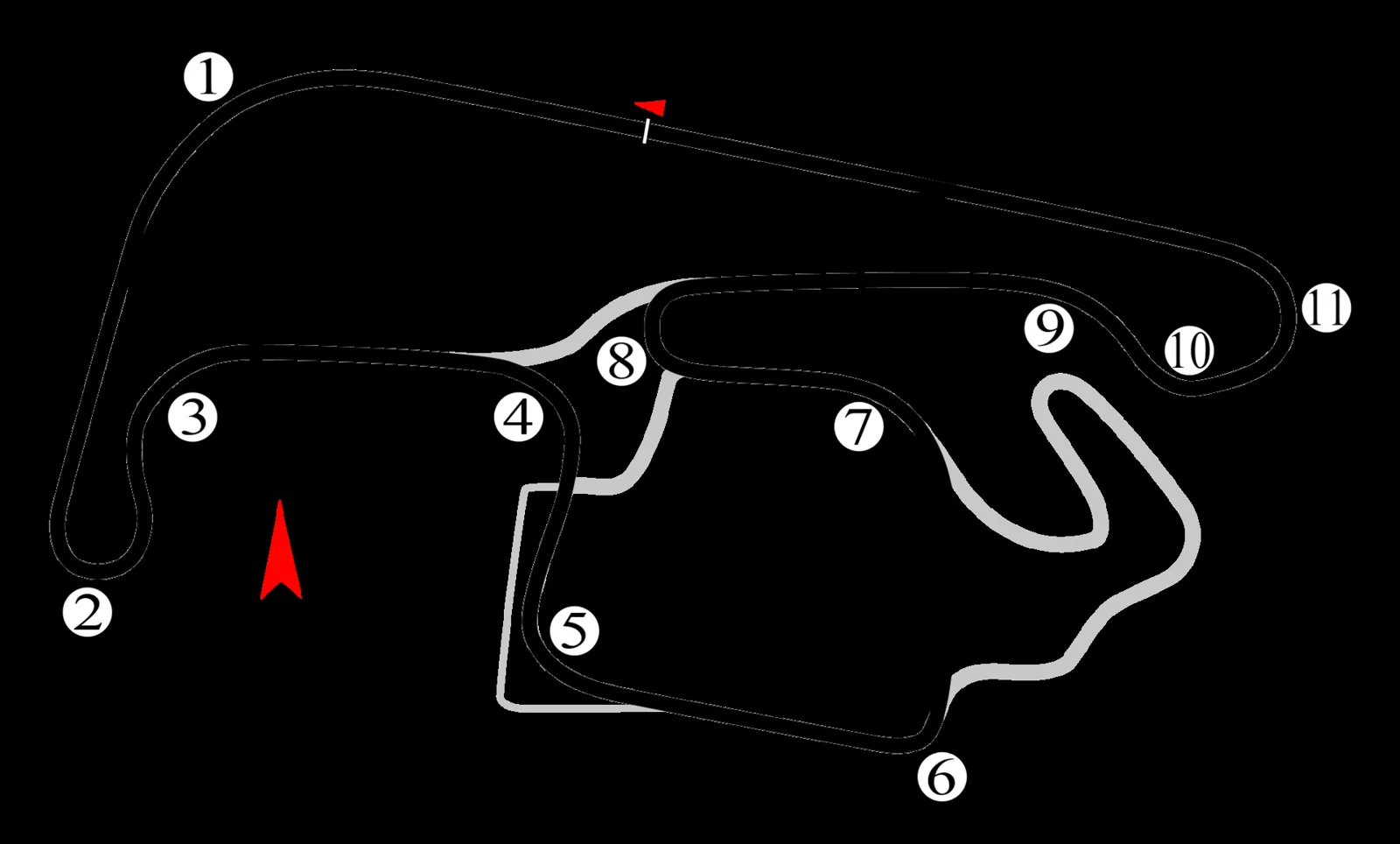
The real upgrade came in early 2011, a $9 million programme paid for with $7 million from the state government and $2 million from the ARDC. It created four layouts, two of which can run at once, with a total length of 4.500 km (2.796 mi), plus a second pit lane, a fresh control tower for racing and new amenity blocks. A link road between turns four and nine, finished in October 2011, created the Druitt Circuit, also called the North Circuit. An 830-metre extension in May 2012 added the Amaroo Circuit, or South Circuit.
The full length, adding the extension to the Gardner GP Circuit, is the Brabham Circuit, named for Sir Jack Brabham, Sydney's triple Formula One world champion and still the only man to win the title in a car bearing his own name, in 1966. On 21 May 2012 the circuit took its present name. Turn five became "Brock's 05" for Peter Brock and his number, and in October 2017 the first two corners were named Moffat Corner and Bond Bend.
What has raced at Sydney Motorsport Park?
Touring cars were first. The 1990 Nissan Sydney 500 closed out both the Australian Endurance Championship and the manufacturers' title, and Larry Perkins and Tomas Mezera won it in a Holden VL Commodore SS Group A. The circuit first held an Australian Touring Car Championship (now Supercars) round in 1992 and had one every year to 2008 except 1998 and 2006.
Marcos Ambrose won the season-ending Grand Finale here in 2003 and 2004, taking the championship each time. Eastern Creek was dropped in 2009 in favour of a Sydney 500 round at Olympic Park, came back in 2012 after the series failed to land a second international event, sat out 2013 and has been on the calendar since 2014. A pre-season test day in 2013 was the first occasion on which all four Car of the Future makes shared a public event.
Motorcycles followed a row over advertising. Once Phillip Island had staged the first Australian motorcycle Grand Prix in 1989, Victoria's government and the tobacco industry, a major sponsor of the teams, fell out. New South Wales saw its chance and in October 1990 agreed a deal to host the race from 1991 to 1993. It stayed until 1996 and went back to Phillip Island in 1997. The Australian Superbike Championship still visits, with the only night race in its calendar as of 2025.
The A1 Grand Prix stopped here from the 2005-06 season to 2007-08. On 4 February 2007 Germany's Nico Hulkenberg set the quickest lap for the original layout, 1:19.142, in the A1 Team Germany Lola-Zytek. In March 2014 Daniel Ricciardo set an unofficial 1:11.2330 in a Red Bull RB7 Formula One car at the Top Gear Festival, but a time set outside a race does not count as a record.
From 1992 to 1995 the Winfield Triple Challenge each January put touring cars, Superbikes and drag racing on one bill, backed by a cigarette brand to promote its sponsorship of all three. Glenn Seton Racing, sponsored by a rival brand, won the touring car part every year, Seton taking the first three and Alan Jones, the 1980 Formula One world champion, the fourth. Mark Skaife crashed in practice in 1995 at Turn 1, hitting concrete drag barriers, and missed the opening round of that year's championship. The event ended when cigarette advertising was banned in Australia at the end of 1995.
The Muscle Car Masters, organised by Australian Muscle Car magazine, runs every Father's Day with races and demonstration laps for Australian muscle cars and former racers dating from the 1950s through to the 1990s. Classes range from Group N and Group C to Group A and Touring Car Masters. Rock gave the venue another life in the 1990s, with Guns N' Roses, Bon Jovi and Pearl Jam among the acts.
A typical year opens with the Supercars Sydney 500 in February and the Australian Superbike Championship in March. June brings the Sydney Classic and Sydney 300, and September the GT World Challenge Australia, Ferrari Challenge Australasia and Porsche Sprint Challenge. November closes with the Summer Festival.
What happened to Oran Park Raceway?
Oran Park was a Sydney circuit that opened in February 1962 and closed in January 2010, after the land was sold to the New South Wales Government for housing. George Murray and Jack Allen designed and started it, the Singer Car Club established it, and today the site is a housing development.
Dan Cleary, a wealthy Camden grazier who also ran an earthmoving business, supplied the land and the machinery to build it, and the opening meeting was on 17-18 February 1962. A motorcycle meeting on 17 February 1963 starred reigning Grand Prix champion Jim Redman, who won nearly every class and set a lap record of 50.4 seconds, 0.8 seconds off the outright time Frank Matich had recorded in a Lotus sports car with a 2.6-litre engine.
The original lap of 1.690 km (1.050 mi) grew to 1.960 km (1.218 mi), and a further extension in 1974 created a "Grand Prix" circuit of 2.625 km (1.631 mi). It was a figure-eight with a bridge at the point where it crossed itself, though racing stayed anticlockwise. Around it were motocross, skidpan, dirt-track and four-wheel-drive facilities and a drag strip 1000 feet long, and the grandstand and grass banks gave views of most of the track.
What raced at Oran Park?
The Australian Touring Car Championship visited every year from 1971 until 2008, when Oran Park left the V8 Supercar series. Allan Moffat and Mark Skaife each won six rounds there, more than anyone. The first race in 1971 pitted Moffat's Ford Boss 302 Mustang against Bob Jane's Chevrolet Camaro ZL-1, with Moffat needing to win or beat Jane by three points. Jane won, taking his third title, while a spectator's Valiant, registered for the road, wandered in through an open gate and completed several laps before officials noticed.
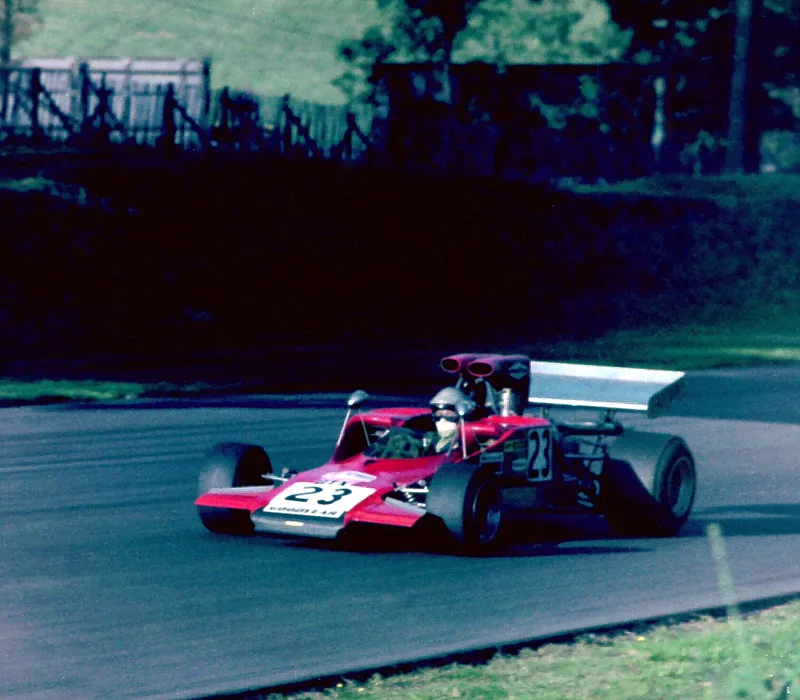
Twice the Australian Grand Prix came to Oran Park, both times for Formula 5000 cars. Max Stewart won in 1974 in a Lola T330 and Warwick Brown in 1977 in a Lola T430 Chevrolet. Alan Jones had actually won the 1977 race on the road, about 40 seconds clear, but a 60-second penalty for jumping the start dropped him to fourth.
The 1970s drew big crowds to the Toby Lee Series, first for production touring cars and then for sports sedans. The Rothmans 500 was staged in 1977 and again in 1978 but never after. Shorter touring car endurance races continued through the 1980s, ending with the 1989 Pepsi 300, taken by Andrew Miedecke and Andrew Bagnall in a Ford Sierra RS500. V8 Supercars made their last visit in December 2008, with Garth Tander winning in a Holden VE Commodore.
The Superbike World Championship came in 1988 and 1989, each time with the second-last round. Mick Doohan, later a five-time 500cc world champion, won both races in 1988 on a Yamaha FZR750. International riders criticised the concrete walls at turns 3, 4, 9 and 12, which left almost no runoff. In the mid-1990s Australian NASCAR and AUSCAR raced on the 1.960 km South Circuit under upgraded lights, and the night races proved popular.
Lap records tell a story of speed. Warwick Brown set 1:05.2 in a Lola T332 on the new Grand Prix circuit in November 1974, and John Bowe went to 1:03.9 in a Ralt RT4 in August 1984. A mid-1984 change added a straight after turn 3 and removed the old turn 4, trimming about two seconds a lap and leaving the circuit 12 corners instead of 13. At closure the record was 1:01.6718, held by Tim Leahey, from July 2000, in a Formula Holden Reynard 92D.
The final motorcycle meeting, the BelRay 6 Hour, took place on 21-22 November 2009. The scheduled finale on 23-24 January 2010 was cancelled, making the Independent Race Series event of 16 January the last real race. Open track days let the public drive road cars and motorbikes round until Monday 25 January 2010.
What was Amaroo Park?
Amaroo Park was a road circuit of 1.930 km (1.199 mi) at Annangrove. Industrialist Oscar Glaser built it as the first piece of a planned motorsport complex. It hosted the Castrol 6 Hour motorcycle race and rounds of the Australian Touring Car Championship, and it closed after its last meeting on 23 August 1998. The name comes from an Aboriginal word meaning beautiful place.
The complex began with a hillclimb, then added a dirt oval, a motocross course, a seldom-used speedway and finally the main bitumen circuit. A full Grand Prix circuit stayed on the drawing board. The first motorcycle meeting was on 26 February, when Larry Simons won a 30-lap production race on a BSA Spitfire in heavy rain, and the official opening was on 12 March 1967 with about 1000 spectators.
Poor crowds, blamed partly on weak facilities, closed the circuit temporarily in mid 1968. It reopened on 31 May 1970 with better spectator facilities and the ARDC in charge, and the first Castrol Six Hour for motorcycles, run by the Willoughby District Motorcycle Club, followed later that year.
What was a lap of Amaroo Park like?
The lap started on the short pit straight, kinked right up towards Bitupave Hill, turned left and dropped into the right-hand Dunlop Loop. The back straight kinked right into the tight left at Honda Corner, then came a short right kink and the tight right-hander at Stop Corner, sometimes called Lake Corner. A short straight led to Wunderlich Corner, the last turn, which was Ron Hodgson Corner in the 1970s after a Holden dealer's sponsorship.
On the run to Bitupave Hill, Sports Sedans, Sports Cars and Formula 5000 cars reached just over 220 km/h (137 mph), and Dunlop Loop, Honda and Stop Corner were the best places to pass. Before 1983 the inside of Honda Corner offered nothing but an earth bank and a concrete wall. In the late 1980s a small chicane went into the final turn to slow motorbikes.
What racing made Amaroo Park popular?
Amaroo's first Australian Touring Car Championship round came in 1974, when Peter Brock won in a Holden Dealer Team LJ Torana GTR XU-1. It staged 15 rounds in all, and in 1994 Skaife won the last in a Gibson Motorsport Holden VP Commodore, so Holden won both ends. The fastest lap at closing, 44.36 seconds, belonged to John Bowe, set in 1987 in a Chevrolet-powered Veskanda C1.
Its own touring car series ran from 1971 as the Sun-7 Chesterfield Series, first won by Lakis Manticas in a Morris Cooper S, and became the AMSCAR Series in 1982. It filled the grid with Sydney privateers and often drew larger fields than national rounds, and it was easy to televise on Channel 7. In 1985 Jim Richards won all 12 AMSCAR races in a BMW 635 CSi, plus the ATCC round and the endurance race as well, for Frank Gardner's JPS Team BMW.
Bigger national fields, better television coverage of the championship and the recession of 1991 all thinned the grids, and the AMSCAR Series ended after 1993. A revival in 1997 split between Amaroo Park and Eastern Creek could not draw enough privateers and folded. Those privateers have largely disappeared, and the major touring car teams now operate from Melbourne and south-east Queensland.
How did Amaroo Park close?
Losses on the Super Touring Bathurst 1000, which the ARDC promoted from 1997 to 1999, led it to sell the circuit. The farewell meeting was billed the "Goodbye Amaroo State open Meeting" and mixed Sports Sedans, HQ Holdens and historic Group N touring cars.
The final race was a "Butchers Picnic", a tribute to the first races at the circuit, with the top three cars from each class together on the grid. It started at 4:30 pm and ran for 10 laps. Sydney driver Ray Lintott won in a four-wheel-drive, twin-turbo Porsche 911 Turbo in 9:16.4942. Andrew Papadopoulos finished last in an Alfa Romeo GTV at 4:40 pm. Arthur Hayes, ARDC member number one, waved the chequered flag, and the curtain came down on one of Australia's most popular circuits after more than 31 years.