From the Denver boot of 1955 to the officers who ticket cars and the rules that force every new building to provide spaces.
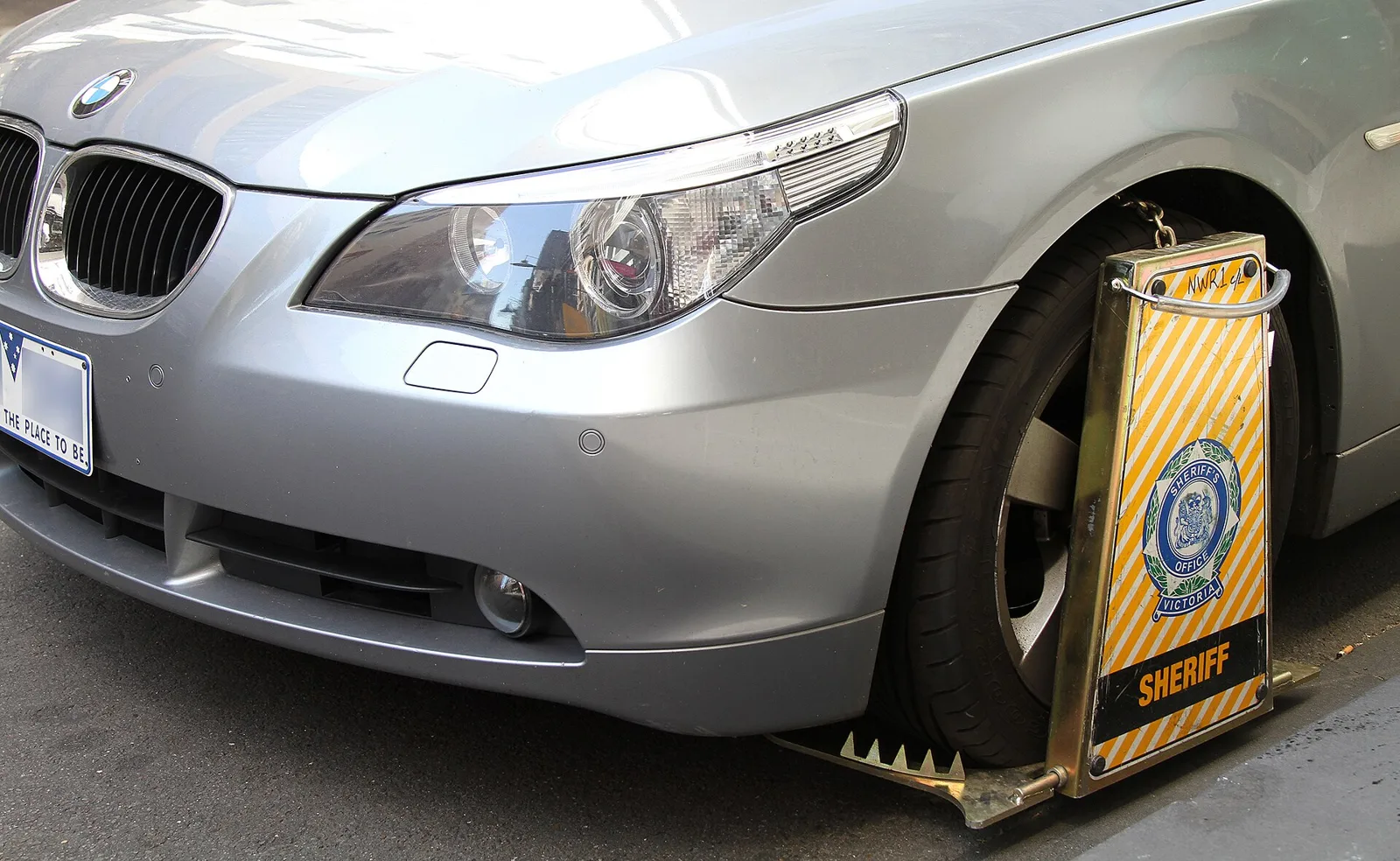
A wheel clamp, or Denver boot, immobilises a vehicle and was first used by Denver police in 1955. Its legality varies: England and Wales banned most private clamping in 2012. Parking officers enforce street rules, while parking minimums force developers to build set numbers of spaces and are being repealed across the US.
The first month the Denver Police Department used a wheel boot, in January 1955, it collected over US$18,000, which is about US$220,000 in 2025 dollars. A simple steel clamp had turned a costly towing problem into a revenue stream almost overnight.
The boot is one of three tools cities use to manage cars that are standing still. The other two are the enforcement officers who write the tickets and the planning rules, known as parking minimums, that dictate how many spaces a building must provide in the first place. Each has its own history and its own legal fights.
What is a wheel clamp and what does it do?
A wheel clamp goes by several names: wheel boot, parking boot, wheel lock and, in the United States, Denver boot. Whatever it is called, its purpose is to keep a vehicle from moving. Most often it wraps around one wheel, built so that neither clamp nor wheel can be removed. Denver, Colorado, gave the device its American name by being the country's first user, mostly to compel payment of outstanding parking tickets. Consumer versions are now sold for personal use against theft, in place of a steering-wheel lock.
Clamps have five main jobs. They punish illegal parking in place of towing, and whoever fits one, police or property owner, may demand a hefty fee for its release. They enforce unpaid fines, with a set number of nonpayments, or enough time passing since the last fine, leading to a clamp on the next violation. They stop a suspended driver from driving or a disabled vehicle from being moved, they prevent a prosecuted person from escaping, and they guard against thieves driving or towing away a car, trailer or caravan.
A simple steel clamp turned a costly towing problem into a revenue stream almost overnight.
Where did the wheel clamp come from?
Locking devices appeared soon after cars did, as thieves and joyriders became a problem. Early versions were locking wheel clamps or chocks that an owner shackled to one road wheel, so the car could not roll unless the whole wheel came off. At least 25 patents for wheel locks were filed between 1914 and 1925, and the devices, from makers including Miller-Chapman, became popular in the early 1920s.
The modern clamp was invented in 1944 by Frank Marugg and patented in 1958. He was a pattern maker and an orchestral violinist in Denver, with friends among the city's politicians and police. Denver had a parking enforcement headache. Ticketed cars went to the pound, vandals often got to them there, owners sued the city, and the police had to list everything inside each car. Dan Stills, head of the traffic division, approached Marugg hoping an immobiliser would keep cars where they were parked.
After that first trial in 1955, Marugg swapped the steel casting for a lighter aluminium alloy and found buyers among car park owners, hotels and ski resorts, with an oversized version for farm machinery and big vehicles. By 1970 he had sold 2,000 boots. The patent ran out in 1976 and modern wheels forced a redesign, yet his daughter kept the business going until 1986, and Clancy Systems International later bought the rights. The Smithsonian Institution displays a copy. For its first fifty years the boot helped Denver keep its collection of parking fines among the highest of any American city.
In Britain, the best-known clamp is the London Wheel Clamp, patented in 1991 by Trevor Whitehouse, who first named it the Preston after his Lancashire home town. It was mostly used on private land until the Road Traffic Regulations Act of 1991, known as the decriminalising of the yellow lines act, brought it onto public roads. The first areas to be decriminalised were the 33 London boroughs in 1993 and 1994, hence the new name.
Is wheel clamping legal?
The answer for a driver depends on the country and on who fitted the clamp. Clamping is notoriously unpopular with those who park without permission, yet in many countries the law lets landowners clamp vehicles left on their property. Cutting off a clamp fitted by a private party is a tactic some drivers have tried, but removing one fitted by the authorities, chiefly the police, is an offence. One British man who removed a clamp with an angle grinder won publicity as Angle-Grinder Man and offered to free others for nothing. Some motorists clamp their own cars first, so that a landowner will not clamp an already-clamped vehicle.
In Scotland, local authorities may clamp, tow or remove vehicles by statute, but clamping on private land was ruled unlawful in the case Black v Carmichael (1992), which held that immobilising a vehicle is extortion and theft. Lord Hope wrote that holding vehicles to ransom in that way was illegal.
In England and Wales, certain clamping on private land became a crime on 1 October 2012 under the Protection of Freedoms Act 2012 when done without lawful authority, which rules out supermarket car parks and many other common places. It is not a total ban. A railway operator may clamp under Railway Byelaw 14(4). Immobilising a vehicle without lawful authority is the offence in section 54(1) of the Act, so a body that holds a separate statutory power commits nothing: a council chasing an unpaid penalty charge, the DVLA pursuing vehicle excise duty, or the police.
Councils draw their own power from section 79 of the Traffic Management Act 2004, and guidance graduates its use. When a vehicle has collected three or more penalty charge notices that were not paid, challenged or appealed in time, or whose challenge failed and whose charge remains unpaid, it is treated as belonging to a persistent evader. It can be immobilised or removed after 15 minutes instead of the usual 30, and the guidance points authorities toward removal to a pound rather than clamping. Landowners meanwhile can hold the registered keeper liable for charges arising from breach of contract, with the terms set out on signs on site.
Ireland allows clamping in public places through a 1988 amendment to the Road Traffic Act 1961. Private car parks clamp widely, with no statute governing it and an unclear legal footing. Local authorities have handed the work to private companies. The Vehicle Clamping Act 2015 was due to replace the existing provisions, cover private as well as public clamping, and standardise the fines and appeals that have drawn public dissatisfaction.
Fakes exist too. Around Los Angeles in 2017 and 2018, a scammer booted unsuspecting drivers and charged a steep fee to free them; victims were told to call 911, and the scammer was arrested. In the UK, a driver clamped illegally or given no receipt can report the operator to the Security Industry Authority.
What does a parking enforcement officer do?
A parking enforcement officer is called a traffic warden in British English and a parking inspector or parking officer in Australia and New Zealand. The post sits in a traffic control agency, a local government or a police force, and its holder writes tickets for parking violations. In the United States the term meter maid is still used for female officers even where meters have gone.
The job drifts. On 9 December 2007, Stockholm's mayor Mikael Soderlund announced that parking officers would also fine graffiti vandals and litterers, and trade union representatives replied that the officers were already stretched and feared violence. English authorities that bought vehicles with onboard computers and cameras have started policing bus lanes. In parts of Britain, civil enforcement officers also hand out fixed penalties for littering, drinking in public, anti-social behaviour and noise.
The title and powers vary. In Canada, parking enforcement is frequently folded into bylaw enforcement, and officers can issue civil citations for most municipal bylaw violations. Montreal, Toronto and Vancouver still employ parking enforcement officers; in Montreal and Toronto they belong to the police, which earned them the nicknames green onions and blue hornets. Canadian officers are treated as de facto peace officers on duty, so assaulting one carries higher penalties than an ordinary assault. Toronto added traffic wardens at busy junctions from early 2018.
Indonesia's wardens answer to the Ministry of Transportation, wear light blue, and also help traffic police and police public transport. Ireland brought in its officers with the Local Authorities (Traffic Wardens) Act 1975; they issue tickets on the spot, and refusing a warden your name and address is an offence. In New Zealand, a local authority appoints parking wardens for public roads. Fines are low there, as little as $12 for minor offences, but abuse and violence against officers is common and some councils have issued body cameras. Wardens can order vehicles off a road or away from an entrance, and can authorise towing.
The British picture
British traffic wardens date from the 1960s, when they were employed by police forces. Their origin lies in a 1959 proposal by Athelstan Popkess to Home Secretary Ernest Marples for a body of men barred by height or age from regular police work who could deal with trifling motoring offences such as illegal parking. He borrowed the idea from a scheme in South Africa. Today local authorities use parking attendants and civil enforcement officers under decriminalised parking enforcement, and these have almost everywhere replaced the police warden. They issue penalty charge notices under sections 63 to 79 of the Road Traffic Act 1991. Northern Ireland has traffic attendants, and National Highways traffic officers have powers over vehicles on motorways and trunk roads.
Public dislike runs deep. Accusations of overzealousness are blamed on pressure to deliver a daily quota of tickets, and critics say the real aim is revenue for the council. Those fined argue that the penalty is out of proportion to the offence. Some attendants have been stabbed or threatened with death, and have been given stab-proof vests and swabs to collect DNA from people who spit at them.
Private enforcement is a separate world. In England and Wales, landowners increasingly hire firms to issue Parking Charge Notices, a contract-based charge not to be confused with the Penalty Charge Notices of civil enforcement officers, for offences such as parking outside bays or overstaying. The British Parking Association is the industry body, and its guidance says a driver who parks without permission is usually trespassing, while one who parks with permission is bound by the terms, which signs must make easy to find.
What are parking minimums and why do they exist?
Parking mandates, also called parking requirements or parking minimums, are decisions by municipal governments that new developments must provide a set number of spaces. They are often traced to the post-war building boom of 1950s America, when they were meant to stop street parking becoming overcrowded, though Columbus, Ohio, introduced the first in 1923.
Requirements vary with the use of the building. Typical ratios include one space per apartment, one per 300 square feet of retail or commercial space, one per 100 square feet of restaurant dining area, two per hospital bed and one per five church pew seats. Los Angeles, for one, asks for a space for every five seats in a church and two per hospital bed.
American cities often draw their numbers from Parking Generation, a handbook of statistics compiled by the Institute of Transportation Engineers and refreshed every five years. It does not say what the minimums should be, but it has been influential. Critics dispute it. The peak parking it observes ignores price, so demand looks permanently high because parking is oversupplied and underpriced, and minimums often ignore nearby parking, forcing businesses that peak at different times to build the largest lots they can. Donald Shoup, a UCLA professor who pioneered parking research, has called minimums a pseudoscience.
The results can be odd. Until it ended minimums in 2022, San Jose, California, demanded seven spaces per lane at a bowling alley, one per 80 square feet of indoor recreation, and a restaurant car park eight times the size of the restaurant. Shoup estimates the US has 700 million to 2 billion parking spaces, which is 2.5 to 7 times the number of registered vehicles. Spaces per new home averaged 0.8 in 1950, peaked at 1.7 in 1998 and stood at 1.1 by 2022. Offices show the same arc per 1,000 square feet: 1.25 in 1950, 3.75 in 1999 and 2.25 in 2022.
What do parking minimums cost?
Minimums move the cost of parking from drivers to developers. A parking structure costs an average of $28,000 a space, an underground one about $56,000, excluding land, and a space in downtown Los Angeles usually costs more than $50,000. Los Angeles spent $274 million on the Walt Disney Concert Hall, and $100 million of that paid for the underground garage. Those hidden costs push rents up by nearly 20%.
Examples make the point. A Charlotte, North Carolina, developer was permitted in 2023 to put up a 104-unit apartment block without any parking, which meant 25% more units, rents $250 a month lower and still a profit. In Aurora, Colorado, a 405-unit complex had to provide 485 spaces, 95 more than the developer expected residents to need, adding about $100 to average monthly rent. A 2016 study found that garages added 17% to average rents, and that 75% of renters with no car still had parking included, together paying $440 million a year for spaces they never used.
The stated aim, ending curb congestion, is not met. While kerbside spaces are free, drivers keep trying to park nearer the door, so the kerb stays full whatever the supply off-street. Circling for free spaces adds traffic while garages nearby sit empty: a 2012 study found downtown garages 20% vacant on weekdays and during special events. Minimums also cut density, and strip malls and office parks are the cheapest way to satisfy them.
Europe leans toward maximums. Planning permission can depend on a set share of visitors arriving by public transport, with parking capped below the number of visitors expected.
Which US states have scrapped parking minimums?
Since 2017 many American cities have overhauled or repealed their rules, and since 2015 more than 35 major cities have partly or fully eliminated minimums, among them Austin, Minneapolis, Nashville, Raleigh and San Jose. States have followed.
| State | Date | What changed |
|---|---|---|
| Oregon | 21 July 2022 | Eight largest metropolitan areas barred from minimums near frequent transit, for small homes of 750 square feet or less, or for homes meeting affordability targets |
| California | September 2022 | AB 2097 bans minimums for buildings within half a mile (0.80 km) of public transit |
| Colorado | May 2024 | HB-1304 prohibits most multifamily mandates within a quarter mile of transit after 30 June 2025, except above 20 units |
| Washington | May 2025 | SB 5184 caps requirements at 0.5 spaces per home and two per 1,000 square feet of commercial space |
| Connecticut | 26 November 2025 | HB 8002 bars minimums for developments of fewer than 16 homes |
| Illinois | December 2025 | SB 2111 bars minimums within half a mile of a transit hub or one-eighth of a mile of a transit corridor |
Washington's law also stops cities from demanding off-street spaces for some uses, among them affordable housing, senior housing and child care. Connecticut's law is the first statewide preemption of its kind east of the Mississippi River.
Where this goes next
The reform laws carry their own dates and conditions. Colorado's ban applies after 30 June 2025, while Connecticut lets each municipality create up to two conservation and traffic mitigation districts, together covering no more than eight percent of its land, in which minimums can still reach developments of fewer than 16 units. Larger developments there must submit a parking needs assessment, and towns may allow a fee in place of spaces for commercial schemes and for housing of 16 or more dwellings.