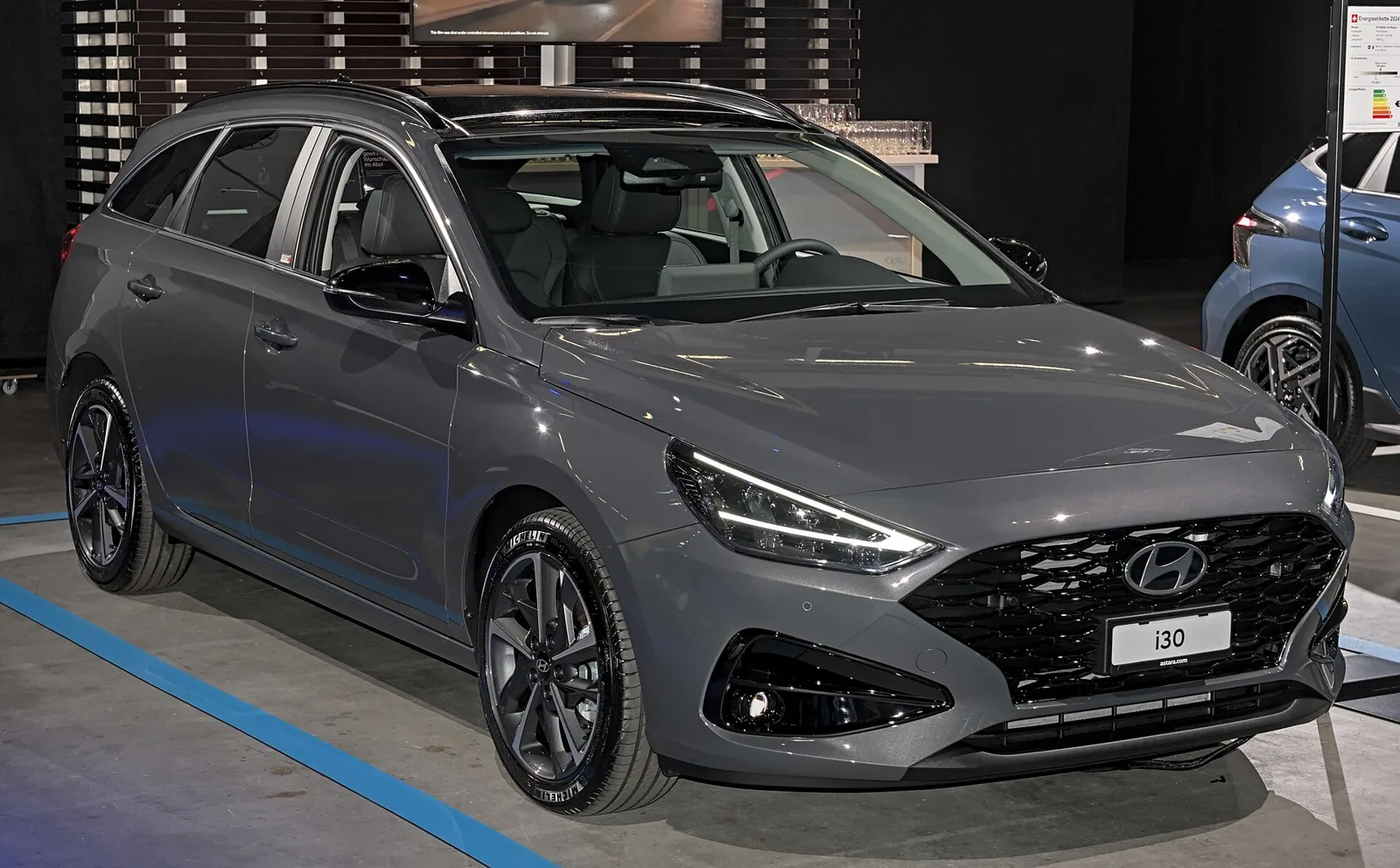
From the 2007 hatchback that won Australian awards to the N performance models and a British touring car title, the i30 grew into one of Hyundai's most versatile small cars.
The Hyundai i30 is a small family car built by Hyundai since 2007 on a platform shared with the Kia Ceed. Now in its third generation, it has come as a hatchback, estate, coupe and fastback, and produced touring car champions.
Hyundai has built the i30 small family car since 2007, and it shares its platform with the Kia Ceed. Across three generations it has taken the form of a hatchback, an estate, a coupe, a fastback and a performance N model. It has also built a record on touring car grids.
When did the Hyundai i30 first appear?
The first generation was previewed at the 2006 Paris Motor Show by the Arnejs concept, and a small run of pre-series cars was completed in late 2006. Series production followed in 2007, with the car shown at the Geneva Motor Show that March and sold in Europe and Australia from mid-2007.
The engineering team worked from Hyundai's Design and Technical Centre in Germany. Malaysia received the first generation in July 2009, with 1.6 L manual and automatic engines and a 2.0 L automatic on offer.
Australian buyers had an early price advantage. The 1.6 L CRDi diesel was the cheapest diesel car in the country when the range arrived at the end of 2007, which helped the model establish itself quickly.
A small family car that grew a performance identity, then a touring car title in one of the world's most competitive series.
What were the first-generation variants?
The i30cw estate debuted in South Korea at the 2007 Seoul Motor Show and reached other markets under different names. It was a larger and roomier body than the hatchback, with a cargo capacity of 65 cubic feet (1,800 L).
North American buyers first saw the estate in 2009 as the Elantra Touring. Later it was offered with a 2.0 L engine with 138 hp (103 kW) and 136 lb-ft (184 N m) of torque, mated to either a five-speed manual or a four-speed automatic.
The i30 blue added Start&Stop technology, which Hyundai called Idle Stop and Go. The British line-up used a 1.6 L petrol and a 1.6 L diesel, in hatchback or estate form, and the 1.6 L petrol's CO2 rating dropped to 142g/km.
How did the second generation differ?
The second generation was shown at the 2011 Frankfurt International Motor Show. Its four engines offered six power options, and an upgraded 1.6 L diesel kept CO2 emissions below 100 g/km. European production took place at the Nosovice plant, and the five-door hatchback reached showrooms early in 2012.
Korean sales started on 20 October 2011 under Hyundai's Premium Youth Lab banner. American buyers met the car in 2012, when the Elantra GT took over from the Elantra Touring name. For 2014 the 1.8 L engine gave way to a 2.0 L GDI unit, because critics felt the smaller engine did not suit a GT.
The estate premiered at the 2012 Geneva Motor Show. It was 185 mm longer than the hatchback, and its boot held 528 litres, rising to 1,642 litres with the rear seats folded. A three-door coupe with a sportier look arrived in early 2013 as part of the first facelift.
What was the i30 Turbo?
The facelift revealed in December 2014 for the 2015 model year brought the i30 Turbo. It paired a 1.6 T-GDI engine with improved handling and more aggressive styling, which made it a hot hatch rather than a family hatchback with a sporting trim.
The Turbo marked a clear change of direction for the range. Earlier i30 models were sold on economy and value, while this version offered a sharper character that later carried through to the N performance range.
What did the third generation bring?
Hyundai unveiled the third generation at the 2016 Paris Motor Show, introducing the brand's Cascading grille design language. North America saw it as the Elantra GT from the 2018 model year, and in European markets the Fastback front design was standardised from the 2019 model year, except on N-Line and N models.
The Fastback took over from the Elantra in EU markets until autumn 2017, when it was presented at the Frankfurt Motor Show. In the United States the range was split between the base Elantra GT and the more sporting Elantra GT Sport, which used a turbocharged 1.6 L four producing 201 hp (150 kW) and an independent rear suspension in place of the torsion beam.
The base Elantra GT relied on a naturally aspirated 2.0 L inline-four producing 161 hp (120 kW). Later the Elantra GT Sport was replaced by the Elantra GT N-Line, which added stiffer springs, firmer mounts and a larger rear anti-roll bar. Sales of the Elantra GT in the US and Canada ended with the 2020 model year.
Which awards did the i30 win?
CarsGuide in Australia named the first generation its 2007 Car of the Year, and the 1.6 L CRDi took the Green Car of the Year title alongside it. Hyundai's i30 Diesel was also chosen as Australia's Car of the Year that year.
Recognition continued across Europe and New Zealand. The car was chosen as the 2008 Car of the Year in Spain, and in 2009 it was judged the supreme winner of the AA Motoring Excellence Awards in New Zealand. Owners named it the most satisfying car to own in the Driver Power survey of 2010.
The last major honour of the first decade came on 14 October 2012, when the car was named Best Family Car of the Year at the Glasgow Thistle awards. Each of these prizes reflected the car's combination of value, space and driving manners.
How did the i30 perform in safety tests?
The 2008 model scored 4.2 in Euro NCAP crash tests, improving on the 3.9 achieved by the 2007 car. The first generation also earned a full five-star rating from the Australasian crash test programme, a result that carried weight with family buyers.
The step from 3.9 to 4.2 in a single model year was a clear sign that the revised structure and equipment were working. Each generation then built on that foundation with its own safety updates.
How did the i30 perform in motorsport?
Customer teams have raced a TCR version of the i30 N since 2017. The 2018 World Touring Car Cup titles went to Gabriele Tarquini and M Racing-YMR, who ran the TCR i30 N, and Norbert Michelisz added a further drivers' cup in 2019.
For the British Touring Car Championship, a version named the i30 Fastback N Performance debuted in 2020. Tom Ingram took the BTCC drivers' championship in 2022 and again in 2025, which gave the model a strong competitive record in a closely followed series.
What changed with the 2020 and 2024 facelifts?
The 2020 update brought slimmer LED headlamps, 18-inch alloy wheels, a 7-inch digital instrument cluster and a 10.25-inch touchscreen. The 1.0 L and 1.5 L T-GDi engines were paired with a 48-volt mild hybrid system, and the Hyundai SmartSense safety package was offered across the range.
In the UK the 2020 car came in SE Connect, N Line and Premium trims. Only the N Line used the 1.5 L T-GDi, which produced 159PS and could be ordered with a six-speed manual or a seven-speed DCT, while the other trims used the 1.0 L engine.
A second facelift in April 2024 redesigned the grille and rear bumper. In Australia the Active and Elite trims were dropped, leaving the N-Line and N models to carry the range forward.
What are the Hyundai i30 specifications?
The table lists the main figures that differ between generations and body styles. Values are quoted metric first, and where a figure belongs to one variant only, the table names that variant so the estate, Turbo and Elantra GT values stay separate.
| Specification | Detail |
|---|---|
| Platform | Shared with the Kia Ceed |
| Bodystyles | Hatchback, estate, coupe and fastback |
| First-generation estate cargo | 1,800 L (65 cu ft) |
| Second-generation estate boot | 528 litres, rising to 1,642 litres with seats folded |
| Euro NCAP rating | 4.2 for the 2008 model; 3.9 for the 2007 car |
| Diesel CO2 target | Below 100 g/km for the upgraded 1.6 L diesel |
| Elantra GT base engine | 2.0 L naturally aspirated, 161 hp (120 kW) |
| Elantra GT Sport engine | 1.6 L turbo, 201 hp (150 kW) |
| UK N Line engine | 1.5 L T-GDi, 159PS |
How did reviewers rate the Elantra GT Sport?
Car and Driver judged that the GT Sport did not match the class leaders for refinement on twisting roads. Its body leaned more than the magazine would have liked through corners, and its electric steering lacked the precision and feel of rivals such as the Honda Civic Sport.
Those criticisms did not stop the model being a capable sporting hatch. The later N-Line update tried to tighten things further through suspension and damper changes.
What was the i30 sedan in Australia?
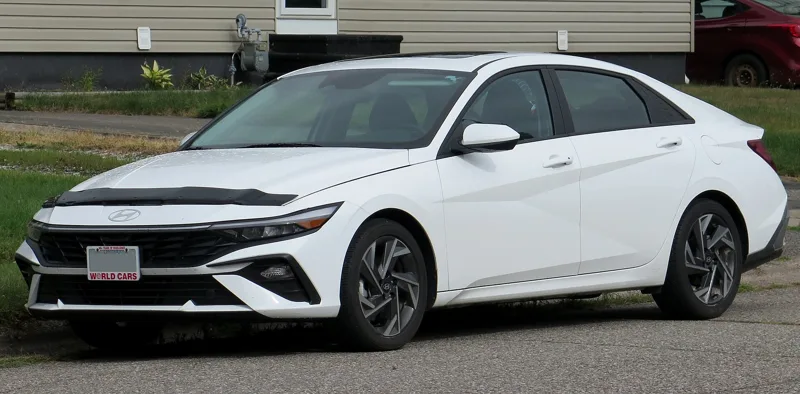
In Australia the Hyundai Elantra (CN7) was sold as the i30 sedan, borrowing the well-known i30 name for a four-door model. That gave the nameplate a presence in both hatchback and saloon form in one of Hyundai's key markets. It gave Australian buyers a saloon option under the familiar name.
The sedan sat alongside the hatchback range, which kept the i30 name strong across more than one body style for Australian buyers.
What did the second-generation coupe offer?
A three-door Coupe followed in 2013, sharing the hatchback's platform but wearing a sportier outline. That styling set it apart from the five-door hatchback and estate that most family buyers chose, and it added a more expressive option to the range.
The coupe showed that the second generation could carry a more expressive body without changing its underpinnings. That flexibility was one reason the model stayed in step with changing tastes across its life, from family use to a sportier image.
Where was the first generation launched?
The first generation reached Europe and Australia in mid-2007, and Malaysia followed in July 2009 with two engine choices. In Argentina the car was judged the safest imported mid-size car, a result that helped its reputation in that demanding market.
Across these launches in the early years the car was sold as a hatchback and an estate, and in some places the estate carried the Elantra Touring name. Taken together, the launches show a brand building a small family car around one common platform that could be sold in many forms.
Frequently asked questions
Is the i30 the same car as the Elantra GT?
In North America and some other markets the third-generation hatchback is sold as the Elantra GT, while Europe and Australia use the i30 name. The two share the same basic design.
Was the i30 built in Europe?
Yes. European second-generation cars were built in the Czech Republic, and the car was engineered in Germany by Hyundai's European team.
Did the i30 win a touring car title?
Yes. Tarquini and his M Racing-YMR team took the 2018 World Touring Car Cup, and Tom Ingram took BTCC drivers' championships in 2022 and 2025 with the Fastback N Performance.
What is the N-Line?
The N-Line is a sportier trim that adds stiffer springs to the Elantra GT. In the UK it was the only trim fitted with the 1.5 L T-GDi engine.