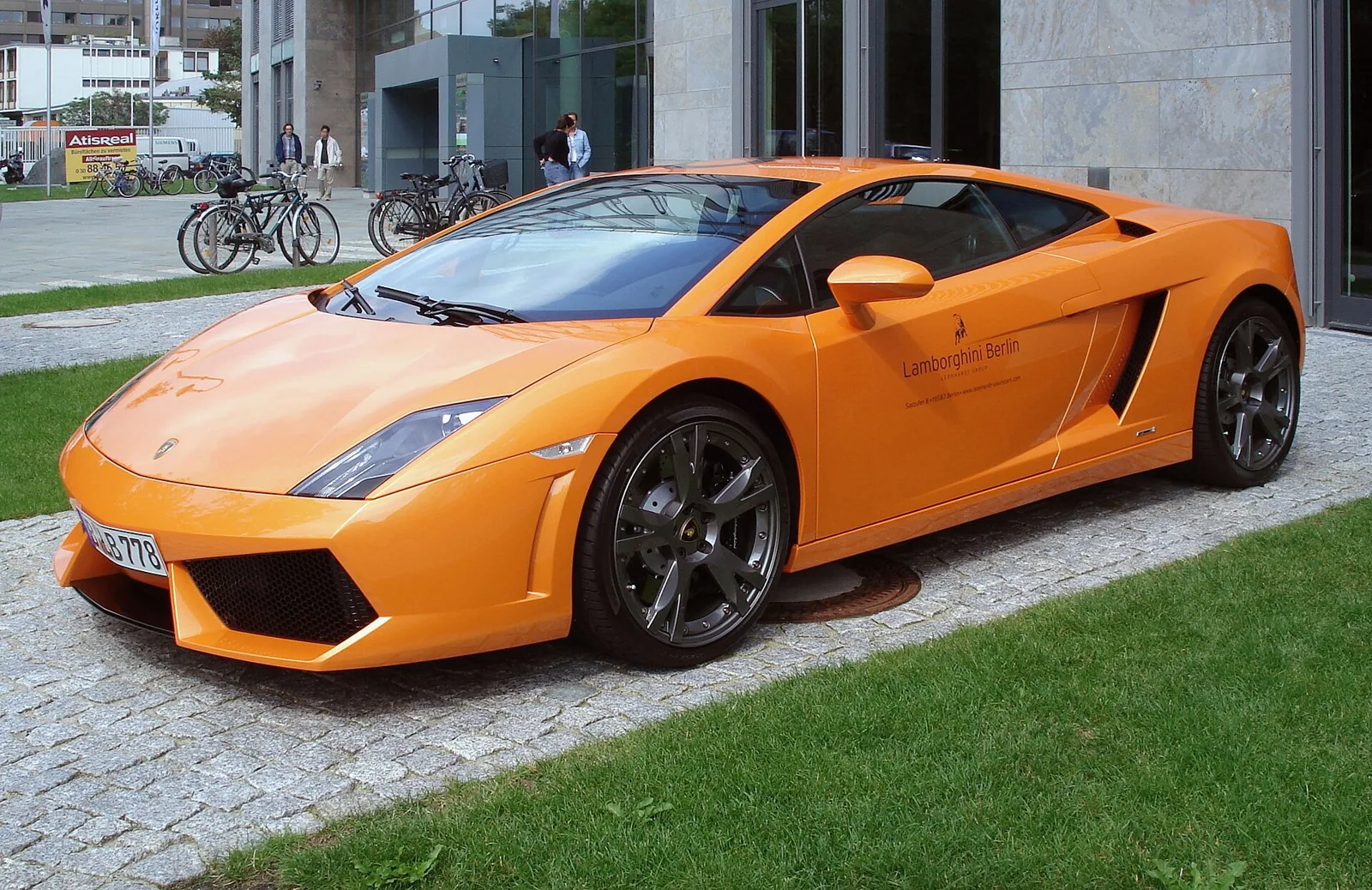
Carbon-fibre styling, a Murcielago-derived V12 and a run of only 20 coupes, followed by a 2009 roadster with 670 PS.
The Lamborghini Reventon is a limited-production mid-engined sports car that debuted at the 2007 Frankfurt Motor Show. Lamborghini planned just 20 coupes for customers, and its 6.5-litre V12 was taken from the Murcielago LP 640. A roadster version followed in 2009.
Lamborghini's Reventon was a mid-engined coupe that appeared at the 2007 Frankfurt Motor Show as a showpiece for a small group of buyers. Only 20 were offered to customers, and each one carried a V12 drawn from the Murcielago LP 640. A roadster followed in 2009 with a stronger engine tune and no roof.
The model sits in an unusual place in the company's history. It was built in tiny numbers, its bodywork carried a design language that later reached the Aventador, and its open-top sibling pushed the price far beyond the original plan. Each of those threads is covered below, starting with the name that gave the car its character.
Several features make the car easy to identify: the carbon exterior, the single grey finish, the LED lighting and the number stamped between the seats. Each one is discussed below, and together they explain why the Reventon reads as a showpiece rather than a volume model.
Where does the Reventon name come from?
The name comes from a fighting bull, in line with Lamborghini tradition. That bull was raised by Don Heriberto Rodriguez and killed the Mexican bullfighter Felix Guzman in 1943. In Spanish, reventon means a small explosion or burst, while in automotive terms it means a blowout or flat tyre.
Used as the name of a bull, the word describes an animal that seems about to burst, which gives the badge a sense of tension. Lamborghini kept that bull-based naming for this limited model, even though the car beneath the name was a modern carbon-fibre design.
For a company that builds its identity around the fighting bull, the Reventon name was a deliberate link to tradition. It sounds dramatic without describing any single piece of engineering, which suited a car whose main purpose was to be rare and striking.
A limited V12 coupe wrapped in carbon fibre, with a roadster that added open-air motoring and 670 PS.
How much power did the Reventon make?
The coupe used a 6,496 cc V12 tuned to 650 PS (641 hp; 478 kW) at 8,000 rpm. Torque peaked at 660 Nm (487 lb ft) at 6,000 rpm. Lamborghini quoted 3.4 seconds for 0-100 km/h (62 mph) and a top speed of over 340 km/h (211 mph).
The V12 and most of the mechanical package came from the Murcielago LP 640, so the Reventon was a re-dressed flagship rather than a clean-sheet engine. The engine measures 6.5 litres (396.4 cu in), and its mid-engined position places it behind the seats.
Torque arrives at 6,000 rpm, while peak power waits until 8,000 rpm. That gap between the two peaks shapes how the engine delivers its pull, with the strongest push coming as the revs climb toward the top of the band.
The headline acceleration figures were the centre of the launch story. They show how a 650 PS output translated into straight-line pace in a car that was still a road-legal coupe.
Taken together, the coupe's figures describe a car that depends on the upper part of its rev range. Peak power arrives at 8,000 rpm, the same rev figure the roadster uses, which keeps the two versions closely linked on paper.
How was the Reventon styled?
The Reventon was built around an all-new carbon-fibre exterior, and every car wore the same mid opaque grey finish without the usual shine. Lamborghini said the styling took cues from fast aircraft. The car was also the first Lamborghini to fit daytime running lamps into its headlamps, and its design later formed the basis of the Aventador.
Lighting is one of the clearest departures from earlier models. Seven LEDs flank each headlamp's bi-xenon main beam. Heatproof LEDs were chosen for the indicators, stoplights and rear lights, and the rear lights carry a triple arrow optical effect.
Aerodynamic aids are kept out of sight until they are needed. The active rear wing and the air intakes set into the shoulders deploy only at high speed, so the body stays clean at lower speeds.
The design left a lasting mark on the marque. Its exterior formed the basis of the Aventador, the company's flagship that followed it, so the Reventon's shapes reached a much wider audience than its production run.
Few cars of the period combined a carbon body with this degree of lighting detail. The active aerodynamics and the lighting together give the Reventon a modern, technical look, even though much of its mechanical package was shared with the Murcielago.
What was the Reventon's cabin like?
The cabin uses three TFT liquid crystal displays that offer two display modes. The instrument housing is milled from a solid aluminium block and protected by a carbon-fibre casing. The seats are black leather with brown Alcantara trim, and a g-force meter displays the size and direction of the forces on the car.
Hard materials dominate the instrument area, from machined aluminium to carbon fibre. The seats add a softer finish, and the displays keep the driver's attention on the g-force readings rather than on a conventional dial layout.
For a driver, the mix of TFT displays, a machined instrument housing and a g-force meter suggests a car designed around measurement. The leather and Alcantara seats add a warmer touch to an otherwise technical cabin.
The instrument panel is the main point of interest for anyone who sits in the car. The three displays and the machined housing combine into a layout that looks more like a technical instrument than a conventional dashboard.
How many Reventons were built?
Lamborghini planned just 20 coupes for public sale, and one further car, marked 00/20, was built for the company's museum. Each car is stamped with its number between the driver and passenger seats, so the run can be tracked one by one. The museum car sits outside the customer run of 20.
The small run is the main reason the model is discussed as a collectible today. Few cars were built, and each one carries its own number, which makes every example easy to distinguish from the rest of the run.
Production was small enough that the Reventon became a collectors' piece almost at once. The limited numbers, rather than any single performance figure, set the car apart from the company's regular range.
The numbering matters to collectors. Each coupe bears its own number between the seats, so an individual car can be traced within the 20 built for customers, while the museum example stands apart as 00/20.
Who bought the Reventon?
The 20 customer coupes were split by region, with the US taking ten and Europe taking seven. Canada received one and Asia received two. One of them now sits with Ramzan Kadyrov, the head of the Chechen Republic. Every one of those buyers received a car with the same grey finish.
That spread across four regions meant the Reventon was never a single-market car. It reached North America, Europe and Asia in small batches, which kept it scarce wherever it was registered.
The spread of owners tells its own story. A car sold in small batches across four regions was never tied to a single market, which let the model build an international profile while remaining hard to find.
What was the Reventon Roadster?
The Reventon Roadster was unveiled at the 2009 Frankfurt Motor Show as an open-top version of the coupe. It produced 670 PS (661 hp; 493 kW) at 8,000 rpm, with a top speed of 330 km/h (205 mph) that sat slightly below the coupe. Production was set at 15 units.
Lamborghini sourced the roadster's engine from the Murcielago LP 670-4 Super Veloce, a more powerful member of the same engine family. The roadster's torque matches the coupe's, so the extra output is a matter of the higher power peak.
Removing the roof came at a cost in stiffness. Lamborghini said the chassis reinforcement needed to make up for the missing roof adds 25 kg (55 lb). To protect occupants in a rollover, the roadster carries deployable roll hoops that extend quickly.
The roadster is a useful case study in how open-top cars are engineered. Lamborghini chose to reinforce the structure rather than accept flex, and the added weight was the price of that decision.
Why did the Reventon roadster cost so much?
The roadster's planned price was EUR 1,100,000 MSRP, but demand lifted the actual figure to around US$2,100,000. Lamborghini planned a run of only 15 units, and the price rise reflected that scarcity. The increase amounted to a twofold rise on the original figure.
Autocar reported in June 2009 that potential buyers had been shown the car. A Lamborghini spokesman called those reports speculation, which left the roadster's status unconfirmed in public at that point.
The roadster therefore arrived as a car whose price was set by the market rather than by the factory list. That is an unusual position for a model that was meant to be a limited, carefully managed release.
Did the Reventon have a racing career?
No racing history is recorded for the Reventon. It was built as a road car, and its reputation rests on styling, the V12 and the small number of cars made.
Motorsport is simply not part of the story here. Any performance talk comes from the company's own figures for the coupe and roadster rather than from race results.
What are the Reventon specifications?
The table sets the coupe beside the roadster. Both versions peak at 8,000 rpm, but the roadster is rated at 670 PS against the coupe's 650 PS, and its top speed is slightly lower. Production numbers sit in the final rows of the table.
| Specification | Coupe | Roadster |
|---|---|---|
| Engine | 6,496 cc V12, Murcielago LP 640 unit | Murcielago LP 670-4 Super Veloce unit |
| Output | 650 PS (641 hp; 478 kW) at 8,000 rpm | 670 PS (661 hp; 493 kW) at 8,000 rpm |
| Torque | 660 Nm (487 lb ft) at 6,000 rpm | Same as coupe |
| 0-100 km/h | 3.4 seconds | 3.4 seconds |
| Top speed | Over 340 km/h (211 mph) | 330 km/h (205 mph) |
| Production | 20 for sale plus one museum car (00/20) | 15 planned |
Read across the rows and the difference between the two cars is small in most respects. Power and top speed do most of the separating, while the sprint time stays the same.
What is the Reventon's legacy?
The Reventon's main legacy is its exterior, which formed the basis of the Aventador. That link carried the car's design language into a much larger production model than the Reventon itself ever became.
Its place in the marque's history is mostly about design. A car built in small numbers can still shape a larger model, and the Reventon did exactly that by handing its exterior ideas to the Aventador.
The car also left a clear marker on the company's range. A limited run of 20 coupes, plus a roadster and one museum car, showed how the company could use a single platform for several special models.
Frequently asked questions
How fast was the Reventon?
The coupe reached 100 km/h (62 mph) in 3.4 seconds, which Lamborghini quoted as its headline sprint figure. Its top speed was over 340 km/h (211 mph). The roadster kept the same 3.4-second sprint but topped out at 330 km/h (205 mph), slightly below the coupe.
Was the Reventon the first Lamborghini with daytime running lamps?
Yes. It was the first Lamborghini to place daytime running lamps in the headlamps, with seven LEDs flanking each bi-xenon main beam. The lighting set the car apart from earlier models and was part of its modern, carbon-bodied look.
Which Lamborghini used the Reventon's exterior design?
The Aventador. Its exterior design formed the basis for that later flagship, which carried the design language forward. That later car spread the Reventon's exterior ideas far beyond the 20 coupes made for customers.
What were the Reventon's seats made from?
The seats were black leather with brown Alcantara trim. The cabin also combined three TFT displays with a g-force meter, giving the interior a technical character. The mix of materials was deliberate and matched the car's carbon-fibre structure.
Is the Reventon a collectible car?
Yes, because so few were made. Only 20 coupes were offered to customers, and one more car went to the museum, so the run is small by any measure. Each example carries its own stamped number, which makes individual cars easy to tell apart.