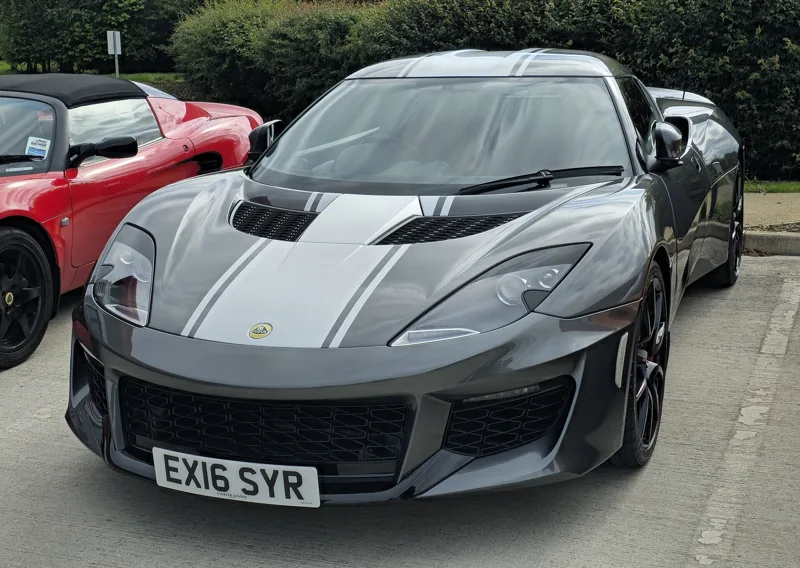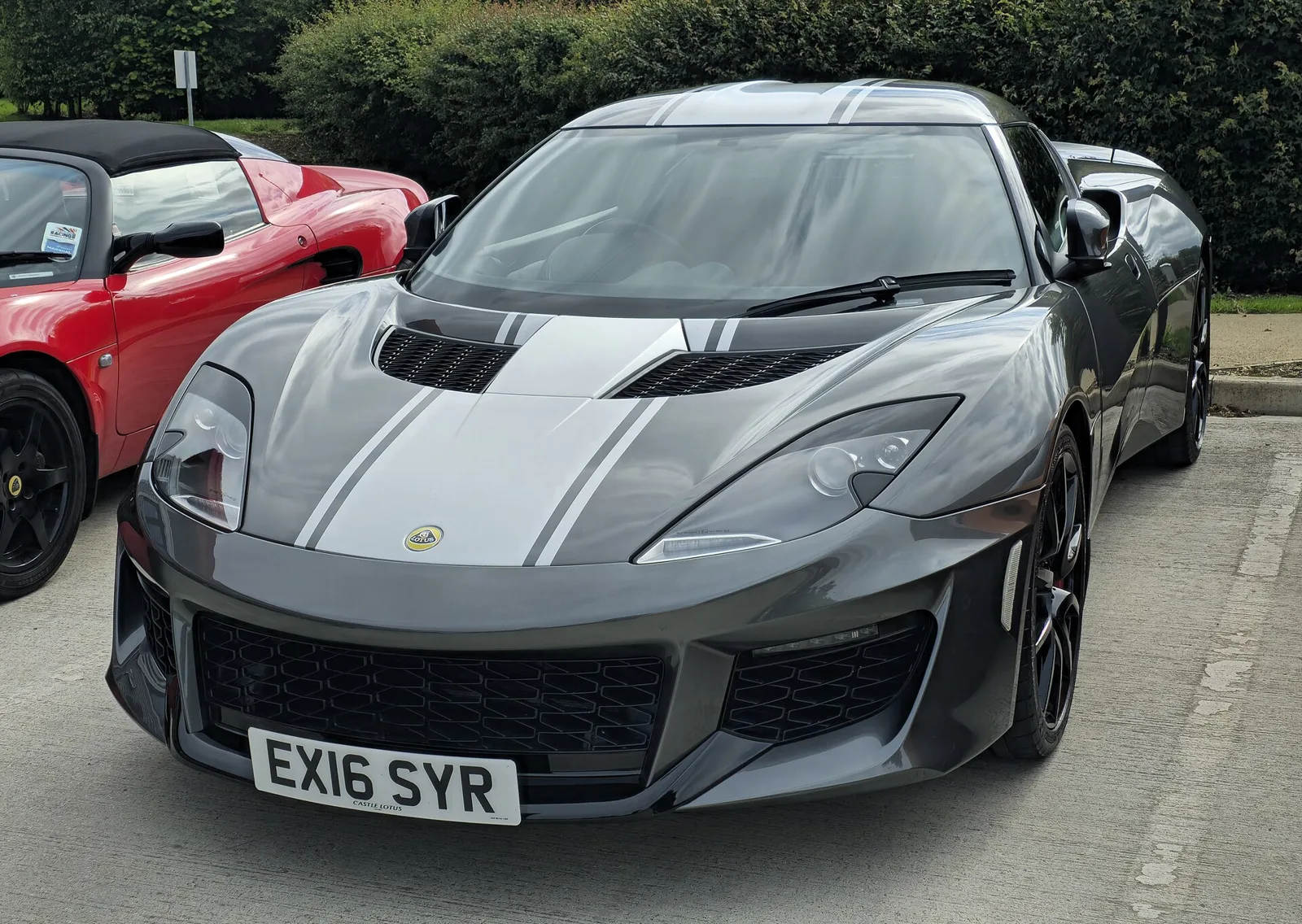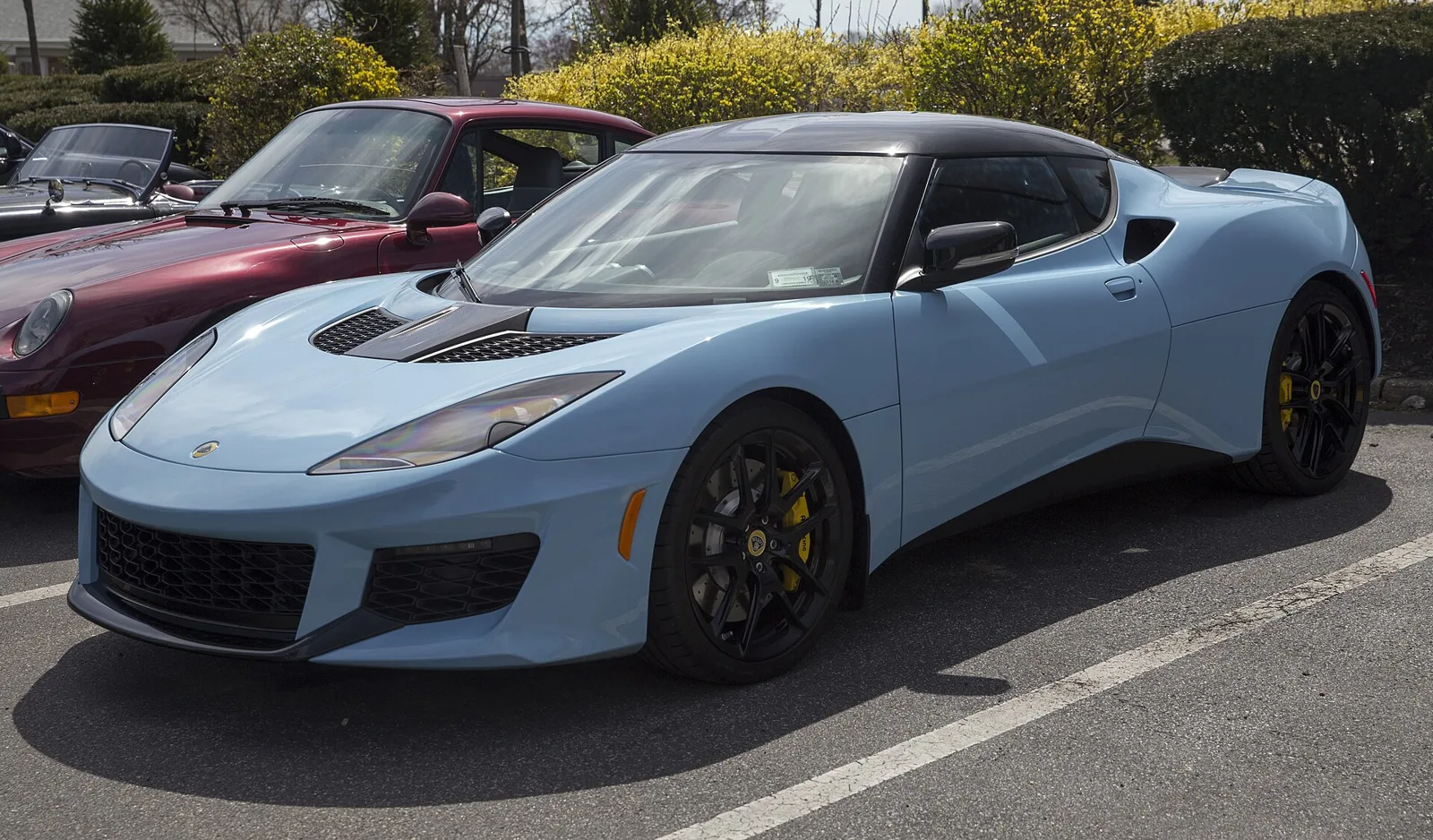
A mid-engined British 2+2 set against the sixth-generation 911, compared on weight, engines, speed, racing and the variants each car spawned.
The Lotus Evora and Porsche 911 (997) were rivals in the same market sector, with the Evora launched in 2008 as a mid-engined 2+2 and the 997 sold from 2004 to 2013. The Evora was lighter, while the 997 GT2 offered the most power of the pair.
The Lotus Evora was built to take buyers from the Porsche 911, and the 911 it faced was the 997. Lotus launched the Evora in 2008 as a mid-engined 2+2 with a Toyota-sourced V6. The 997 was the sixth generation of Porsche's 911, sold from 2004 to 2013, and the two cars reached similar owners by very different routes.
Why did Lotus aim the Evora at the 911?
Lotus wanted a practical road car that could sell beyond its track-focused models, and the Evora opened a five-year plan begun in 2006. The company hoped to sell 2,000 cars a year at prices from 45,000 pounds sterling, with US sales planned from early 2010.
The Evora was the first all-new Lotus platform since the Elise arrived in 1995, and the plan called for three vehicles to share it. The car was developed as Project Eagle and made its debut at the British International Motor Show on 22 July 2008.
Lighter and roomier on paper, the Evora met a 911 that had far more power to offer.
What was the Evora built on?
The core is an aluminium tub with a front crash structure of the same metal, and a steel rear sub-frame carries the drivetrain. Lotus bonded and riveted proprietary 6000 Series extrusions to stiffen the chassis. The suspension uses forged aluminium double wishbones with Bilstein gas dampers and Eibach coil springs, plus hydraulically assisted steering for easier manoeuvring.
The Evora was larger than the Elise and its derivatives, and the figures show it. It weighed 1,383 kg (3,049 lb) unladen, or 1,442 kg (3,179 lb) with the automatic, and the cabin was enlarged to suit taller passengers. Its drag coefficient was 0.337.
The boot behind the engine is large enough for a set of golf clubs, although Russell Carr, Lotus's design head, denied that this was intended. The Evora was also the only Lotus with a 2+2 seating layout at the time, and a two-seat layout, called Plus Zero, could also be offered.
Which car was lighter?
The Evora was lighter than both 997 models with a stated weight. Its 1,383 kg (3,049 lb) base figure sits under the 1,440 kg (3,175 lb) GT2 and the Turbo at around 1,569 kg (3,460 lb), and the GT430 manual was the lightest Evora at 1,258 kg (2,773 lb).
Lighter does not automatically mean quicker. The Evora's automatic cars carried extra mass from the gearbox and its cooling system, and the Targa's glass roof added 60 kg (132 lb) on top of the all-wheel-drive hardware the Targa required.
How did the engines compare?
The Evora's engine was a Toyota-sourced 3.5-litre 24-valve V6, mounted amidships and set transversely. The supercharged S used a Harrop unit, and later variants kept the same basic engine with superchargers from Edelbrock. Output rose from 350 PS (257 kW; 345 hp) on the S to 436 PS (321 kW; 430 hp) on the GT430.
Porsche's flat-six started at 3.6 litres in the Carrera, and the Carrera S moved up to 3.8 litres for 29 PS (21 kW; 29 bhp) more. The Turbo's engine drew on the design of the 911 GT1 and used two BorgWarner variable turbine geometry units, a Porsche production first.
The 2009 refresh changed the 997 further. A direct-injection engine replaced the Mezger unit, and PDK dual-clutch transmission replaced the five-speed Tiptronic automatic sourced from Mercedes-Benz. The updated cars beat their predecessors on speed, weight and fuel economy.
Specifications side by side
| Specification | Lotus Evora | Porsche 911 (997) |
|---|---|---|
| Launch or model years | Launched 22 July 2008; Evora S 2010; Evora 400 2015; GT430 2017 | Sold 2004 to 2013; Carrera 2004; Turbo and GT3 late 2006; GT2 2007 |
| Engine | 3.5-litre V6, Toyota-sourced, mid-mounted and transverse | Flat-six: 3.6 litres (Carrera), 3.8 litres (Carrera S); twin turbochargers on the Turbo and GT2 |
| Power | 350 PS (257 kW; 345 hp) on the S; 436 PS (321 kW; 430 hp) on the GT430 | 480 PS (353 kW; 473 bhp) on the Turbo; 530 PS (390 kW; 523 bhp) on the GT2 |
| Torque | 400 N m (295 lb ft) on the S; 450 N m (332 lb ft) on the GT430 automatic | 620 N m (457 lb ft) on the Turbo; 680 N m (502 lb ft) on the GT2 |
| Weight | 1,383 kg (3,049 lb) unladen; 1,258 kg (2,773 lb) for the GT430 manual | Turbo around 1,569 kg (3,460 lb); GT2 1,440 kg (3,175 lb) curb |
| Acceleration | 0-60 mph in 4.6 seconds on the S; 3.7 seconds on the GT430 manual | 0-100 km/h in 3.9 seconds on the Turbo manual; GT2 reaches 97 km/h (60 mph) in 3.4 seconds |
| Top speed | 277 km/h (172 mph) on the S; 306 km/h (190 mph) on the GT430 manual | 310 km/h (193 mph) on the Turbo; 330 km/h (205 mph) on the GT2 |
| Transmission | Six-speed manual or six-speed automatic by Aisin | Six-speed manual; Tiptronic automatic before 2009; PDK from the 2009 refresh |
| Body styles | Coupe, with a two-seat Plus Zero option | Coupe, cabriolet and Targa; Turbo Cabriolet from September 2007 |
| Price at launch | Planned from 45,000 pounds sterling to just over 50,000 pounds | GT3 at US$106,000; 911 Club Coupe at US$99,911 |
Which car was quicker in a straight line?
On the published figures, the 997 GT2 was the quickest of the pair. It reached 97 km/h (60 mph) in 3.4 seconds and topped out at 330 km/h (205 mph). The GT430 manual managed 0-60 mph in 3.7 seconds, but the two cars were quoted against different benchmarks.
The one like-for-like 0-60 mph figure available is a 2006 Motor Trend test of a manual 997 Turbo, which recorded 3.2 seconds. The GT430's 3.7 seconds is a quoted figure, so the two numbers should not be treated as a clean contest.
Top speed sits closer together. The Turbo reached 310 km/h (193 mph) with either transmission, while the Evora 400 was rated at 299 km/h (186 mph) and the GT430 manual at 306 km/h (190 mph).
How did the 997 range grow?
The 997 began with the Carrera and Carrera S coupe in early 2004. All-wheel-drive Carrera 4 models reached customers in November 2005, and the Turbo and GT3 followed in late 2006. The GT2 went on sale in November 2007, while the Turbo Cabriolet had arrived in September of that year.
Styling marked a break from the 996. The fried-egg headlamps gave way to classic bug-eye units, and the tail section ran 88 mm (3.5 in) wider than the 996's. Standard wheels grew to 18 inches, and the drag coefficient was 0.28 on the Carrera and 0.29 on the Carrera S.
Development ran in an unusual order. The cabriolet led the engineering work, on the reasoning that solving the convertible's stiffness problems first would leave the coupe with spare rigidity.
Cabriolet buyers could also specify factory hard tops, which protected the car better from bad weather than the soft roof and could be swapped with those for the late 996 cabriolet. The Turbo Cabriolet went further, ranking among the quickest drop-tops on sale, with speeds and acceleration close to the coupe's.
The Targa kept a glass roof, which drops 25 mm and slides a metre back under the rear window. Only the Targa 4 and 4S used it, and both were all-wheel drive. Porsche built 1,760 Targas in the debut year, 800 of them for the US market.
Porsche also built a limited run of 50 911 Club Coupes in 2005 to celebrate half a century of the Porsche Club of America. They were Carrera S models with the X51 Powerkit, finished in Azurro California paint, and the car bearing chassis number 001 went to the Porsche Museum in Stuttgart.
At the top of the range, the GT3 debuted at the 2006 Geneva Motor Show with the Turbo's 3.6-litre displacement but no turbochargers. Its 415 PS (305 kW; 409 bhp) came with an 8,400 rpm redline, and the GT2 added rear-wheel drive and a titanium exhaust to cut weight.
What did the Evora range add over time?
The Evora grew from a single V6 into a much wider line. The supercharged S arrived in 2010 and gave way in 2015 to the 400, which made 406 PS (298 kW; 400 hp) with an intercooled Edelbrock supercharger.
The Sport 410 followed at the 2016 Geneva Motor Show with carbon-fibre roof, tailgate and front access panels, a lithium-ion battery and lighter wheels. It weighed 1,325 kg (2,921 lb). The GT430 came in 2017 with 60 units planned, and it was the most powerful Evora and the fastest street-legal Lotus built to that point.
The GT430 Sport removed the rear wing for smoother airflow and lifted the top speed to 315 km/h (196 mph). The GT410 Sport marked Lotus's 70th anniversary and weighed 1,297 kg (2,859 lb), 62 lb (28 kg) less than the Sport 410.
The North American-only Evora GT arrived in June 2019 as a 2020 model, with 422 PS (310 kW; 416 hp) and an estimated 0-60 mph time of 3.8 seconds.
Earlier, Lotus built a prototype 414E hybrid in 2012 as a range-extended demonstration for a UK government body, the Technology Strategy Board. It emitted 55 g/km of CO2 and offered 30 miles of electric range, and a 1.2-litre three-cylinder petrol engine acting as a generator stretched the total to 300 miles. The 414E was the groundwork for the Infiniti Emerg-e concept.
Lotus also gave two specially equipped Evora S cars to the Carabinieri, Italy's gendarmerie, in July 2011. The company pledged to maintain the cars and train their drivers, which made the Evora a police car as well as a sports car.
Did either car go racing?
Both cars had a racing life, though the Evora's was short. Lotus fielded a pair of Evoras at the 2011 Le Mans race with tuned naturally aspirated V6 engines in place of the planned V8, and the car that finished took 22nd overall.
Car No. 65 completed 295 laps despite overheating during practice and qualifying, while the second car, No. 64, quit after 126 laps. The team behind them, Jetalliance Racing, could not secure a European deal for 2012, so Alex Job Racing ran an LM GTE car in the American Le Mans Series instead.
Alex Job Racing's results did not go well, and a Ferrari 458 Italia GT2 later became the team's main race car. The Evora GTE road car, built so its racer could run under GT3 and LM GTE rules, produced 438 hp (327 kW; 444 PS), with 25 units made.
Porsche's competition link ran through the GT2 and GT3. The GT2 used rear-wheel drive to save weight for GT2 class racing, as its predecessors had, while the GT3 gave Porsche a way to homologate aerodynamic features for racing and to supply race cars to customer teams.
How were the two cars received?
The 997 had a warm reception. Reviews from the worldwide motoring press were mostly positive, and even Jeremy Clarkson, a known critic of Porsche cars, praised it warmly.
For the Evora, the record offers sales figures rather than a critical verdict. Lotus set a target of 2,000 cars a year at launch, and 6,117 Evora were built overall before production ended.
Which car suits which buyer?
The Evora suits a buyer who wants a mid-engined Lotus with a 2+2 layout, while the 997 suits someone who wants a wide choice of body styles and more power. Neither wins on every figure, so the choice turns on which trade-off matters more.
Practicality favours the Evora on the evidence here. Its cabin was enlarged for taller passengers, and the boot behind the engine is generous.
Performance and range favour the 997. Coupe, cabriolet, Targa, all-wheel-drive and track-focused versions were all on offer, and the GT2 made 530 PS (390 kW; 523 bhp), more than any Evora in this comparison. The GT2 was also the first 911 past 200 mph and the first Porsche with launch control.
Weight is the Evora's strongest card. The GT430 manual was the lightest car in the pair, so a buyer who values agility should check the variant closely, since an automatic Evora adds mass and a Targa 997 adds roof weight.