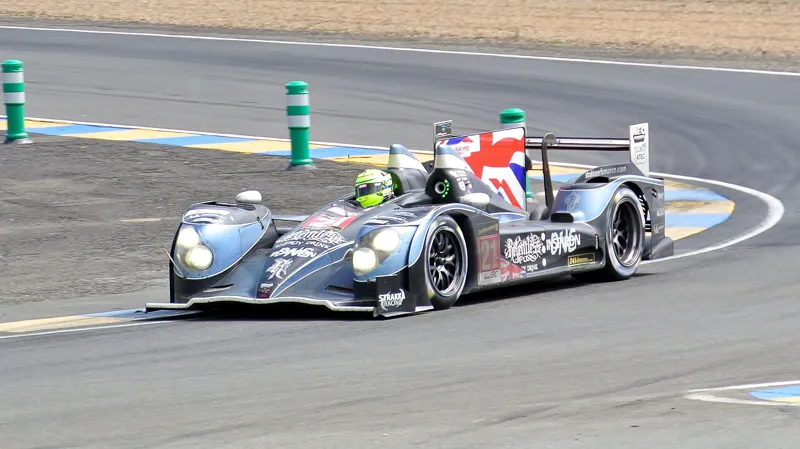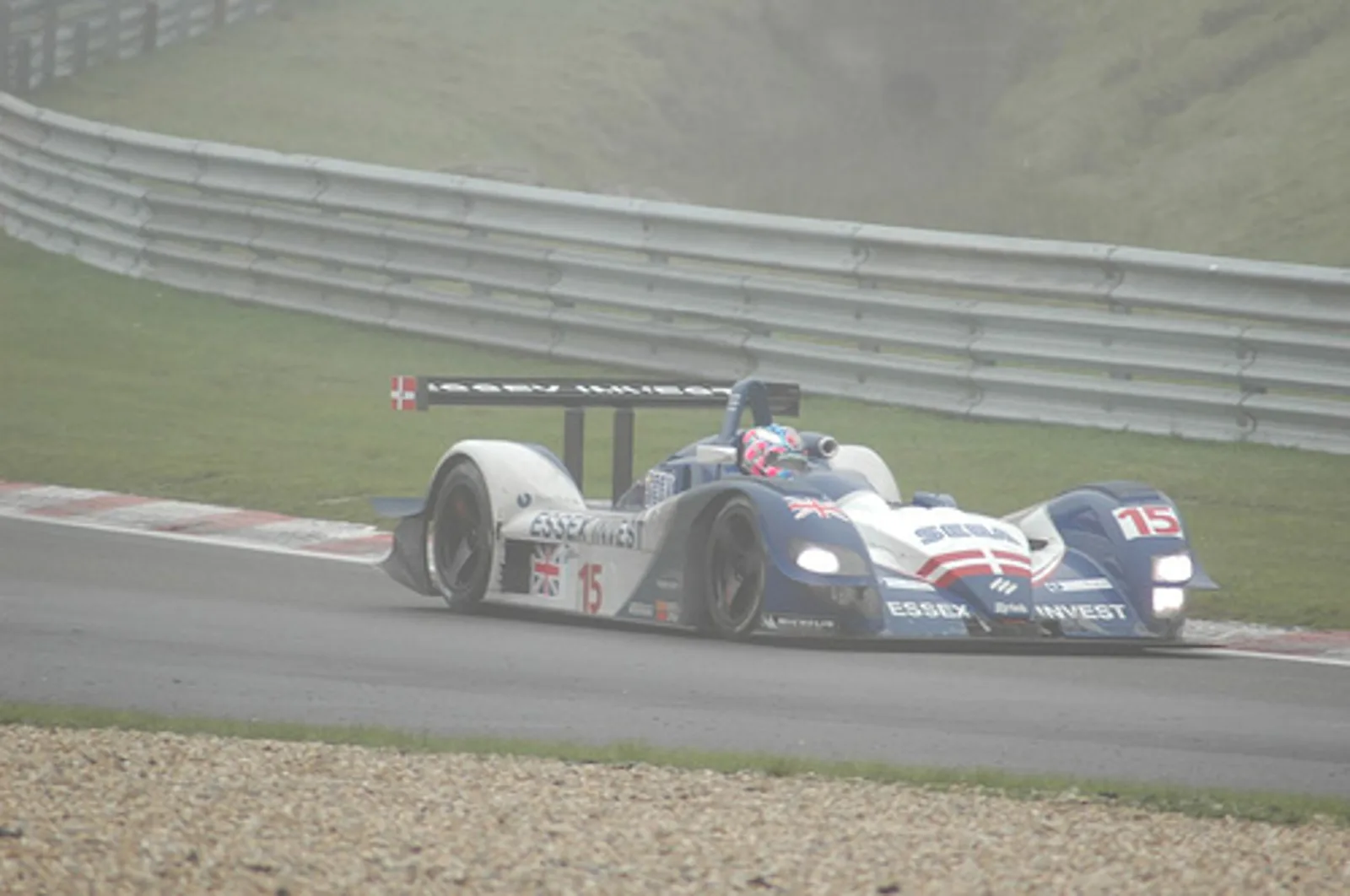
An unfinished Reynard that became a DBA, a Zytek and a Creation, and a Lola-based Ascari that turned into the KZR-1 and crossed the Atlantic.
Both were Le Mans prototypes of the early 2000s. Ascari built the A410 in 2000 around a Judd V10 and a Lola Group C design, then renamed it KZR-1. Reynard went bankrupt before finishing the 02S, whose design lived on as the DBA4 03S, the Zytek 04S, 05S and 06S, and the Creation CA06/H.
Reynard never finished the 02S. The company went bankrupt before the project was complete, and only three cars to its original design were ever built.
Yet the car did not die with its maker. It raced as the DBA4 03S, was reborn as the Zytek 04S, 05S and 06S, and then reappeared as the Creation CA06/H, wandering through Europe, America and Japan under a string of different names. The Ascari A410, a very different Le Mans prototype from the same era, had its own identity crisis: built in 2000, it was renamed the KZR-1 two years later and shipped across the Atlantic.
What was the Reynard 02S?
Reynard Motorsport built the 02S in 2002 as a Le Mans Prototype, intended to replace the failed Reynard 2KQ. It proved to be the company's final new design. International Racing Management bought the rights, completed the car as the DBA4 03S, and later partners built further versions.
Reynard never finished the 02S.
Why did Reynard need a new prototype?
The 2KQ, introduced in 2000, had enjoyed mixed success at best. Aerodynamic problems dogged it, and many customers quickly moved on to better chassis. An upgrade package called the 01Q followed in 2001, but Reynard concluded that only an all-new car would do.
The timing mattered. The Automobile Club de l'Ouest, which organises the 24 Hours of Le Mans, had just reorganised its prototype classes into LMP900 and LMP675. Because the chassis for the two classes looked so alike, Reynard designed one that could run in either, with ballast and engine choice deciding which. The 02S was first built around a Zytek ZG348 V8 of 3400 cc, the largest the LMP675 rules allowed.
Several details were new. Ricardo built a sequential gearbox with paddle shifters on the steering wheel, designed specifically for the 02S. Will Phillips shaped bodywork that sat very low, topped by a tall rear wing set at the maximum permitted height.
Who finished the Reynard 02S after the bankruptcy?
When Reynard went under, International Racing Management, known as IRM, bought the 02S designs and the unfinished chassis. The Japanese team YGK was offered the project first, with the idea that the car would be renamed the YGK 02S, but it declined to carry on developing it. RN Motorsport eventually joined, and after the car's debut as a Reynard at the 2002 Petit Le Mans it was renamed the DBA4 03S, later shortened to DBA 03S.
The name has a small story attached. Carsten Rae, a co-owner of RN Motorsport, chose DBA in honour of the newspaper he owned, Den Bla Avis. IRM changed very little between Reynard's development work and the finished car that appeared in late 2002.
How did the Reynard 02S and DBA 03S race?
RN Motorsport picked the 2002 Petit Le Mans as the car's first outing, hoping to prove what the chassis could do. It qualified tenth overall and third in LMP675 among 48 cars, with only two MG-Lola EX257s ahead of it in the class. John Nielsen and Casper Elgaard lasted six hours before cooling problems ended the race. For 2003 the team stayed in America for the 12 Hours of Sebring, qualified fifth overall and on the LMP675 pole, then broke a gearbox after only 73 laps.
Back in Europe, the renamed car contested the FIA Sportscar Championship in the SR1 class. Nielsen was joined by Hayanari Shimoda and Andy Wallace, and the car won at Oschersleben and finished second at Estoril. Money was tight, though, and the team had to skip several rounds, so it ended the season third in the championship.
The 24 Hours of Le Mans produced a better story. RN Motorsport took the LMP675 class pole, and its car was one of only three LMP675 machines to finish. It took second in class, but it was 31 laps behind the class winner and ranked a distant 23rd overall.
How did Zytek turn the Reynard 02S into the 04S, 05S and 06S?
After the 2003 season, the results of the lone DBA4 03S brought customers to IRM, all hoping for more chassis. IRM formed a partnership with Zytek Engineering: Zytek would build the cars while IRM kept the intellectual rights. Because Zytek built the new chassis entirely itself, they became the Zytek 04S. The classes had changed again, since LMP900 and LMP675 were eliminated in 2004, and the cars moved to the new LMP1 class with some adaptation.
The 04S layout held steady through 2004 and 2005. Then new regulations required older LMP900 and LMP675 cars to wear fresh bodywork, because their monocoques did not fully comply. Zytek reworked its 04S and fitted a larger 4000 cc 2ZG408 V8 for more power, which earned it the name 06S. A similar 4000 cc ZB408 V8 went into an existing 04S for Hitotsuyama Racing in Japan, and that car became the Zytek 05S.
Once 2006 ended, the hybrid Zytek could no longer race, which forced a new chassis, the Zytek 07S. It kept many styling elements of the 04S, but it shares nothing mechanical with the Reynard 02S and counts as an entirely new car.
What powered the Reynard descendants and the Ascari?
| Car | Engine | Size or detail |
|---|---|---|
| Reynard 02S (as designed) | Zytek ZG348 V8 | 3400 cc, the LMP675 maximum |
| Zytek 05S | Zytek ZB408 V8 | 4000 cc, for Hitotsuyama Racing |
| Zytek 06S | Zytek 2ZG408 V8 | 4000 cc, larger than the original V8 |
| DBA 03S (Creation, 2005) | Judd GV5 V10 | 5000cc, replacing the Zytek V8 |
| Ascari A410 | Judd GV4 V10 | 4 litres, naturally aspirated, around 600 hp |
How did the Zytek, Jota and Hitotsuyama cars get on?
Zytek's own team ran its second chassis in the new Le Mans Series in 2004 but did not complete a season. In the only two races it entered it finished sixth and fourth, enough for eighth in the championship, and it failed to finish at Le Mans. For 2005 the programme grew to a full campaign, and it paid off. Shimoda, Elgaard and Nielsen won the opening round at Spa, and Shimoda and the newcomer Tom Chilton repeated the feat at the Nurburgring. Even so, the team ended second in the LMP1 championship, just two points behind Pescarolo Sport.
In America that year the team also took pole and then the win at Laguna Seca. The 06S season in 2006 was less happy. Delays in finishing the chassis meant missing the opening round, third and seventh places followed, and problems at the fourth round led the team to skip the final one, leaving it fifth in the championship.
Sam Hignett's Team Jota bought a customer 04S for the 2004 Le Mans Series after racing against the DBA4 03S. A best finish of fifth was all it managed that year, though it still tied for sixth in the championship. In 2005 it took second at Monza, scored points in every remaining race and finished sixth again. At Le Mans it ran 12th towards the end, but a mechanical problem stopped the car before the line and left it unclassified. Jota then sold the 04S to Creation Autosportif to be converted into a second CA06/H.
Hitotsuyama Racing bought Zytek's former 04S for the newly launched Japan Le Mans Challenge and fitted the 4000 cc ZB408 V8. After no finish in the first two rounds of 2006, it came fourth overall in the last, 23 laps behind the winning Courage-Mugen.
What did Creation Autosportif do with the car?
Creation Autosportif bought the lone DBA4 03S after RN Motorsport was dissolved and entered the new Le Mans Series in 2004. Jamie Campbell-Walter and Nicolas Minassian scored third-place finishes, leaving it fourth in the LMP1 standings with three Audi R8s ahead.
For 2005 the chassis was modified to suit the new LMP1 regulations, with the engine bay heavily revised to take a 5000cc Judd GV5 V10 in place of the Zytek V8. Minassian and Campbell-Walter finished second at Silverstone and fifth in the teams championship, and the team made its Le Mans debut with a 14th-place finish.
The hybrid rules of 2006 forced a bigger rebuild. With help from KW Motorsport, Creation produced its own car, quite unlike Zytek's 06S, and renamed it the Creation CA06/H. Early Le Mans Series rounds were a struggle, but by the third the team was second again. At Donington a second CA06/H made its debut and both cars reached the podium, one of Creation's strongest days. A fourth at the final round secured second in the championship.
For 2007 Creation moved to an all-new chassis, the Creation CA07, and sold its CA06/Hs. Intersport Racing, an American team hoping to step up from LMP2 to LMP1, bought one. The ALMS rules allowed older hybrid chassis to continue, but Kumho tyres caused trouble because the company had never made an LMP1 tyre before. Dunlop tyres brought no improvement, and Intersport abandoned the chassis. Autocon Motorsports bought the other one.
What was the Ascari A410?
Ascari Cars built the A410 in 2000 as an LMP900 prototype. Its basis was the Lola T92/10 Group C racing car, and its engine was a 4-litre Judd GV4 V10. Ascari made two cars plus a spare chassis, and in 2002 the cars were renamed the Ascari KZR-1.
Klaas Zwart founded Ascari Cars in the late 1990s and began entering the team in sports car racing, first with the Ascari Ecosse in 1999 and then with the A410 in 2000. The name came from the capacity of the Judd engine. The car borrowed heavily from the Lola: a similar chassis design, similar suspension and the flat-nosed front end. The obvious difference was open bodywork where the T92/10 had a closed cockpit. Even the engine had a family link, since the GV4 was a bigger version of the 3.5-litre GV10 in the earlier car, which itself began life as a Formula One unit.
What was the Ascari A410 like to drive and race?
The A410 had a carbon fibre monocoque, double wishbone suspension and coil springs and dampers at each end worked by push-rods. Behind the driver sat the naturally aspirated Judd GV4, producing around 600 hp (447.4 kW; 608.3 PS) at 10,250 rpm and 450 Nm (332 lb ft) of torque at 8,500 rpm. A 6-speed sequential gearbox sent power to the rear wheels, and carbon disc brakes were standard in the class.
The power matched that of the most successful LMP900 car, the Audi R8, but the delivery did not. The R8 used a 3.6-litre twin-turbocharged V8, and it produced around 250 Nm (184 lb ft) more torque. Power and torque are different things: power is how much work an engine can do each second, while torque is the twisting push it delivers at the wheels at a given moment. With similar power but far less push, the Ascari had to be kept spinning hard to give its best, and its torque peak sat at 8,500 rpm.
How did the Ascari A410 do at Le Mans and in 2000 and 2001?
The early days were rough. The A410 made its debut at the 2000 500 km of Silverstone, but gearbox problems stopped it racing. Team Ascari then tried for the 24 Hours of Le Mans, but it had missed the Le Mans Test and did not get an invitation. At the 1000 km of the Nurburgring, Zwart entered himself alongside Werner Lupberger and Jeffrey van Hooydonk. The car started a race for the first time, only to retire after 41 laps with another gearbox failure.
Brno, in the Sports Racing World Cup, saw an A410 reach the flag for the first time: Lupberger and Zwart were 19th and last overall, twelve laps adrift of the car ahead. It was the only finish of the year. At Donington Park the team stopped before finishing a lap because of electrical issues, suffered similar problems at the Nurburgring after 27 laps, and spun out after 29 laps in the final race at Magny-Cours.
The 2001 season began in much the same way. Mike Phillips tried to enter an A410 at the 24 Hours of Daytona but did not turn up. The championship had been renamed the FIA Sportscar Championship, and Lupberger and Ben Collins began with a retirement, though the car lasted 74 laps at Barcelona before the engine blew with half an hour to go. At the European Le Mans Series round at Donington Park, Lupberger and Collins were classified 23rd after 35 laps and 54 minutes, stopped by another gearbox problem.
Success arrived at the 1000 km of Monza, where Collins and Lupberger took the car to second place in the 1000 km race, 7 seconds adrift of the Ferrari 333SP-Judd driven by Giovanni Lavaggi and Christian Vann. At Spa-Francorchamps they were fourth, a lap down, with the second fastest lap of the race.
Le Mans in 2001 was a disappointment. Lupberger and Collins were joined by Harri Toivonen in the A410-001, while Zwart shared the other car with Xavier Pompidou and Scott Maxwell. Neither finished. The A410-001 retired with fuel pump trouble after 134 laps, 11 hours in, and the second car crashed out 15 hours in, after 66 laps.
Back in the FIA Sportscar Championship, Collins and Lupberger took fourth at both Brno and Magny-Cours, and then won at Donington Park by almost a minute. That was the car's maiden victory. In the last race of the year at the Nurburgring the car was disqualified from third place because of issues with its dimensions. Team Ascari finished fourth in the championship with 71 points, nine behind Racing for Holland in third and 30 ahead of R&M in fifth. Its one European Le Mans Series race left it eighth with 11 points.
What happened to the Ascari KZR-1?
For 2002 both cars were renamed the Ascari KZR-1, a name not to be confused with the later Ascari KZ1-R GT3 racing car, and shipped to America. Their first appearance came at the 24 Hours of Daytona. Lupberger and Toivonen shared the A410-001 chassis with T. J. Bell, while Collins, Zwart and Vann drove the A410-002, which also carried a BMW 4-litre V8 engine.
Neither had a good race. The A410-001 retired with a blown engine after 15 hours and 429 laps, yet was still classified 38th overall and ninth in the SRP class. The second car was classified 70th and 16th in class after electrical issues ended its race at six hours and 116 laps. At the 12 Hours of Sebring, Kristian Kolby replaced Toivonen and Justin Wilson replaced Zwart. Collins, Vann and Wilson finished sixth overall, and the other car came home 29th overall and tenth in class.
Team Ascari was allowed to enter only one KZR-1 at Le Mans. Lupberger, Collins and Bell drove it, but an accident caused by suspension failure ended their race after an hour and 17 laps. The team ended tenth in the American Le Mans Series Team's Championship with 19 points.
The KZR-1s returned to Europe for 2003. Lupberger, Zwart and Charles Hall finished second overall at Monza, the third round of the FIA Sportscar Championship, though ninety seconds behind the winner. At Donington Park a driveshaft failure came with just over 15 minutes remaining, after 83 laps. Team Ascari entered the 1000 km of Spa but did not attend. That single finish put it joint seventh in the standings, level on eight points with Promec Engineering.
After that, Ascari put its energy into the KZ1 supercar, the road car behind the KZ1-R GT3 racing car, and into Zwart's classic Formula One cars, which raced in the EuroBOSS series.