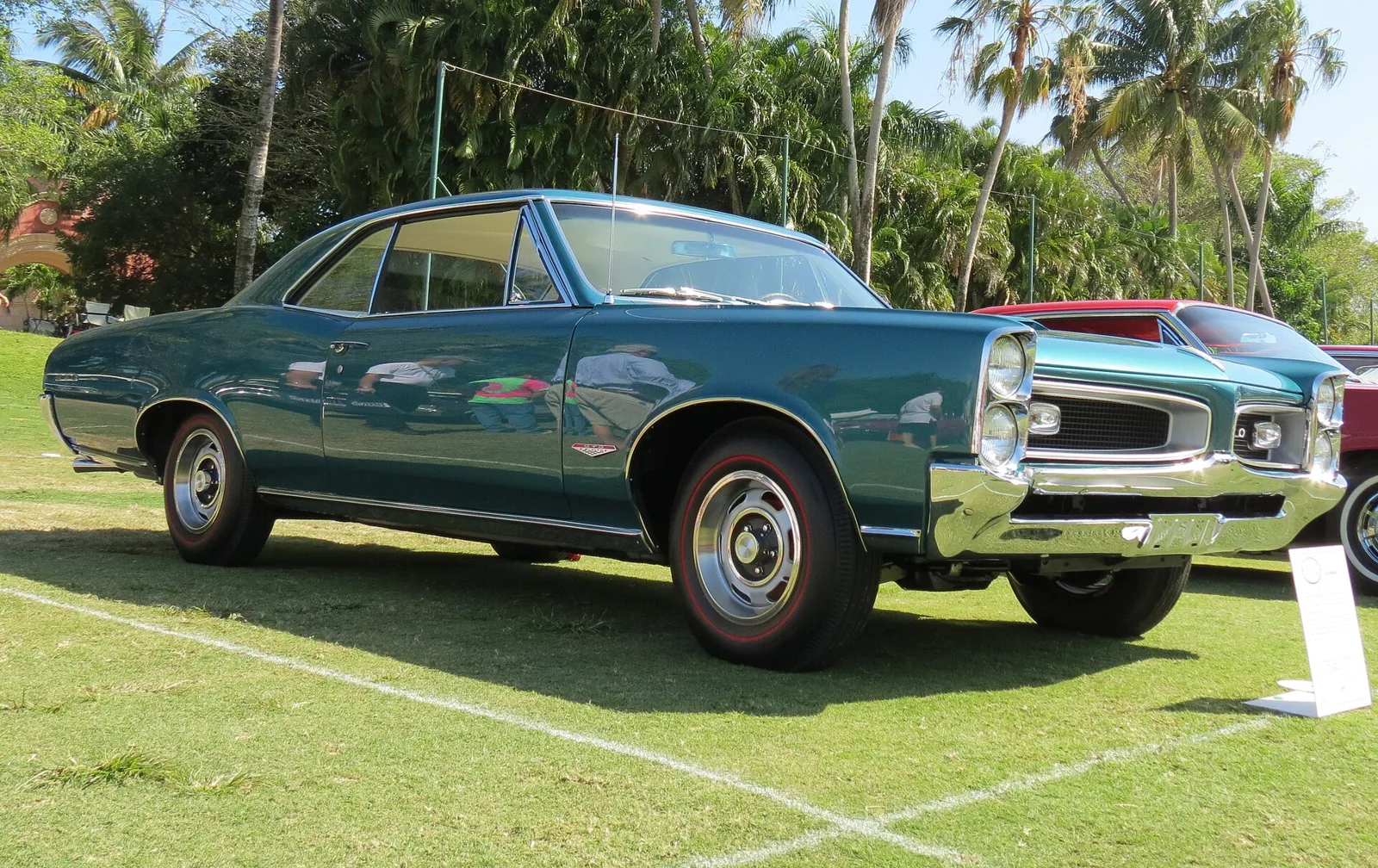
Three American performance names, each born in a garage or a driving school, that ended up on the cars Detroit sold.
Hurst, Edelbrock and Callaway are American performance brands. Hurst made gear shifters and the Jaws of Life, Edelbrock has made intake manifolds and engine parts since 1938, and Callaway built twin turbo Corvettes sold through Chevrolet dealers from 1987 to 1991.
The Jaws of Life, the hydraulic rescue tool, came out of the research department of a company best known for gear shifters. That oddity is a fair summary of American performance brands. Hurst, Edelbrock and Callaway each began as a garage, a repair shop or a driving school, and each grew into a company with its own parts catalogue, race programme or factory option.
Hurst Performance began as a repair shop and a bumper
George Hurst and Bill Campbell set up an auto repair shop in 1958 in Glenside, Pennsylvania, and called it Hurst-Campbell. They later moved to a larger building in Warminster. One customer, an older man named Lawrence Greenwald, had cars in his collection repaired there and decided to finance the pair. The plan was to make big bolt-on tubular bumpers for Volkswagen Type 2 buses and trucks built before 1958.
That product did not last. Volkswagen began making its own bumper guards, so Hurst-Campbell looked elsewhere and found its answer in the gearshift. The firm made piston-driven shifters, along with engine mounts, wheels and shift knobs. Hurst Performance, as it became, started out as a maker of motor mounts for engine swaps and floor-shifters, and added wheels, gloves, clutches and brakes over the 1960s. It bought Schiefer Manufacturing, a clutch maker, and Airheart, which made brake systems.
A repair shop, a garage and a driving school each became a performance name.
Why a Hurst shifter sold a car
By the early 1960s a Hurst shifter had become the badge of a serious drag car. Enthusiasts pulled out the floor or column lever fitted at the factory and bolted in a Hurst floor shifter for firmer, more precise control of gear selection when racing.
General Motors then reversed itself. Company policy had barred the names of outside suppliers from GM products, yet the 1964 Pontiac GTO carried a Hurst shifter, and the Pontiac division manager, Elliot "Pete" Estes, persuaded GM that the name would help sell cars. Cobranding began in 1965, and Hurst teamed up with all four domestic makers: General Motors, Ford, Chrysler and American Motors.
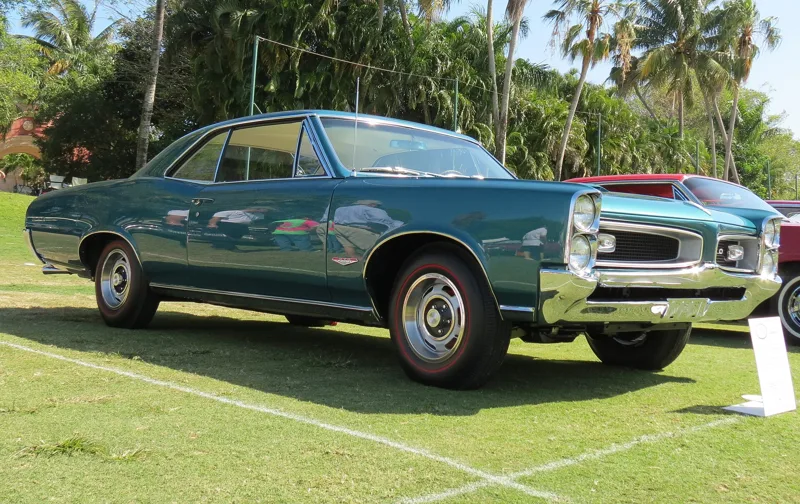
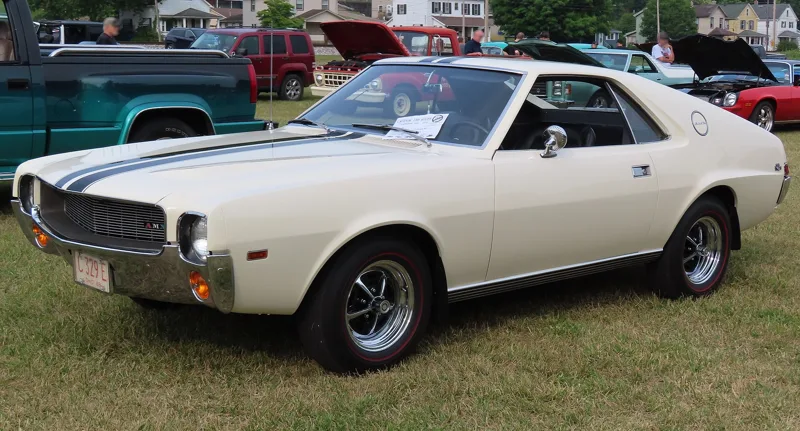
That made Hurst a supplier to the factories as well as to the aftermarket. Its parts were standard on AMC's The Machine and optional on cars such as the AMX and Javelin, the Camaro and Firebird, the GTO, the Oldsmobile 442s, the Boss 302 and Boss 429 Mustangs, the Charger, the Barracuda and the Superbird. Specialty models carried its name too, among them the 1969 AMC SC/Rambler, the 1970 Chrysler Hurst 300, the 1971 Hurst Jeepster and the 1971-1972 Pontiac Grand Prix SSJ.
Lightning Rods, a Pace Car and a double-dropped wheel
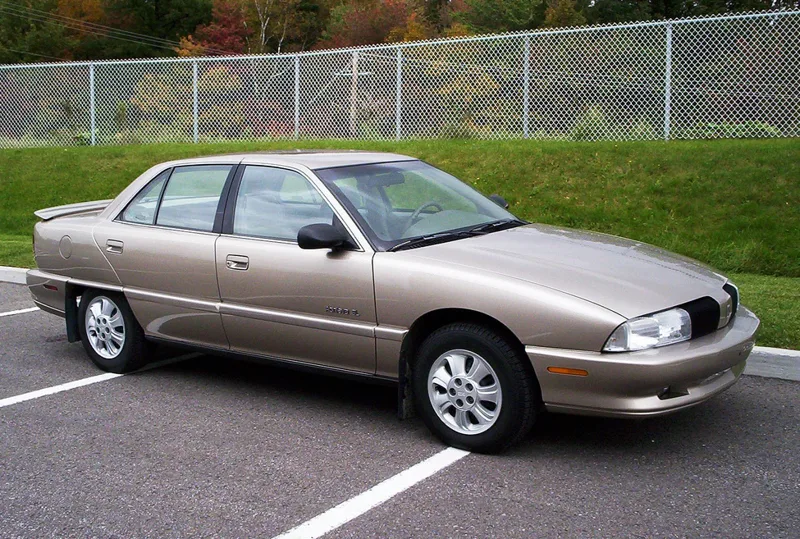
The 1972 Hurst Oldsmobile Pace Car was built by Hurst for Indianapolis race day and copied for Oldsmobile showrooms. The 1983 Hurst/Oldsmobile took the shifter idea somewhere odd. Instead of one lever, the console carried "Hurst Lightning Rods": three chrome shafts of unequal length side by side, intended to simplify straight-line acceleration. The model was sold for two years, and aftermarket conversions for the THM200-R4 transmission were offered for Buick, Chevrolet and Pontiac performance cars.
The wheels were a serious product. Without industry standards, many aftermarket road wheels of the time were poorly built and prone to failure from metal fatigue. Hurst answered with a wheel that had a double-dropped forged aluminium centre and a heavy-duty steel rim.
How Hurst gave the world the Jaws of Life
The company's research department developed the Jaws of Life. The product was later spun off and sold separately while Dick Chrysler owned the business. In the early 1970s Hurst also designed a complete Hurst Rescue System, an emergency medical vehicle built on the AMC Gremlin. It was quicker and more compact than the heavy rescue vehicles used at racetracks, and it was meant to accompany highway emergency crews.
Hurst changes hands
Greenwald and Hurst took the company public in 1968, and Sunbeam Products, a maker of small appliances, bought it in 1970. Hurst had been promised an executive role and a board seat, which never materialised. Greenwald retired at 67, and both men died in 1986.
After Sunbeam, the Hurst operations passed to Richard Chrysler's Cars and Concepts operation in Brighton, Michigan. Mr. Gasket followed, then Echlin in the 1990s, and B&M bought the brand in 2007. A subsidiary, Hurst Performance Vehicles, was created in 2008 to build new versions of the Hurst Challenger, Viper and Camaro.
Edelbrock parts began with a 1932 Ford and a bad manifold
Vic Edelbrock Sr. was born in 1913 in Eudora, Kansas. He left school at 14, after the family grocery burned down, to drive Model T Fords from Wichita to outlying farms, stopping to replace parts that vibrated loose on dirt roads. He reached California in 1931 and, after working as a mechanic and parking cars at an apartment complex, opened a repair shop of his own.
In 1938 he bought a 1932 Ford Roadster. Seeking more power from its flathead V8, he teamed up with Tommy Thickstun on a new intake manifold, found it wanting, and designed his own, nicknamed the Slingshot. It let the engine breathe through two Stromberg 97 carburettors, which removed a bottleneck that limited power. He tested it at the Muroc dry lake, now the site of Edwards Air Force Base. On 16 November 1941, with the fenders and hubcaps stripped off, he set a national flying quarter-mile record of 195.45 km/h (121.45 mph). The response to the record run persuaded him to build more manifolds, and in the end he made 100. The Slingshot was the first product Edelbrock sold, and it is where the company starts.
Edelbrock racing: the midget that beat the Offys
The Second World War put Edelbrock's machine skills to work at Todd Shipyards in Long Beach, where racing was banned. Afterwards he produced aluminium racing cylinder heads and manifolds that caught on among hot rodders. In 1946 he and Pete Petersen produced the company's first catalogue, Edelbrock Power and Speed Equipment, and in 1947 he made the first cylinder heads for the Ford flathead. By 1949 he was an early adopter of the engine dynamometer, working from a 5,000 sq ft shop.
Racing was his testing ground. In 1946 he bought a midget car built by Frank Kurtis, both to race and to serve as a test bench. His team toured the dirt tracks of Southern California, and its drivers included Walt Faulkner, Bill Vukovich and Rodger Ward. On 10 August 1950 at Gilmore Stadium, Ward's Edelbrock-powered number 27 V8-60 broke the winning streak of the Offenhauser-engined midgets, which had held a power advantage for years. It ran on a secret fuel blend with 20 per cent nitromethane, disguised with the smell of orange oil. The car won again the next night in San Bernardino. Edelbrock is generally regarded as the mechanic who made that volatile fuel work.
Small-block Chevrolets and the one-horsepower-per-cube barrier
Until 1955 Edelbrock made parts only for Ford. That year Chevrolet delivered three of its new small-block V8s to him. He put one on a dynamometer, used another to test multi-carburettor manifolds for magazine articles and prepared the third for boat builder Henry Lauterback, who set two world records. In 1958 he extracted one horsepower per cubic inch from a 283 cubic-inch Chevrolet fitted with his new Cross Ram manifold, which led to manifolds for Pontiac and Chrysler engines. In 1964 a four-barrel manifold for the small-block Chevrolet, the C-4B, opened a new product line, and the risk of competing with the factory paid off.
| Brand | Started | Founder | First product | Today |
|---|---|---|---|---|
| Edelbrock | 1938 | Vic Edelbrock Sr. | Slingshot intake manifold | Owned by Industrial Opportunity Partners since 2010; headquarters moving to the Memphis region |
| Hurst | 1958 | George Hurst and Bill Campbell | Tubular VW bumpers, then shifters | Brand owned by B&M since 2007 |
| Callaway | 1977 | Reeves Callaway | Turbocharger kits | Based in Old Lyme, Connecticut |
How Edelbrock grew, listed and went private
Vic Sr. died of cancer in 1962, aged 49. The company then had ten employees and annual sales of $450,000. His son, Vic Jr., then 26, took over as president and chief executive, and held the post until 2010. He served as president of SEMA, the Specialty Equipment Market Association, from 1971 to 1974, at a time when the Clean Air Act and the new Environmental Protection Agency were targeting engine pollution. When fuel prices rose in the 1970s, Edelbrock launched its Streetmaster manifolds, which promised better mileage as well as performance.
In 1987 the company moved to Torrance, California, to a site of more than 400,000 square feet (37,000 m2). It built a 73,000-square-foot (6,800 m2) aluminium foundry at San Jacinto in 1990. The 1994 stock market listing on NASDAQ raised $21 million, mostly spent on a new exhaust division. In 2000 it acquired Russell Performance Plumbing. In 2004, the year it went private again, Edelbrock employed 722 people and reported revenue of $125.98 million. Industrial Opportunity Partners bought the company on 7 June 2010.
What Edelbrock parts and sponsorship look like today
The Edelbrock parts list now covers camshaft and lifter kits, carburettors, crate engines, cylinder heads, electronic fuel injection, engine blocks, fuel pumps, intake manifolds, nitrous oxide injection, superchargers and water pumps. Resellers, online and in shops, carry it, and a direct-to-consumer website launched in 2018.
The Edelbrock logo is common in NASCAR even though the company sponsors no team. In 2004 it paid $250,000 a year for the contingency sticker that appears on every NASCAR race car, a payment that rewards winners in return for use of their images. It has been the title sponsor of the PRO Edelbrock Drag Racing Series since 2002, which runs seven heads-up classes and three index classes. In 2021 it worked with Ilmor on engines for the Superstar Racing Experience, supplying the camshaft and ignition coils for an engine based on the Ilmor 396.
Callaway Corvette: a golf heir with a BMW and a turbocharger
Reeves Callaway, the son of the Callaway Golf founder, could not afford a racing career in 1973, so he took a job as an instructor at Bob Bondurant's school. The school car was the newly launched BMW 320i. Callaway learned its faults well enough to talk BMW into letting him take one to his garage in Old Lyme, Connecticut, and tune it. His first prototype turbocharger system impressed the Car and Driver writer Don Sherman, who gave it a one-page article. Callaway promised turbo kits for BMW owners even though he lacked the equipment to make them, a drill press included. He founded Callaway Cars in 1977.
Kits followed for Volkswagen, Porsche, Audi and Mercedes-Benz. In 1980 and 1981 the company designed an IndyCar V8, the HH, in an eleven-month programme with the engine designer Hans Hermann. Next came a twin turbo Alfa Romeo GTV6; between thirty and thirty-six were built from 1983 to 1986. The GTV6 caught the attention of Dave McLellan, chief engineer of the Corvette, and that led to the Callaway Corvette association.
The Callaway Twin Turbo Corvette that Chevrolet sold
The Callaway Corvette was a factory option, Regular Production Option B2K, offered from 1987 to 1991 at select Chevrolet dealers. Cars ordered with it went from the Bowling Green assembly plant straight to Old Lyme, where the twin turbo conversion was fitted, and then on to the ordering dealer. The standard GM warranty of 12 months or 12,000 miles covered them, and Callaway reimbursed dealers for work on the added parts. It was the only time GM let a customer order a non-GM performance upgrade for the Corvette from the factory.
The 1987 car made 257 kW (345 hp) and 630 N m (465 lb ft), with a top speed of 286 km/h (178 mph), for just over $50K. That put it in the same performance bracket as Ferraris and Lamborghinis costing $100K to $175K. National Corvette Museum records show 188 Corvettes built that year with 167 carrying the Callaway option.
Output rose each year. The 1988 cars were rated at 285 kW (382 hp), with 762 N m (562 lb ft) of torque, and 125 were built, 105 of them ordered with the B2K option. In 1989 the power was unchanged and an AeroBody became available, with 68 built. In 1990 GM introduced the ZR-1 with similar performance to the 1989 Callaway, and the Callaway option hit its lowest order tally, 59 ordered and 58 built. For 1991 Callaway lifted the output to 300 kW (402 hp), with torque at 789 N m (582 lb ft), the last year for the L98 engine on which the car was based, and 62 were ordered. Altogether 497 were ordered through normal channels.
The Sledgehammer Corvette and its world record
The ultimate version was the Sledgehammer. In November 1988 at the Transportation Research Center in Ohio it set a World Street Legal speed record of 410.00 km/h (254.76 mph), which stood until 1999. It was a production car, built from chassis 1988-051, emissions compliant and equipped with air conditioning and a radio. Modified body panels, designed by Paul Deutschman and known as the Callaway AeroBody, cut drag and improved stability. After the record, the AeroBody became an option from 1989. The last twin turbo cars and the Callaway Speedsters made up the 500 Series, with OZ Racing wheels and Bridgestone Potenza tyres.
Callaway beyond the Corvette
Aston Martin hired Callaway to re-engineer its 30-year-old two-valve V8, designed by Tadek Marek, with four-valve heads for the Virage, which debuted in 1989. Callaway then supplied the race version of the engine for the AMR-1 Group C car, which finished eleventh at Le Mans. The C7 supercar, developed from 1993 to 1996 for GT1 racing, failed to pre-qualify at Le Mans in 1996. At the Daytona 24 Hours it led after 12 hours before an electrical failure caused an oil system failure.
The wider range included the SuperNatural Camaro, of which about 55 were built, the Callaway Impala SS with a 400 bhp 383 cubic-inch engine, a ski boat made at 125 a year, and a 1999 Range Rover 4.6 HSE limited to 220 cars at $75,000. The Callaway engine in the Range Rover made 180 kW (240 bhp) and cut the 0-60 mph time from 9.7 to 8.6 seconds. Reeves Callaway died on 11 July 2023, aged 75.
Callaway keeps building packages and Edelbrock is moving to Memphis
Callaway's current projects are the Corvette SC757 based on the Z06, the Stingray-based SC627, the Camaro SC630 and SC750, the Cadillac CTS-V SC740, and SC480 and SC560 packages for the Tahoe, Suburban, Yukon and Escalade, with headquarters in Old Lyme, a West Coast base in Temecula and a European one in Leingarten, Germany. In January 2021 Edelbrock announced that its headquarters would move to the Memphis, Tennessee region. Hurst Performance Vehicles was set up in 2008 to build new Hurst versions of the Challenger, Viper and Camaro.