From a converted factory in Dearborn to the global stage, Ford has spent more than a century shaping how the world builds, buys and drives cars.
Ford has built cars since 1903, when Henry Ford and twelve investors set up shop in a converted factory in Dearborn, Michigan. The company created the moving assembly line, put the world on wheels with the Model T, and remains one of the largest family-controlled businesses on earth.
Henry Ford, together with a dozen backers, launched a car-making enterprise in 1903, operating from a repurposed plant in Dearborn, Michigan. A hundred-plus years on, the firm still ranks among the biggest businesses worldwide that are run by a family, and it markets Ford and Lincoln models around the world.
How did Ford get started?
Henry Ford was 39 when he incorporated the company on June 16, 1903, raising $28,000 from twelve investors. That money came from a group that included John and Horace Dodge, who would later found their own rival marque.
The first president was not Henry Ford himself but John S. Gray, a local banker chosen to reassure backers that Ford would not walk away with their money. It was not Ford's first attempt at building cars: the Henry Ford Company of 1901 was reorganised and became Cadillac in 1902, leaving Ford to try again with a cleaner slate.
Ford did not simply build cars; it built the system that made cars affordable, and then spent a century refining it.
What was the first Ford car?
Ford's first cars bore plain one-letter names - A, B, C, F, K, N, R and S - and came together in workshops where just two or three workers put them together using components bought in from elsewhere. Produced from 1903 to 1908, these machines laid the groundwork for the business ahead of the model that would go on to be its best-known offering.
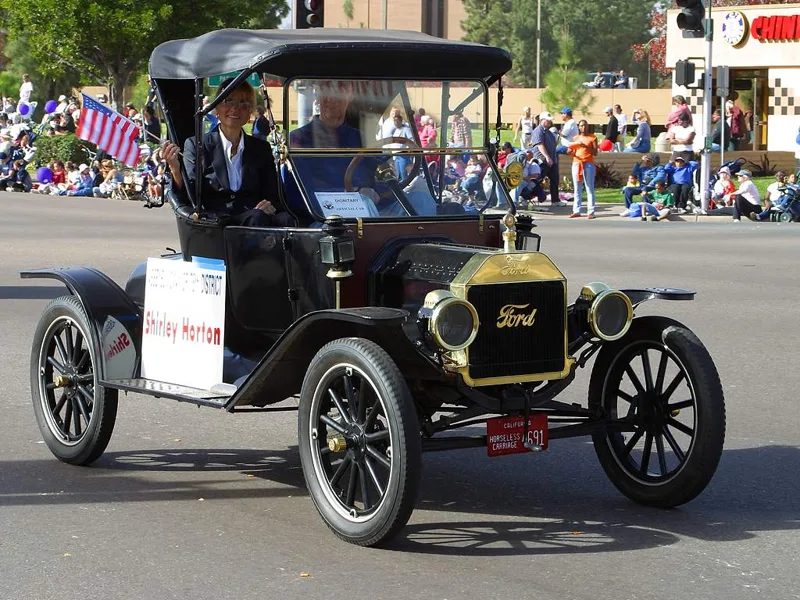
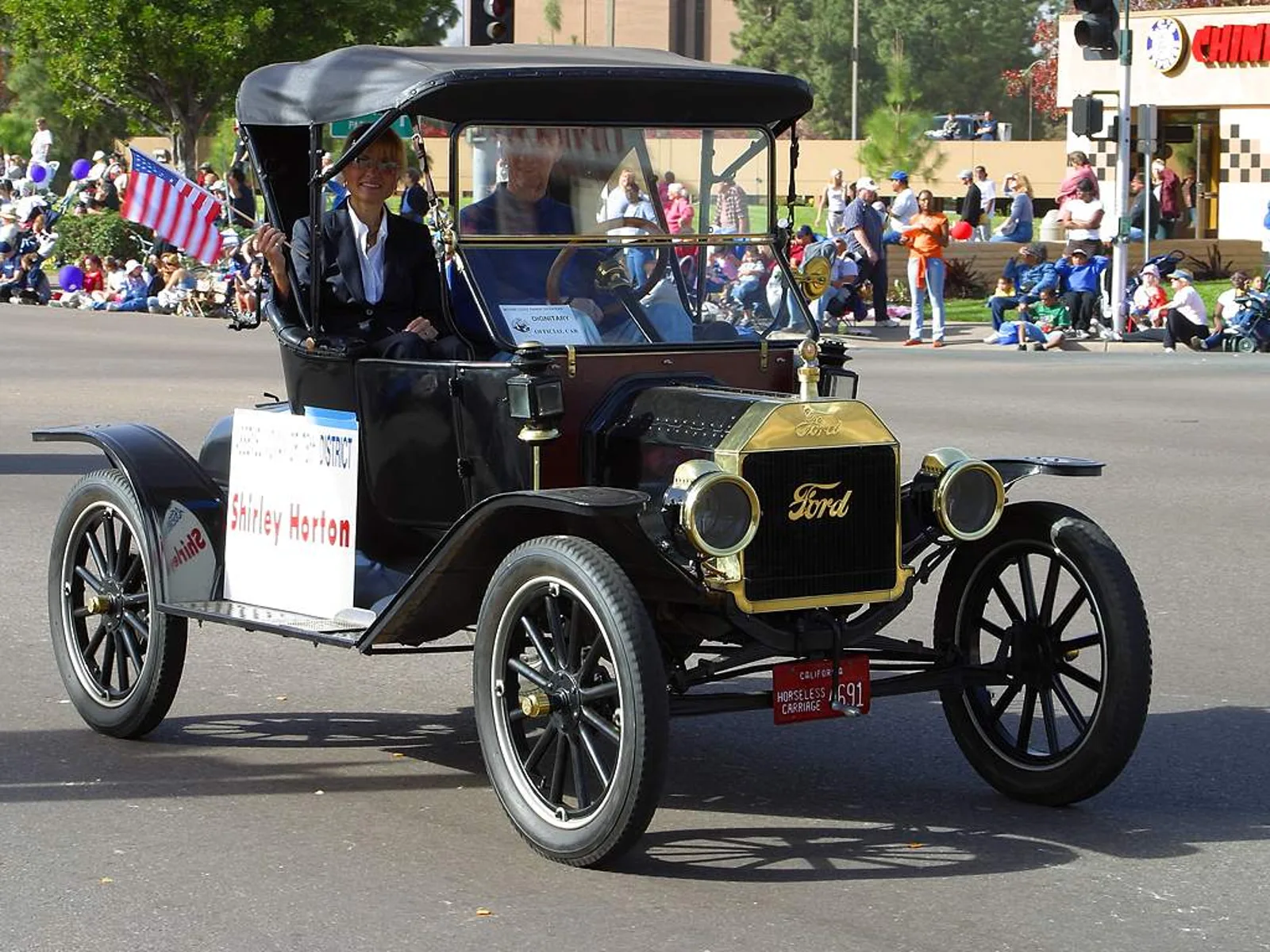
The car in question was the Model T, which made its debut in 1908. Thanks to its straightforward design, robust build and modest price, ordinary households could afford one, and roughly two decades of sales drew in buyers by the million. When the final example left the line in 1927, no rival machine had contributed more to spreading motoring across the globe.
How did the moving assembly line change car making?
Ford's greatest industrial contribution came in 1913 at the Highland Park plant, where the company pioneered the moving assembly line. Instead of workers moving to the car, the car moved to the workers, and the time needed to build a Model T fell dramatically.
The approach had acquired a label by 1914: Fordism. Through vertical integration, Ford additionally moved the manufacture of parts inside the firm, with command over all stages from raw materials through to completed components. Less than ten years later, the business was the global frontrunner in developing and improving assembly line production, and it ranked among the biggest and most lucrative enterprises anywhere.
What came after the Model T?
In 1927 the Model A took over from the Model T, and it carried a real safety breakthrough: a windshield made of laminated safety glass, which no production car had featured before. Ford then became, in 1932, the first maker to offer a cheap car powered by a V8, so that everyday customers could at last enjoy eight-cylinder performance.
Ford also widened the range of marques it owned. Its purchase of Lincoln Motor Company in 1922 brought a presence in the luxury market, while Mercury arrived in 1939 as a pricier alternative to Ford, sold across the US, Canada, Mexico and the Middle East.
Which Fords changed the industry?
Across the years, Ford brought several firsts to market before its competitors did. For 1956, the Lifeguard safety package included a deep-dish steering wheel as standard equipment, made front seatbelts available as an option, added a padded dashboard, and marked the manufacturer's earliest installation of rear seatbelts in one of its cars. The following year saw the arrival of child-proof door locks, along with a retractable hardtop - a groundbreaking layout on a six-seat model built in substantial volume.
Unveiled at the New York World's Fair on April 17, the 1964 Mustang effectively established the pony car segment on its own. Ford then introduced the Escape Hybrid in 2005, a model that drew on Toyota hybrid technology used under licence, and the firm additionally built a plug-in hybrid Escape demonstration fleet in partnership with Southern California Edison.
Where are Fords built and sold?
Dearborn, Michigan serves as the base of operations for Ford, which markets Ford-badged cars and commercial vehicles across the globe, while Lincoln handles its premium segment. Its shares trade on the NYSE under the symbol F, and although the Ford family owns a minority slice of the business, Class B stock gives it command of 40 per cent of voting power.
Ford's production and retail operations reach across the world via partnerships such as Changan Ford and Jiangling Ford in China, Ford Lio Ho in Taiwan, AutoAlliance Thailand and Ford Otosan in Turkey. A 32 per cent stake in Jiangling Motors is also held by Ford.
What happened to Ford's other brands?
Ford spent decades buying and shedding marques. Jaguar Cars was acquired in 1990, Aston Martin in 1994, and Volvo was owned from 1999 to 2010. In 2008 Jaguar and Land Rover were sold to Tata Motors for $2.3 billion.
The Edsel division, created in 1955 and launched for the 1958 model year, was discontinued in 1959, after which Mercury, Edsel and Lincoln were merged as M-E-L. Mercury itself survived until 2010, when it was discontinued in the third quarter. A Continental division had also been established in 1955 for luxury cars.
How did Ford survive the 2008 crisis?
Ford's modern history includes a remarkable turnaround. In 2006 the company posted the largest annual loss in its history, $12.7 billion, but in the second quarter of 2007 it surprised Wall Street with a $750 million profit. The full year still ended with a $2.7 billion loss, attributed to Volvo restructuring.
In 2008 chief executive Alan Mulally requested a $9 billion credit line as a backstop, and in 2009 Ford reported a $14.6 billion loss, a record. Yet that same year it posted its first full-year profit in four years, $2.7 billion, and by 2012 its corporate bonds had been upgraded from junk to investment grade. Unlike its Detroit rivals, Ford was not rescued by the federal government.
What does Ford look like today?
Ford continues to be a major player. Its worldwide production in 2022 placed it sixth among all car manufacturers, and among firms headquartered in the United States only General Motors built more. The company turned out 4.4 million vehicles in 2023 and had a global workforce of roughly 177,000. Revenue worldwide stood at $156.7 billion in 2017, while Fortune's 2018 list of American-based companies put it in 11th place.
Ford's approach has moved away from body-on-frame trucks in favour of unibody crossover SUVs, and 2018 saw the firm state that, apart from the Mustang, it would end passenger car sales in North America. Tariffs led to the cancellation of a Focus Active that had been planned for the US. The company has put money into autonomy as well, taking a majority stake in Argo AI during 2017, while in 2016 it pledged $1.2 billion towards a ten-year upgrade of its Dearborn campus.
What is Ford's racing and engineering legacy?
Ford's technical ambitions were never confined to vehicles. In 1951 a research facility was established in Dearborn to pursue open-ended fundamental work, and 1964 saw the Ford Research Labs create the SQUID, or superconducting quantum interference device. The sale of Cosworth in 2004 to Gerald Forsythe and Kevin Kalkhoven signalled a scaling back of the firm's racing activities.
Industry forms the broader part of this story. In 1929 the Soviet Union engaged Ford to establish the Gorky Automobile Plant, and Stalin in 1944 named Henry Ford among the greatest industrialists the world had seen. Ford's factories turned out B-24 Liberator bombers in large numbers at Willow Run throughout the Second World War, even as Ford Werke and Ford SAF supplied military vehicles to Nazi Germany, with forced labour used at some German sites. The record is a tangled one, yet it has allowed the Ford family to retain control for more than a century.
Ford specification highlights
| Model or era | Defining feature | Year |
|---|---|---|
| Model T | Mass-produced motoring for the masses | 1908 |
| Model A | First production car with laminated safety glass windshield | 1927 |
| V8 Ford | First low-priced car with a V8 engine | 1932 |
| Lifeguard package | Deep-dish wheel, optional belts, padded dash | 1956 |
| Mustang | Launched at the New York World's Fair | 1964 |
| Escape Hybrid | Licensed Toyota hybrid technology | 2005 |
Ford's achievement went beyond manufacturing vehicles: the company created the framework that brought car ownership within reach of ordinary people, then kept improving that framework across a hundred years.