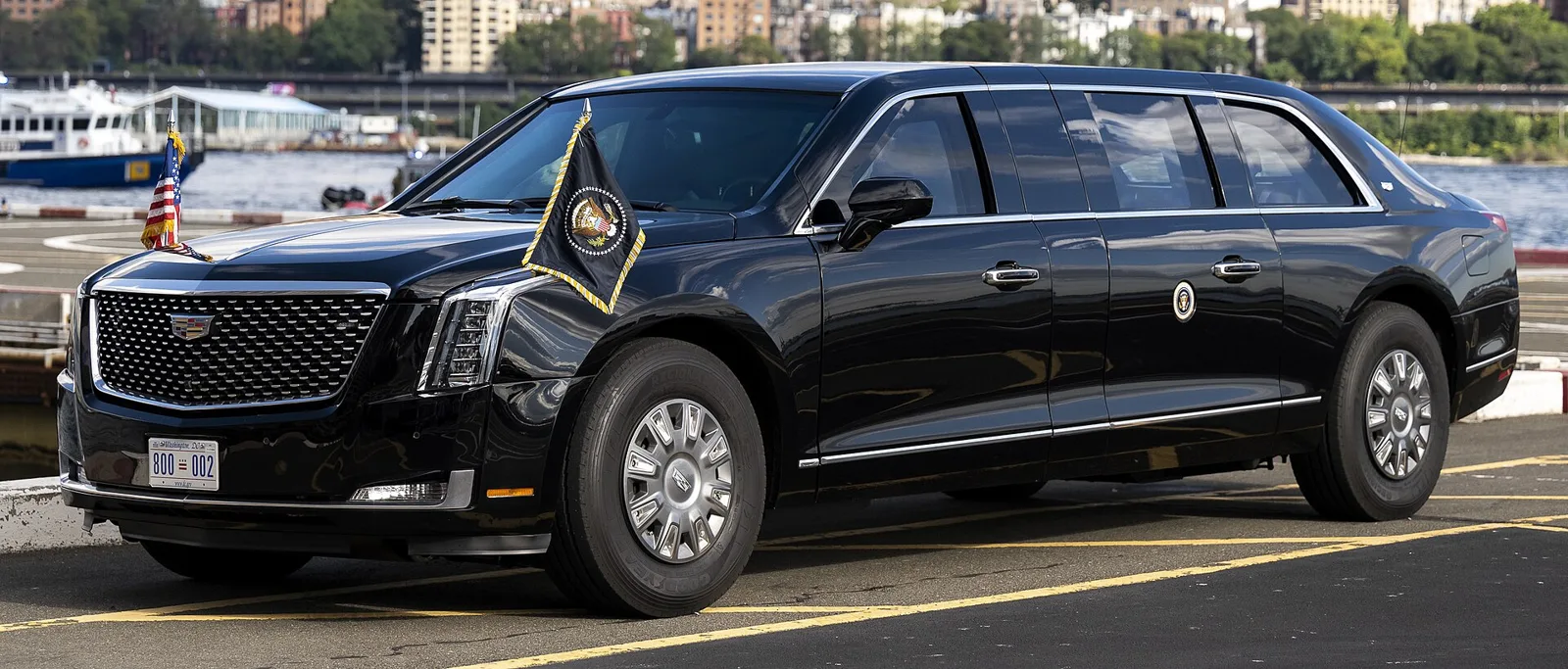
A 1902 start built on precision parts, the V8 and V-16 years, tailfin styling, the Cimarron slump and today's electric Cadillacs.
Cadillac is General Motors' luxury division, founded in 1902 and named after the French explorer who founded Detroit. Its early reputation rested on precision manufacturing, and it has since built V8 and V-16 engines, tailfin-era cars and a line of electric luxury models.
Cadillac is the luxury arm of General Motors and has built premium cars since 1902. Its early name rested on precision manufacturing, and its V8 and V-16 engines once set the pace for the American industry. Today the brand sells in the United States, Canada and China, and in dozens of other markets.
Where did Cadillac begin?
The company grew out of the remains of the Henry Ford Company. Ford walked away in March 1902 after a falling-out with his financial backers, and the investors asked the engineer Henry M. Leland to assess the plant. Leland persuaded them to carry on building cars with his tested single-cylinder engine.
The Cadillac Automobile Company was set up on 22 August 1902, taking its name from Antoine de la Mothe Cadillac, the French explorer who founded Detroit. The crest on the badge is drawn from his heraldry.
Precision parts, a V8 standard for an industry, tailfins, a Cimarron low, and an electric future.
What were the first Cadillacs like?
The first two models, a runabout and a tonneau, were completed in October 1902. Both were two-seat carriages powered by a single-cylinder engine of 10 hp (7 kW), and their layout was close to that of the early Ford Model A.
Precision was the brand's chief claim from the start. Cadillac cars were better made than many rivals, and that reputation brought in a steady flow of buyers who valued reliability above fashion.
How did General Motors take control of Cadillac?
In 1905 the Cadillac Automobile Company joined forces with Leland and Faulconer, creating the Cadillac Motor Company. In 1906 it became the first mass producer of fully enclosed cars, a step that widened its appeal to wealthier buyers. Enclosed bodies were a notable selling point at the time.
General Motors acquired Cadillac on 29 July 1909. The brand became the group's prestige division for large luxury vehicles, placed at the top of the GM range above Buick, Oldsmobile and, later, Chevrolet.
How did Cadillac prove its engineering?
In 1908 Cadillac took part in a British test of interchangeable parts and won the Dewar Trophy for the most important advance of that year. The slogan Standard of the World grew out of that result, and the company won the trophy again in 1912.
The 1912 award recognised electric starting and lighting in a production car. That made Cadillac the first automaker to combine starting, ignition and lighting in one electrical system, a claim the brand used for years afterwards.
What engine breakthroughs did Cadillac make?
In 1915 the company launched a flathead V8 with a 90-degree layout, rated at 70 hp (52 kW) at 2400 rpm, enough to carry its cars to 65 miles per hour (105 km/h). The company was an early adopter of the dual-plane crankshaft in 1918, and it added the first clashless Synchro-Mesh manual gearbox in 1928.
Its 1930 V-16 used overhead valves and displaced 452 cubic inches (7.41 litres), making 165 hp (123 kW). A later overhead-valve V8, introduced in 1949, set the benchmark that the wider American industry followed.
How did the Depression hit Cadillac?
Between 1928 and 1933 Cadillac sales dropped by 84 per cent to 6,736 vehicles, and the luxury end of the market fell faster than the rest. A discriminatory sales policy made matters worse until Nick Dreystadt, the national service chief, argued for its removal.
After that change, brand sales rose 70 per cent in 1934, and by 1940 they were ten times their 1934 level. The Series 60 arrived in 1936 as a mid-priced entry, and Cadillac became the first automaker to use the Phillips screw in 1937.
What did postwar Cadillacs look like?
Postwar Cadillacs set many of the styling trends of the late 1940s and 1950s. Those trends defined the era's image. Tailfins appeared in 1948 and peaked in 1959, while the Dagmar bumpers were softened in 1958 and removed the year after.
The pillarless four-door hardtop Sedan de Ville arrived in 1956, and a year later the feature was standard across the range. Buick and Cadillac had introduced the first mass-produced hardtop coupe in 1949, and the Coupe de Ville became a long-running favourite.
When did Cadillac sales peak?
Cadillac built its one-millionth car on 25 November 1949. The brand had reached 100,000 cars in a year for the first time in 1949, and it repeated that figure in 1950 and 1951. Those were the company's strongest years to that point.
Volume kept climbing in the 1960s. The brand sold more than 192,000 units in 1966, up more than 60 per cent, and passed 200,000 for the first time in 1968. The 1977 de Ville sold 234,171 units in a single year, a record for the line.
Why did the Cimarron hurt the brand?
The Cimarron arrived in 1982 as Cadillac's first compact car. Its poor performance became a symbol of the company's product problems, and it was one of several setbacks in the decades that followed. Buyers who had trusted the badge for generations felt let down.
Cadillac's share of the US market fell from 3.8 per cent in 1979 to 2.2 per cent in 1997. The journalist Dan Neil later placed the Cimarron on his 2007 list of the worst cars ever made.
How did the 1977 downsizing change the de Ville?
General Motors downsized its full-size cars for 1977, and the de Ville came out markedly smaller, trimmed by more than nine inches in length and half a ton in weight. Its 425 cu in (7.0 L) V8 made 180 horsepower, a figure chosen to help fuel economy under the new federal rules.
The 1977 model year also marked the company's 75th anniversary, and it produced a record run of de Villes despite the smaller cars.
What did the Art and Science era bring?
In 2000 Cadillac introduced a design philosophy called Art and Science, built on sharp forms and crisp edges. It first appeared on the CTS and the XLR roadster, and it guided the brand's move toward rear-wheel-drive models. The approach was meant to express high technology through the shape of the car.
The last DeVille rolled off the line on 23 June 2005, and the last DTS on 27 May 2011. Cadillac's luxury sedans and crossovers then took over the range, reflecting the changing taste of its buyers.
How fast was the CTS-V?
The second-generation CTS-V sedan arrived in 2009 to challenge the BMW M5, which was its clearest rival at the time. Its supercharged 6.2-litre LSA V8 let an automatic version lap the Nurburgring in 7:59.32, a production sedan record at the time.
The CTS-V showed that Cadillac could compete with the best German performance sedans, and its later racing programmes built on that reputation. The model is still cited by enthusiasts as a turning point.
Which Cadillac engines matter most?
The Northstar V8 was built by General Motors between 1991 and 2010, and is regarded as the company's most technically complex engine. Its design used a double overhead cam, four valves per cylinder and an aluminium block and head. It remains one of the most discussed engines in the brand's history.
The High Technology engine arrived in 1982 and powered Cadillac's front-drive models, which were designed around it. The Northstar System that followed combined variable valve timing, road-sensing suspension and four-wheel disc brakes with the Northstar engines.
Did Cadillac race?
Many Allard cars used Cadillac engines before World War II, and the brand entered the NASCAR Grand National Series in the 1950s. Other American makers took part in the series during the same period. The Northstar LMP competed in the American Le Mans Series during the early 2000s.
The CTS-V became the brand's most successful venture in SCCA World Challenge. The DPi-V.R took the brand back to prototype racing in 2017, and in 2023 its V-Series.R entered the FIA World Endurance Championship and IMSA. Cadillac joins the Formula One grid in its 2026 campaign, relying on a Ferrari engine until its own unit arrives in 2029.
What awards did Cadillac win?
Motor Trend has named Cadillac its Car of the Year five times, in 1949, 1952, 1992, 2008 and 2014. Each of those honours was a result of a specific model or engine. The 1949 honour recognised the company's overhead-valve V8, which was a major step for the American industry.
The 1992 award went to the Seville Touring Sedan, and the two later honours both went to the CTS. Cadillac still highlights these awards in its publicity, and it treats them as a point of pride.
Which Cadillacs are sold today?
The range includes the Escalade, first sold in 1999, and the Escalade ESV. Other current models are the CT6, XT5, XT4, CT4, CT5 and XT6, while the Lyriq, Optiq, Vistiq, Celestiq and Escalade IQ are electric. Each one sits in a specific segment of the luxury market.
Cadillac sold 390,458 vehicles worldwide in 2019, a brand record. Its electric line-up now plays a central role in the company's plans for luxury models.
Cadillac milestones at a glance
The table below lists the main figures covered in this article. Each row names one item, so the values should not be read as applying to every model in the range.
| Item | Detail |
|---|---|
| Founded | 1902, named after Antoine de la Mothe Cadillac |
| General Motors purchase | 29 July 1909 |
| First V8 | 1915, 70 hp (52 kW) at 2400 rpm |
| V-16 engine | 1930, 452 cubic inches (7.41 litres), 165 hp (123 kW) |
| Sales low point | 6,736 vehicles in 1933 |
| Brand sales in 1966 | More than 192,000 units |
| Cimarron launch | 1982, first compact car |
| Last DeVille | 23 June 2005 |
| CTS-V Nurburgring lap | 7:59.32 |
| Worldwide sales in 2019 | 390,458 vehicles |
Who was Harley Earl and what did he change?
Harley Earl was brought in on a consulting basis in 1926 and stayed with General Motors for decades. By 1928 he headed the new Art and Color division, and his first car there was the LaSalle, a smaller companion marque.
Designer-styled bodywork appeared in 1927, and the turret top brought an all-steel roof to the range. Earl's influence was therefore felt in both the shape of the body and the materials of the roof.
What special Cadillacs were built in small numbers?
The Eldorado Brougham of 1957 was a bold attempt to move the brand further upmarket, with self-levelling suspension and a memory seat. It sold only 904 units, which made it one of the rarest models of its decade. Its price and exclusivity set it apart from the regular range.
Later specials included the Allante roadster, which Pininfarina bodied and which arrived in 1987 with the HT-4100 V8. The Sixty Special, first sold as a mid-priced model, continued through 1993 as a top owner-driven car.
What early technology did Cadillac introduce?
Cadillac offered an automatic high-beam dimmer, a system that protected oncoming drivers from glare. It was an early step in the driver aids that later became common. Features like these were a selling point for the brand's buyers. Each of these features reflected the company's engineering focus.
A dual-reservoir brake master cylinder came in before federal rules demanded one. A fully automatic heater and air conditioning system also appeared, showing how quickly the brand adopted comfort features.
How did the Eldorado and Seville change the range?
The front-wheel drive Eldorado of 1967 set a new standard for the personal luxury car, and it gave the brand a sporting image without leaving the luxury segment. The Seville arrived in May 1975 as a rival to the expanding imports from Europe.
Cadillac's variety grew from those models into SUVs and sedans. The Escalade of 1999 was its first SUV, and the CT6 was a full-size sedan with rear-wheel drive, the first of its kind since the Fleetwood was dropped in 1996.
Frequently asked questions
Who was Cadillac named after?
The name honours a French explorer who founded Detroit, and the badge takes its crest from his heraldry.
When did General Motors buy Cadillac?
The sale to General Motors took place on 29 July 1909, and the brand then sat above Buick, Oldsmobile and Chevrolet.
What did the Cimarron do to the brand?
The Cimarron, Cadillac's first compact car, is widely cited as a low point in the company's product history. Its failure helped push the brand's US market share down.
Will Cadillac compete in Formula One?
Cadillac will enter Formula One from the 2026 season, working with Andretti. It will use a Ferrari engine until its own power unit is ready in 2029.
.jpg)