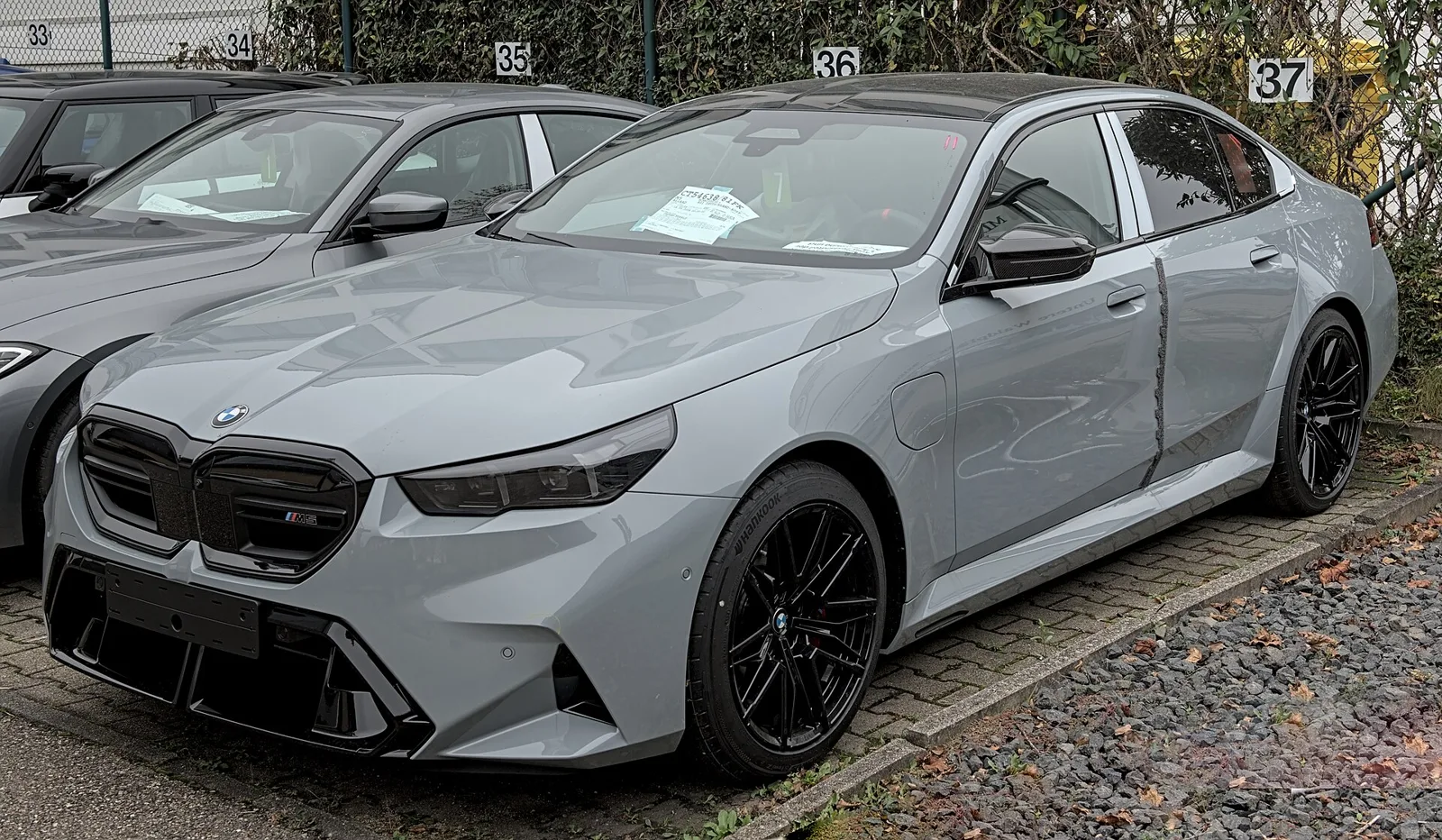
A hand-built 535i derivative that became the fastest saloon of its day, then a V10, a turbo V8, an all-wheel-drive car and finally a 727 PS plug-in hybrid.
Built by BMW M since 1984, the M5 is the high-performance 5 Series that has appeared in seven generations, from the 1984 E28 to the 2024 G90 plug-in hybrid. Each generation has been a saloon, with estate versions in some markets, and V8 and V10 engines have powered most of them.
The BMW M5 is the high-performance version of the 5 Series, built by BMW M since 1984 with interruptions. Seven generations have carried the name, and each one has been a saloon, with estate versions offered in some generations and markets.
What made the first M5 special?
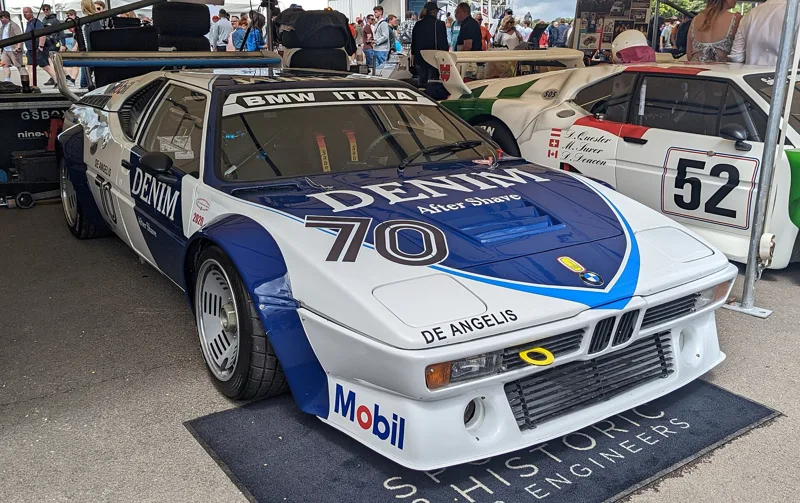
The first M5 was based on the E28 535i and built from October 1984 until June 1988, with the M88/3 engine shared with the E24 M635CSi coupe. At launch it was the fastest production saloon in the world, and it debuted at the Amsterdam Motor Show in February 1985.
The M88/3 was an updated version of the engine used in the M1 sports car. European and South African cars produced 210 kW (286 PS; 282 hp), while North American cars received a catalysed S38B35 rated at 191 kW (256 hp).
Production was largely hand-built. Aside from 96 kits assembled in Rosslyn, South Africa, the cars were built by hand in Germany, first at Preussenstrasse in Munich and then at Daimlerstrasse in Garching.
Seven generations, from a hand-built 535i derivative to a 727 PS plug-in hybrid, with the saloon the constant.
How rare was the E28 M5?
Only 2,241 E28 M5s were built in total, which makes it one of the rarest regular-production BMW Motorsport cars. For comparison, the M1 had 456 units, the E34 Touring 891 and the 850CSi 1,510.
A class action in the United States led to owners receiving a US$4,000 voucher in 1993, after the production run ran longer than BMW's forecast. North American production ran from November 1986 to November 1987.
How did the E34 M5 change the formula?
The E34 M5 was built from September 1988 to August 1995 with the S38 straight-six, an evolution of the earlier engine. Production began with an E34 shell from Dingolfing, which Garching finished by hand over two weeks. The saloon came first, and a Touring estate followed in 1992.
The 3.6-litre engine was followed in late 1991 by a 3.8-litre S38B38 with 250 kW (340 PS; 335 hp), which took 5.9 seconds to reach 97 km/h. A six-speed Getrag 420G manual arrived in 1994.
Total E34 M5 production was 12,254, with 8,344 of the 3.6-litre cars and 3,910 of the 3.8-litre. The Touring estate, the last hand-built M car, reached 891 units.
Which special editions did the E34 have?
The E34 had four special editions: the Cecotto, Winkelhock, 20 Jahre and UK Limited. Cecotto cars numbered 22, Winkelhock Editions 51, and the 20 Jahre Motorsport Edition twenty cars in Mugello Red.
The UK Limited Edition ran from March to June 1995 with 50 cars, 15 in Rosso Red and 35 in Orinoco. The M-System wheels of 1988 to 1992 were three-piece designs, and the 1994 Style 37 M Parallel wheels dropped the finned cover altogether.
How did the E34 perform at Bathurst?
BMW Australia entered an E34 M5 in the 1992 Bathurst 12 Hour production car race, where it finished second overall and first in its class. The car was driven by Alan Jones, Neville Crichton and Tony Longhurst.
The E34 also left a mark on the development side, with a convertible prototype that was built but never produced because of financial considerations.
Why was the E39 a turning point?
The E39 M5, introduced at the 1998 Geneva Motor Show, was the first M5 to use a V8. Its 294 kW (400 PS) output and aluminium front suspension made it a major change, and production began in October 1998 on the same line as regular 5 Series cars at Dingolfing.
Production totalled 20,482 cars from 1999 to 2003. Ratings for the sprint to 97 km/h stood at 4.8 seconds, and an unrestricted car was said to exceed 300 km/h. Its Nurburgring lap was 8:20.
What did the E39's engine and chassis use?
The S62 V8 made 294 kW (400 PS; 394 hp) by 6,600 rpm, and its torque peaked at 500 N m (369 lb ft) from 3,800 rpm. It had electronically actuated throttle bodies, double-VANOS variable valve timing and a semi-dry sump oil system, with an aluminium block and heads.
The gearbox was the Getrag 420G six-speed manual with an upgraded clutch, and the differential had a 3.15:1 final drive ratio with a limited-slip unit locking up to 25 percent. The M5 kept recirculating-ball steering with a quicker 14.7 ratio, against 17.9 for other V8 models.
What was the E60's V10 like?
The E60 M5 arrived in 2004 with a 5.0-litre V10 and a 7-speed SMG paddle transmission linked to BMW's Formula One programme. It was the world's first production saloon with a V10 petrol engine, and it was also built as the E61 Touring estate for Europe.
The S85 made 373 kW (507 PS; 500 hp) by 7,750 rpm, with torque of 520 N m (384 lb ft) at 6,100 rpm. Three driver-selectable modes, P400, P500 and P500 S, controlled how much of that power was on tap.
The engine was known for rod bearing failures, because the stock bearings gave too little clearance, and the throttle actuators could also fail. The E60 built 20,589 units, including 1,025 Touring estates, and 8,800 saloons went to the United States.
How did the E60 perform?
Ratings for the 100 km/h sprint stood at 4.7 seconds, although magazines recorded figures as low as 4.1 seconds. Top speed was limited to 250 km/h (155 mph), but the M Driver's package raised it to 305 km/h (190 mph), and the Nurburgring lap was 8:13.
The SMG-III shifted gears in 65 to 250 milliseconds. North American buyers could order a conventional six-speed manual from October 2006, and 1,366 of them were produced, a take rate of about 14 percent.
Did the F10 return to turbo power?
Yes. The F10 M5, unveiled at the 2011 Frankfurt Motor Show, was the first turbocharged M5, using a 4.4-litre twin-turbo V8 derived from the X5 M. Most markets received a 7-speed dual-clutch gearbox, the first dual-clutch automatic in an M5.
Its S63B44TU engine produced 412 kW (560 PS; 553 hp) between 6,000 and 7,000 rpm and 680 N m (502 lb ft) from 1,500 to 5,750 rpm. Its 100 km/h sprint took 4.4 seconds, and the Nurburgring lap was 7:55.
The F10 weighed 1,945 kg (4,288 lb), 90 kg (198 lb) more than its predecessor. Critics pointed to the sound, the steering feel and the extra weight, while the gearbox and fuel economy drew praise.
How did the F10 gain more power?
The Competition Package from 2014 raised power to 423 kW (575 PS; 567 hp), lowered the car by 10 mm and revised its suspension. In 2015 the output rose to 441 kW (600 PS; 591 hp) with 700 N m (516 lb ft) of torque.
BMW marked the M5's 30th anniversary in 2015 with 300 cars in Frozen Dark Silver metallic. US and South African buyers got the Pure Metal Silver Edition, limited to 50 and 20 cars, with a sportier suspension and the 441 kW output.
Why did the F90 drop rear-wheel drive?
The F90 M5, which arrived in 2017, was the first M5 with all-wheel drive, a system called M xDrive with a rear bias. It was based on the G30 5 Series, and a rear-wheel-only mode became available once stability control was switched off.
BMW paired it with an eight-speed ZF automatic, the first M5 to use a torque converter rather than a dual-clutch unit. Despite the extra all-wheel-drive hardware, the car was 40 kg lighter than its predecessor.
How quick is the F90 M5?
The F90 M5 accelerated from a standstill to 100 km/h in 3.4 seconds and reached 200 km/h in 11.1 seconds. The quarter mile took 10.9 seconds, and the top speed is capped at 250 km/h (155 mph), with 305 km/h (190 mph) available through the M Driver's Pack.
The engine evolved from the S63, producing 441 kW (600 PS; 591 hp), with torque lifted to 750 N m (553 lb ft). The F90 also set Guinness records for the longest continuous vehicle drift and the longest water-assisted twin-vehicle drift, at 374 km and 79 km.
What did the Competition Package add?
The Competition Package arrived in August 2018 with 460 kW (617 hp; 625 PS) at 6,000 rpm, while torque stayed at 750 N m (553 lb ft). Its 0-100 km/h time fell by 0.1 seconds to 3.1 seconds, and stiffer springs and a 7 mm lower ride height sharpened the handling.
The Competition car lapped the Nurburgring in 7:35.90 in a test by sport auto, and Car and Driver's dyno measured 460 kW (617 hp; 626 PS) at the wheels.
What is the M5 CS?
The M5 CS was the first CS version of the M5, entering production in March 2021 with 467 kW (635 PS; 626 hp) and a weight of 1,866 kg (4,114 lb). It was 116 kg (256 lb) lighter than the standard M5, with four bucket seats and gold-coloured exterior trim.
Carbon fibre-reinforced polymer parts for the hood, front splitter, mirror caps, lip spoiler and rear diffuser saved 70 kg over the Competition car. The top speed remained 305 km/h (190 mph).
What is the G90 M5 hybrid?
The G90 M5 is BMW M's first plug-in hybrid saloon. It uses a 4.4-litre twin-turbocharged S68 V8 with an electric motor integrated into the eight-speed torque-converter gearbox, for a a combined output of 535 kW (727 PS; 717 hp) and torque of 1,000 N m (738 lb ft).
The V8 contributes 430 kW (585 PS; 577 hp), along with 750 N m (553 lb ft), and the electric motor adds 145 kW (197 PS; 194 hp) plus 280 N m (207 lb ft). The European car weighs 2,435 kg (5,368 lb), about 500 kg (1,100 lb) more than the F90.
BMW says the G90 reaches 100 km/h in 3.5 seconds and 200 km/h in 10.9 seconds, but the weight increase drew heavy criticism. BMW M's chief executive, Frank Van Meel, argued that the plug-in setup was the only way to keep the V8 and meet stricter emissions rules.
What driving modes does the G90 have?
The hybrid system offers HYBRID, ELECTRIC, eCONTROL, Dynamic and Dynamic Plus modes. ELECTRIC allows speeds up to 140 km/h (87 mph) on electric power alone, using an 18.6 kWh battery for a claimed 67 km (42 mi) of WLTP range in Europe.
The M xDrive system with its rear bias remains, including a rear-wheel-only mode. The car rides on 20-inch front and 21-inch rear wheels, and it has 20 mm more rear legroom than its predecessor, along with a Bowers and Wilkins sound system and four-zone climate control.
When did the M5 Touring arrive?
BMW confirmed an estate version on 26 June 2023, and it was shown in June 2024 before going on sale in November 2024. It is the first M5 estate since the E61 and the first M5 Touring to be sold in North America.
The G90 was priced from US$119,500 when it made its global debut at the 2024 Goodwood Festival of Speed. Production began in July 2024 at Dingolfing, and the Touring variant reached the US for the 2025 model year.
How do the generations line up?
The table lists each generation with its years, engine and peak output. Where a generation had several power levels, the table shows the standard figure, and the text covers later uprates. This keeps the comparison simple.
| Generation | Years | Engine | Peak output |
|---|---|---|---|
| E28 | 1984-1988 | M88/3 straight-six | 210 kW (286 PS; 282 hp) |
| E34 | 1988-1995 | S38 straight-six, 3.8-litre later | 250 kW (340 PS; 335 hp) |
| E39 | 1998-2003 | S62 V8 | 294 kW (400 PS; 394 hp) |
| E60 | 2004-2010 | S85 V10, 5.0-litre | 373 kW (507 PS; 500 hp) |
| F10 | 2011-2016 | S63B44TU twin-turbo V8 | 412 kW (560 PS; 553 hp) |
| F90 | 2017-2023 | S63 evolution with xDrive | 441 kW (600 PS; 591 hp) |
| G90 | 2024-present | S68 4.4-litre plug-in hybrid | 535 kW (727 PS; 717 hp) system |
_DSC_6010.jpg)