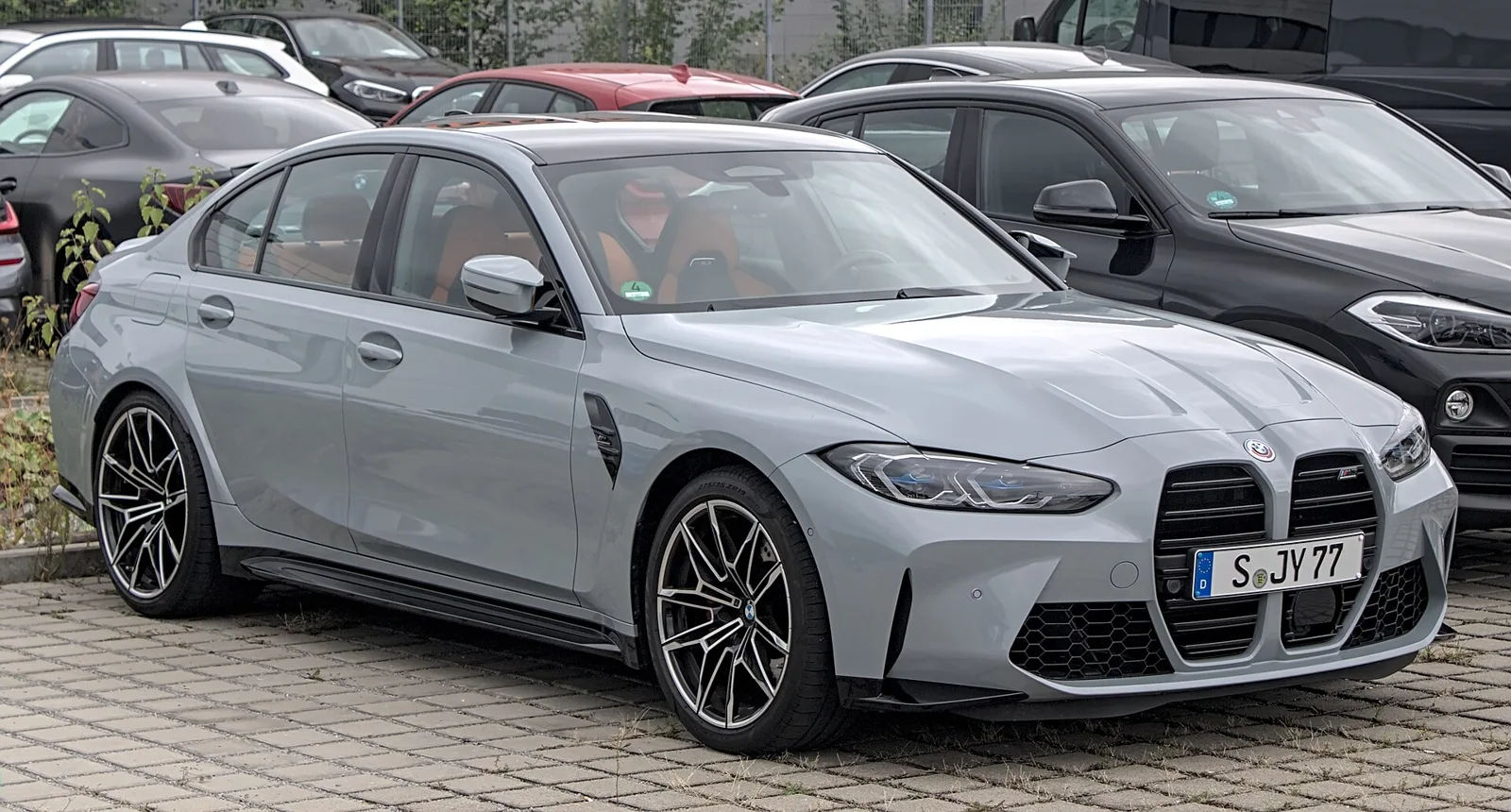
From a 1986 homologation special with a 7,250 rpm four-cylinder to a turbocharged, optionally all-wheel-drive saloon with an estate option.
The BMW M3 is a performance version of the 3 Series built by BMW M GmbH since 1986. It has produced six generations, from the four-cylinder E30 to the twin-turbo G80, and its race record includes European and DTM championship wins.
The BMW M3 is a high-performance version of the 3 Series, developed by BMW M GmbH and produced for every generation since the E30 arrived in 1986. Across six generations it has moved from a homologation special to a turbocharged saloon with an optional all-wheel-drive system and an estate version.
This profile follows the car through each generation, covering its engines, racing record, special editions and the specification table. Metric figures come first, with imperial values in brackets.
Where did the BMW M3 begin?
The first M3 was the E30, presented at the 1985 Frankfurt Motor Show and built from March 1986 to June 1991. It existed to homologate the car for the Deutsche Tourenwagen Meisterschaft and Group A touring rules, which required 5,000 base cars plus 500 evolution specials.
Body changes improved the aerodynamics. A front splitter, a rear apron and a flattened rear window lowered lift forces, and the windscreen was glued in rather than framed with rubber. The drag coefficient fell to Cd=0.33 from the standard 3 Series figure of Cd=0.38.
The engine was the BMW S14, a high-revving four-cylinder with a 7,250 rpm redline. Catalysed cars were rated at 143 kW (195 PS; 192 hp), while uncatalysed versions reached 147 kW (200 PS; 197 hp). A Getrag five-speed manual and a clutch-type limited-slip differential were standard.
Total E30 production reached 17,970 cars, with convertibles built in limited volumes. Sports Car International placed the car sixth in its list of the top sports cars of the 1980s.
The M3 began as a homologation special and became a six-generation performance benchmark, from the E30 to the G80.
How did the E30 M3 win races?
The E30 M3 won the European Touring Car Championship in 1987 and 1988, and it took two British Touring Car titles. It also won the Spa 24 Hours four times and the 24 Hours Nurburgring five times, often against cars with bigger or turbocharged engines.
Its most notable rally success came on the 1987 Tour de Corse, won by Bernard Beguin in round five of the World Rally Championship. The M3 struggled against four-wheel-drive rivals on loose surfaces, but it was very effective on asphalt.
Evolution cars kept the M3 competitive. The Evolution 1 of 1987 had a revised cylinder head, with 505 built. The Evolution 2 of 1988 reached 162 kW (220 PS) at 6,750 rpm, and the 1990 Sport Evolution used a 2,467 cc engine for 175 kW (238 PS; 235 hp).
The Sport Evolution was limited to 600 units and raised top speed to 250 km/h (154 mph). The 1989 Ravaglia and Cecotto editions were named after DTM drivers, and the Cecotto edition built 480 cars plus 80 for Switzerland.
What changed with the E36 M3?
The E36 M3 arrived in November 1992 as a coupe, with a convertible in 1994 and a saloon in December 1994. It was the first M3 with a six-cylinder engine, the S50 straight six, a layout that most later M3s would keep.
The original 2,990 cc unit made 210 kW (286 PS; 282 hp) at 7,000 rpm, and its torque was 320 N m (236 lb ft) at 3,600 rpm. North American cars used a less powerful S50B30US rated at 179 kW (243 PS; 241 hp), and US sales did not begin until 1995.
A September 1995 facelift raised capacity to 3,201 cc and output to 236 kW (316 hp) at 7,400 rpm, with torque of 350 N m (258 lb ft). The six-speed SMG automated manual was introduced with the facelift and was the first automated transmission on an M3 outside the United States.
The M3 GT of 1994 was a homologation special for Europe, with 356 cars built and 220 kW (295 hp) on tap. It was finished in British Racing Green, and it had a derestricted top speed of 275 km/h (171 mph).
US buyers got the M3 Lightweight from 1995, after racing teams pressed BMW for a homologation car. It came without a radio, air conditioning or leather seats, and it weighed 91 kg (200 lb) less than a regular M3. Around 125 were estimated to have been built, although BMW never published the exact figure.
What made the E46 M3 different?
The E46 M3 arrived in 2000 as a coupe and convertible with the S54 3.2-litre straight six, rated at 252 kW (343 PS; 338 hp) at 7,900 rpm. It ran 0-100 km/h in 5.2 seconds and was electronically limited to 250 km/h (155 mph).
Production ran from September 2000 to August 2006, reaching 85,766 cars. The S54 was the final evolution of the BMW S50, and it used individual throttle bodies with drive-by-wire control, a new feature for the engine.
The 2004 CSL was the headline model. Only 1,383 were built, and it weighed 1,385 kg (3,053 lb), which was 110 kg (243 lb) less than a regular M3. It used a carbon fibre roof, 19-inch wheels and semi-slick tyres, and it reached 100 km/h in 4.9 seconds.
The CSL's SMG II transmission cut shift times to 80 milliseconds, and its engine gained 13 kW (17 hp) over the European M3. The CSL was never sold in North America.
BMW also built a V8 race car. The GTR road car used a 4.0-litre P60 V8 detuned from 331 kW to 285 kW (382 hp), with a top speed of 295 km/h (183 mph). The racing version won the 2001 American Le Mans Series GT class and later took the Nurburgring 24 Hours in 2004 and 2005.
Why did the E90 M3 return to a V8?
The E90 M3 was the only standard M3 with a V8, using the S65 engine, which made 309 kW (420 PS; 414 hp) at 8,400 rpm and 400 N m (295 lb ft) at 3,900 rpm. It was also the first BMW with a dual-clutch gearbox, a seven-speed M-DCT option from April 2008.
The coupe, saloon and convertible were all offered, and the coupe used a carbon fibre roof to lower its centre of gravity. Production totalled 40,092 coupes, 16,219 convertibles and 9,674 saloons, with the saloons ending in 2011 and the coupes in July 2013.
The GTS arrived in 2010 with a 4.4-litre engine producing 331 kW (444 hp). It was 136 kg (300 lb) lighter than the regular M3, and only 135 were made. The 2011 CRT used the same engine in a saloon with a carbon bonnet, and only 67 were produced.
On track the E92 M3 returned BMW to the DTM in 2012 and won the drivers and manufacturers titles that year. The 54 DTM Champion Edition cars were built to mark the result.
How did the F80 M3 go turbocharged?
The F80 M3, produced from 2014 to 2018, used the BMW S55 twin-turbo straight six, which made it the first turbocharged M3. Peak power rose from 309 kW to 317 kW, while torque climbed from 400 N m to 550 N m (406 lb ft).
Official 0-60 mph times were 3.9 seconds with the M-DCT and 4.1 seconds with the manual. The top speed was 250 km/h (155 mph), rising to 280 km/h (174 mph) with the optional M Driver's package, and the kerb weight was 1,621 kg (3,574 lb).
The F80 was unveiled alongside the F82 M4 coupe at the 2014 North American International Auto Show. The coupe was renamed the M4 when the 4 Series range was introduced, which left the F80 as a saloon only. The 2016 Competition Package raised output to 331 kW (450 PS; 444 hp).
The 2018 M3 CS added 338 kW (453 hp) and 601 N m (443 lb ft), with 1,200 units built. Production ended in October 2018 because of the extensive changes needed to meet WLTP emissions rules.
What is the current G80 M3?
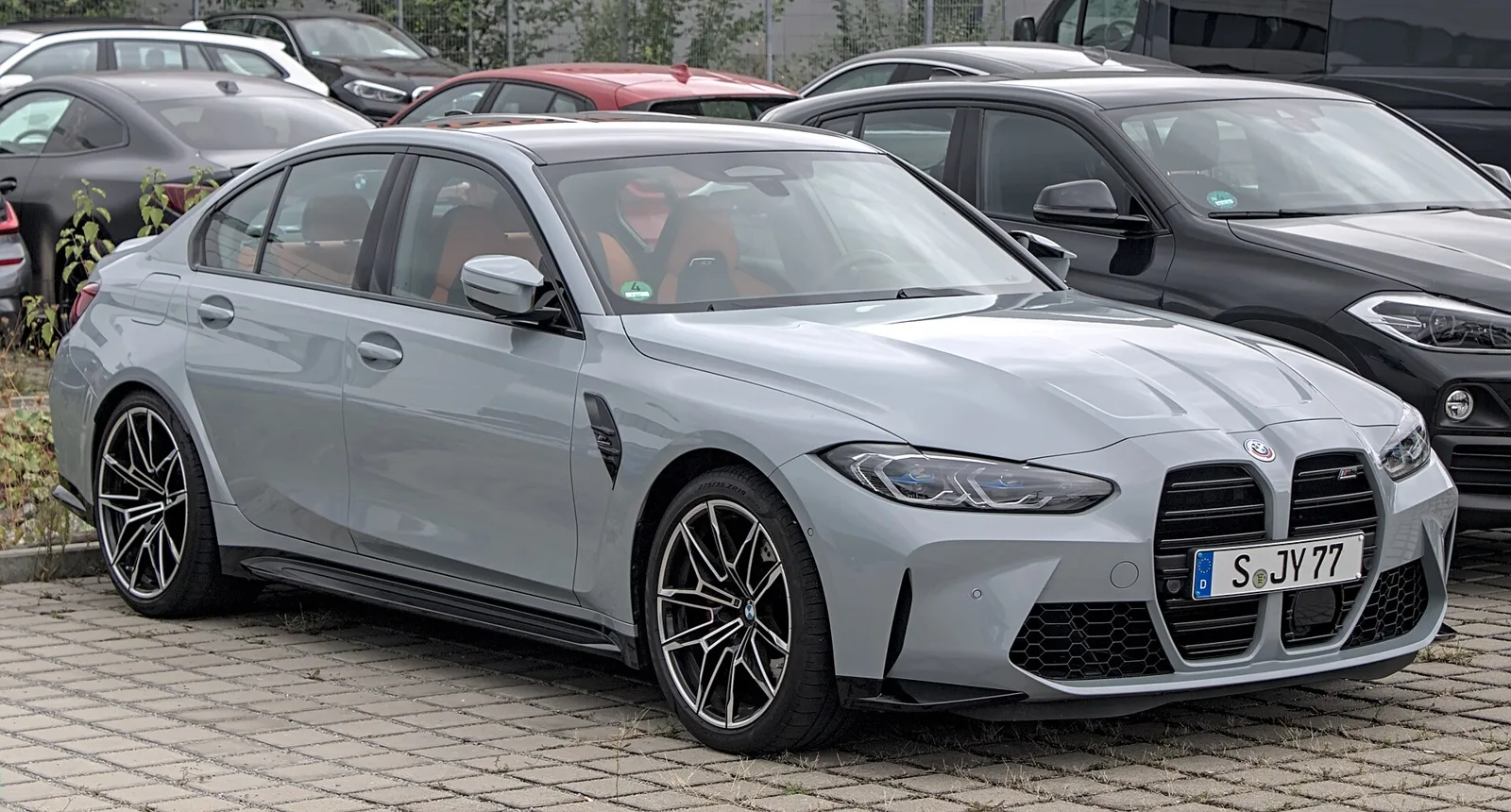
The G80 M3 was unveiled on 23 September 2020 alongside the M4. It uses the S58 twin-turbo straight six, which produces 473 hp. It was the first M3 to offer all-wheel drive through xDrive, although the manual gearbox is available only with rear-wheel drive.
The M3 Touring estate arrived as the first estate version of the car. The twin-kidney grille, borrowed from the 4 Series, proved controversial with critics, but it became part of the car's look.
The M3 Competition raised output to 375 kW (510 PS; 503 hp) and torque to 650 N m (479 lb ft), with an 8-speed M Steptronic automatic. The 2023 M3 CS pushed power to 405 kW (550 PS; 542 hp) and cut 15 kg (33 lb) from the Competition xDrive.
BMW has said a rear-wheel-drive M3 CS Handschalter with a manual gearbox will arrive in 2027 as a final send-off for the sixth generation. In March 2026 BMW also unveiled an M3 Touring 24H racing car for the 24 Hours of Nurburgring.
What are the BMW M3 specifications by generation?
The table lists the main engine, power and torque figures for each generation. Where a figure was not published for a generation, the table says so, and the variant names show which figure belongs to which version.
| Generation | Engine | Power | Torque | Notes |
|---|---|---|---|---|
| E30 (1986 to 1991) | S14 four-cylinder | 143 kW (195 PS; 192 hp) catalysed | Not given | Homologation special |
| E36 (1992 to 1999) | S50 straight six, 2,990 cc | 210 kW (286 PS; 282 hp) | 320 N m (236 lb ft) | First six-cylinder M3 |
| E36 facelift | S50 straight six, 3,201 cc | 236 kW (316 hp) | 350 N m (258 lb ft) | From 1995 |
| E46 (2000 to 2006) | S54 straight six, 3.2 litres | 252 kW (343 PS; 338 hp) | 365 N m (269 lb ft) | Limited to 250 km/h |
| E90 (2007 to 2013) | S65 V8 | 309 kW (420 PS; 414 hp) | 400 N m (295 lb ft) | First V8 M3 |
| F80 (2014 to 2018) | S55 twin-turbo straight six | 317 kW (431 PS; 425 hp) | 550 N m (406 lb ft) | First turbocharged M3 |
| G80 (2020 to present) | S58 twin-turbo straight six | 473 hp | Not given | xDrive optional |
The jump from the E90 to the F80 shows how turbocharging delivered more torque from a smaller engine, a theme that has continued into the current car.
Frequently asked questions
Did the M3 ever have a manual gearbox?
Yes. Every generation offered a manual, and the current G80 manual is limited to rear-wheel-drive cars. The manual remains the only transmission on the standard model.
Was the M3 ever sold as a convertible?
Yes, from the E30 onward. The E30 convertible was built in limited volumes, and later generations offered convertibles alongside the coupe and saloon bodies.
What was the M3 Pickup?
The M3 Pickup was a one-off prototype built in 1986 on the convertible body, with a narrower shell and a 2.0-litre engine. BMW M used it as a workshop transporter for about 26 years before it was retired in 2012.
Did the M3 GTR go on sale to the public?
BMW planned a road version of the GTR priced at 250,000 euros, but the American Le Mans Series changed its homologation rules and the road project was stopped. Only a few prototypes and display cars were built.
Which M3 appeared in a video game?
The M3 GTR appeared in the 2005 video game Need for Speed: Most Wanted, which gave the car a cult following. BMW later wrapped a 2001 race car in that livery as a museum piece.
_IMG_1176.jpg)