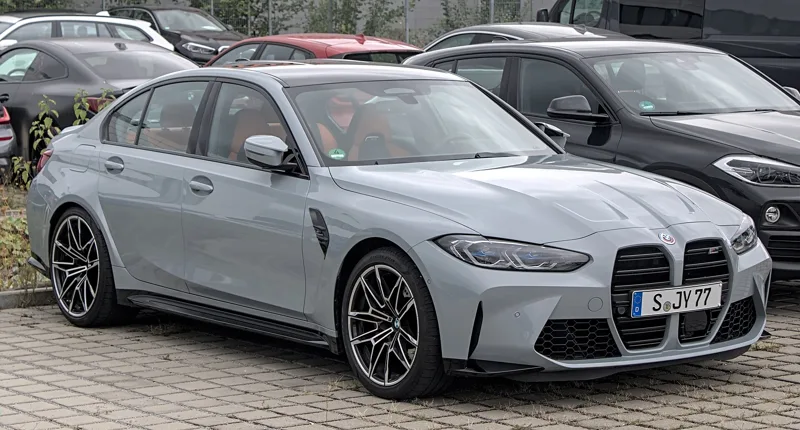
Launched in 1997 with a body claimed to be 70 per cent more rigid, the E46 came in five body styles and produced an M3 that still lines up in amateur racing.
The BMW 3 Series E46 was built from 1997 to 2006 as the fourth generation of BMW's 3 Series compact executive car. Five body styles were offered, the range introduced Valvetronic engines, and the 3.2-litre S54 M3 became its performance flagship.
The BMW 3 Series E46 was the fourth generation of BMW's compact executive car, built from 1997 to 2006. It replaced the E36 and came as a sedan, Touring estate, coupe, convertible and Compact hatchback. The best-known variant was the M3, which used a 3.2-litre straight-six engine.
When was the BMW 3 Series E46 built?
BMW built the E46 from 1997 to 2006. The sedan was unveiled by press release on 11 November 1997 and reached customers at the end of April 1998. Coupe and convertible production ended in August 2006, after the range had begun to phase out in late 2004 when the E90 3 Series sedan arrived.
Development began in 1993 under chief engineer Wolfgang Ziebart, with Wolfgang Reitzle as head of research and development. Chris Bangle led design work from late 1993, and the exterior approved in May 1995 came from Erik Goplen at DesignworksUSA. BMW brought DesignworksUSA in during February 1996 to work alongside its own designers.
The production sedan needed 31 months from styling approval in 1995 to the start of series production in December 1997. Design patents were filed in Germany on 16 July 1997 and in the United States on 16 January 1998.
A stiffer body, a rear-drive chassis and an M3 that still races gave the E46 a lasting reputation.
What made the E46 chassis different from the E36?
The E46 body shell was claimed to be 70 per cent more rigid than the E36, and aluminium suspension parts reduced unsprung mass. The car started life rear-wheel drive with 50/50 weight distribution, and the 328ci weighed 1,450 kg (3,197 lb).
All-wheel drive returned to the range on the 325xi, 330xi and 330xd, after the 3 Series had last offered it in 1991. Against the E36 equivalent, the 328ci was 55 kg (121 lb) heavier.
Electronics were more integrated than in earlier models. Drivetrain data such as engine and stability control travelled on a CAN bus, while the radio, navigation and telecoms talked over a K-bus. Dynamic Stability Control replaced the older ASC+T traction control in 2000.
Which engines and gearboxes did the E46 offer?
Petrol and diesel engines ranged from the 316i to the 330d, with coupes and convertibles badged Ci for petrol and Cd for diesel. Manual gearboxes came from ZF and Getrag, automatics came from GM and ZF, and the M3 could also be specified with the SMG-II automated manual.
The E46 was the first 3 Series to use Valvetronic variable valve lift, and the range gained satellite navigation, electronic brake-force distribution, rain-sensing wipers and LED tail-lights. Automatic models added Steptronic manual shifting in 2000.
What body styles did the E46 come in?
The E46 came as a four-door sedan, a five-door Touring estate, a two-door coupe, a two-door convertible and a three-door Compact hatchback. Sedans were the biggest seller, with 1,918,984 examples built, including 54,528 CKD units.
- Touring estate: 428,061 built between 1999 and 2005
- Coupe: 443,264 built between 1998 and 2006
- Convertible: 277,146 built between 1999 and 2006
- Compact hatchback: 199,430 built between 2000 and 2004
The Compact was the shorter three-door version and had its own headlights and tail-lights. Its steering rack had a faster ratio than the rest of the range.
What was the E46 M3 like?
The M3 used the 3.2-litre S54 straight-six, which revved to 8,000 rpm and had six individual electronically operated throttle bodies. Buyers picked a manual or the SMG-II automated manual, and the M3 coupe went on sale in 2000 with the convertible following in 2001.
The CSL was a lighter and faster version of the standard M3. Weight came down by removing equipment and fitting carbon fibre for its roof, door panels and centre console.
What changed in the E46 facelifts?
The sedan and Touring received a facelift for the 2002 model year, with revised headlights, grille, hood and bumpers introduced in September 2001. Coupes and convertibles followed in March 2003 for the 2004 model year, gaining LED tail-lights, a revised grille and adaptive headlights as an option.
The 2003 update also brought a DVD-based Mark IV navigation system. The SULEV M56 engine became an option on automatic 325i models in select parts of the United States, and it claimed identical power output to the M54 it replaced.
What engine changes came with the 2001 facelift?
The 2001 facelift for the 2002 model year moved the 320i to the M54 engine, replaced the 323i with the 325i and the 328i with the 330i. The 320d moved to the updated M47TU diesel, and the navigation display became widescreen.
The 320i came from the older M52TU engine, while the 330i moved onto the M54 unit that the 325i also used. Both changes sat inside the same update that gave the sedan and Touring their new headlights and bumpers.
The 2003 update then moved the 330d to the M57TU engine and fitted a six-speed manual to the 330 models, replacing the five-speed unit they had used before.
What made the M3 GTR street car different?
Ten street versions of the M3 GTR were built in 2001 so that the race car could compete in the American Le Mans Series. The road car kept the racer's stiffer chassis and suspension, sat lower than a standard M3 and used carbon fibre for many of its panels.
The road car's 4.0-litre V8 was slightly detuned from the racing engine and made 283 kW (380 hp) at 7,000 rpm. Power went to the rear wheels through a race-type sequential dual-clutch gearbox with an M locking differential, and the engine kept the dry sump lubrication of its racing counterpart.
Chassis changes followed the race car closely. The road car was lowered further, with extra strut braces, and redesigned front and rear fascias plus a rear wing improved its aerodynamics. Inside, leather Recaro bucket seats replaced the rear seats, and bigger radiators were fitted to cope with the engine's output.
How long was each E46 body style on sale?
The Compact hatchback was the first to finish, in December 2004, while the sedan and Touring ended in May 2005. The convertible continued until November 2006, and the coupe and convertible were the last E46 bodies still in production in 2006.
Sedan production ran from December 1997 to May 2005, with CKD assembly continuing to December 2005 for markets that received kits. Touring production ran from January 1999 to May 2005, and the Compact hatchback had started in April 2000.
Which transmissions did the E46 use?
The E46 used five-speed and six-speed manuals from ZF and Getrag, plus automatics from GM and ZF. The M3 stood apart with a six-speed Getrag manual and the SMG-II automated manual, while most other models were matched to a particular gearbox by engine.
Manual gearboxes were matched to each model. The 316i, 318i, 320i, 323i and 325i used a five-speed Getrag 250G, while the 325xi and 330xi used a five-speed ZF S5-39. Six-speed ZF S6-37 units went into the 325ti, 330i, 330Ci, 330xi, 320d and 320Cd, and the 330d, 330xd and 330Cd used the ZF S6-53.
Automatics included the four-speed GM 4L30-E, the five-speed GM 5L40-E and 5L50-E units, and the ZF 5HP19. The 330i version of the 5HP19 was more reinforced than the one fitted to the 320i and 325i, and the non-M SMG-I offered automated shifting with six speeds.
Where was the E46 built and sold?
The E46 was built in Germany at Leipzig, Munich and Regensburg, and at Rosslyn in South Africa. Cars for several other markets were assembled from complete knock-down kits, and 2002 was the peak year with 561,249 vehicles sold worldwide.
Complete knock-down kits, or CKD, were assembled in China, Egypt, Indonesia, Malaysia, Mexico, Thailand and Russia. Those builds are included in the sedan total of 1,918,984 examples, which covered 54,528 CKD cars.
Which special E46 models were built?
The most notable special models were the ZHP performance package sold in North America, the German-only M3cd and the 2002 Clubsport trim for M-Sport cars. Alpina also built B3 3.3 and B3 S versions of the E46, both with inline-six engines.
ZHP models had sportier camshafts, a shorter final drive and firmer springs and dampers. Their power rose from 225 to 235 hp, and the redline moved from 6,500 rpm to 6,800 rpm.
The Clubsport package was available only in 2002 on 320Ci, 325Ci and 330Ci M-Sport models. It removed 20 kg of insulation, added a rear M spoiler and came in just four paint shades, including Estoril Blue and Carbon Black.
How did the E46 perform in racing?
The E46 raced in touring car championships across Britain, Europe, Russia and Asia, winning titles in several regions. Andy Priaulx took the 2004 European title and the 2005 World Touring Car crown in a 320i, while Franz Engstler won the 2006 Asian Touring Car Championship in the same model.
Why did the Spec E46 series catch on?
Spec E46 is an amateur racing series in the United States, organised by the National Auto Sport Association and the BMW Car Club of America. Its cars were built to a common standard with limited modifications, so drivers competed on a level playing field.
By mid-2020 Spec E46 had become one of BMW CCA's three largest racing classes, a sign of how long the car stayed in demand on the track.
What are the BMW 3 Series E46 specifications?
The table lists the core figures for the range. Where a figure belongs to a specific model such as the M3 or ZHP, the table says so, so the performance models do not blend into the standard car. Figures are given in metric first, with imperial in brackets where both are available.
| Specification | Detail |
|---|---|
| Production years | 1997 to 2006 |
| Sedan unveiled | 11 November 1997 |
| Body styles | Sedan, Touring, coupe, convertible, Compact hatchback |
| Curb weight (328ci) | 1,450 kg (3,197 lb) |
| Weight against E36 (328ci) | 55 kg (121 lb) heavier |
| M3 engine | 3.2-litre S54 straight-six, 8,000 rpm redline |
| M3 transmissions | 6-speed manual or 6-speed SMG-II |
| ZHP output | 235 hp, up from 225 hp; redline 6,800 rpm |
| Sedan production | 1,918,984 built, including 54,528 CKD |
| Peak sales year | 2002, 561,249 vehicles worldwide |
Frequently asked questions
How quick was the ZHP package?
A Car and Driver track test recorded 0-60 mph in 5.6 seconds and the quarter mile in 14.3 seconds for the North American ZHP car. The package was offered on the 330i sedan from 2003 to 2005 and on the 330ci coupe and convertible from 2004 to 2006, and it raised power from 225 to 235 hp.
Did the E46 come with all-wheel drive?
Yes. The 325xi, 330xi and 330xd models carried all-wheel drive, a layout the 3 Series had last used in 1991. The 330xd was the diesel option, and it was also offered on the Touring estate. The 325xi and 330xi were petrol models, so the choice was between petrol all-wheel drive and diesel all-wheel drive.
Could an M3 be ordered with a manual?
Yes. The M3 was offered with a six-speed manual as well as the six-speed SMG-II automated manual, so buyers could choose between a clutch pedal and automated shifting. The M3 coupe came first in 2000 and the convertible followed in 2001, with both body styles offering the same transmissions.
Was there a diesel M3?
Yes, although only in Germany. The M3cd was a 102-unit run from 2004 to 2006, with a tuned BMW M57N 3.0d diesel that was limited to 3,200 rpm when stationary. It shared its body with the E46 M3, so it looked like the petrol car while running a diesel engine.