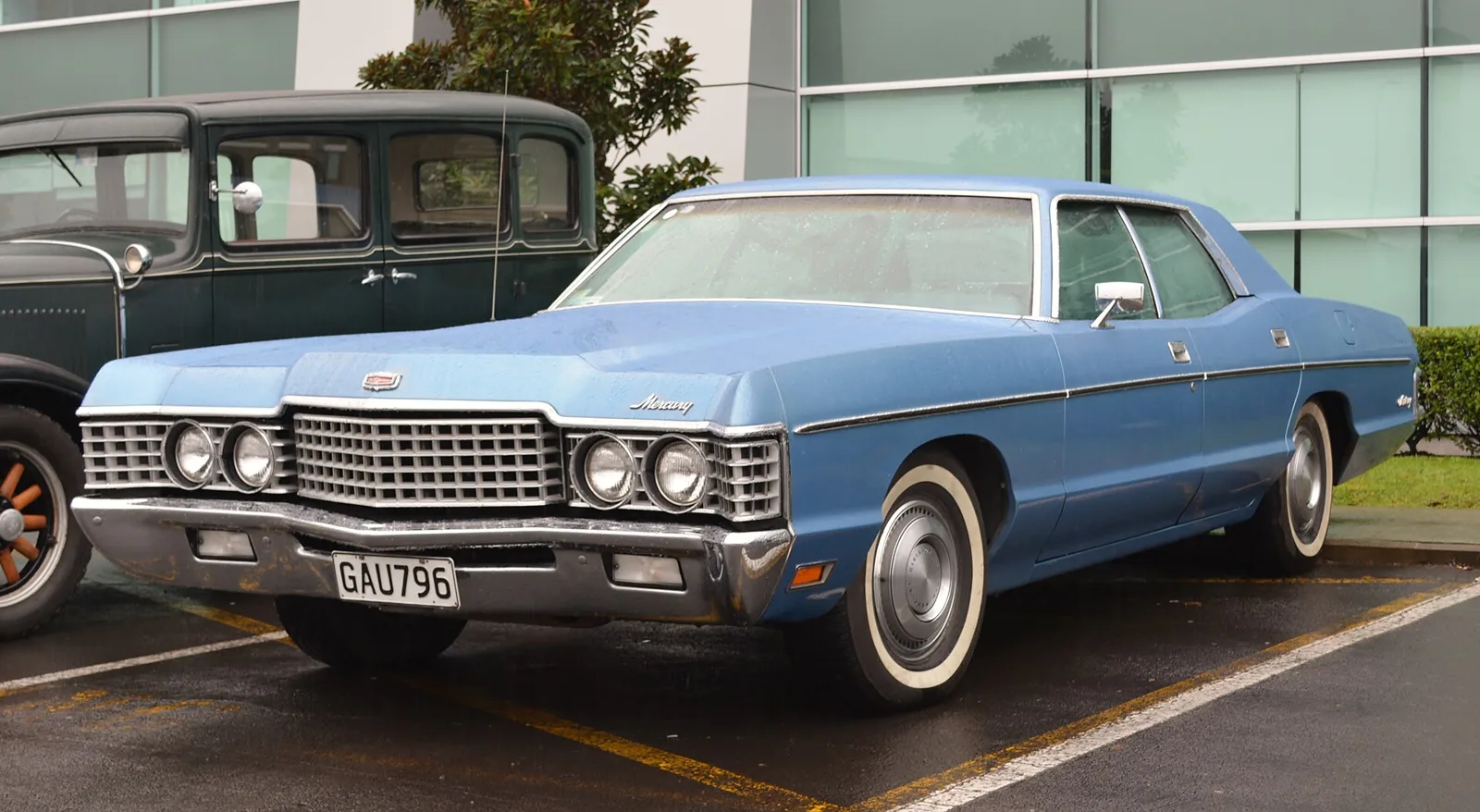
A name taken from Monterey Bay became the division's most versatile full-size car, with hardtops, wagons, Breezeway roofs and engines from six cylinders to a 428 V8.
The Mercury Monterey was a full-size Mercury built from 1950 to 1974, starting as a two-door coupe. It moved from Edsel-era bodies to Ford platforms in 1961 and was discontinued in 1975, when the Marquis became the only full-size Mercury. Its engines ranged from six-cylinder units to a 428 V8.
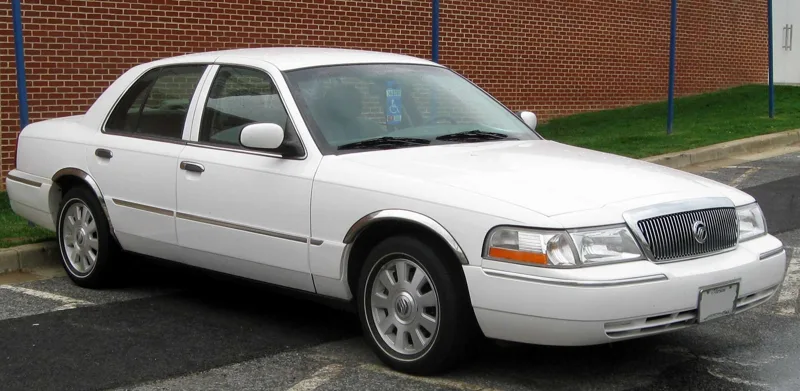
The Mercury Monterey was a line of full-size cars built by Ford's Mercury division from 1950 to 1974, with a revival for 2004 to 2007 as a Freestar counterpart. Over 22 years it served as the flagship, mid-range and entry-level full-size model at different points, and it was the only Mercury nameplate in continuous production through the 1960s.
What was the Mercury Monterey when it started?
The Monterey was introduced in 1950 as the top-of-the-line two-door coupe in the Mercury Eight series, meant to meet the hardtop coupes that General Motors and Chrysler had launched the previous year. The name came from Monterey Bay, and the first cars were model 72C.
Montereys were offered as a canvas convertible at $2,146 or a vinyl-roofed car at $2,157 in 1950 money, roughly $28,717 and $28,864 in 2025 dollars. Standard equipment included leather-faced seats, a simulated leather headliner, wool carpets, a two-toned dash and gold winged hood ornament. All-leather seats cost $10 extra. Few were sold.
Colours were limited to Turquoise Blue with a dark blue top, Cortaro Red metallic with a black top, and black with a yellow top. The car was never a volume seller, but it offered a stylish, well-equipped step above the rest of the Mercury range.
A name borrowed from a bay on the coast became one of Mercury's longest-running full-size badges.
How did the Monterey change between 1952 and 1954?
In 1952 Ford began positioning Mercury as a mid-priced rival to the Pontiac Chieftain and Buick Special, and all Mercury models received a redesign. The Monterey became a separate series and Mercury's top line, above the Custom, with a convertible and a four-door sedan in the lineup. The hardtop body arrived the same year, and the cars gained 18% more window area.
The new heater and vent controls were placed on a plane perpendicular to the dash, behind the steering wheel, in a style that owed something to aircraft flight controls. The 1952 convertible was listed at US$2,370, or about $28,734 in 2025 dollars, and buyers could choose from eleven exterior colours and seventeen two-tone combinations.
A station wagon joined the Mercury range for 1953 with an optional woodie look. In 1954 the new 161 hp (120 kW) Ford Y-block V8 arrived, along with the bubble-top Monterey Sun Valley, which had a Plexiglas front half to its roof. The Mercury XM-800 concept car first shown in 1954 also took the Monterey name.
What did the 1955 and 1956 Montereys offer?
For 1955 the Monterey gave up its top-model status to the new Montclair, but a 292 cu in (4.8 L) Y-block from the Thunderbird now sat under the hood. That engine produced 188 hp (140 kW) with the standard transmission and 198 hp with the Merc-O-Matic. The front suspension used independent ball joints, and brakes were enlarged.
The 1956 model brought a 312 engine at 235 hp (175 kW) and a dual four-barrel setup that offered 260 hp (190 kW). Mercury swapped its crest for a Big M emblem, and the side trim became a full-length multi-tier chrome spear. There were thirty-one two-tone combinations and twenty-eight Flo-tone options, where the roof and lower body shared one colour.
Safety and convenience gains followed. A 12-volt electrical system allowed power accessories such as air conditioning, and the cars came with standard dual exhausts, deep-dish steering wheels and tubeless tyres. Mercury added its own version of the Ford Lifeguard package, and childproof rear door locks and seatbelts were made available as free-standing options.
Why was the 1957 Monterey a major redesign?
The 1957 full-size Mercury was redesigned and grew noticeably, riding on a 122 in (3,099 mm) wheelbase unique to Mercury, lifting it above the new Edsel line. A new frame allowed a lower floor, which made the car look lower and longer, and interior features included memory power front seats.
The station wagons were moved out of the Monterey series into their own line, and the 312 Y-block gained 20 horsepower to go with the added weight. Buyers could also order a Lincoln Y-block of 368 cu in (6.0 L), rated at 290 hp (220 kW). Early 1957 cars had two headlights, while later examples switched to four.
Mercury also offered mechanically operated pushbutton transmission controls for 1957, a reply to the Chrysler TorqueFlite buttons introduced a year earlier. The panel sat to the left of the steering wheel, and the keyboard arrangement was dropped in 1959 for a steering-column selector.
How did the 1958 to 1960 cars change?
In 1958 a new 383 cu in (6.3 L) MEL V8 arrived with the Multi-Drive three-speed automatic. As tailfins grew less popular, Mercury toned down its styling while keeping a similar look.
For 1959 the Monterey grew to a 126-inch wheelbase, and Mercury stopped using Edsel-derived chassis and bodies for the first time since 1940. The line offered five bodystyles, including the Cruiser hardtops with a large compound-curved rear window, taking the name from the discontinued Turnpike Cruiser.
The base Monterey sedan used a 210 hp 312 V8, while the 383 producing 280 hp was optional. A three-speed manual was standard on the 312, and the 383 came only with the automatic. For 1960 the car was facelifted, with less exterior trim and a grille that integrated the headlights.
How did the 1961 downsizing change the Monterey?
For 1961 Mercury transformed its model line. The Monterey moved from the Edsel-based body to a Ford body and became the equivalent of the Ford Galaxie. It shifted from the base Mercury sedan to the flagship, above the new Meteor, while the Montclair and Park Lane were dropped.
Compared with the earlier car, the 1961 Monterey was six inches shorter in wheelbase, almost two inches narrower and over four inches shorter overall. Depending on the powertrain, it shed over 300 pounds of curb weight. Even so, at 120 inches its wheelbase ran one inch longer than the Galaxie's.
The lineup covered four bodystyles: hardtops in two and four doors, a four-door sedan and a convertible. The car differed from the Galaxie mainly in its grille and six small taillamps instead of two large ones, and the trim was subdued compared with the Ford.
What engines did the 1961 to 1963 Montereys use?
The Monterey shared its 292 cubic-inch Y-block V8 with the Galaxie, rated at 175 hp. Buyers could choose a 352 or 390 cubic-inch FE V8, rated at 220 hp and 300/330 hp respectively. Three-speed manual and automatic transmissions were offered, with a four-speed manual available as an option.
In 1962 the Monterey became the entire full-size Mercury line, after the Meteor name moved to the intermediate range. The six-cylinder Monterey 6 arrived with a 135 hp 223 cubic-inch inline six from the Meteor, and the Mercury S-55 option brought bucket seats, floor-mounted shifters and special trim, plus a 405 hp 406 cubic-inch V8.
For 1963 the roofline was substantially revised, bringing back the retractable rear window used on the Continental and Turnpike Cruiser. The Breezeway name applied to that window, fitted as standard to every car except convertibles, including S-55 models. The Marauder trim package was added as a 1963 1/2 model, pairing the Monterey body with the Galaxie hardtop roofline for racing use.
The engine lineup was simplified, with the 223 six and the 292 and 352 V8s dropped, and a 250 hp 390 becoming standard. The 390 could also be had at 300 hp, and the 406 came in 385 hp and 405 hp forms. Mid-year, the 406 gave way to a 427 cubic-inch V8 rated at 410 hp, with a 425 hp version only on special order.
How did the Monterey evolve from 1964 to 1968?
In 1964 the Montclair and Park Lane returned, and the S-55 was discontinued. The Marauder fastback became a four-door hardtop, giving Mercury a second roofline distinct from Ford. The Monterey itself came back as a two-door sedan, while the four-door hardtop was offered only as a Marauder fastback.
For 1965 the full-size line was redesigned on a 123-inch wheelbase, four inches longer than the Ford, with coil springs at the rear replacing leaf springs. The styling borrowed from the Lincoln Continental, with four horizontal headlamps and a grille that matched the Continental. The Monterey now came in six bodystyles, including a Breezeway four-door sedan.
The 1965 engine line began with a 250 hp 390 V8, with a 300 hp Super and a 330 hp Interceptor available as extras, plus a 425 hp 427 V8. For 1966 the 390 rose to 265 hp (275 with automatic), and a 330 hp 410 V8 was exclusive to Mercury. The 427 was dropped, and a 345 hp 428 became the top option.
In 1967 four-door sedans received a more formal C-pillar, and the Breezeway roof was discontinued. The S-55 became an option package for the two-door models. The 1968 car got a minor restyle with a Continental-inspired front, a 280 hp 390 was added and the 428 was detuned to 340 hp.
What happened to the Monterey from 1969 to 1974?
For 1969 Mercury launched an all-new full-size generation, with sedans on a 124-inch wheelbase and station wagons on 121 inches. The Monterey Custom replaced the Montclair, and the Marquis took over the Park Lane's place. The Monterey was distinguished from the Marquis by its lack of hidden headlights.
The 1971 restyle brought a Continental-like grille and taillamps. Ford and Mercury introduced pillarless hardtops using frameless door glass, and the Monterey and Marquis convertibles were discontinued after 1970, leaving the Cougar as Mercury's sole convertible. The 351 Windsor and the 400 cu in (6.6 L) Cleveland arrived in 1971.
In 1972 the Monterey gained an egg-crate grille and, for the first time, an automatic transmission as standard, with power steering and power brakes. The 1973 model adapted to federally mandated 5 mph bumpers and adopted much of the Galaxie's front fascia. Lincoln's 460 V8 became the top option for 1974.
In 1975 Mercury discontinued the Monterey, in line with Ford retiring the Galaxie, and the full-size range was reduced to the Marquis. The Grand Marquis arrived in 1975 as the new flagship, becoming a distinct range by 1983.
Was the Monterey sold in Canada?
Ford Motor Company of Canada sold the Monterey, and it also offered the Mercury 400 for 1963 only. That car was essentially a Monterey with lower trim and a six-cylinder engine as standard.
From 1964 Canadian buyers could no longer order the Monterey, and the revived Meteor filled the low-priced slot. The Meteor's top series were broadly similar to the American Monterey in styling and appointments, and the name continued as a separate marque through 1976.
What are the key Monterey specifications?
The table covers the main figures across the decades, with the engine and price data listed by year. Where a figure belongs to one model year, the table says so, so the 1950s and 1960s cars are not blended together.
| Specification | Detail |
|---|---|
| Production span | 1950 to 1974, with a 2004 to 2007 revival |
| 1950 convertible price | $2,146 (about $28,717 in 2025 dollars) |
| 1957 wheelbase | 122 in (3,099 mm) |
| 1959 wheelbase | 126-inch |
| 1961 wheelbase | 120 inches |
| 1965 wheelbase | 123-inch |
| 1969 wheelbase | 124-inch sedans, 121-inch station wagons |
| 1961 engine | 292 cubic-inch Y-block V8, 175 hp |
| 1963 engine | 250 hp 390 V8 standard |
| 1966 largest V8 | 428 cubic-inch V8, 345 hp |
| 1972 engine | 429 four-barrel, 209 net hp, designed for regular fuel |
| 1974 top option | Lincoln 460 V8 |
Frequently asked questions
How long was the Mercury Monterey in production?
The original Monterey ran from 1950 to 1974, a span of 22 years. The nameplate was revived for 2004 as the counterpart of the Ford Freestar minivan and built through the 2007 model year.
What was the largest engine in a Monterey?
The 428 cubic-inch V8 at 345 hp, introduced in 1966, was the most powerful option. It was detuned to 340 hp for 1968.
Did the Monterey ever come with an automatic as standard?
Yes. In 1972 an automatic transmission became standard for the first time, along with power steering and power brakes.
What replaced the Monterey after 1974?
The Marquis became the only full-size Mercury after the Monterey was discontinued in 1975, and the Grand Marquis was added as the flagship that year.
.jpg)