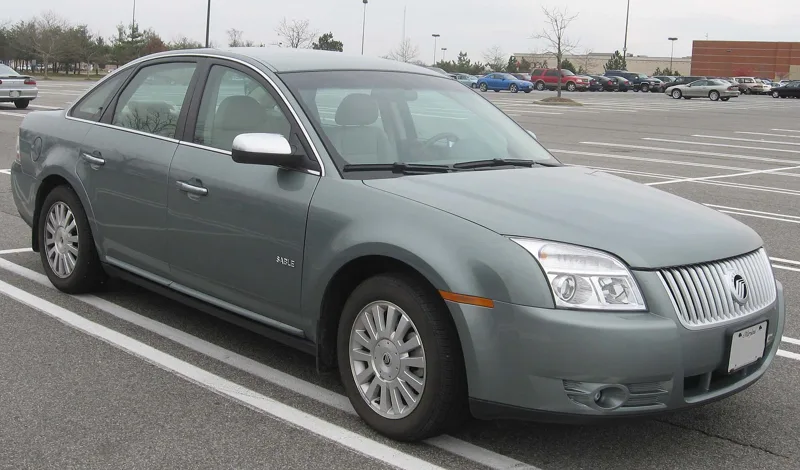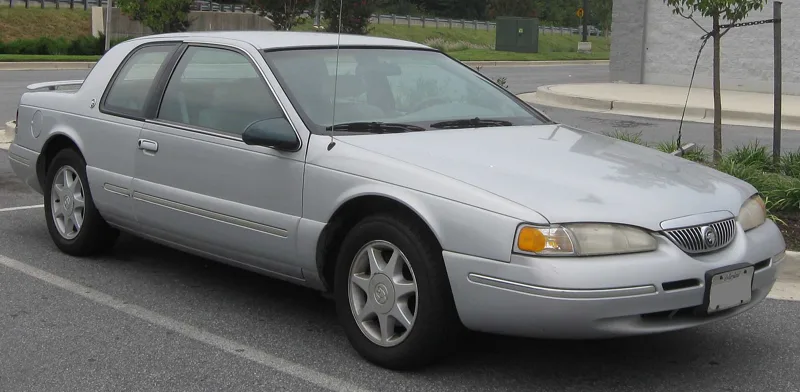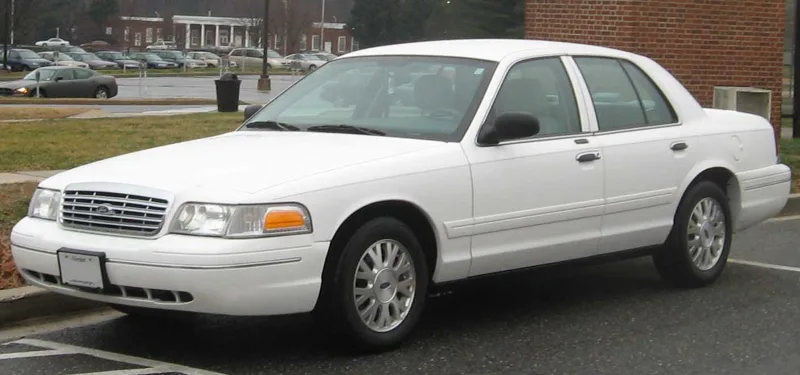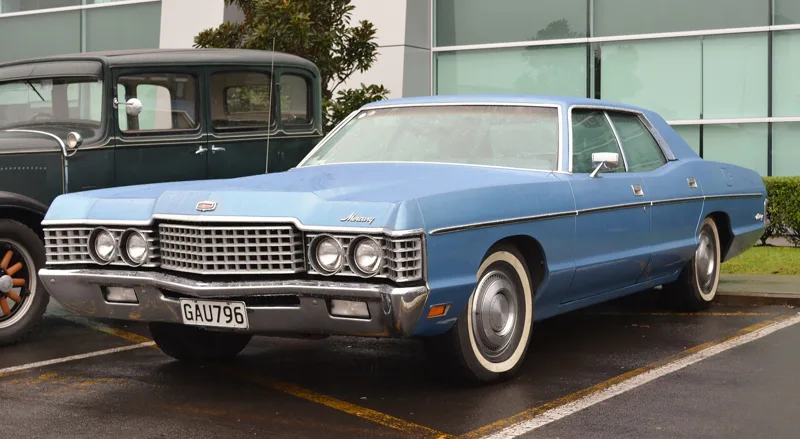
A rear-wheel drive V8 sedan that shared its bones with the Ford Crown Victoria, lasted 36 years and was the last car built under the Mercury badge.
The Mercury Grand Marquis was a full-size rear-wheel drive sedan built from 1975 to 2011, starting as the Marquis flagship and becoming a stand-alone line in 1983. It shared the Panther platform with the Ford Crown Victoria, reached 2.7 million units, and was the final car built under the Mercury badge.
The Mercury Grand Marquis was Mercury's flagship sedan for most of a 36-year run, from the 1975 model year to the final car in January 2011. It was the largest Mercury sedan from 1983 onward, and it rode on the rear-wheel drive Panther platform it shared with the Ford Crown Victoria and the Lincoln Town Car. Its life is the story of a traditional big American sedan that outlived the brand that built it.
Where did the Grand Marquis come from?
The Grand Marquis began in 1975 as the flagship sub-model of the Mercury Marquis, after the name had first appeared in 1974 as an interior trim package. It became a stand-alone model line in 1983 and served as the sedan counterpart of the Colony Park wagon until 1991.
The fourth generation later underpinned the Marauder for 2003 and 2004. For 1975 the division also retired the Monterey name, which had been in use since 1950, and gave every full-size Mercury sedan the Marquis nameplate.
The Grand Marquis sat above the Marquis Brougham and was pitched at premium medium-brand sedans such as the Buick Electra 225 and Oldsmobile Ninety Eight. It also faced the Chrysler New Yorker Brougham, giving Mercury a car to set against the buyers of those rivals.
A rear-wheel drive V8 sedan that outlived the Mercury brand and sold 2.7 million cars.
What engines did the 1975 to 1978 Grand Marquis use?
The 1975 Grand Marquis was offered with a 460 cu in (7.5 L) V8, and the 400 cu in (6.6 L) unit was the standard choice in 1976 and 1977. For 1978 the 351 cu in (5.8 L) V8 took over as standard, except in California, where the 400 stayed.
Every engine was matched to a three-speed automatic, and four-wheel disc brakes were optional, shared with the Lincoln Continental. The 460 stayed available as an option through 1978.
The Grand Marquis came as a four-door pillared hardtop or a two-door hardtop sedan, with hidden headlights as standard, like the Marquis and Colony Park. A four-door hardtop ran from 1975 to 1978 and a two-door hardtop from 1975 to 1987.
How did the 1979 downsizing change the Grand Marquis?
For 1979 Mercury cut the Grand Marquis by 17 inches and removed nearly 1,000 pounds, depending on the powertrain, while still offering more interior and luggage space than before. Its exterior footprint matched the Cougar (Montego) intermediate sedan.
The Ford LTD Crown Victoria arrived for 1980 as the first direct divisional counterpart, with near-identical bodies apart from the front and rear fascias. Both cars sat on the Panther platform, where the Mercury wheelbase fell from 3,150 mm (124 in) to 2,903 mm (114.3 in).
Ford and Mercury sedans had shared chassis underpinnings since 1961, but the Panther chassis was the first time the two lines shared the same wheelbase. The Grand Marquis kept a live rear axle with double wishbones at the front and coil springs at all four wheels.
How was the first-generation Grand Marquis powered?
The 4.9 L (302 cu in) V8 became the only engine through 1991, and Ford rounded its capacity up to 5.0 L in its literature. With throttle-body injection it made 130 hp (97 kW; 132 PS), and multi-port injection from the 1986 model year lifted that to 150 hp (112 kW; 152 PS).
The 4.9 L was paired with the four-speed AOD overdrive automatic. The 4.2 L (255 cu in) V8 that had been the previous standard engine was discontinued.
Gas-charged shock absorbers were standardised in 1985, and load-leveling rear air suspension was offered as an option. Front vented discs and rear drum brakes completed the braking package, and 15-inch wheels returned as standard in 1986.
What changed in the 1992 redesign?
The 1992 redesign gave the Grand Marquis an all-new body on the same chassis. Unveiled on November 28, 1990, it was the biggest change to the Panther cars since 1979, and it finally separated the Grand Marquis from its Crown Victoria twin, which had been almost identical for years.
Ford sought younger buyers for the car, rather than the older customers who had traditionally bought full-size Mercurys. The new Grand Marquis was pitched at buyers who needed more room than a Taurus or Sable offered.
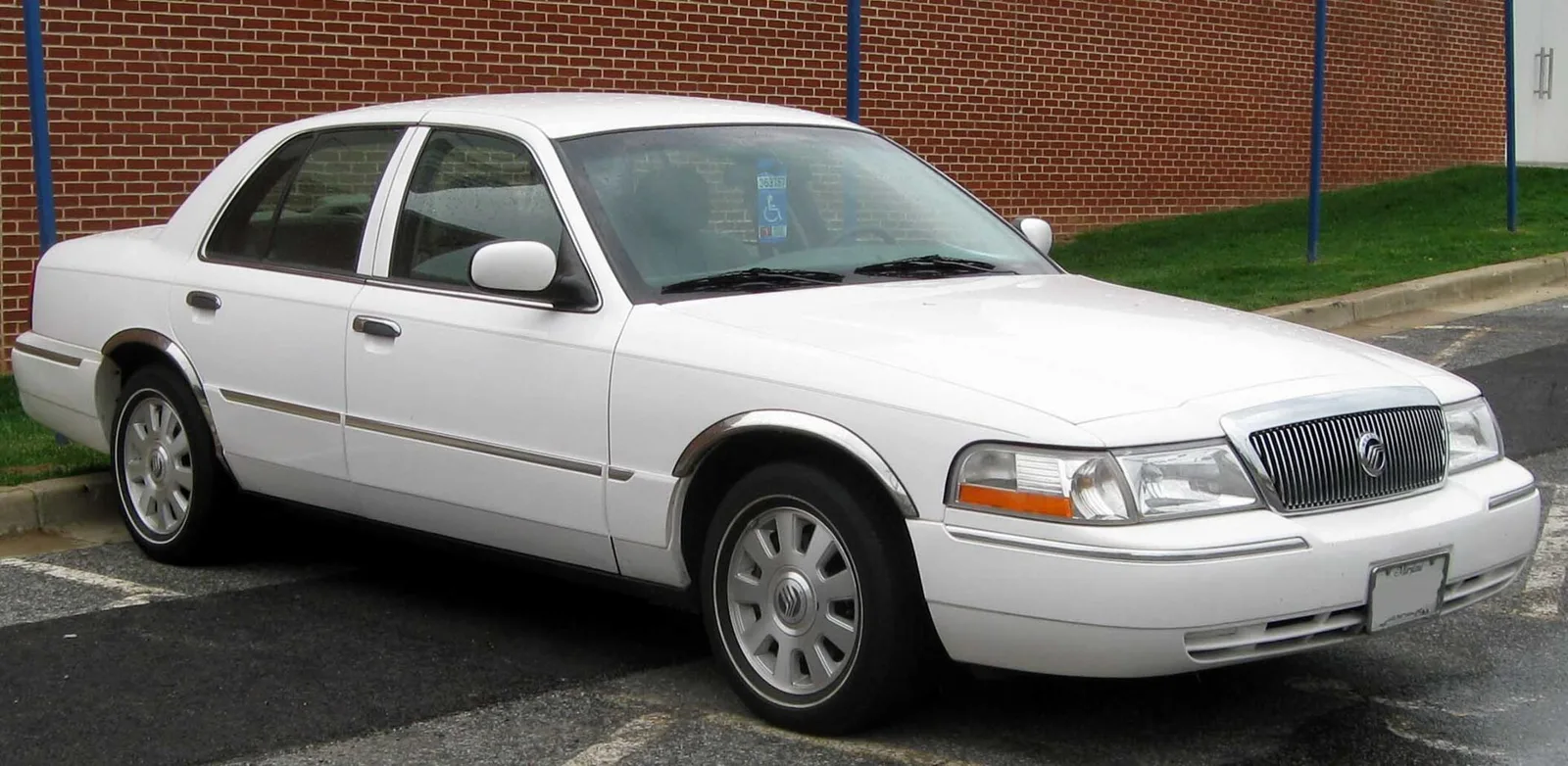
Aerodynamics and fuel economy shaped the design. The Grand Marquis kept more traditional styling than the Crown Victoria, which followed the Taurus theme. Its full-width taillights, formal roofline and chrome waterfall grille set it apart, and the waterfall grille later became a signature across the Mercury range.
Four-wheel disc brakes replaced the rear drums, with ABS traction control as an option, and aluminium alloy wheels replaced the simulated wire covers. The GS and LS trims continued, with front cornering lamps marking the LS, and the car was sold solely as a four-door sedan from 1992.
Why did the 1992 car's parts sourcing draw attention?
During the 1991 changeover at St. Thomas, Ford moved a number of parts suppliers outside North America, cutting domestic content from about 90% to below 75%. Under the CAFE rules of the time, a vehicle below 75% domestic content counted toward an automaker's imported fleet.
The arrangement let Ford keep full-size V8 sedans in its line while lifting the average fuel economy of the wider fleet. In effect the sedan was filed alongside the small Festiva, imported from South Korea, rather than against the V8 Cougar and Mustang.
After 1996 General Motors dropped the Buick Roadmaster and Chevrolet Caprice, and its full-size sedans moved to front-wheel drive. From 1997 the Crown Victoria was the Grand Marquis's main rival, as the only other nameplate with rear-wheel drive, body-on-frame construction, a V8 and six seats.
What changed in the 1998 third generation?
The third generation arrived in late 1997 as the 1998 model, bringing an evolutionary revision to both the exterior and the interior. It beat the Crown Victoria in sales in 1994 and again in 1997, despite the rival's police and fleet business.
Ford kept the Grand Marquis's design language for 1998 and brought much of it to the Crown Victoria, moving that car away from its 1992 look. The two lines again shared a rear roofline, using the Grand Marquis's formal styling, a configuration that lasted until 2011.
The chassis lengthened to a 114.7-inch wheelbase, and the four-link rear gained a Watt's linkage while staying on a solid axle. Front calipers became dual-piston units that needed 16-inch wheels, and traction control was revised to work at any speed.
The standard 4.6 L Modular V8 rose from 190 hp to 200 hp in single-exhaust form, and the handling package with dual exhaust produced 215 hp (160 kW; 218 PS). For 2001 the Performance Improved heads lifted the two outputs to 220 hp and 235 hp (164 and 175 kW).
Sales stayed strong, and the car was regularly selling more than 100,000 units a year. The Handling & Performance Package carried over, adding sport-tuned shocks, larger sway bars, a heavy-duty rear suspension with air springs and lace-spoke 16-inch wheels.
What was the LSE package?
The LSE was a trim added at the 2001 Chicago Auto Show, built on the LS and the Handling & Performance Package. It added five-passenger seating with front bucket seats, a floor shifter and a centre console, and its base price for 2001 was US$28,295.
The LSE also brought the leather-wrapped steering wheel, electronic climate control and dual 8-way power seats that were options on the LS. Its wheels were lace-spoke 16-inch units on P225/60TR16 tyres.
The package returned for 2005, with only 533 examples built. Later LSE kits were simply a package for LS Premium cars, adding a 3.27:1 rear axle, dual exhaust and a 16x7 inch snowflake wheel.
What changed in the 2003 fourth generation?
The fourth generation arrived for 2003 with mechanical, exterior and interior updates, and it replaced the Ford Crown Victoria in the retail market. The Panther chassis was redesigned, and the new frame was hydro-formed and fully boxed, with Mercury claiming it resisted vertical bending 20% better.
Suspension changed with coil-over front shocks, aluminium lower control arms and inverted mono-tube rear shocks mounted outside the frame rails. The steering moved from recirculating ball to an electronic variable-assist rack and pinion, which was 22.5 pounds lighter.
The 4.6 L V8 and 4R70W automatic carried over, now rated at 224 hp (167 kW; 227 PS) with single exhaust and 239 hp (178 kW; 242 PS) with dual exhaust. Those figures held until production ended in 2011.
The 2005 model year introduced drive-by-wire throttle control and an all-new steering wheel, while the 2006 update brought the final styling change of any Panther-platform car, with a rectangular grille and fog lamps as an option.
Which trims did the final years offer?
From 2003 the Grand Marquis expanded to four trims: the base GS, GS Convenience, LS Premium and LS Ultimate. The GS was dropped for 2009, and the LS was split into LS Fleet and LS Retail versions, with the fleet version offered only for fleet purchase.
The LS Ultimate added rear air suspension with a rear stabiliser bar, Ultimate fender badging, standard leather seats and, from 2003 to 2005, a fully digital gauge cluster. It was missing for 2008 but returned for 2009.
Limited Edition LS cars sold from 2003 to 2005 came with chromed mirrors, body-coloured door handles and two-tone leather. The Handling package that replaced the LSE from 2006 to 2007 kept the chassis upgrades but dropped the five-passenger seating.
Where was the Grand Marquis sold outside the United States?
The Grand Marquis was sold across North America, and outside the continent its exports centred on the Middle East. In Canada the Mercury brand was phased out after the 2004 model year, but the car kept selling through Ford of Canada until 2011.
After 1999 Ford of Canada stopped selling the Crown Victoria to private buyers, so civilian sales in Canada focused on the Grand Marquis. The redesigned 2011 Ford Taurus eventually replaced it in that market.
In Mexico, Ford de Mexico sold the car as a Ford from 1982, and a Country Squire wagon ran through the 1984 model year when it was built locally. Imports from St. Thomas resumed for 1992, and the Ford Five Hundred replaced the car for 2005.
In the Gulf Cooperation Council states the car sold on lower price and reliability compared with German and Japanese luxury sedans. By the 2000s it was losing share to newer rivals such as the Holden-built Chevrolet Caprice and the Dodge Charger.
GCC cars carried a High Ambient Temperature and Speed Package, a heavy-duty battery and an auxiliary transmission fluid cooler, plus a 40/20/40 front split from the Lincoln Town Car from 1998 and Arabic warning labels.
Why did Grand Marquis production end?
Ford's 2006 Way Forward plan proposed closing 14 North American plants by 2012, saving nearly US$5,000,000,000 and cutting almost 30,000 jobs. The St. Thomas plant, where the Grand Marquis was built, moved to a single daily shift and was ultimately closed in 2011.
On June 2, 2010 Ford announced that it would end all Mercury vehicles, closing a brand that had run for 72 years. The last car, a white LS Fleet, rolled out at 7:46 am on January 4, 2011, and the St. Thomas plant itself shut on September 15, 2011.
Over 36 years and more than 2.7 million cars, the Grand Marquis was the longest-running Mercury nameplate, ahead of the Cougar's 34-year run. Its Panther platform underpinned the design for 32 years, and its outside looks stayed nearly unchanged for its last 19 years.
What were the Grand Marquis specifications?
The table gives the main engine, dimension and production figures for the Grand Marquis across its four generations. Each row names the generation it applies to, and metric figures come first wherever both systems are given.
| Specification | Detail |
|---|---|
| Model years | 1975 to 2011 |
| Platform | Panther, rear-wheel drive |
| Wheelbase, 1979 onward | 2,903 mm (114.3 in) |
| Wheelbase, 1998 onward | 114.7 inches |
| Engines, 1975 to 1978 | 460 cu in (7.5 L), 400 cu in (6.6 L), 351 cu in (5.8 L) V8 |
| First-generation engine | 4.9 L (302 cu in) V8: 130 hp (97 kW; 132 PS), then 150 hp (112 kW; 152 PS) from 1986 |
| Second-generation engine | 4.6 L Modular V8: 190 hp, or 210 hp with dual exhaust |
| Third-generation engine | 200 hp (149 kW; 203 PS); 215 hp (160 kW; 218 PS) with dual exhaust; 220 and 235 hp from 2001 |
| Fourth-generation engine | 224 hp (167 kW; 227 PS) single exhaust; 239 hp (178 kW; 242 PS) dual exhaust |
| Transmissions | Three-speed automatic (1975 to 1978); AOD; 4R70W; 4R75E from 2006 |
| Driver airbag | Standard from 1990 |
| Two-door body | Discontinued after 1987; 4,904 produced |
| Total production | 2.7 million units over 36 years |
| Final car | January 4, 2011, St. Thomas Assembly, Ontario |
Frequently asked questions
Was the Grand Marquis ever offered as a two-door?
Yes, but only in part of its run. A two-door hardtop was offered from 1975 to 1987, and the two-door body was discontinued after the 1987 model year, with only 4,904 produced.
How much did the LSE cost?
The LSE carried a base price of US$28,295 for the 2001 model year. It sat on top of the LS trim and borrowed hardware from the Handling & Performance Package.
What was the final engine?
The fourth generation kept the 4.6 L Modular V8, whose output was 224 hp (167 kW; 227 PS) in single-exhaust form and 239 hp (178 kW; 242 PS) with dual exhaust. Flex-fuel capability on E85 arrived for 2007.
When was the last Mercury built?
The final Mercury-branded car was the Grand Marquis built on January 4, 2011, at St. Thomas Assembly in Ontario, Canada.