A front-drive mid-size Mercury that shared its engineering with the Ford Taurus for almost a quarter of a century, moving from a wagon-friendly hatchback body to a full-size sedan before the brand closed.
The Mercury Sable was a Mercury-badged version of the Ford Taurus, sold from 1986 to 2009 in five generations. It began as a front-drive mid-size sedan and wagon and was revived in 2008 as a full-size sedan before Mercury was retired.
The Mercury Sable was a range of cars that Mercury sold from the 1986 to the 2009 model years. It was the divisional counterpart of the Ford Taurus for its whole production run, and it was the largest front-wheel-drive model the brand offered. Over 2.1 million were built, which put it third among Mercury's model lines by volume.
What did the Sable name and role mean?
The name comes from the sable, a small weasel valued for its fur. The Sable sat below the Grand Marquis in size, and for its first four generations it was a mid-size car offered as a sedan and a wagon.
Its engineering was shared with the Taurus, and the two cars were assembled side by side at Ford's Atlanta Assembly in Hapeville, Georgia and at Chicago Assembly in Illinois.
The Sable was discontinued after the 2005 model year, when Mercury replaced it with the full-size Montego and the mid-size Milan. It returned for 2008 as a fifth generation, and it was discontinued again after 2009, when Mercury itself was retired.
A Taurus twin that carried the Mercury badge for twenty-three model years, from front-drive family sedan to full-size car.
Why was the Taurus and Sable project so large?
Development began in early 1980 alongside the Ford Taurus. At the time it was the largest project Ford had ever undertaken, and the plan was to replace both the rear-drive Panther and Fox platforms with a single front-drive chassis.
During 1981 the objective changed. The stabilisation of petrol prices justified keeping the Panther chassis for longer, so Ford went on with the project as the successor to the mid-size Fox, in a segment that was moving rapidly to front-wheel drive.
The design approach borrowed from the Ford Escort. An interdisciplinary team designed each element at the same time, including manufacturing and assembly, and designers studied buyer input and reverse-engineered rival cars to lower repair costs and improve production.
How did rival manufacturers respond?
Once the 1981 Dodge Aries and Plymouth Reliant were on sale, General Motors remade its A-body cars for 1982. The Buick Century, Chevrolet Celebrity, Oldsmobile Cutlass Ciera and Pontiac 6000 were downsized and moved to front-wheel drive.
For 1983 Chrysler extended its K-car footprint into the mid-size class with the Dodge 600 and Chrysler New Yorker. The Taurus and Sable were therefore arriving in a market where front-drive was becoming the norm for mid-size cars.
How did Ford reshape Mercury's range in 1983?
In 1983 Ford overhauled its mid-size and full-size ranges. The Cougar returned to its traditional role as a two-door personal coupe, a counterpart of the Ford Thunderbird, and its body was completely redesigned with aerodynamic styling, which was a central goal of the Taurus and Sable.
The redesign was well received, and the 1983 Cougar outsold the Thunderbird. The Cougar sedan and wagon, the Mercury counterpart of the Ford Granada, took the Marquis name, and the LTD and Marquis moved onto the Fox platform in a second downsizing.
That move set the final course for the project. The Ford Taurus would replace the Ford LTD, and the Mercury Sable would replace the Mercury Marquis, while the Fairmont and Zephyr gave way to the Tempo and Topaz in 1984.
How was the Sable launched?
Ford unveiled the Mercury Sable alongside the Ford Taurus in mid-1985 as a 1986 model. Instead of a traditional auto show, Ford held a single launch event on an MGM Studios soundstage, the same lot where Gone with the Wind had been filmed.
Staff entered a room decorated in space-age style, holding cups shaped like flying saucers, while the two cars sat behind a curtain. Strobe lights and a drum roll preceded the reveal of the Taurus and Sable to the press.
Ford also planned an advertising campaign for the Sable featuring the singer Bette Midler. Midler declined to appear, and Ford used an impersonator instead. Midler sued, and the case of Midler v. Ford Motor Co. became a leading ruling on whether an impersonation could amount to an appropriation of identity.
What was the first-generation Sable like?
The first Sable went on sale in December 1985 as a 1986 model. It took over from the Mercury Marquis as the mid-size Mercury, sitting between the Topaz and the Grand Marquis and Colony Park. For 1986 the Sable was sold alongside its Marquis predecessor for a short time.
The Sable trailed the Taurus in sales by a wide margin, but it proved successful on its own. For its first generation it competed with the Grand Marquis for the title of Mercury's best-selling line. Car and Driver put it on its Ten Best list at launch, and it appeared again in 1990 and 1991.
Ford did not sell Mercury in Mexico, so Ford of Mexico sold the Sable as a Ford Taurus there. In South Korea, Kia sold the Sable under its own brand next to the Potentia, a model tied to the Mazda Luce and 929.
What was under the first-generation Sable's skin?
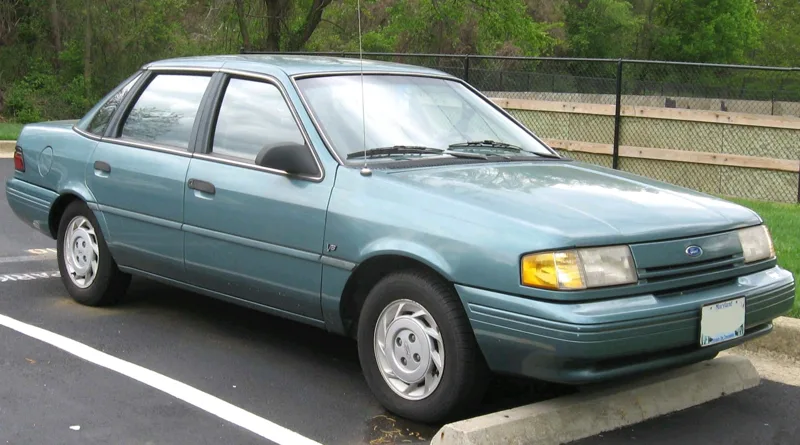
The first generation rode on the front-drive DN5 platform, with the same 106 in (2,692 mm) wheelbase as the Taurus. Like its Marquis predecessor it used unibody construction, and it had four-wheel independent suspension.
The front axle used MacPherson struts and a stabiliser bar. Sedan rear suspension was a coil-sprung four-link layout, while station wagons used a coil-sprung double-wishbone design with a stabiliser bar. Front disc brakes and rear drum brakes were fitted, with larger rear brakes on the wagons.
The Sable was never offered with a manual transmission, unlike the Taurus. That meant there was no Sable version of the Taurus MT-5 or the SHO.
Which engines did the first-generation Sable offer?
For 1986 buyers could choose a 90 hp HSC four-cylinder with a three-speed automatic, or a 140 hp Vulcan V6 with a four-speed automatic. Poor sales of the four-cylinder led to its removal for 1987, and the V6 combination remained standard for the Taurus through 1991.
For 1988 Mercury added a 3.8 L Essex V6 as an option. It was rated at the same 140 hp as the 3.0 L Vulcan, but it produced nearly 35 percent more torque, which suited the heavier station wagons.
The 1990 changes included a redesigned dashboard to accommodate a driver-side airbag, and a CD player was offered as an option. Engines and mechanical parts otherwise changed little across the first generation.
How did the first-generation body and interior look?
The first generation came as a sedan and a wagon. While the 1983 to 1986 Marquis had shared nearly its whole body with the Ford LTD, only the doors and roof stamping of the Sable sedan were common with the Taurus. The Sable wagon body was derived from the Sable, and the Taurus wagon had its own front fascia.
The Sable had a six-window roofline with dark-finished B, C and D pillars creating a floating roof look, and it borrowed elements from the Ford Scorpio liftback. Though two inches longer than the Taurus, its rear wheel openings were cut off at bumper height, which made it look longer still.
A low-wattage lightbar between the headlamps became a Mercury trademark, and it later appeared on the Topaz, Tracer and Villager. The Sable had no conventional grille, using vestigial air slots in the bumper below the lightbar. Sable sedans had a 50/50 split bench seat as standard, and the wagon could seat seven or eight with an optional rear-facing third row.
The Sable also introduced aerodynamic composite headlights with replaceable halogen bulbs to US production, after lobbying the National Highway Traffic Safety Administration. The 1984 Continental Mark VII became the first American car to use them, and the Sable followed.
Trim was limited to two levels, the base GS and the top LS, against the four levels of the Taurus. Mercury also ended its use of the Brougham name on the station wagon, as it did not offer exterior woodgrain trim.
What changed in the second generation from 1992?
The second generation arrived for the 1992 model year backed by a $650 million outlay on the Taurus and Sable. Ford chose an evolutionary change, and although the car looked similar, every body panel on the sedan except the doors was changed.
The interior received new door panels, dashboard and controls. A passenger-side airbag became an option for 1992 and standard in 1993, and the steering wheel was redesigned to bring the horn back to the centre. Unpopular options such as the InstaClear heated windshield were dropped for 1993.
The GS and LS trims carried over. Cloth bench seats were standard on GS cars, with cloth buckets available on GS sedans, while LS sedans had bucket seats as standard. Leather was offered on all LS Sables, and the 3.0 V6 gained a single-belt drive setup for 1993.
The wagon could carry up to 81.1 cubic feet of cargo with its 60/40 rear seat folded and 45.7 cubic feet with the seats upright. It came with a two-way liftgate, a roof rack, a compartment under the floor that locks, and an optional picnic table that folds out. With the front bench and folding rear seat it could seat eight, making it the only eight-passenger Lincoln-Mercury vehicle, since the Mercury Villager minivan seated seven.
The 1995 model year ended the second generation, and the rare LTS trim was added. The package brought leather bucket seats, LX-inspired alloy wheels and special cladding, with a choice of the 3.0 L Vulcan V6 as standard or the 3.8 L Essex V6 as an extra.
How did the third generation of 1996 differ?
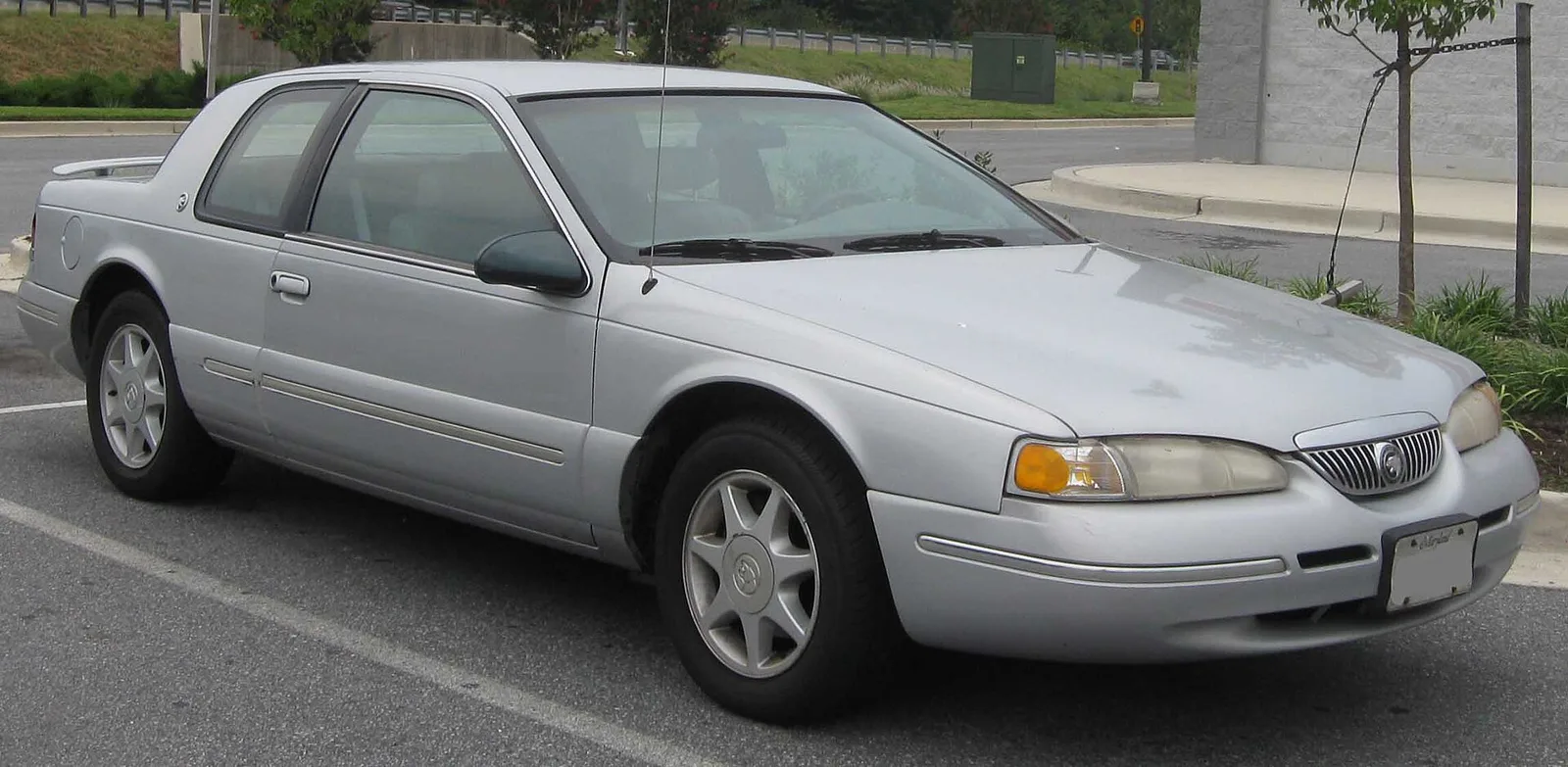
The third generation arrived for 1996 on a revised platform, redesignated DN101, with the wheelbase extended from 106 to 108.5 inches. The Sable kept its four-door sedan and five-door wagon bodies, but the two cars shared less sheet metal than before.
Only the front doors, bonnet and front fenders were shared with the Taurus. The Sable had a sloped roofline with a rectangular rear window and its own front and rear fascias. The lightbar gave way to a chrome-trimmed grille with oval headlight housings, and the Sable took the Taurus interior, apart from seat fabrics.
The Sable G became the entry model and was sold only as a sedan, with the Sable LTS dropped. The GS and LS returned in sedan and wagon form. The standard engine on the G and GS was the 3.0 L Vulcan V6 at 145 hp, while the LS came with a 3.0 L DOHC Duratec V6 at 200 hp.
For 1997 cost cutting removed some LS features from the list, and in 1998 new headlights and a centred Mercury emblem were added. The Vulcan became standard on all Sables, with the Duratec available only on the LS for 1999. Mercury cut the price by up to $2,000 for 1999 to stimulate sales.
What did the fourth generation of 2000 bring?
The fourth generation was introduced in late 1999 for the 2000 model year. It dropped many of the oval design elements of the 1996 car in favour of more conventional styling, and it had a taller roof over the rear seats to restore headroom lost to the tapered design.
The interior changed completely to a more conservative look. The integrated control console kept its job of combining sound and climate controls, but its oval shape became a plain trapezoid. The suspension was softened to appeal to a wider, less sporting audience.
Four-wheel disc brakes were removed from the sedan to cut costs, while station wagons kept them. For 2002 the GS gained a CD player and power driver's seat, and the LS could be ordered with a power moonroof or leather. Side airbags and traction control became options on all models.
For 2004 the front and rear fascias were refreshed, with a fully chrome grille, and the cabin gained a new instrument cluster and steering wheel. The fourth generation was never sold in Canada, where the Mercury brand had been discontinued, so it was unique to the United States and Mexico.
How did the Sable end in 2005?
The Montego (2005) and Milan (2006) arrived as the Sable's successors. Shortly after the Montego arrived, the Sable was discontinued along with the Taurus wagon, while the Taurus sedan carried on mainly for fleet buyers. The final Sable from Atlanta rolled out on April 29, 2005.
Was the Sable revived for 2008?
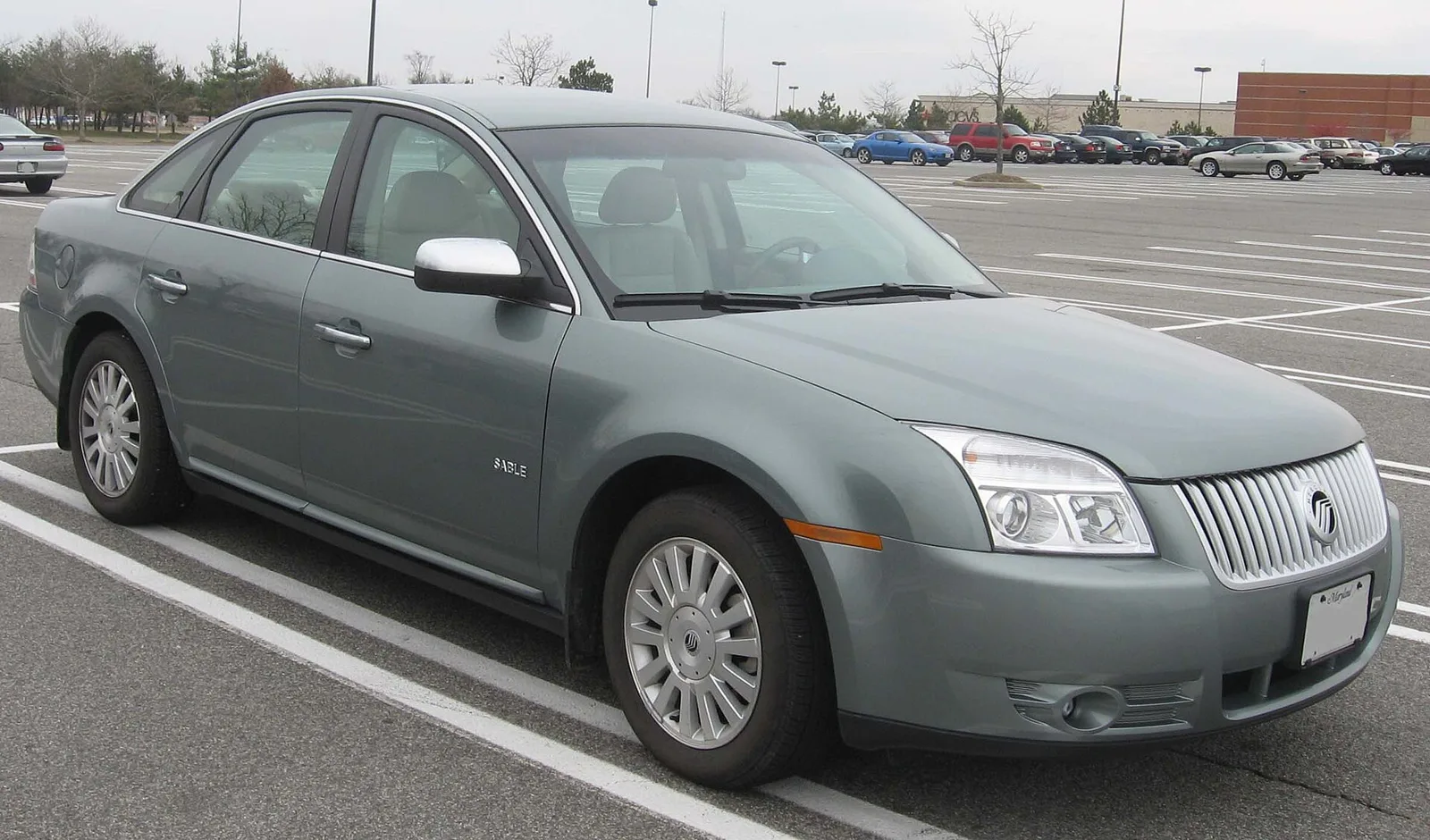
The fifth-generation Sable launched for the 2008 model year. It was developed as a mid-cycle update of the Montego and revived the better-known Sable name at the 2007 Chicago Auto Show. The 2008 Taurus revival, renamed the Five Hundred, largely ended retail sales of the Crown Victoria at the same time.
Despite the name, the fifth generation was the first Sable built as a full-size car. It was roughly 10 inches shorter and 500 pounds lighter than the Grand Marquis, and it was offered only as a four-door sedan, with no wagon counterpart. Front-wheel drive stayed standard, and all-wheel drive became an option for the first time.
The 263 hp 3.5 L V6 and six-speed 6F automatic were added, along with a revised bumper and grille, redesigned headlamps and LED taillamps with white lenses. The trim structure followed the Montego and Milan, with an unnamed standard model and a top Premier trim.
Did the 2008 and 2009 Sables have a water pump problem?
Yes. The 3.5 L Ford Cyclone V6 used in the 2008 and 2009 Sables had internally mounted water pumps driven by the timing chain, and they could fail without warning. When one did, antifreeze entered the crankcase, mixed with the oil and could damage head gaskets and connecting rod bearings.
Repair could mean removing the engine or, in some cases, replacing it. A class action lawsuit was filed against Ford over the issue. The final Sable came off the line on May 21, 2009, as the Mercury brand was retired.
What special editions did the Sable get?
Several special editions were created from the first generation. The LS Monochrome Edition was offered as an option for 1987, with a white-painted car having its bumpers, side trim and wheels painted white as well. How many were built is unrecorded.
For the 1989 Detroit Auto Show Mercury built a Sable two-door convertible. It used a Sable sedan body with the front doors lengthened by 12 inches, and it had a power-folding top and seatback-mounted television screens. It was the only example built, and it was put into storage during the 1990s before being given a VIN in the early 2000s.
The 50th Anniversary Edition marked Mercury's 50th year in 1989. Only 50 were sold, combining highly optioned GS and LS trims, with 50th Anniversary badging on the fenders and trunklid. The car also served as a testbed for a planned Sable LTS, a Mercury counterpart to the Taurus SHO, which Ford later shelved.
What are the key Sable specifications?
The table covers the main figures for the generations and engines. Where a figure belongs to one generation or engine, the table says so, so that the first-generation and fifth-generation cars are not confused.
| Specification | Detail |
|---|---|
| Model years | 1986 to 2009 |
| First-generation platform | Ford DN5, 106 in (2,692 mm) wheelbase |
| Third-generation wheelbase | 108.5 inches on the DN101 platform |
| 1986 engines | 90 hp HSC four-cylinder; 140 hp Vulcan V6 |
| 1988 option | 3.8 L Essex V6, nearly 35 percent more torque than the 3.0 L |
| Third-generation LS engine | 3.0 L DOHC Duratec V6, 200 hp |
| G and GS engine | 3.0 L Vulcan V6, 145 hp |
| Fifth-generation engine | 3.5 L Ford Cyclone V6, 263 hp, six-speed 6F automatic |
| Wagon cargo, maximum | 81.1 cubic feet with rear seat folded |
| Wagon cargo, upright | 45.7 cubic feet |
| Fifth-generation size | About 10 inches shorter and 500 pounds lighter than the Grand Marquis |
| Final production | May 21, 2009; over 2.1 million built overall |
Frequently asked questions
How many Mercury Sables were built?
Over 2.1 million Mercury Sables were built across the 1986 to 2009 model years. Only two Mercury lines were built in greater numbers.
Was the Sable ever sold with a manual gearbox?
No. The first-generation Sable had no manual option, while the Taurus did, so there was no Sable equivalent of the Taurus MT-5 or the SHO.
Why did the fifth-generation Sable carry the name?
The fifth generation brought the Sable name back for 2008. It sat below the Grand Marquis in the range and came only as a sedan.
Did the Sable ever come to Canada?
The fourth generation was never offered in Canada, because the Mercury brand had been discontinued there. It was sold only in the United States and Mexico.