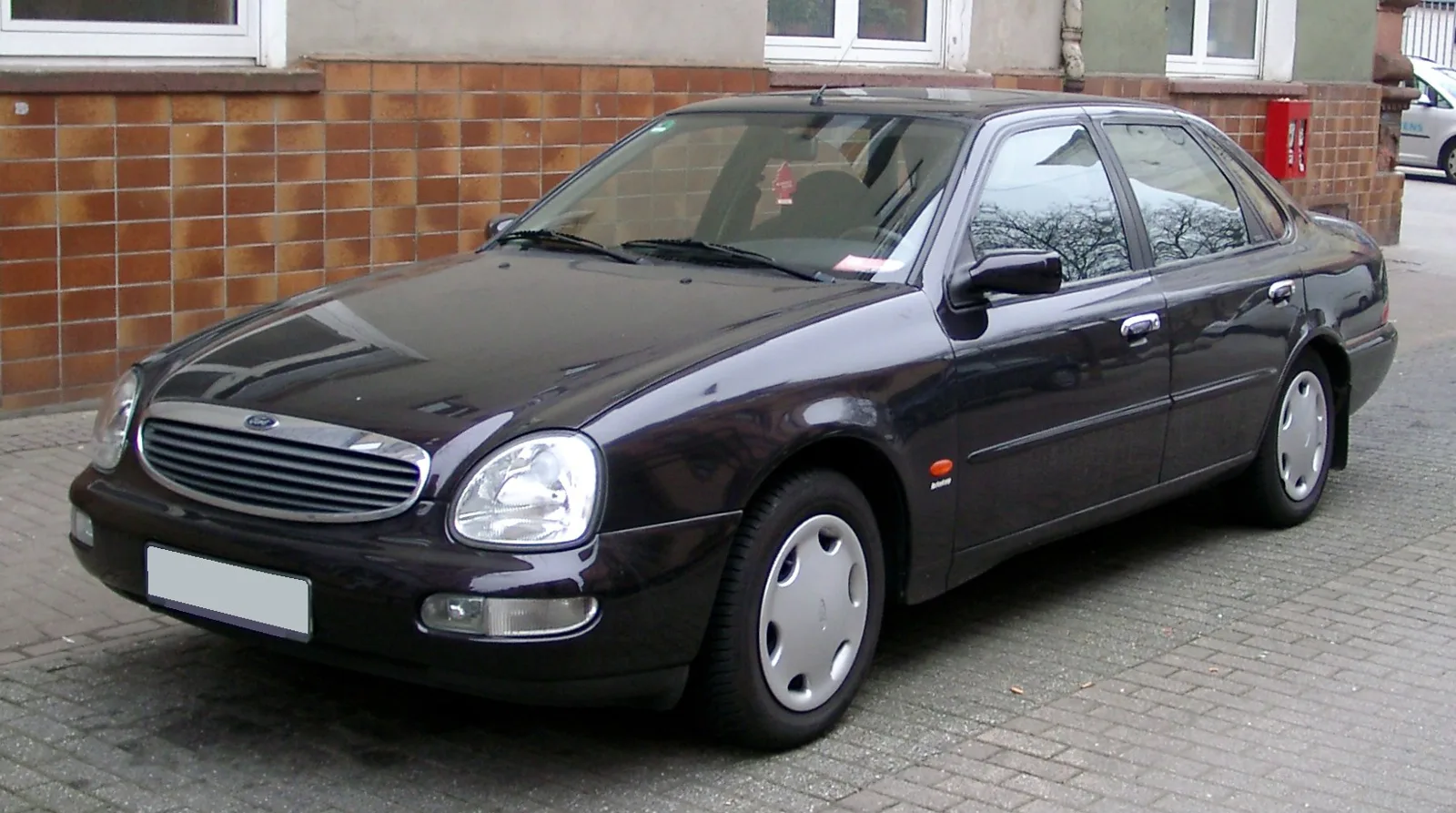
A Sierra-based executive saloon with ABS across the range, a Cosworth V6 and a styling debate that outlasted the car itself.
The Ford Scorpio was an executive car built by Ford Germany from 1985 to 1998 as the successor to the Granada. It was based on the Sierra's floorpan, offered ABS across the range and sold in the UK under the Granada name until 1994.
Few cars of the late 1980s drew as much argument in the press as the Ford Scorpio. Beneath the controversial styling sat a capable and comfortable executive car, and Ford hoped it would hold its ground against Mercedes and BMW in Europe.
Where did the Ford Scorpio come from?
Ford Germany developed the Scorpio under the codename DE-1, a car meant to straddle the European D and E segments. It replaced the Granada, and it was launched more than a year ahead of new rivals from Rover and Opel/Vauxhall.
Ford's aim was to remain the main alternative to a Mercedes or BMW for buyers who wanted an executive car. The company built on the well-equipped Granada Mk II, which already offered leather seats, air conditioning, an electric sunroof and a trip computer, and added features that were rare on a mass-market car.
Ford also kept a second car in the American market, where the Taurus was of similar size. Scorpio buyers in Europe valued high-speed stability, a tight turning circle and a generous rear seat, while American buyers wanted something different. That split shaped how the Scorpio was specified and sold.
In the United Kingdom and Ireland the car was sold as the Granada, since the Sierra had struggled there at launch. Models in those markets used the Scorpio name only as a trim designation, sitting above the traditional Ghia level and badged with a Granada line underneath.
A Sierra-based executive car with ABS across the range, a Cosworth V6 and a styling debate that outlasted the car.
What engines and trim levels did the Scorpio offer?
The launch line-up used the Pinto engine in 1.8 and 2.0-litre sizes and the Cologne V6 in 2.4 and 2.8-litre form. The larger V6 was later replaced by a 2.9-litre derivative, and the 2.4 stayed in production until 1994, when the 2.0 DOHC took over in most markets.
By the summer of 1989 the Pinto units were being phased out, and an eight-valve version of Ford's DOHC engine took the place of the 2.0-litre.
Trim levels were Executive, Ghia and Ultima. Even the Executive came with electric windows, ABS, power steering, an alarm and an immobiliser. Ghia added air conditioning, alloy wheels, front fog lights and electric mirrors, while Ultima brought a CD autochanger, climate control, leather seats and cruise control.
Some Ultimas were fitted with a 2.5-litre turbodiesel from VM Motori. It halved the fuel bill compared with petrol, but it suffered from turbo lag and an all-or-nothing delivery of power.
Why did the Scorpio's styling divide opinion?
The Scorpio's styling was the most discussed aspect of the car from the moment it launched. Its bulbous headlights and wide grille were defended by Ford as bold and dramatic, but press and public reaction was largely negative from the start.
Ford set up a focus group of motoring journalists at its Cologne engineering and design centre before the car went on sale. The session praised the company for recognising good design elsewhere, but the Scorpio itself took heavy criticism, and the group did little to calm the press.
Critics attacked the headlights, the grille and the tail. One Top Gear writer felt the lamps looked out of place and the car looked unfinished, while another described it as the ugliest car in Britain. The rear was a frequent target because of its featureless look.
Ford never named the designer, and it insisted that the car outsold its expected figures, although it did not publish those figures.
How did the Scorpio change in 1992 and 1994?
The first major change came in March 1992, when Ford launched a facelifted Mk I with a changed grille, headlights, rear lights, bonnet and dashboard. An estate version had been shown at the London Motorfair in October 1991, and it joined the range at the same time as the facelift.
The facelift also swapped the outdated Peugeot XD3 diesel for a more powerful unit from the Italian firm VM Motori. The new look brought the car into line with the forthcoming Mondeo and kept the styling consistent across the range.
The second generation arrived at the Paris Motor Show in October 1994. It was offered only as a saloon or an estate, and the hatchback was dropped. The floorpan stayed largely the same, but suspension and handling were improved, and estates gained self-levelling rear suspension.
The second-generation car was radically restyled inside and out, with new headlights, a new grille and new door handles borrowed from the Ford Crown Victoria. Reviewers praised the interior, handling and performance, even as the styling continued to attract criticism. The UK and Ireland also finally dropped the Granada name in favour of Scorpio.
What was the Merkur Scorpio?
The Merkur Scorpio was the North American version of the European Mk I. It was offered at select Lincoln-Mercury dealerships from 1988 to 1989, and it was only available with the Cologne 2.9-litre V6. That engine produced 140 hp (104 kW) in American specification.
Most cars came with the A4LD four-speed automatic, while a small number received a T-9 five-speed manual. Canadian buyers could only get the automatic. Ford marketed the car as an upscale mid-size luxury model, but it never achieved the impact the company had hoped for, and the Merkur name was dropped after 1989.
What made the Scorpio Cosworth stand out?
The Scorpio Cosworth used a 2.9-litre 24-valve Cosworth V6 and arrived in December 1990. Its output rose from 195 hp (145 kW) to 207 hp (154 kW) in the second generation, and every example came with traction control, cruise control and an automatic gearbox as standard.
Its size and speed came at a cost in fuel economy. Owners frequently noted that around 25 miles per gallon was about the best a car with that engine could manage. Prop-shaft deterioration was also seen as a problem on early Mark I and Mark II Cosworths.
What are the Ford Scorpio specifications?
The Scorpio was a large executive car with a range of engines and trim levels across two generations. The table below sets out the main details for the models that define its story.
| Specification | Detail |
|---|---|
| Built by | Ford Germany, 1985 to 1998 |
| Codename | DE-1 |
| Replaced | European Ford Granada |
| Engines, launch | Pinto 1.8 and 2.0; Cologne V6 2.4 and 2.8 |
| Cosworth | 2.9-litre 24-valve V6, from December 1990 |
| Cosworth output | 195 hp (145 kW), rising to 207 hp (154 kW) |
| Merkur Scorpio | 2.9 V6, 140 hp (104 kW), 1988 to 1989 |
| Diesel | VM Motori 2.5-litre turbodiesel in some Ultimas |
| Trim levels | Executive, Ghia, Ultima |
| Estate debut | London Motorfair, October 1991 |
| Second generation | Paris Motor Show, October 1994 |
| Final facelift | September 1997 |
How did the Scorpio's production end?
The car received a final facelift in September 1997, with darker headlight surrounds, a subtler grille and revised rear lights. A new model planned for 1998 never arrived, and production finished over the summer of 1998.
Ford did not replace the Scorpio directly. The market was moving toward premium brands at the top end, and Ford's ownership of Jaguar and Volvo gave it access to the executive segment through the Jaguar S-Type and the Volvo S80 instead. The Volvo S80 took over in the market that the Scorpio had served.
The Scorpio's reputation was not helped by a Top Gear survey in April 1998, which ranked it as the third worst N-registered car out of 120 cars registered from August 1995 to July 1996. It scored particularly poorly for reliability, though it fared slightly better in the 1999 and 2000 surveys.
What was the Scorpio's interior like?
The new Scorpio brought armchair-style seats and better interior quality than its predecessor, even though its exterior styling remained controversial. Buyers could choose from Executive, Ghia and Ultima trims, which ranged from a well-equipped base car to a fully loaded flagship.
Even the base Executive was unusually well equipped. Electric windows and ABS came as standard, which made the entry model a strong proposition for buyers who wanted safety features without paying for extras.
Long-distance comfort was central to the Scorpio's appeal, which suited an executive car aimed at owners who spent hours behind the wheel.
Reviewers consistently praised the interior space. The car was widely described as very comfortable and spacious, and the rear legroom in particular drew favourable comment from testers who had expected a more cramped back seat.
Ford developed the new Scorpio entirely on a CAD/CAM computer system, the first Ford design to be done that way. That method became a notable step for the company's design process, even though the finished exterior drew some of the strongest criticism the car ever faced.
How were the Scorpio's engines badged?
Engine size badges on the flanks identified each Scorpio, with 2.0 16v, 2.3 16v, 2.9 12v and 2.9 Cosworth 24v among the designations used. Older cars carried different wording, and the simplest 2.0 needed no badge at all.
The Cosworth name itself did not appear on the outside of the car, which may have reduced the risk of theft, although it appeared across the top of the engine. The 1998 facelift changed that, with a visible Cosworth badge on the boot lid.
How did the Scorpio compare with its rivals?
Ford enjoyed a head start of more than a year over new executive rivals from Rover and Opel/Vauxhall, and it intended the car to be Europe's main alternative to Mercedes and BMW. Its Sierra-derived floorpan and well-proven engines were central to that plan.
The Vauxhall Omega was the Scorpio's main rival. One reviewer judged the two cars equally talented and described the Scorpio as good value for money, even though the styling continued to draw criticism.
The styling row never fully eclipsed the car's engineering. Reviewers could be unsparing about the front end, yet many still praised the comfort, space and handling. That split between how the car looked and how it drove shaped its reputation for years.
Frequently asked questions
Was the Ford Scorpio sold in the United States?
Not as the Scorpio. A North American version called the Merkur Scorpio was sold through select Lincoln-Mercury dealers from 1988 to 1989 with a 2.9-litre V6 making 140 hp (104 kW).
Why was the Scorpio called Granada in the UK?
Following the initial resistance to the Sierra, Ford kept the Granada name for the UK and Ireland. The Scorpio name was used there as a trim designation, and the Granada name was finally dropped in 1994.
Did the Scorpio have anti-lock brakes?
Yes. ABS was fitted as standard across the whole range, which was the first time that had happened on a mass-produced car. The Executive trim also included ABS as part of its equipment.
Did royalty use the Scorpio?
The Dutch royal family used several Scorpios, some of them stretched, all painted in Royal Blue. A custom Scorpio landaulet is still kept in the royal stables.
Who designed the Scorpio?
The designer's identity was never published. Ford has maintained that the car beat its own sales expectations, while declining to give the figures.
Which Scorpio engine was the most powerful?
The 2.9-litre Cosworth V6 was the most powerful Scorpio. It reached 195 hp (145 kW) in the first generation and 207 hp (154 kW) in the second, and it was the only engine that ruled out a manual gearbox entirely.