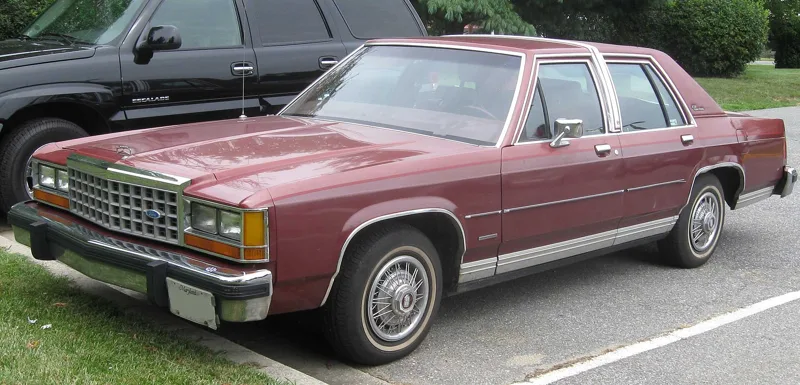
A Galaxie top trim that moved Ford upmarket, grew into a full-size Panther, then became a mid-size car before the Taurus replaced it in 1986.
The Ford LTD was a North American range built for the 1965 to 1986 model years. It began as a top trim of the Galaxie 500, grew into a Panther full-size car and later became a mid-size sedan before the Taurus replaced it.
The Ford LTD ran in North America for the 1965 to 1986 model years, starting as the top trim of the full-size Galaxie range. Over two decades it moved from a luxury full-size car to a mid-size family sedan before the Taurus took its place.
What was the Ford LTD?
The Ford LTD was a range of automobiles that Ford built for the 1965 to 1986 model years. It was introduced as the highest trim of the full-size Ford line, then the Galaxie 500, and it moved the Ford range upmarket with options and features once reserved for Mercury and Lincoln vehicles.
The LTD was pronounced ell-TEE-dee. For much of its life it competed with the Chevrolet Caprice, which was sold alongside the Impala, while Mercury's Marquis was its counterpart from 1967 until 1986.
Over its first three generations the LTD was Ford's largest vehicle in North America. Its body styles changed over time, but the model included two- and four-door hardtops, pillared sedans, a two-door convertible and a five-door wagon in woodgrain trim, sold as the LTD Country Squire.
A Galaxie luxury trim that moved Ford upmarket, then outlived the full-size car as a mid-size sedan.
What does the LTD name stand for?
Nearly 40 years after the LTD was discontinued in North America, no full explanation of the designation has emerged. Several theories exist, including Luxury Trim Decor and Limited, the latter as a trim designation for the Galaxie 500. The designation has never received a full explanation.
Ford Australia introduced the LTD name in 1969 on right-hand-drive converted Galaxies, and moved it to locally built Fairlanes in mid-1973. In the early 1970s the Australian company adapted the name as Lincoln Type Design, to suggest Lincoln-like exclusivity for its Falcon-based luxury car.
North American brochures and advertising never used the Lincoln Type Design phrase, and an early Car Life review of the first Galaxie 500 LTD suggested that the letters stood for nothing in particular.
What did the first-generation LTD add in 1965?
For 1965 the 500 LTD arrived as a luxury-oriented version of the Galaxie 500, sharing top billing with the performance 500XL. It had a plush cloth interior with woodgrain accents, plus contoured seats and door panels that no other full-size Ford offered.
Buyers could add power windows, a power seat, power brakes and steering, air conditioning and a full or half vinyl roof, known as a Landau or Brougham roof depending on the maker. The car was sold only as a two-door or four-door hardtop.
Rivals responded quickly. Chevrolet added its top-of-the-line Caprice in mid-year, AMC brought out the Ambassador DPL in 1966, and Plymouth launched the Fury VIP while Dodge introduced the Monaco.
How did the LTD change in 1966 and 1967?
For 1966 the Galaxie name was dropped from the LTD, and the car received a minor exterior revision with a split grille. Front disc brakes became an option. The changes were modest, but they set up the larger revisions of 1967.
For 1967 a four-door pillared sedan joined the range. Federal safety rules brought a padded steering wheel hub, flush instrument knobs, a dual-circuit master cylinder, four-way hazard flashers and front outboard shoulder belt mounts.
The two-door hardtop was extensively restyled with a more formal profile, and Twin Comfort Lounge front seats, a 50/50 split bench, became an option. Lincoln-Mercury's equivalent was the Marquis two-door hardtop.
What did the 1968 model year bring?
The 1968 LTD made several minor changes that previewed the major redesign to come. The wood-trimmed Country Squire station wagon received the LTD badge for the first time, although it did not fully adopt the LTD name until 1969. The stacked headlamps were the most visible change at the front.
Four-door hardtops were restyled to match their two-door counterparts, with the rear doors given more curves. The vertically stacked headlamps of 1965 gave way to hidden headlamps, shared with Lincoln-Mercury, which were operated by engine vacuum and would retract upward if the system failed.
Hidden headlamps became a design feature that marked the top-trim LTD until 1971. Safety work continued too, with the parking lamps lighting alongside the headlamps, front outboard shoulder belts on cars built from 1 January 1968, and an energy-absorbing steering column replacing the padded wheel.
What was the second-generation LTD?
The second generation arrived for 1969 as a major redesign. Its chassis was largely carried over from the other full-size Ford sedans, though the wheelbase grew by two inches, and about 7,850,000 full-size Fords and Mercurys were sold between 1969 and 1978.
That total made the full-size platform the second-best selling Ford automobile platform after the Model T. From 1969 the full-size Fords used only V8 engines, a situation not seen since the 1940s, with the 302 cubic-inch unit as the base engine.
The 351 cubic-inch V8 was the most common choice, the 400 was larger, and the 429 topped the range until the 460 arrived for 1974. The full-size Fords stayed strong sellers thanks to their comfort, sound engines, good build quality and reasonable cost.
What was the Police Interceptor?
From 1973 to 1978 the LTD was offered as a Police Package, using a 351 or 400 cubic-inch motor for city patrol cars. The 460 Police Interceptor, rated at 260 net horsepower, was for heavy-duty and high-speed use, and it was the stronger choice for demanding work.
Reported figures put 0-60 mph at roughly eight seconds, with quarter-mile times in the upper 15-second bracket and top speeds above 135 mph.
What was the LTD II?
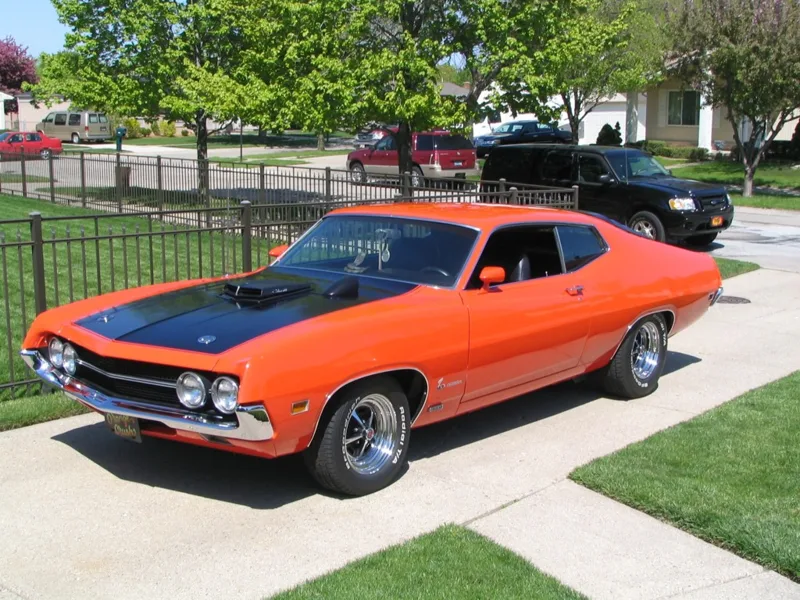
The LTD II arrived in 1977 as an intermediate-segment car that carried the LTD name. It was based on the Ford Torino and served as a restyled replacement for that range, with the Ranchero's final generation also adopting its styling.
Ford took the LTD name for its mid-size line to appeal to buyers who wanted a downsized alternative to the full-size LTD, which faced competition from GM's newly downsized full-size cars. The LTD II was discontinued after 1979 without a replacement.
How did GM's downsizing shape the 1979 LTD?
General Motors was the first American maker to downsize its full-size sedans, for the 1977 model year. Ford responded with the LTD II, and the third-generation 1979 LTD followed on a new rear-wheel-drive platform that Ford shared with the Mercury Marquis.
To reassure buyers wary of smaller full-size cars, Ford's advertisements compared the 1977 LTD side by side with the GM Cadillac Fleetwood Brougham.
Production of the 1979 LTD began on 31 July 1978 at Louisville Assembly, with Atlanta, Los Angeles and Oakville coming online during August. The LTD was offered as two- and four-door pillared sedans, plus a five-door wagon, and the wood-paneled Country Squire was back.
The Custom 500 was dropped in the United States, but stayed as the base trim in Canada through 1981. Lincoln introduced its downsized Continental for 1980, making it the last brand to bring out downsized full-size cars.
What changed with the 1979 Panther platform?
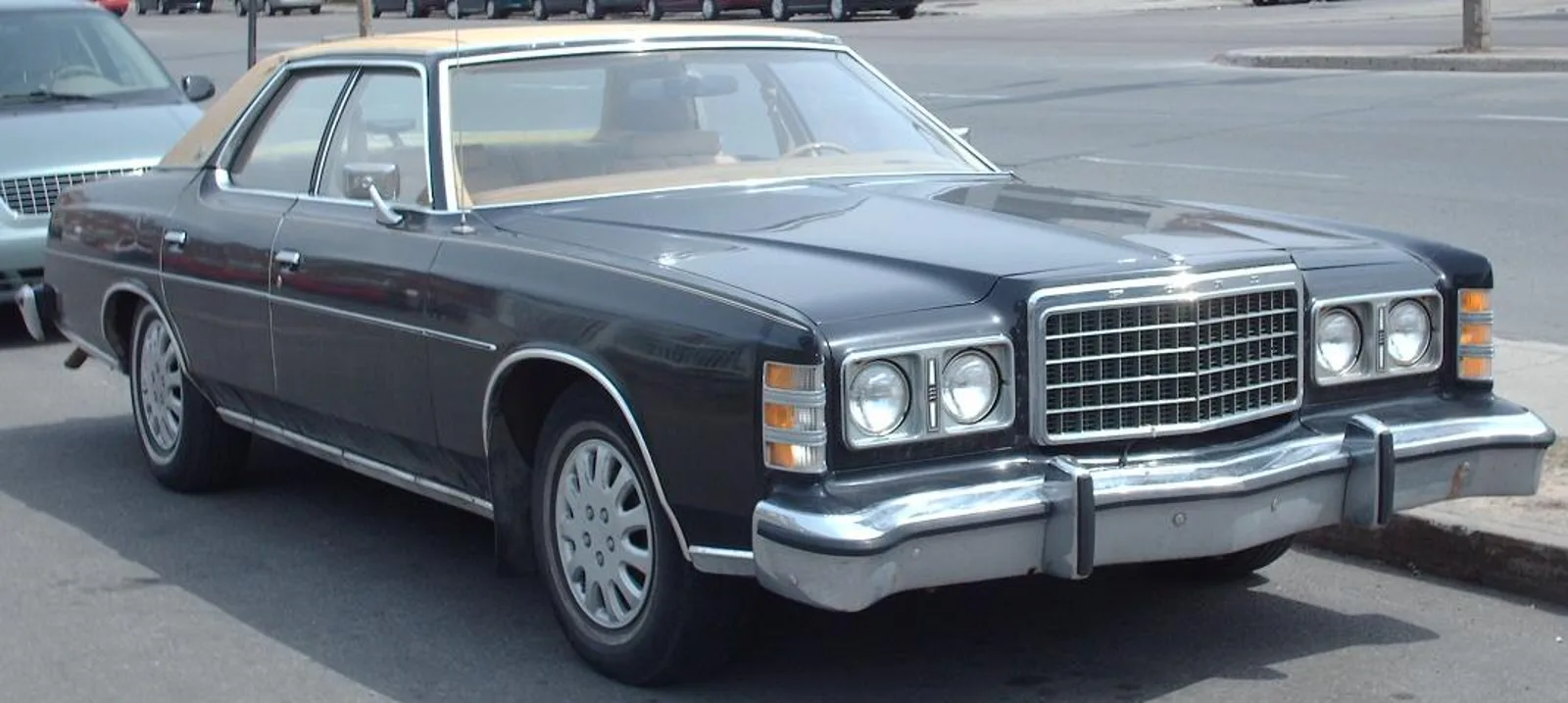
The Panther platform was a completely new rear-wheel-drive design, not a rebody of older underpinnings. Against the 1978 model, the 1979 LTD shed about 15 inches of body length and about 7 inches of wheelbase, and the Panther chassis lost over 700 pounds of curb weight.
Although the body was slightly narrower, the smaller car offered more interior and trunk space. The 1979 LTD also dropped its optional hidden headlamps in favour of exposed rectangular units, with a much wider grille to match.
The 302 V8 was standard with a 351 optional, and Ford now advertised the engines in metric as 5.0 L and 5.8 L displacements. The lighter chassis removed the need for the bigger 6.6 L and 7.5 L V8s. For 1981 a 4.2 L V8 became standard, but it was rated for only 115 hp, the lowest for a Ford V8 since the 1953 Flathead 239.
How did the LTD trims and engines change in 1980 to 1982?
For 1980 the trim line was reorganised. The base model became the LTD S for fleet sales, the standard LTD became the mid-range trim, and the flagship Landau was renamed the LTD Crown Victoria after a brushed aluminium band on the B-pillar and roof.
For 1981 minor body revisions improved fuel economy. The vents in the front bumpers were removed, the mirrors were repositioned, and the 5.0 L V8 received optional throttle-body fuel injection, which had first been used by Lincoln in 1980.
For 1982 the Blue Oval replaced the FORD lettering on the grille and trunklid, and a trip computer became an option to track fuel use. The four-speed overdrive automatic became standard across the engine range that year.
How did the mid-size LTD arrive in 1983?
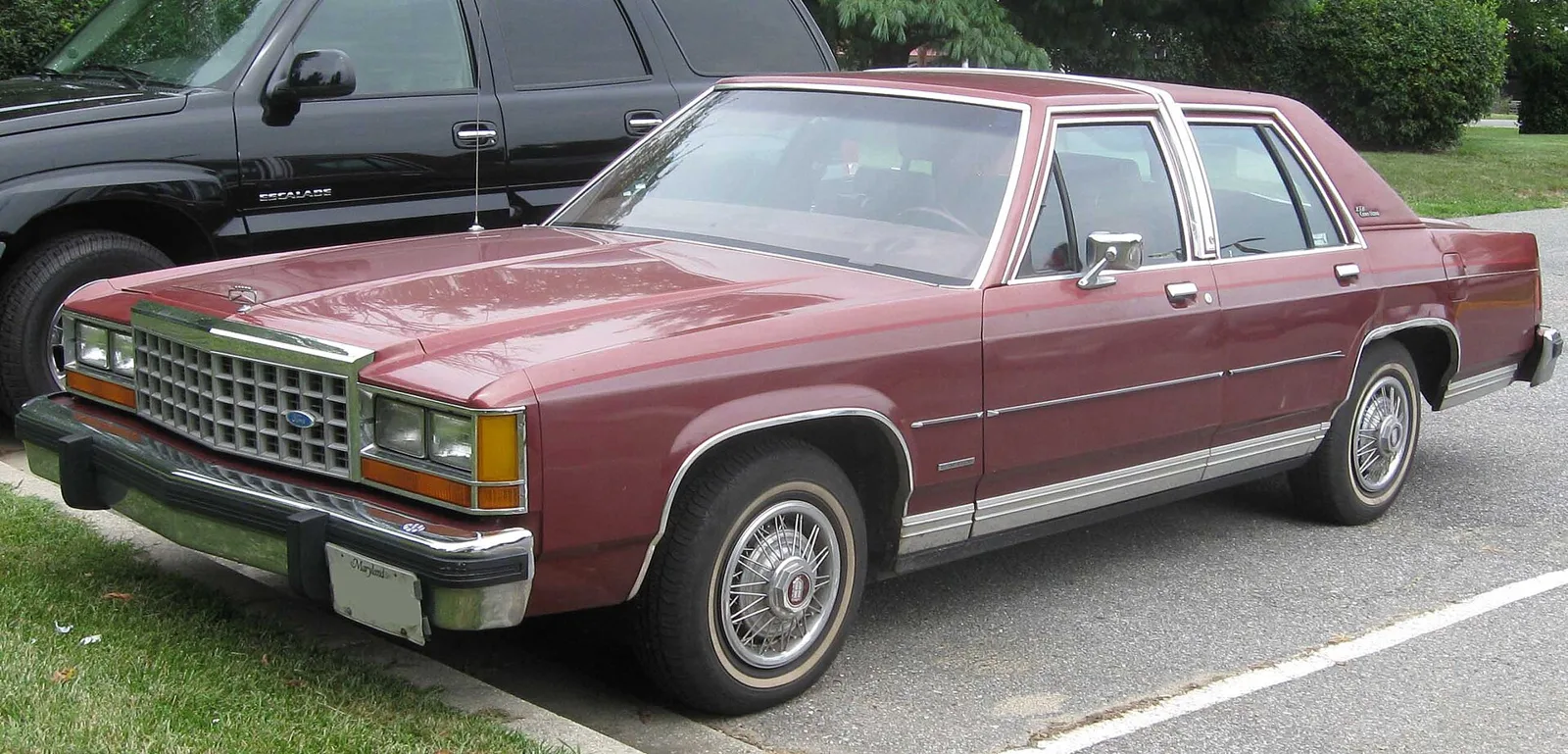
For 1983 the LTD became a mid-size car, replacing the Ford Granada, while the previous full-size model was renamed the LTD Crown Victoria. Its length fell by nearly 13 inches, its wheelbase by 9 inches and its width by 7 inches, and it weighed over 600 pounds less.
The LTD became the third-best selling automobile in the United States for 1983 and 1984. Its slanted nose and large greenhouse gave a drag coefficient of 0.38, and the chassis gained nitrogen-charged shocks and struts with larger wheels.
Sharing the mid-size Fox platform with the Granada, the fourth-generation LTD rode a 105.6-inch wheelbase. It came only as a four-door sedan and a five-door wagon, with no two-door versions, and the LTD Brougham and a wood-trimmed Squire returned.
Which engines did the mid-size LTD use?
The 1983 LTD carried over engines from the Granada: a 2.3-litre Lima inline-four, which was not offered on the wagon, and a 3.3-litre Falcon Six inline-six. A 3.8-litre Essex V6 rated at 112 hp (84 kW) replaced the six entirely for 1984, and both engines gained central point fuel injection in the US.
An LPG-powered version of the four-cylinder was offered only between 1982 and 1984, but it was discontinued because it sold poorly and propane fuelling was scarce. The four-cylinder remained a slow seller, and in 1986 only 485 four-cylinder LTDs were sold, which was 0.7 percent of LTD and Squire sales.
A manual gearbox returned after a gap that began in 1971, with the 2.3 offering a three-speed automatic as an option and the 3.3 fitting one as standard. The larger 3.8 was offered only with the overdrive four-speed automatic.
What was the LTD LX?
From mid-1984 through 1985 Ford offered a performance version called the LTD LX. Its standard kit included a high-output 5.0 L fuel-injected V8, a four-speed overdrive automatic, stiffer coil springs and sway bars, and a Traction-Lok differential with a 3.27:1 rear gear ratio.
The LX was the only LTD of this generation with a tachometer in the instrument cluster. The centre console and floor-mounted shifter also returned, a layout last seen in the full-size car of 1972 and in the LTD II from 1977 to 1979.
Production figures vary. Some estimates put the total at 3,260 units, but Ford itself has confirmed 5,287 built, of which 1,920 were from 1984 and 3,367 from 1985. Mercury's counterpart, the Marquis LTS, was sold only in Canada in 1985, with 134 built.
A police package for the mid-size LTD was also produced, with bigger sway bars and brakes, bench seats and an automatic trunk opener. Most were fitted with light bars and police equipment, although some came without.
Why did the LTD end in 1986?
By the 1980s American makers were moving front-wheel drive from compacts into mid-size cars. Chrysler's K-cars and GM's A-body sedans led the trend, and Japanese rivals such as the Honda Accord and Toyota Camry targeted the front-drive sedan segment, so by 1984 Ford was the last major non-premium maker with a rear-drive mid-size sedan.
For 1986 Ford introduced the Taurus and the Mercury Sable to replace the LTD and Marquis. The Taurus was front-wheel drive and styled for fuel efficiency, replacing the boxy LTD with one of the most aerodynamic sedans of its time. The LTD continued alongside it for part of the 1986 model year.
Atlanta Assembly produced its final LTD on 13 December 1985, thirteen days before the Taurus was unveiled. Chicago Assembly built the last example on 3 January 1986.
How was the LTD sold outside North America?
Brazil assembled the LTD from 1967 to 1981 on the 1966 Galaxie platform, and a higher-end Landau version followed there from 1971 to 1983. Later Brazilian models ran on alcohol. Local versions differed from the North American original in names and trims.
In Venezuela the LTD was introduced in 1966 to compete with Chrysler's New Yorker, and it performed much better than its rivals. Over 85,000 were assembled at the Ford plant in Valencia, with some cars exported to Colombia, Bolivia, Ecuador and Peru.
Venezuelan versions of the 1983 to 1986 Fox-body LTD kept the Granada name, including uplevel Elite badged cars. There was also a Ford Cougar equivalent of the Mercury Marquis.
What were the Ford LTD specifications?
The table shows the headline figures across the generations and the markets covered. Where a figure applies to one generation, one engine or one country, the table says so, so the full-size V8 cars and the mid-size fours are not blended together.
| Specification | Detail |
|---|---|
| Model years (North America) | 1965 to 1986 |
| Launch model | 500 LTD, a Galaxie 500 top trim, 1965 |
| Full-size V8s, 1969 onward | 302, 351 and 400 cubic-inch; 429 until the 460 in 1974 |
| 1979 Panther weight saving | Over 700 pounds of curb weight |
| 1981 base V8 | 4.2 L, rated at 115 hp |
| Mid-size wheelbase (1983) | 105.6 inches, Fox platform |
| Mid-size V6 (1984 onward) | 3.8-litre Essex, 112 hp (84 kW) |
| LTD LX rear gear ratio | 3.27:1 with Traction-Lok |
| 1983 drag coefficient | Cd 0.38 |
| Full-size sales, 1969 to 1978 | About 7,850,000 Fords and Mercurys |
| Final North American LTD | Chicago Assembly, 3 January 1986 |
Frequently asked questions
Did the LTD begin as a Galaxie?
Yes. The first LTD was the top trim of the Galaxie 500, and the Galaxie name was dropped from it for 1966. The car then carried the LTD name alone.
Could you get a manual LTD?
Yes. Manual gearboxes returned to the mid-size model in 1983, after an absence since 1971. A three-speed automatic remained the main choice on the 2.3-litre car.
How rare is the LTD LX?
Figures are disputed: one estimate says 3,260 were built, while Ford's own count is 5,287 across 1984 and 1985.
When did the last LTD leave the factory?
Chicago Assembly built the final example on 3 January 1986. Atlanta had already ended production on 13 December 1985, shortly before the Taurus was revealed.