A Hiroshima cork maker that became a carmaker known for Wankel rotary engines, a 1991 Le Mans win, the Ford years and Kodo design.
Mazda is a Japanese car maker that started out in 1920 making cork and now sells vehicles built around its Kodo design language and SkyActiv engineering. Enthusiasts know it for rotary engines, the MX-5 roadster and a 1991 Le Mans victory, while the United States is its biggest market.
Mazda is a Japanese carmaker headquartered in Fuchu, Hiroshima, and it began in 1920 as a cork factory before it started building vehicles in 1931. It matters because it kept the Wankel rotary engine in production when other manufacturers abandoned it, and because its 1991 Le Mans win made it the first Japanese brand to take overall victory in that race.
Where did Mazda begin?
Mazda began as Toyo Cork Kogyo Co., Ltd., a cork-making factory founded in Hiroshima on January 30, 1920 by Jujiro Matsuda. The company was renamed Toyo Kogyo Co., Ltd. in 1927, and in the late 1920s the Hiroshima Saving Bank helped rescue it from bankruptcy.
In 1931 the business moved from machine tools into vehicles with the Mazda-Go auto rickshaw. The name Mazda came with its first three-wheeled trucks, and the company says the word references Ahura Mazda.
The company also produced Type 99 rifles for the Japanese military. After the atomic bomb blast its headquarters survived, and days after the bombing the company resumed production of its three-wheeled trucks.
Hiroshima's economy depended heavily on the company. In the early 2000s Mazda accounted for about a third of the city's GDP, which helps explain why the company remains central to the region.
The company formally adopted the Mazda name in 1984.
A cork factory in Hiroshima grew into a carmaker that kept the rotary engine alive when others gave up on it.
How did the Wankel engine shape Mazda?
Mazda devoted serious engineering resources to the Wankel rotary engine from the 1960s, a choice that set it apart from other Japanese manufacturers. It launched the limited-production Cosmo Sport in 1967, and other makers, including NSU and Citroen, later gave up on the design during the 1970s.
The 1973 oil crisis hit the thirsty rotary models hard. Heavy losses in 1975 were followed by a rescue from the Sumitomo group.
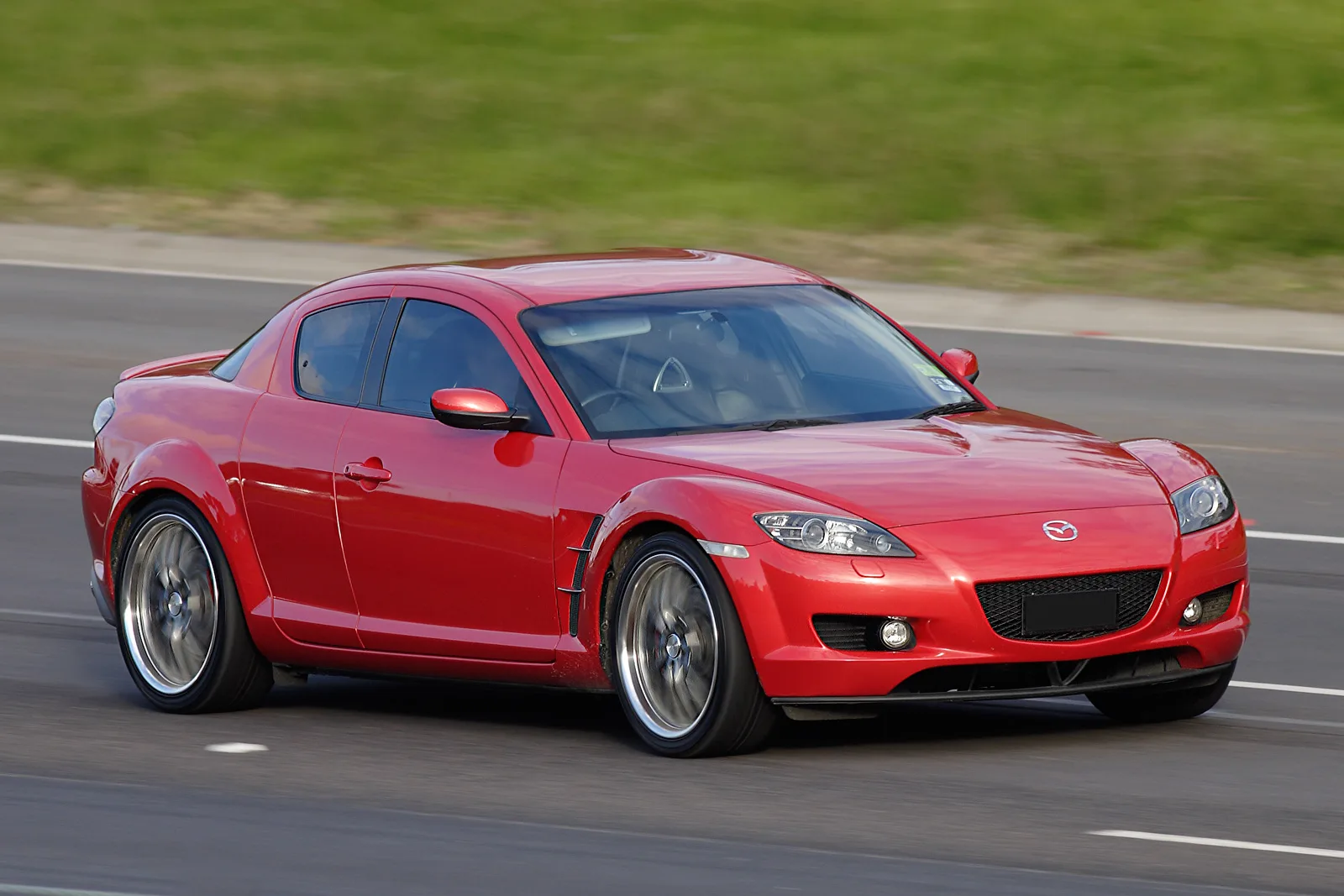
Mazda then made the rotary a choice for sports cars. The lightweight RX-7 arrived in 1978, and the RX-8 was discontinued in 2012 as the last rotary production model. Meanwhile the MX-5 Miata arrived in 1989, a roadster built around the jinba ittai concept.
Mazda also built a Rotary Pickup for North American buyers, and no other carmaker has built a Wankel-powered pickup. The company became the sole Wankel engine maker for cars, mainly by attrition, as rivals dropped out.
Why did the rotary engine fall out of favour?
The Wankel's appeal faded when the 1973 oil crisis arrived. Rotary models were thirsty compared with rivals, and buyers in the United States and elsewhere turned to cars with better fuel efficiency, which left the company exposed to heavy losses in 1975.
Mazda's answer was to make the rotary a sports engine rather than a mainstream one. The RX-7, launched in 1978, carried that idea for years, and the RX-8 ended the line in 2012.
What was the Ford partnership?
From 1974 to 2015 Mazda and Ford shared technology, platforms and manufacturing ties. Ford acquired a 24.5% stake in 1979, and after financial difficulties in the 1990s it built a controlling interest of 33.4%, before selling down from 2008 and exiting completely in 2015.
Ford's ownership reshaped product plans. Mazda sold a two-door version of the Ford Explorer as the Mazda Navajo from 1991-1994, while Mazda's B-Series trucks were based on Ford's Ranger from 1994 to 2010.
The divestment came in stages. On November 18, 2008 Ford sold a 20% stake, cutting its holding to 13.4%, and Mazda bought back 6.8% of its shares for about US$185 million. Ford sold its remaining shares on September 30, 2015.
Who led Mazda through its changes?
Henry Wallace was appointed president in June 1996 and became the first person born outside Japan to lead a Japanese carmaker. He was followed by James Miller in November 1997, and in December 1999 Mark Fields, a Ford executive, took over the top job.
Leadership changed again in 2008. It was reported that Hisakazu Imaki would step down as chief executive, and Takashi Yamanouchi succeeded him.
Taken together, the leadership changes trace a company that moved from a major shareholder's orbit to one that ran its own strategy again once Ford exited in 2015. That shift set the stage for the product push of the following decade.
Which models defined the Mazda range?
The models that define the brand run from the R360 of 1960 to the electric MX-30 and the CX-60 on the Large architecture. Among them, the RX-7, the MX-5 Miata and the CX-5 explain much of the brand's reputation, and the CX-5 has been the best-selling model since 2014.
The R360 arrived in 1960, followed by the Carol in 1962, and the range grew from there.
The RX-7 arrived in 1978 as a lightweight sports car, and the MX-5 Miata launched in 1989 under the jinba ittai concept. The MX-5 is widely credited with reviving small sports cars.
The MX-30 was Mazda's first mass-production electric model, with production starting in May 2020. In March 2022 the CX-60 debuted on the Large architecture, and in April 2024 Mazda introduced the EZ-6, an electric sedan developed with Changan and marketed as the Mazda 6e.
When did Mazda's electric push begin?
Mazda's electric push began with the MX-30, which entered production in May 2020 as its first mass-production electric model. It was followed by the EZ-6, a sedan developed with Changan and sold as the Mazda 6e from April 2024. Both cars show how far the company has moved beyond its rotary past.
That plan rests on the Changan partnership, which carries 10 billion yuan (US$1.4 billion) of investment through 2027.
The CX-60 debuted in March 2022 on the Large architecture. The company had revealed its inline-six engines with 48-volt mild hybrid options in November 2020, and those engines were planned for the same platform.
What are SkyActiv and Kodo?
SkyActiv is Mazda's umbrella name for engine, transmission and chassis technology announced in 2011, and Kodo is the design language first used on the CX-5 in October 2011. Together they define much of the brand's modern identity, from its engines to its styling.
SkyActiv covers engines, transmissions and chassis, and its gasoline versions run at a compression ratio of 13.0 to 1. The diesel versions run at 14.0 to 1.
Mazda has used biomaterials in its cars, including the Mazda5, whose interior used up to 30% biomaterial components. Bioplastic consoles and bio-fabric seats were shown at EcoInnovasia 2008 as part of the company's environmental push.
How did Mazda win at Le Mans?
Mazda won the 24 Hours of Le Mans overall in 1991 with the four-rotor 787B, becoming the first Japanese brand to win overall there. It is the only car without a piston engine ever to win at the race, and the winning engine showed very little wear after the race.
The 787B displaced 2622 cc in reality, but under the FIA formula it was rated at 4708 cc.
In 1974 the Sigma MC74, powered by a Mazda 12A engine, finished the 24 Hours. Mazda's own record is also strong, with 67% of its Le Mans entries finishing.
How has Mazda raced beyond Le Mans?
Mazda has competed with rotary and piston cars across many series. Its long-running records include RX-7 results in IMSA races and an early win at the Singapore Grand Prix, while its competition programme ranged from the Nurburgring to Daytona.
Mazda's competition debut came on October 20, 1968, when two Cosmo Sport 110S coupes entered the 84-hour race at the Nurburgring. One finished fourth and the other suffered an axle failure.
Mazda won the Singapore Grand Prix in April 1969. In 1973 a Wankel-engined car earned the first Wankel racing victory in the United States, at Lime Rock Park. In 1976 a Cosmo (RX-5) won its class at Daytona and finished 18th overall among 72 starters.
The RX-7 won the IMSA GTU championship each year from 1980-1987 and recorded its hundredth IMSA class victory by September 2, 1990.
How has Mazda marketed its cars?
Mazda's advertising has long leaned on the enjoyment of driving. Its Zoom-Zoom theme dates from 2000 and describes what the company calls the emotion of motion in its cars, and the interactive UK television campaign for the Xedos 6 in 1994 is among its most notable adverts.
Zoom-Zoom has run since 2000, and the 'What Do You Drive?' campaign has carried the theme since 2011. It argues that a car not worth driving is not worth building.
Kansei engineering, a Japanese engineering philosophy, was used as an advertising theme from 1990-1995. In the UK, an interactive campaign for the Xedos 6 debuted on June 6, 1994.
A 2005 British television advertisement ranked fourth among the year's most complained-about adverts, and 425 viewers complained to the Advertising Standards Authority about it.
Where does Mazda sell and build cars today?
The United States is Mazda's largest market, and the company produced 1.1 million vehicles globally in 2023. Its production network includes a joint plant in Huntsville, Alabama, which began operations in September 2021, and a partnership with Changan on electric vehicles in China.
The United States was Mazda's largest market as of January 2022, and its share there fell to 1.7% in 2016, a 10-year low.
The Huntsville, Alabama plant is a joint venture with Toyota that began operations in September 2021. In 2017 Toyota bought 31,928,500 shares worth 50 billion yen, taking a 5.05% stake in Mazda.
In China, Mazda works with Changan on electric vehicles, with an investment of 10 billion yuan (US$1.4 billion) to develop and produce EVs by 2027. Mazda also holds a 0.25% stake in Toyota.
When did key Mazda milestones happen?
Key milestones run from the 1920 cork factory to the 2024 EZ-6, with the 1991 Le Mans win and the 2015 end of Ford's stake as turning points. Several of them shaped the range on sale today. The list below gives the main dates in order.
- January 30, 1920: Toyo Cork Kogyo Co., Ltd. founded in Hiroshima.
- 1927: Company renamed Toyo Kogyo Co., Ltd.
- 1931: First vehicles, starting with the Mazda-Go auto rickshaw.
- 1967: Limited-production Cosmo Sport launched.
- 1978: Lightweight RX-7 arrives.
- 1984: Mazda name formally adopted.
- 1989: MX-5 Miata launches.
- 1991: Four-rotor 787B wins the 24 Hours of Le Mans overall.
- 2008: Ford sells a 20% stake.
- 2011: SkyActiv announced, and the CX-5 introduces the Kodo design language.
- 2012: RX-8 discontinued as the last rotary production model.
- 2015: Ford sells its remaining Mazda shares.
- 2017: Toyota takes a 5.05% stake in Mazda.
- May 2020: MX-30 production begins.
- March 2022: CX-60 debuts on the Large architecture.
- 2023: 1.1 million vehicles produced globally.
- April 2024: EZ-6 introduced, marketed as the Mazda 6e.
Key Mazda figures
| Figure | Detail |
|---|---|
| Founded | January 30, 1920 as Toyo Cork Kogyo Co., Ltd. |
| Headquarters | Fuchu, Hiroshima, Japan |
| Output in 2023 | 1.1 million vehicles |
| Le Mans overall win | 1991, four-rotor 787B |
| Largest market | United States, as of January 2022 |
| CX-5 cumulative sales | Around 3.5 million units by March 2022 |
| Toyota stake in Mazda | 5.05% |
| Ford controlling interest | 33.4% |
Frequently asked questions
Did Mazda stop making rotary cars?
Production of the RX-8 ended in 2012, and Mazda remains the sole Wankel engine maker for automotive use, mainly by attrition.
How many vehicles does Mazda build each year?
Mazda produced 1.1 million vehicles globally in 2023. The CX-5 reached around 3.5 million units by March 2022 and has been its top seller since 2014.
Does Mazda work with Toyota?
Toyota bought a stake in Mazda in 2017, and the two companies have a joint plant in Huntsville, Alabama that opened in September 2021.
What is the MX-5 Miata?
The MX-5 Miata is a lightweight sports car from 1989, launched under the jinba ittai concept. Its arrival is often linked to renewed interest in compact roadsters.