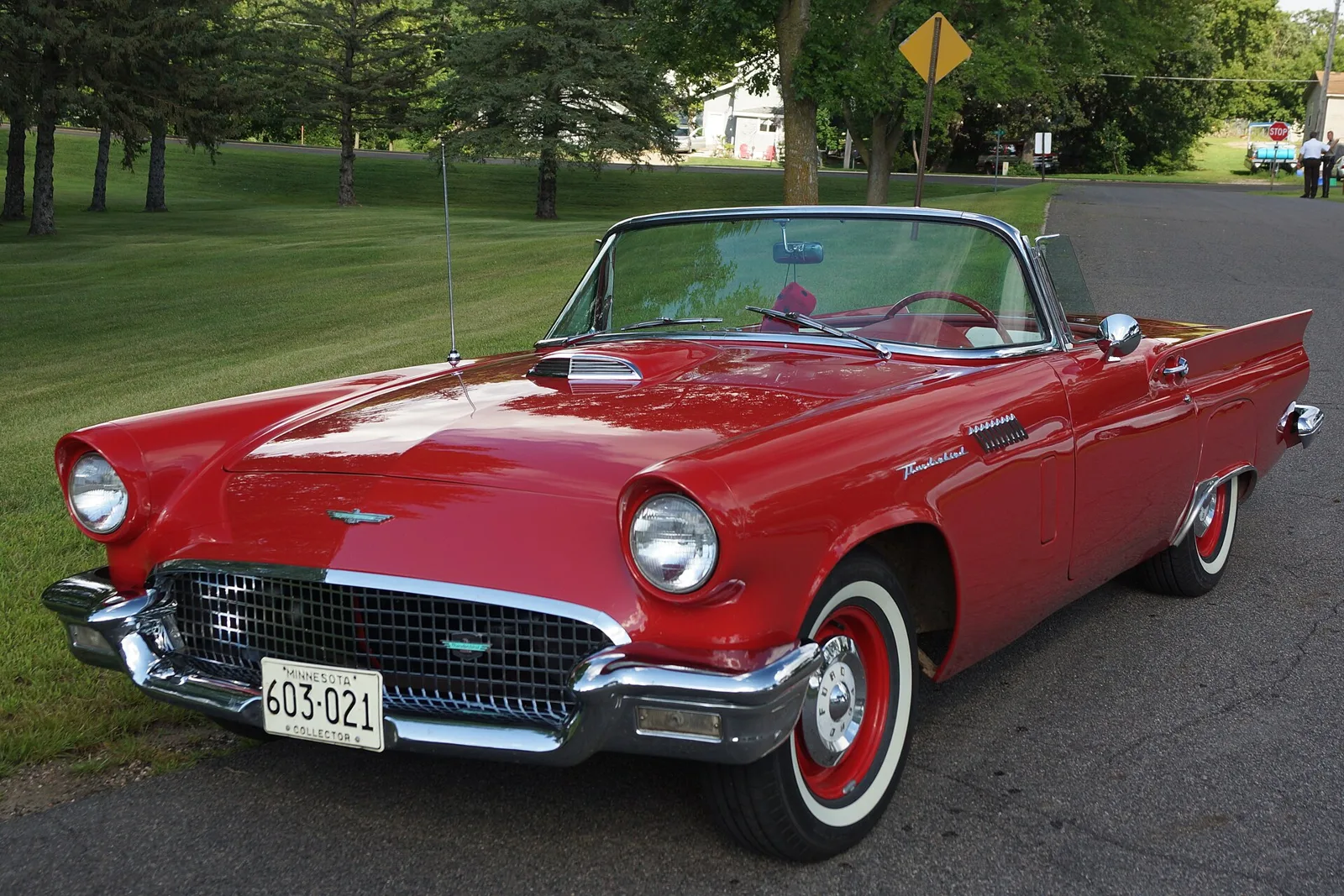
Ford's T-Bird ran from 1955 to 2005 across eleven generations, started as a two-seat convertible, invented the personal luxury segment and raced in NASCAR.
Built by Ford from 1955 to 2005, the Thunderbird began as a two-seat convertible. Its 1958 four-seat redesign created the personal luxury segment, and more than 4.4 million cars were produced over eleven generations. It was discontinued after the 2005 model year, and the final car was built on 1 July 2005.
The Ford Thunderbird was a personal luxury car that Ford Motor Company built for model years 1955 to 2005, with a break from 1998 to 2001. It began as a two-seat convertible aimed at buyers who wanted style rather than outright sports car performance. Over the decades it grew into a four-seat coupe, a larger luxury car and finally a two-seat convertible again, with more than 4.4 million built.
When did the Ford Thunderbird go on sale?
The Thunderbird was unveiled to the public at the Detroit Auto Show on 20 February 1954. Production began on 9 September 1954, and the car started selling as a 1955 model on 22 October 1954. It entered production for the 1955 model year as an upscale two-seat convertible rather than a pure sports car.
Ford developed the car quickly, and the design went from idea to prototype in about a year.
A two-seat convertible that became the personal luxury car, then grew, shrank and returned as a convertible before Ford ended the line in 2005.
Why did Ford build the Thunderbird?
Ford built the Thunderbird to answer Chevrolet's new Corvette, which had been unveiled in prototype form only a month earlier. Ford aimed the car at a more comfortable market than the Corvette, so it was marketed as a personal car of distinction. That positioning avoided a head-on contest with the Corvette on outright speed and handling.
The idea had a precursor. A smaller two-seater sports roadster called the Vega was developed in 1953 at the request of Henry Ford II. The one-off attracted interest, but it had meagre power, European looks and a high cost, so it never reached production. The Thunderbird kept the concept but made it more American, more luxurious and less sport-oriented.
Who designed the original Thunderbird?
Credit for the original car is shared among several people. Lewis Crusoe, a onetime General Motors executive, was persuaded back from retirement by Henry Ford II. George Walker, a Ford vice president and chief stylist, worked with Frank Hershey, chief stylist for the Ford Division, and Bill Boyer, who became manager of the Thunderbird Studio in the spring of 1955. Bill Burnett served as chief engineer.
Crusoe and Walker had met in Paris in October 1951, when Crusoe asked Walker about a sports car he had seen. Walker then telephoned Ford's headquarters in Dearborn and told Hershey about the conversation, and Hershey began working on the vehicle. Crusoe saw a painted clay model on 18 May 1953 that corresponded closely to the final car.
How did the Thunderbird get its name?
The name was chosen from thousands of proposals. Rejected options included Apache, Falcon, Eagle, Tropicale, Hawaiian and Thunderbolt, and Falcon was owned by Chrysler at the time. A Ford stylist with a southwestern background proposed the name, which referred to a mythological bird of great power in indigenous North American lore.
Ernest Breech, who chaired Ford Motor Company at the time, belonged to a country club in Rancho Mirage, California. Club lore holds that he sought the club's approval to use the name, and the approval was given.
How well did the first Thunderbird sell?
The first Thunderbird sold exceptionally well, outselling the Corvette by more than 23-to-one in 1955 with 16,155 Thunderbirds against 700 Corvettes. The success was enough for Ford to keep changes modest for 1956.
The 1956 model year moved the spare tyre to a Continental-style rear bumper, added a 12-volt electrical system and gave the roof standard porthole windows. A 312 cu in (5.1 L) V8 was offered with 215 hp (160 kW) on the manual gearbox or 225 hp (168 kW) with the Ford-O-Matic automatic. Ford also added its Lifeguard safety package that year.
The 1957 car was restyled with a larger grille, tailfins and larger tail lamps. Its standard 312 V8 produced 245 hp (183 kW), and a Paxton supercharged version reached 300 hp (224 kW). Sales rose to a record 21,380 units, but executives felt the car could do even better.
Why did the Thunderbird become a four-seater in 1958?
Ford executives, Robert McNamara among them, were concerned that the two-seat layout limited sales. The car was redesigned as a four-seater for 1958, and the new model began a sales momentum previously unseen with the car. It sold 200,000 units in three years, four times the output of the three-year two-seat run.
The four-seater created a new market segment, the personal luxury car. It was also the first individual model line, rather than a whole brand, to earn Motor Trend's Car of the Year honours. The convertible arrived in June 1958, five months after the hardtop, and mid-1958 sales reached 37,892 units.
Thunderbird specifications at a glance
The table below sets out headline figures for the Thunderbird from the first two-seater to the last convertible. Each row names the generation or model year it covers, so the early and late cars are not blended together.
| Specification | Detail |
|---|---|
| Model years | 1955 to 2005, with a hiatus from 1998 to 2001 |
| First generation wheelbase (1955) | 102.0 in (2,591 mm) |
| Second generation wheelbase (1958) | 113.0 in (2,870 mm) |
| 1958 V8 | 352 cu in (5.8 L) FE, 300 hp (224 kW) |
| 1961 V8 | 390 cu in (6.4 L) FE, 300 hp (224 kW) |
| 1983 Turbo Coupe | 2.3 L turbocharged four, 142 hp (106 kW); 155 hp (116 kW) by 1985 |
| 1989 V6 | 3.8 L Essex, 140 hp (104 kW) |
| 1994 V8 | Modular 4.6 L OHC V8, replacing the 302 |
| 2002 to 2005 V8 | Jaguar 3.9 L AJ-30, 252 hp (188 kW); 280 hp (209 kW) in 2003 |
| Seventh generation weight | 900 lb (408 kg) lighter than the sixth |
| Total production | Over 4.4 million |
How did the 1960s Thunderbird change?
The third generation arrived for 1961 with bullet-like body sides and a 390 cu in (6.4 L) FE V8 rated at 300 hp (224 kW). It sold 73,051 units in its first year and served as the Indianapolis 500 pace car that year. Sales of the 1959 and 1960 cars had already climbed to 67,456 and 92,843.
The fourth generation of 1964 was restyled with squared-off lines and a 113.2 in (2,875 mm) wheelbase. For 1965 it gained sequential turn signals and standard front disc brakes. The 1966 cars used a 390 V8 rated at 315 hp (235 kW), and a 428 cu in (7.0 L) V8 with 345 hp (257 kW) was the top option.
Why did the fifth generation grow larger?
The fifth generation was upsized because of competition. Lincoln-Mercury introduced the similarly configured Mercury Cougar for 1967, and it was less expensive than the Thunderbird. Ford responded by making the car larger and adding a four-door option, while moving to body-on-frame construction.
The fifth generation's four-door hardtop coupe had a very wide C-pillar and simulated landau bars. The 1970 model added a bird's-beak projection to the grille, and the 1971 car was the last year to offer the four-door.
What was the sixth generation like?
The sixth generation debuted in the fall of 1971 as a 1972 model. It was the largest Thunderbird ever produced by Ford, with a 120.4 in (3,058 mm) wheelbase and a length of 214 in (5,436 mm), which grew to 225 in (5,715 mm) by 1974. It shared its assembly line with the Lincoln Continental Mark series.
Sales peaked at over 87,000 units in 1973, despite the oil crisis, but had slumped to less than 43,000 by 1975. A small recovery to almost 53,000 units followed for 1976, before rising fuel prices and tougher emissions rules forced a downsize.
How did the downsizing change the Thunderbird?
The seventh generation of 1977 moved to a 114 in (2,900 mm) wheelbase and was 900 lb (408 kg) lighter. A small-block 302 cu in (4.9 L) Windsor V8 became the standard engine outside California, and the 1978 Diamond Jubilee Edition marked the company's 75th year at almost US$12,000. It was the most successful generation ever, with over 955,000 units in its three-year run.
The eighth generation of 1980 rode on the compact Fox platform and lost 5.6 inches (142 mm) of wheelbase and 17.3 inches (439 mm) in overall length. A six-cylinder appeared in 1981, and a 3.8 L Essex V6 with 112 hp (84 kW) became standard in 1982. Sales for 1980 to 1982 totalled 288,638 units.
What did the ninth and tenth generations bring?
The ninth generation of 1983 was a radically sleeker car on the Fox body, with a wheelbase of 104.2 in (2,647 mm). Its Turbo Coupe was a Thunderbird first, with a turbocharged 2.3 L four-cylinder that initially made 142 hp (106 kW) and reached 155 hp (116 kW) by 1985. A five-speed manual was available with it.
The tenth generation arrived for 1989 on Ford's MN12 platform, with a wheelbase 9 in (229 mm) longer and four-wheel independent suspension. The naturally aspirated V6 produced 140 hp (104 kW), and the Super Coupe's supercharged version made 210 hp (157 kW). A 302 V8 marketed as the 5.0 arrived for 1991, and the 1994 model year replaced it with the Modular 4.6 L V8.
What was the eleventh generation?
After a five-year hiatus the Thunderbird returned for 2002 as a two-passenger convertible. Its removable hardtop had a circular window that recalled the 1956 and 1957 cars, and the design combined many first-generation elements with minimalist styling.
The eleventh generation used the DEW platform that also underpinned the Lincoln LS sedan and the Jaguar S-Type. Its Jaguar 3.9 L AJ-30 V8 produced 252 hp (188 kW) and 267 lb ft (362 N m) of torque. For 2003 the AJ35 gained variable valve timing and electronic throttle control, lifting output to 280 hp (209 kW). Sales fell sharply after the first year, and production ended in 2005.
Did the Thunderbird race in NASCAR?
Yes. Thunderbirds first raced in NASCAR in the 1959 season, when Curtis Turner, Johnny Beauchamp, Tiger Tom Pistone and Cotton Owens took the cars to victory lane. From 1977 Thunderbird bodies replaced the Torino as Ford's main NASCAR body style.
Bobby Allison won 13 races for Bud Moore between 1977 and 1980. The downsized, aerodynamically cleaner Thunderbirds were successful from 1981 to 1997. A 1983 to 1988 car set the fastest lap in stock car history at Talladega, averaging 212.809 mph (342.483 km/h), and that record still stands.
Bill Elliott won the 1988 championship with Thunderbirds, and Alan Kulwicki took the 1992 title in a car nicknamed the Underbird. The last Cup Series appearance of the car came when Billy Standridge failed to qualify for the 1999 Daytona 500.
Frequently asked questions
Was the Thunderbird a sports car?
No. Ford sold the first Thunderbird as an upscale, sporty two-seat convertible rather than a sports car, and it avoided direct competition with the Corvette. Its comfort and convenience were the selling points.
Did Ford ever revive the Thunderbird after 2005?
No. The eleventh generation was discontinued after the 2005 model year, and the final vehicle was built on 1 July 2005. Ford has not returned the model line to sale in any form.
What is a Sports Roadster Thunderbird?
The Sports Roadster was a package offered from 1962 to 1964 on convertibles. It had a fiberglass tonneau cover over the rear seat and 48-spoke wire wheels, which made the car look like a two-seat roadster.
How many Thunderbirds were built?
Over 4.4 million Thunderbirds were produced from 1955 to 2005. The seventh generation alone accounted for more than 955,000 units in its three-year run.
_(cropped).jpg)