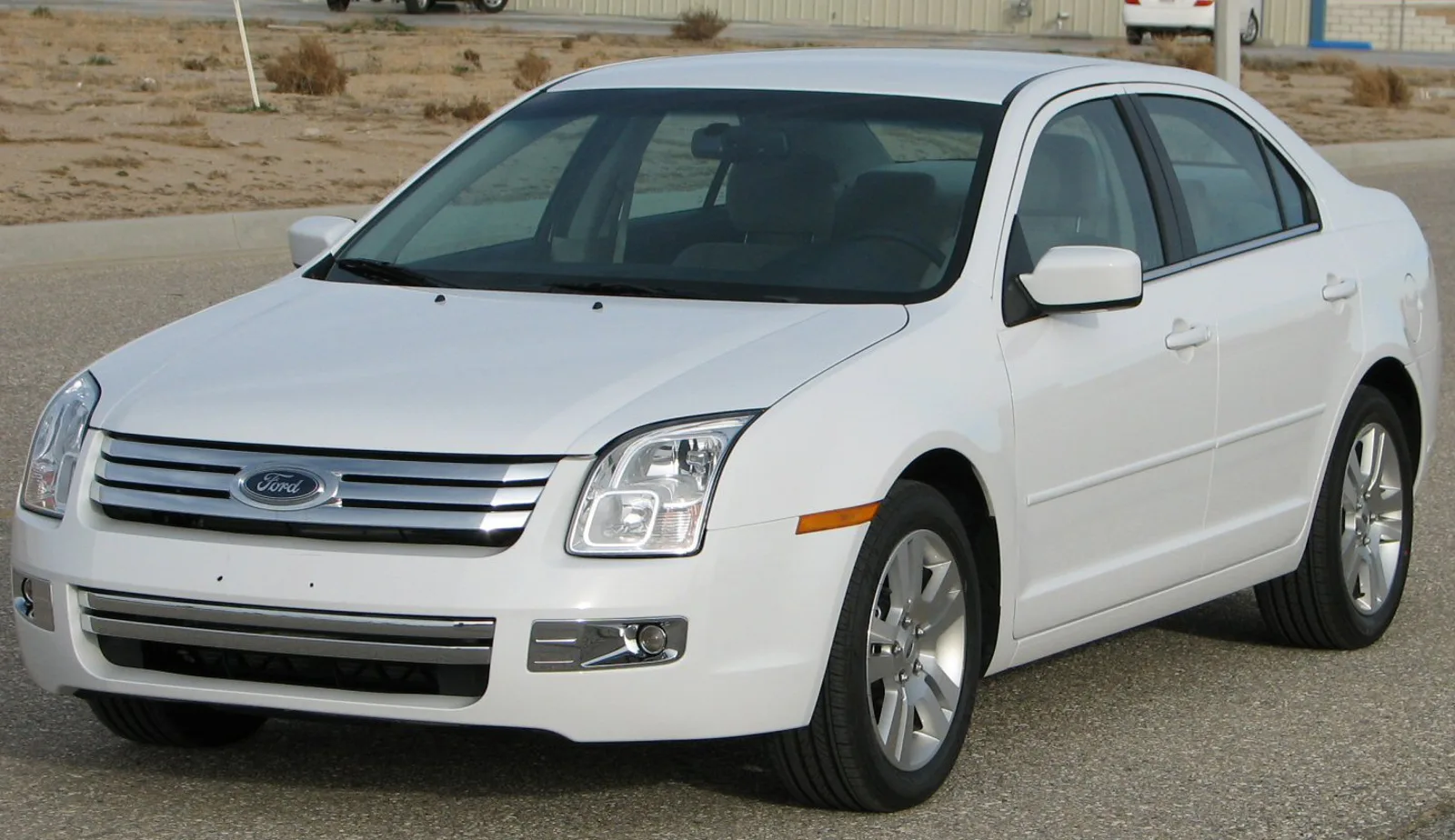
From the CD3 launch to the hybrid, plug-in and EcoBoost years, the Fusion was Ford's mid-size answer across the Americas until its 2020 finale.
Sold from 2006 through 2020, the Fusion was a mid-size Ford in two generations, built first on CD3 and then on CD4. Petrol, hybrid and plug-in versions all existed before its North American end.
Ford's Fusion was a mid-size sedan that ran from the 2006 through 2020 model years, across two generations. It came as a petrol car, a hybrid and a plug-in hybrid, and it was built at Hermosillo in Sonora, Mexico.
The car shared its CD3 platform with the Lincoln MKZ and the former Mercury Milan, and it sat between the compact Focus and the full-size Taurus in Ford's range.
Where did the Fusion come from?
The first Fusions rolled off the line starting on August 1, 2005. In Latin America it took over from the Mondeo, Argentina excepted, while North American buyers got it in place of the Taurus and the Contour. Its positioning was clear: a step above the Focus, a step below the Taurus.
The first-generation car used Ford's CD3 platform, which Mazda had originally designed as its G platform. Ford stretched the wheelbase by 5 cm and widened the body by 5.5 cm, and the Fusion became the first production car to wear Ford's three-bar grille.
A mid-size sedan built on a Mazda-designed platform, then sold as hybrid and plug-in versions until 2020.
What engines did the first Fusion offer?
The standard engine on every first-generation car was the 119 kW (160 hp) 2.3-litre Duratec 23 four-cylinder, paired with a five-speed manual or five-speed automatic. SE and SEL models could also take a 165 kW (221 hp) 3.0-litre Duratec 30 V6 with a six-speed automatic made by Aisin in Japan.
Mazda designed the four-cylinder and both transmissions. Cabin parts, including some of the console and the seats, came from the European Mk III Ford Mondeo, though the two cars were otherwise unrelated.
How were the first-generation trims set up?
The S was the base model, with sixteen-inch steel wheels under plastic covers, cloth seats and keyless entry. The SE added sixteen-inch alloy wheels, a power driver's seat and a security system, while the top SEL had seventeen-inch aluminium wheels and power dual front seats.
Mexico had its own line-up. Until 2005-06 it offered only the SE and SEL, both with automatics, and the S arrived for 2007 with a manual gearbox on the S and SE. Mexican cars never had steel rims, and the manual was dropped after 2008 because of poor sales.
How did the Fusion sell itself in its first years?
Ford's early US advertising used the tagline Life in Drive, and in Canada the car was pitched as Create a Reaction. In January 2007 a new Fusion Challenge campaign arrived, later renamed Ford Challenge. The campaigns stressed styling and driving fun.
Side-by-side drives organised with readers of Car and Driver and Road and Track, around Washington, D.C. and Los Angeles, put the American Fusion above the Toyota Camry and Honda Accord for looks, reliability ratings, handling and fun.
Was there ever a Fusion GT?
In July 2007 Motor Trend said Ford's Special Vehicle Team planned a Fusion GT for late 2009 or early 2010. It would have used a 3.5-litre EcoBoost V6 making about 340 horsepower, but the car never came to fruition. That output would have made it a quick family sedan.
What changed in the 2007 to 2009 model years?
For 2007 V6 models could be bought with all-wheel drive. Front side airbags, curtain airbags and a perimeter alarm moved from paid options to standard kit. Sirius Satellite Radio was offered on the SE and SEL, and a fold-flat passenger seat appeared.
For 2008 ABS and tyre pressure monitoring became standard, with rear parking assist, SYNC and ambient lighting optional. The DVD navigation gave way to a voice-command system, and navigation was offered with a manual gearbox for the first time.
The Sport Appearance Package added 18-inch machined aluminium wheels, a rear spoiler and stiffer suspension. Moon and Tune brought a power moonroof and an eight-speaker Audiophile system with amplifier, and for 2009 electronic stability control became an option.
How did the IIHS and NHTSA rate the first generation?
The IIHS rated the frontal offset test Acceptable for early 2006 and 2007 cars, improving to Good on later 2007 to 2009 models. Side impact without a side airbag was rated Poor for 2006 cars, while cars with side airbags reached Acceptable and later Good.
The IIHS also noted a caveat on the later frontal offset Good rating. Injury measures for the head, neck and right leg and foot were rated Acceptable.
Roof strength was Acceptable on cars built before May 2010, and Good on those built after April 2010.
What did the 2010 refresh bring?
Ford gave the Fusion a thorough 2010 facelift under chief designer Darrell Behmer, and the Milan and MKZ received the same treatment. The roof and doors were kept, while the front and rear fascias, interior and powertrains were revised, with new powertrains similar to those first seen on the 2009 Ford Escape.
The engines included a 2.5-litre four with 130 kW (175 hp), and a 3.0-litre Duratec V6 making 179 kW (240 hp) with E85 capability. A 3.5-litre Duratec 35 with 196 kW (263 hp) was standard in the Fusion Sport, and a six-speed 6F35 transmission arrived with the new engines.
The 2010 cars also carried Carlite SoundScreen glass, which laminated acoustic vinyl between two panes. It trimmed noise by as much as 6 dB at some frequencies and 2 to 3 dB overall, and the vinyl layer saved up to seven pounds per car.
The IIHS named the mid-size Fusion to its 2010 Top Safety Picks, though the rating applied only to Fusions built after April 2010.
What safety concerns hit the 2010 Fusion?
In June 2010 the NHTSA was reported to be investigating floor-mat-related unintended acceleration in the 2010 Fusion and Mercury Milan, with as many as 249,301 cars possibly affected. On May 28, 2010 the agency warned that stacking all-weather mats on top of the factory mat could trap the accelerator.
On October 2, 2014 the NHTSA opened an investigation into the electric power-assisted steering system in Fusions, MKZs and Milans from 2010 to 2012, after more than 500 complaints of sudden steering loss. An estimated 938,000 vehicles were included, and on May 27, 2015 Ford recalled 2011 and 2012 cars built in Mexico for a software update or steering replacement.
What was the Fusion Hybrid?
The 2010 Ford Fusion Hybrid launched in the US in March 2009 with an initial price of US$27,270. EPA ratings were 41 mpg city and 36 mpg highway, and a full tank was said to deliver 700 miles in city driving.
Kelley Blue Book editors put it on their 2009 list of Top 10 Green Cars. Buyers got a US$3,400 credit before March 31, 2009, then US$1,700 by September 30, 2009 and US$850 by March 31, 2010, when it ended.
Consumer Reports found the Fusion Hybrid was the worst under-performer against EPA figures in real-world use, out of 16 others tested. A class action followed on December 26, 2012, after owners reported figures well short of the stated 47 mpg.
How did the second generation of 2013 change?
The second generation debuted at the 2012 Detroit show as a 2013 model, riding on the Ford CD4 platform. It was part of Ford's One-Ford global car strategy, with design led by Ford of Europe, and Chris Hamilton, head of advanced design there, was lead designer based in Detroit.
The new car had a wheelbase 122 mm (4.8 in) longer than the CD3 car. Overall length grew by 28 mm (1.1 in), width by 18 mm (0.7 in) and height by 31 mm (1.2 in). MacPherson struts replaced the first car's double wishbones at the front, and a multi-link rear suspension was fitted.
Boot space shrank from 467 L (16.5 cu ft) to 453 L (16.0 cu ft). Hermosillo kept final assembly, with added capacity at Flat Rock in Michigan. The Mexican plant also took a prestigious plant award.
Which powertrains did the second generation offer?
The 2013 Fusion came in S, SE and Titanium trims, with five powertrains including two hybrids. All engines were four-cylinders, as Ford dropped the 3.0-litre V6 and the Sport's 3.5-litre V6 in a push to phase out the ageing Duratec 30.
For 2014 a 1.5-litre engine replaced the 1.6-litre turbocharged four, because China taxed cars with a displacement below 1500 cc far less. In 2017 the Sport returned with a 2.7-litre turbocharged V6 rated at 325 hp, the first V6 in a second-generation Fusion.
What driver-assist features came with the second generation?
Sensor and camera kit on the second generation covered Lane Keeping System, adaptive cruise with Forward Collision Warning, active park assist with a rear camera, and the BLIS blind-spot system with cross-traffic alert. Ford Sync, second-row inflatable belts and Intelligent All-Wheel Drive were also listed.
Sensors in the rear quarter-panels watched for traffic a driver could not see, then sounded and flashed a warning. The same system provided rear cross-traffic alert for drivers backing out of spaces with obstructed views.
What did the 2017 and 2019 updates change?
The 2017 update was shown at the January 2016 Detroit show, on the 11th. Every Fusion gained new styling and a rotary-controlled automatic selector, while the Platinum trim added luxury features above the Titanium. Each update brought a fresh look and new kit.
Pricing began at $22,120 for a base gasoline S with the 2.5 L Duratec I4, and reached $39,120 for the top Fusion Energi Platinum, which had a 2.0 L Atkinson-cycle I4 and an electric motor with EV Mode.
From 2019, Ford's Co-Pilot 360 package came as standard, bringing emergency braking, lane keeping, blind-spot and rear-traffic alerts, auto high beams and auto wipers. The 1.5 L EcoBoost became standard on SE and above, the SEL replaced the SE Luxury Package and the Platinum was dropped.
Why did the Fusion end in 2020?
In 2018 Ford began plans to discontinue its North American sedans as it shifted towards pickups, crossovers, SUVs and the Mustang. The performance Fusion Sport went after the 2019 model year, and 2020 closed the car's North American run. That plan came as Ford ended all national advertising for its sedans in September 2018.
The 2020 range was condensed to four gasoline-only trims, S, SE, SEL and Titanium, plus two Hybrid models and a single Energi Titanium plug-in.
What recalls and problems affected the Fusion?
In 2012 Ford recalled roughly 90,000 2013 Escape and Fusion cars with 1.6-litre engines, after 13 fire reports tied to overheating. In 2017 Ford recalled 2013 and 2014 Fusions with 1.6 EcoBoost engines for a risk of engine fires, and that recall partly contributed to a US$300 million charge.
In 2018 a recall covered 2013 to 2015 Fusions with 1.6-litre Sigma GTDI engines and B6 manual gearboxes, because the steering wheel could become loose. On May 15, 2019, about 270,000 2013 to 2016 cars with the 2.5 L engine and automatic were recalled over a bushing that could let the shift lever safety cable detach.
In June 2022 a customer satisfaction programme covered 2017 to 2019 Fusions with 1.5 L GTDI engines, which needed short-block replacement after coolant intrusion.
How did the Fusion race?
The Fusion became Ford's NASCAR body style from 2006, replacing the Taurus. It was the first new Ford model since the Torino in 1968 to race in NASCAR on launch day. For 2013 the Generation 6 body was updated to match the second-generation car.
Ford also tried a fuel-cell Fusion Hydrogen 999 on the Bonneville Salt Flats, aiming to exceed 200 mph (320 km/h). On August 15, 2007, the car clocked the fastest fuel-cell ground vehicle speed, at 333.612 km/h (207.297 mph). The Mustang took over from the Fusion in NASCAR's Cup Series in 2019.
What awards did the Fusion win?
In July 2006 Strategic Vision named the Fusion its Total Quality best midsize sedan. In November 2009 the 2010 Fusion line-up was chosen as Motor Trend's Car of the Year, beating nearly two dozen rivals. Several of these honours came in the years just after launch.
The 2010 Fusion Hybrid took North American Car of the Year at the Detroit show in January 2010. The 2013 line-up, including the Energi plug-in, won Green Car of the Year in November 2012, and in 2017 the car took MotorWeek's Drivers' Choice award for Best Family Sedan.
How did reviewers and buyers respond?
A December 2005 test had Car and Driver placing the Fusion just under the Honda Accord, a few points clear of the Toyota Camry and Hyundai Sonata. Later, Consumer Reports called the Fusion Hybrid the best domestic sedan for 2010.
Ford reported 30,000 sales in the opening quarter of 2006. By October 2009 it ranked among the US top ten sellers and led the domestic makers, and in 2007 about 77% of sales went to retail buyers and 23% to fleets.
In Brazil the car was the class sales leader in 2008.
What are the main Fusion specifications?
The table covers engine outputs, wheelbase and trunk changes between generations, and the hybrid and record figures cited above. Metric values come first where the published figures give them, and each row names the generation it covers. Figures are as published.
| Specification | Detail |
|---|---|
| Model years | 2006 through 2020, two generations |
| First-generation standard engine | 2.3 L Duratec 23 four-cylinder, 119 kW (160 hp) |
| First-generation V6 | 3.0 L Duratec 30, 165 kW (221 hp) |
| 2010 refresh 3.0 V6 | 179 kW (240 hp), E85 capable |
| 2010 refresh Sport V6 | 3.5 L Duratec 35, 196 kW (263 hp) |
| Second-generation wheelbase gain | 122 mm (4.8 in) over the CD3 car |
| Second-generation overall length gain | 28 mm (1.1 in) |
| Trunk capacity | 453 L (16.0 cu ft), down from 467 L (16.5 cu ft) |
| 2013 hybrid rating | 5.0 L/100 km (47 mpg-US; 56 mpg-imp) |
| NASCAR record speed | 333.612 km/h (207.297 mph) |
Frequently asked questions
Was the Fusion sold outside North America?
Yes. It replaced the Mondeo across Latin America, except Argentina, and from 2015 the Mondeo name was used in Europe and Asia. South Africa sold the car as the Fusion.
Was there a V6 in every market?
No. The Middle East sold only 2.5-litre cars, and South Korea offered only 2.5-litre engines, including those in the hybrid, as of the 2012 model year.
Did the Fusion ever top a sales chart?
In 2019 it ranked seventh among the best-selling cars in the United States. Brazil also put it top of its class in 2008.
What was the Fusion Energi?
The Fusion Energi was the plug-in hybrid version, first delivered in the US in February 2013. A Platinum version was added in 2017, and from 2019 the Energi came only in Titanium trim.