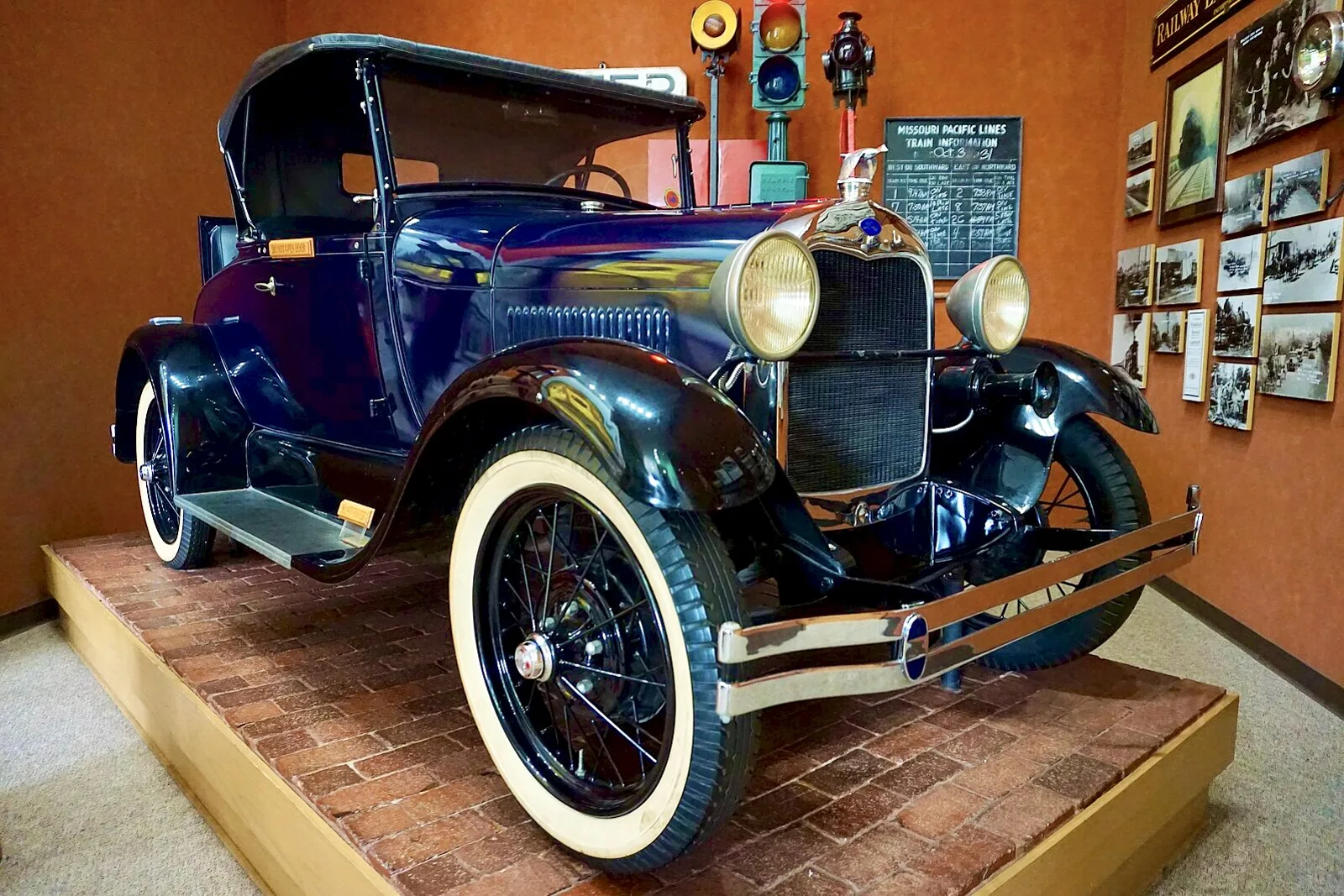
Ford's successor to the Model T, a four-cylinder car that passed a million sales in little over a year, and the hot rods, railcars and famous survivors that followed.
The Ford Model A was a 1927 car that replaced the Model T and was built until 1932, with 4,858,644 made. It sold a million units in little over a year, used a four-cylinder engine producing 30 kW, and became a favourite of hot rodders and railcar builders.
Ford's Model A replaced the Model T after that car had been built for 18 years. Production began in October 1927, and one million examples had sold by February 1929. The car remains one of the most recognisable vehicles of its era, both as a production model and as a base for hot rods and custom builds.
Why did Ford replace the Model T?
Rival manufacturers, especially the General Motors divisions, had caught up with Ford's mass production during the mid-1920s. They offered more powerful engines and new convenience features, and the Model T's appeal faded as buyers looked elsewhere, a threat that Edsel Ford and the sales staff recognised first.
Edsel Ford and the sales force had pressed for a response for some time. Henry Ford resisted at first, but the Model T's sagging market share forced his hand, and he then concentrated the new car on mechanical design and on how easily it could be manufactured.
Development was not smooth. Die stamping of sheet steel had made the Model T a success, but Henry was wary of it and wanted more drop-forged parts for durability. Engineers eventually persuaded him to accept stamped parts so that the production cost did not climb too far.
A four-cylinder Ford that replaced the Model T, passed a million sales in little over a year, and outlived its own era.
When did the Model A go on sale?
Production began on 20 October 1927, and the car was introduced on 2 December. It was designated a 1928 model and offered in four standard colours. An earlier car carrying the Model A name, built in 1903-04, was an entirely different machine.
The million mark came on 4 February 1929, and two million followed by 24 July 1929. Sales hit three million in March 1930, when nine body styles were on offer, which made the new car a commercial success within a few years of its launch.
Output stopped in March 1932, once 4,858,644 cars had been built in all body styles. The Model B followed with an updated inline four, and the Model 18 introduced Ford's flathead V8 engine. Both cars came after the Model A's production run, which ended in March 1932 in all body styles.
What was the engine like?
Under the bonnet sat a four-cylinder L-head design with water cooling, displacing 3.3 L (201 cu in) and giving 30 kW (40 hp; 41 PS). It drove a conventional three-speed sliding-gear manual transmission with a single reverse gear, which was a familiar layout for drivers of the period.
The car could reach roughly 105 km/h (65 mph) at best. Its final drive ratio was 3.77:1 on a 2,630 mm (103.5 in) wheelbase, and four-wheel mechanical drum brakes slowed it down.
Ford's Model A moved the company onto conventional driver controls, with clutch and brake pedals, a throttle and a gearshift. Earlier Fords had used controls that other makers had abandoned, so the change made the car easier for drivers of other makes to learn.
What body styles did the Model A come in?
The Model A came in a wide range of styles, including coupes, roadsters, phaetons, Tudor sedans, Fordors, a town car and a station wagon. Roadsters were the cheapest at US$385, while the most expensive town car cost US$1,400. That range let buyers choose between a utilitarian body and a more stylish one.
The entry-level sedan was priced at US$500 and came in grey, green or black. A dual-cowl town car cost US$1,200 in the same range, and by March 1930 there were nine body styles available.
The fuel tank sat in the cowl, with a visual gauge, and gravity fed the carburettor from it. Rear-view mirrors were an optional extra, and the windscreen used safety glass, one of the first production cars to do so.
What did the Model A cost in today's money?
Inflation-adjusted figures put the Tudor's US$500 at roughly $9,375 in 2025 money, and the dual-cowl town car's US$1,200 at about $22,500. Those comparisons show that the car was a significant outlay for most households of its time, and it was priced accordingly for the buyers who wanted it.
Ford's pricing aimed at a broad market, and the range spread from the cheapest roadster to the most formal town car, so buyers could choose the body that suited their budget and needs.
Which Model A variants were built?
Beyond the passenger body styles, Ford built taxicab, truck and commercial versions of the Model A. The special coupe was produced from around March 1928 until mid-1929, which made it a short-lived variant among the family's many forms. Each variant served a different buyer, from the taxi operator to the hot rodder.
The 1931 roadster was one of the last variants produced, and it became the favourite of enthusiasts who wanted an open car with a simple chassis. Later enthusiasts formed a Model AA truck club to keep the commercial versions in the public eye.
How did the Model A fare in Europe and Britain?
European Model As sold poorly against the smaller successor cars. Ford in the UK built a version with a 2,043 cc engine, but the British tax system on fiscal horsepower made it expensive to own. The mismatch between engine size and tax rules was the central problem.
That engine produced a claimed 21 kW (28 hp; 28 PS), yet its fiscal rating was 14.9 hp, compared with 24 hp for the larger engine. The tax of 1 pound per fiscal horsepower was punitive, so the car was too heavy and costly for volume sales.
The Soviet company GAZ built a licensed version from 1932 to 1936, a sign of the car's reach beyond America and Britain.
What became of famous Model As?
Several Model As became icons in their own right. The Mean Green Machine is a 1929 Tudor sedan, painted green and built up in 1931, and it has been a fixture at University of North Texas football games since 1974. Georgia Tech's student body mascot is the Ramblin' Wreck, a 1930 sports coupe.
Ala Kart is a customised 1929 roadster pickup built by George Barris. It claimed back-to-back Most Beautiful Roadster prizes in Oakland and went on to appear in films and on television.
Hector Quevedo and his son Hugo covered 35,406 km (22,000 mi) between 1992 and 1994, driving a 1928 Model A from Chile to Dearborn. The trip needed little service, although it did require a flat tyre fixed and transmission work in Nicaragua. The car is today displayed at the Henry Ford Museum.
Gangster John Dillinger reportedly used a 1930 Model A to escape federal agents in 1934, and that car fetched US$165,000 at auction in 2010.
Why did the Model A inspire hot rodders?
Enthusiasts favoured the 1931 roadster, whose open body was lighter than the closed styles and whose chassis was simple to work on. That combination made it a popular starting point for hot rod builds. Their work reflected the car's openness to modification from the start.
The roadster's open cockpit and straightforward engineering gave builders room to experiment, and many of the cars that survive show how varied those builds became.
Were Model As used as railcars?
Yes. West Side Lumber, a Californian firm, turned several Model As into railcars that could carry 12 people. A few still run on the Yosemite Mountain Sugar Pine Railroad, alongside Shays Nos. 10 and 15. The conversions showed how adaptable the basic vehicle was beyond the road.
What did the Model A mean for mass production?
The Model A arrived as the limits of Ford's first mass production system became clear. The rigidity of the Model T system left little room to adapt, and the car's development showed the company what a more flexible approach would need.
That shift towards flexible production is one reason the Model A is studied alongside the Model T, even though it was the successor and not the original. Between the mid-1920s and the early 1930s the boundaries of early mass production became plain, and the Model A era marked the start of a broader move towards more adaptable methods.
What are the Ford Model A specifications?
The table lists the core figures for the standard American car and the UK-market variant. Values are quoted metric first with imperial in brackets, and the UK engine is shown separately because its tax rating differed from the American car.
| Specification | Detail |
|---|---|
| Production span | 20 October 1927 to March 1932 |
| Total built | 4,858,644 cars |
| Engine | 3.3 L (201 cu in) water-cooled L-head inline four |
| Power | 30 kW (40 hp; 41 PS) |
| Transmission | Three-speed sliding-gear manual, single reverse |
| Final drive | 3.77:1 |
| Wheelbase | 2,630 mm (103.5 in) |
| Brakes | Four-wheel mechanical drum |
| Top speed | About 105 km/h (65 mph) |
| UK engine | 2,043 cc, 21 kW (28 hp; 28 PS) |
How did owners keep warm in winter?
In cooler climates owners could buy an aftermarket cast iron unit to fit over the exhaust manifold, which supplied heat to the cab. A small door controlled how much of that hot air entered the car, so drivers could balance warmth against draughts.
The arrangement was a practical answer to a car that had no factory heater of its own. It shows how much early motoring relied on owners adapting their vehicles to the weather.
What did design for manufacturability mean for the Model A?
Design for manufacturability, which Henry Ford had always strongly embraced, shaped the Model A's mechanical design. The principle was the same one for which the Model T production system had become famous, so the new car was engineered with the production line in mind.
The aim was to keep the cost of building each car under control while still delivering the durability that Henry wanted. That balance was the central engineering problem of the Model A's development.
How did the Model A compare with its smaller successors in Britain?
European Model As struggled against the smaller cars that followed them. The smaller successor cars would later find success in Britain and Germany, where the larger Model A's engine had proven too costly under the local tax system. Both points show how closely car design and national regulation were linked.
The lesson for Ford was that taxation and engine size could matter as much as styling in a European market, and that a car had to fit the local rules to sell well.
Frequently asked questions
How many Model As were built?
Production totalled 4,858,644 cars across all body styles between October 1927 and March 1932.
Did the Model A have a V8?
No. The Model A used a four-cylinder engine, while the Model 18 that followed introduced Ford's flathead V8.
Did the Model A have safety glass?
Yes. It was one of the first production cars with safety glass in the windscreen, and a rear-view mirror was an optional extra.
What replaced the Model A?
The Model B, with an updated inline four, followed the Model A in production.
What was the top speed?
Its top speed was about 105 km/h (65 mph), and the final drive ratio was 3.77:1, which kept the engine working steadily on the road.
Did the Model A use a manual gearbox?
Yes. It used a three-speed manual transmission with sliding gears and a single reverse gear, and its gears were not synchronised, so drivers had to match speeds carefully when changing.
_-_(Brighter).jpg)