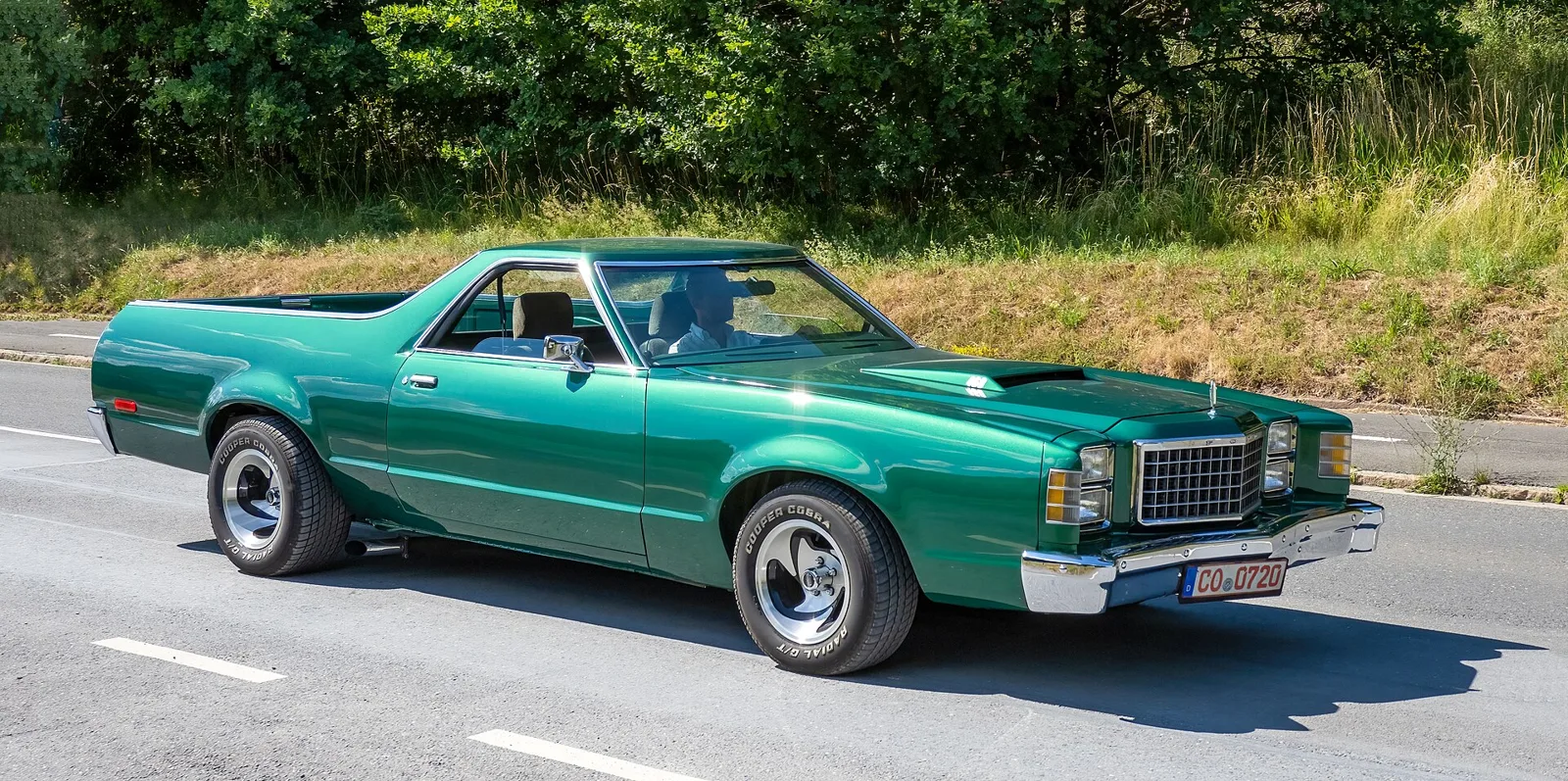
A coupe utility that wore Falcon, Fairlane and Torino clothes across seven generations, then lived on in Argentina until 1991.
The Ford Ranchero was a coupe utility built from 1957 to 1979, using a station wagon and later Falcon, Fairlane and Torino platforms. Its 508,355 American units were joined by Argentine versions that carried the name until 1991, plus a 1970s South African variant.
The Ford Ranchero is a coupe utility that Ford built from 1957 to 1979, with 508,355 units produced over that span. Unlike a conventional pickup, it was built on a station wagon platform that merged the cab and cargo bed into a single body. Over the years it rode on full-sized, compact and intermediate Ford platforms, and the car-based pickup remained its defining idea.
What is a coupe utility, and where did the Ranchero come from?
A coupe utility is a car with an open cargo bed built into its rear, rather than a truck with a separate cab and bed. Its underpinnings came from a two-door station wagon, and it was the first American vehicle of its kind after the war to be engineered from a well-known sedan at the factory. It blended sedan looks with the practicality of a light pickup.
The idea goes back a long way. Early Ford pickups were made by placing a load box behind a roadster body. In 1934 Lew Bandt, a designer at Ford Australia, reworked a coupe so its rear loadbed blended in smoothly, creating the coupe utility that Australians still call the ute.
The Ranchero's success prompted a rival from General Motors in 1959, the Chevrolet El Camino. In North America pickups had taken a heavier-duty path, but the Ranchero showed that a car-based design could find its own buyers.
A car with a bed at the back: the coupe utility that gave Ford a sedan-styled pickup for nearly a quarter of a century.
How was the first-generation Ranchero built?
The first Ranchero arrived in December 1956, three months after the usual September model-year beginning. It was based on the new-for-1957 full-sized Ford platform, using the short-wheelbase Custom sedan, the two-door Ranch Wagon and the Courier sedan delivery as its starting points.
Essentially a Courier with an open, reinforced bed and its own rear window, the Ranchero was built on the car line, yet marketed as a truck via Ford's truck division. A basic model was aimed at traditional pickup buyers such as farmers, while the Custom picked up most of the Fairlane range's options, such as stainless bodyside mouldings and two-tone paint.
Upscale models carried both Fairlane and Ranchero badges and a Longhorn symbol on the tailgate. Advertising played on the American Southwest theme, with the slogan More Than A Car! More Than A Truck! The car had about 50 lb (23 kg) more cargo capacity than the half-ton F-Series pickup.
What changed in the 1958 and 1959 Rancheros?
The 1958 model kept its under-skin layout but gained new front sheet metal and four headlamps, and the 1957 rear end and tail lights were reused. The 1959 model shared the 118 in (3,000 mm) wheelbase of every 1959 Ford, which allowed a longer bed of 7 ft (210 cm).
The 1959 car also had a windshield 25% larger than before. Seat covers came in vinyl or woven plastic, and the spare tyre sat behind the passenger seat. Only the Custom Ranchero was sold that year, in 26 colours including 11 solid shades and 11 two-tone combinations.
Why did the Ranchero shrink in 1960?
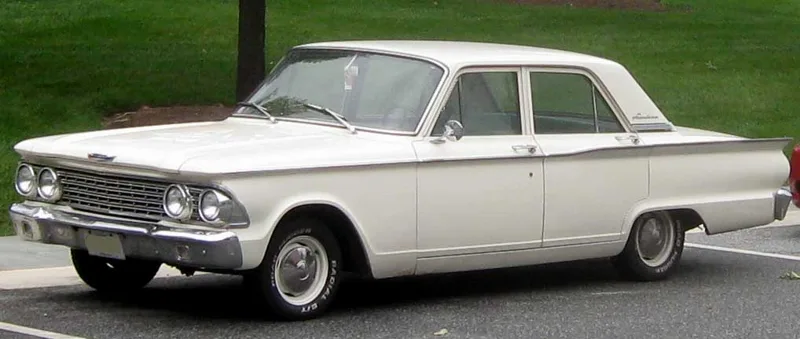
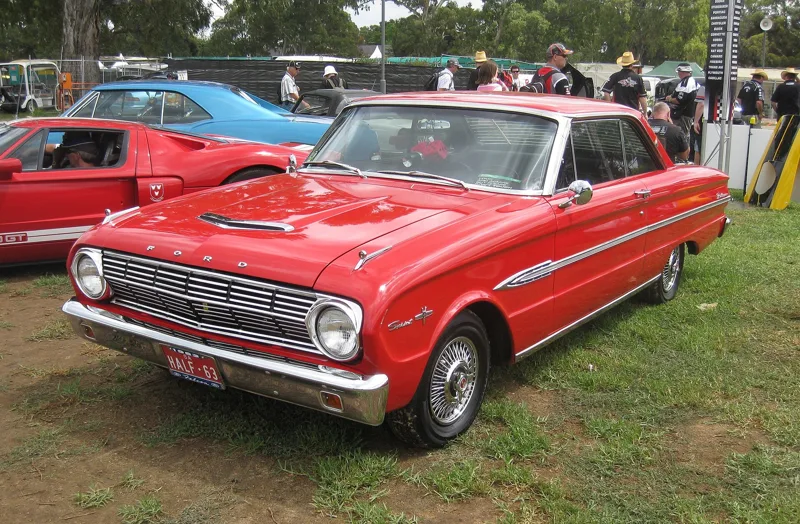
From 1960 the car shrank, built on the compact Falcon and specifically its two-door sedan delivery form. Small economical cars such as the Volkswagen Beetle had shifted thinking among the big American makers, and the late-1950s recession added to the pressure for a cheaper, lighter vehicle.
Marketed as the Falcon Ranchero, the new car started with a 144 cu in (2.4 L) straight six. A 170 cu in (2.8 L) six arrived in 1961, and the optional 260 cu in (4.3 L) V8 was added in 1963. It sold well, and it was the smaller, cheaper answer to the full-sized pickup that Ford had hoped for.
Gearboxes were a two-speed Ford-O-Matic automatic, offered from 1960 to 1963, or the three-speed C4 Cruise-O-Matic, along with a three-speed manual. The Ranchero had an 800-lb load capacity.
How did the 1966 and 1967 models differ?
The 1966 Ranchero was a one-year model. It used Falcon front sheet metal and trim on a modified station wagon platform, although cars built late in the model year wore the same front clip as the Fairlane. It was marketed simply as the Ford Ranchero, without Falcon badges, and seat belts were standard.
Engines for 1966 were the 170 cu in (2.8 L) six, a 200 cu in (3.3 L) six with carburettor choices of two or four barrels on the 289 cu in (4.7 L) V8. The 1967 car, based on the post-1966 Falcon and Fairlane chassis, was sold as the Fairlane Ranchero with Fairlane trim.
The 1967 range reached as high as a 390 cu in (6.4 L) FE V8 rated at 315 bhp (234.9 kW), which could be paired with a C6 automatic or a Toploader four-speed manual. New Ranchero 500 and 500/XL models expanded the trim choice, but the Fairlane GT and GTA performance options were never offered on the Ranchero.
What was the 1968 and 1969 Ranchero like?
In 1968 the Ranchero grew to become the largest model since the full-sized 1959, and it was more angular, with a horizontal grille and headlamps. The interior was new and shared the Torino and Fairlane four-pod instrument cluster, with a tachometer in upscale models.
Three trim levels were offered: the base Ranchero, the Ranchero 500 and the premium Ranchero GT, which borrowed Torino GT trim. The engine list started at the 250 cubic inch six and climbed to the 428 cu in (7.0 L) Cobra Jet, the largest engine the Ranchero had carried, offered as a mid-1968 option.
The 302 cu in (4.9 L) V8 became standard in 1969, replacing the 289, and the 351 Windsor was introduced in two- and four-barrel form. The FMX automatic was offered with both 351 versions. For 1969 a rare Rio Grande special-order car appeared, in Grabber colours with bed rails and a vinyl top. Output is unclear, but the Rio Grande may have totalled around 900 units.
How did the 1970 and 1971 Rancheros look?
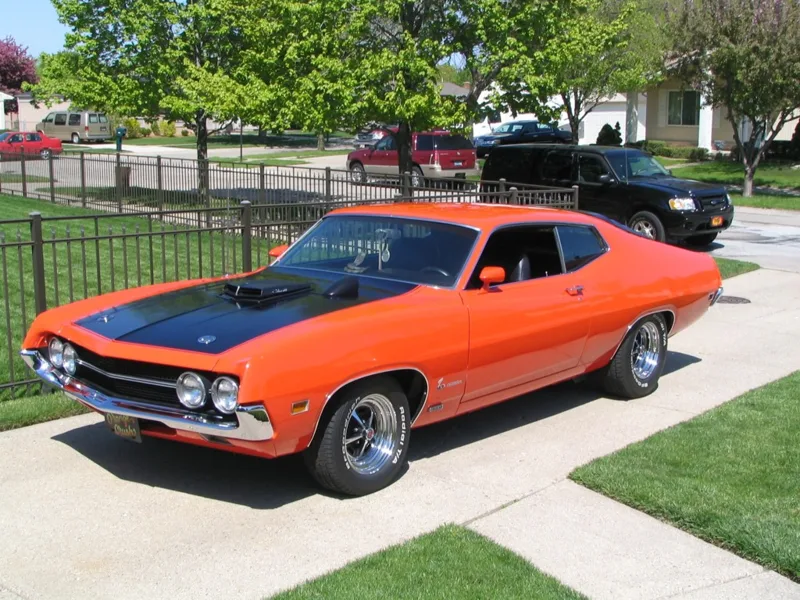
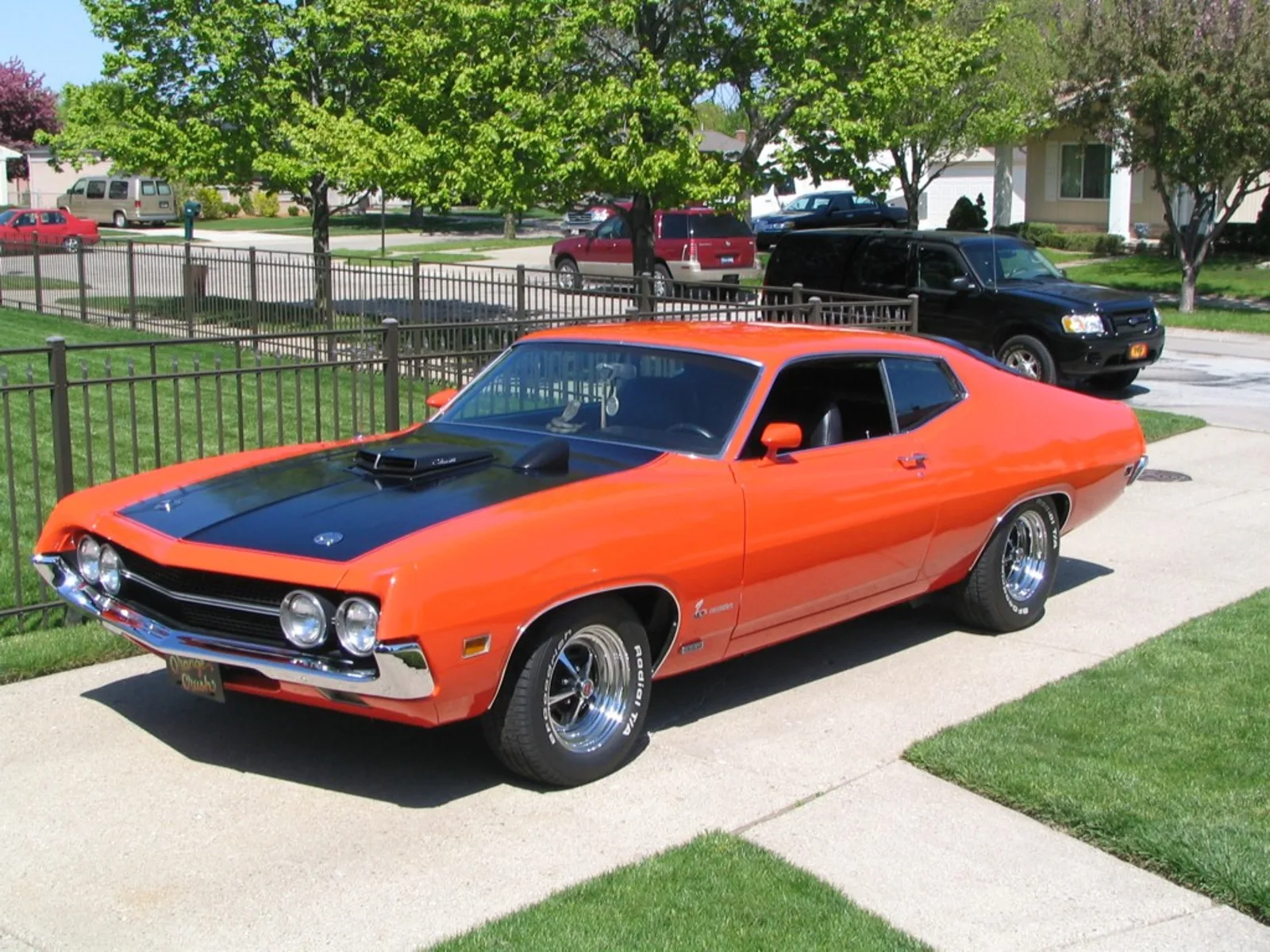
The 1970 Ranchero was a complete restyle, moving away from the boxy look of the previous car. Both the Torino and the Ranchero adopted a shallow-pointed grille and curvier lines shaped by coke-bottle styling. A fourth trim option, the Squire, added a woodgrain applique similar to the Country Squire wagon.
All Torino trim and engine options were available, including the Ram-Air 429 Cobra Jet and Super Cobra Jet engines of 7 L, with the shaker hood scoop mounted directly to the carburettor. From 1970 the glove compartment carried a Ranchero or Ranchero GT badge rather than Fairlane or Torino plates. The 1971 car is set apart by a grille divided by a centre section.
What was the 1972 to 1976 generation like?
In 1972 the Torino and Ranchero changed radically. The sleek shape gave way to a larger, heavier design with a wide semi-oval grille and a body-on-frame structure. The range was the 500, the Squire with simulated woodgrain along its flanks, and the sporty GT.
The engine list opened with the 250 cubic-inch six, then moved through a range of V8s, including the 302, the Cleveland and Windsor 351s and a new 400 for 1972. The 385-series V8 was 429 for 1972 and 1973 and 460 for 1974 to 1976, although all of them had lower compression ratios to meet emissions rules. The 351 Cleveland could still be ordered in tuned 4-V Cobra Jet form through 1974.
The 1973 car received a reworked nose to satisfy newer federal front-impact rules. Otherwise the Ranchero changed little until the Torino ended in 1976.
Why did the Ranchero end in 1979?
With the Torino finished after 1976, the 1977 Ranchero was restyled to match the Ford LTD II mid-sized car, which used the same platform. Engines went up to 400 cu in (6.6 L), and the car could be ordered in quite luxurious form.
Production ceased in 1979 with, among the usual choices, a commemorative 1979 1/2 model. The LTD II-based Ranchero, with its stacked rectangular headlamps, is one of the most popular body styles among collectors today, and owners often swap in front-end clips from other Ford and Mercury models.
Cars were getting smaller and more heavily regulated, and a car-based pickup became less attractive to build. Purpose-designed light trucks faced looser emissions and fuel economy rules. Ford decided that small light trucks were the future, starting with the Mazda-built Courier as a stepping stone to its own Ranger.
What was the Argentine Ranchero?
From 1973 to 1991, Ford Motor Argentina sold a utility version of its Falcon called the Ford Ranchero. Unlike the American car, it was based on the four-door sedan, with the front kept as it was and the rear half cut down to make a light pickup.
It came in a light version with a maximum load of 465 kg (1025 lb) and a heavy version rated at 565 kg (1245 lb). Both rode on 14-inch wheels, and the heavy model had front disc brakes. The first generation sold very well, and exports to Cuba began in 1974.
Later in 1974 it became the best-selling car in Argentina, with 110,382 sold between 1973 and 1978. Later generations followed in 1978, 1982 and 1987, and a diesel was added in 1988 but dropped in 1989. The fourth and final generation ended production in 1991.
Was the Ranchero name used in South Africa?
During the 1970s the Ranchero name also appeared in South Africa on a rebadged Australian Ford Falcon utility. The vehicles arrived as complete knock-down kits from Australia and were assembled at Ford's plant in Port Elizabeth. The name was therefore used across three markets, each with a different car underneath.
How collectible is the Ranchero today?
Rancheros are reasonably collectible, though they are often overlooked in favour of the Chevrolet El Camino, which lasted eight more years. Model makers have covered the car in many scales, from 1/64 to 1/18.
Revell has offered 1957 kits in 1/32 and 1/25 scale, and AMT/Ertl produced a 1961 kit. Matchbox issued a 1961 Ford Falcon Ranchero for its 2018 line and a 1970 Ford Ranchero for 2023. Greenlight Collectibles released 1972, 1973, 1974 and 1976 models in 1/64 scale in 2019, and BOS Models made a 1979 resin model in 1/18 scale.
Hot Wheels has made several Rancheros, including a '72 model in production since 2009 and a '65 with a hard tonneau cover and an opening hood, introduced in 2011. Tonka made a resin toy of the 1968-69 car at about 1/24 scale.
Will the Ranchero name return?
The car-based pickup idea remains attractive, and US rules favouring light trucks over cars have shaped the market for decades. Ford filed for the Ranchero trademark in the United States in 2025, after the earlier registration had expired in 2008.
Some automotive publications speculated that the name would go on a $30,000 two-door electric pickup planned for 2027. In August 2026 that truck was officially announced as the Ford Fathom, and whether the name returns remains open.
What are the key Ranchero specifications?
The table covers the main figures across the generations, with the Argentine models listed separately. Where a figure belongs to a particular year or market, the table says so, so the American and Argentine cars are not blended together.
| Specification | Detail |
|---|---|
| Production span | 1957 to 1979, 508,355 units |
| 1959 wheelbase | 118 in (3,000 mm) |
| 1959 bed length | 7 ft (210 cm) |
| Early engine | 144 cu in (2.4 L) straight six, Falcon Ranchero from 1960 |
| Load capacity, 1960s | 800 lb |
| 1967 top V8 | 390 cu in (6.4 L) FE V8, 315 bhp (234.9 kW) |
| Largest engine | 428 cu in (7.0 L) Cobra Jet, 1968 |
| Ram-Air option | 429 Cobra Jet, 7 L, 1970 |
| Late American V8 | 400 cu in (6.6 L), 1977 |
| Argentine light model | 465 kg (1025 lb) maximum load, 14-inch wheels |
| Argentine heavy model | 565 kg (1245 lb) maximum load, front disc brakes |
| Argentine sales | 110,382 units from 1973 to 1978 |
Frequently asked questions
How many Rancheros were built in the United States?
Ford produced 508,355 Rancheros across the American run from 1957 to 1979. That total covers all seven generations, from the full-sized original to the LTD II-based car of the late 1970s.
What was the biggest engine in a Ranchero?
At 428 cu in (7.0 L), the Cobra Jet offered as a mid-1968 extra was the largest the Ranchero carried. The 1970 Ram-Air 429 Cobra Jet of 7 L came close, and the 1977 range topped out at 400 cu in (6.6 L).
Did Argentina build a Ranchero?
Yes. Ford Motor Argentina sold a Falcon-based Ranchero from 1973 until 1991. Its base was the four-door sedan, and by 1974 it topped Argentina's sales charts.
Is the Ranchero name coming back?
Ford filed for the trademark in 2025, and the planned electric pickup was announced as the Ford Fathom in August 2026. Publications had speculated that the name would go on that truck, so the trademark filing is the clearest sign of intent.
_Kulmbach-20220626-RM-160247.jpg)