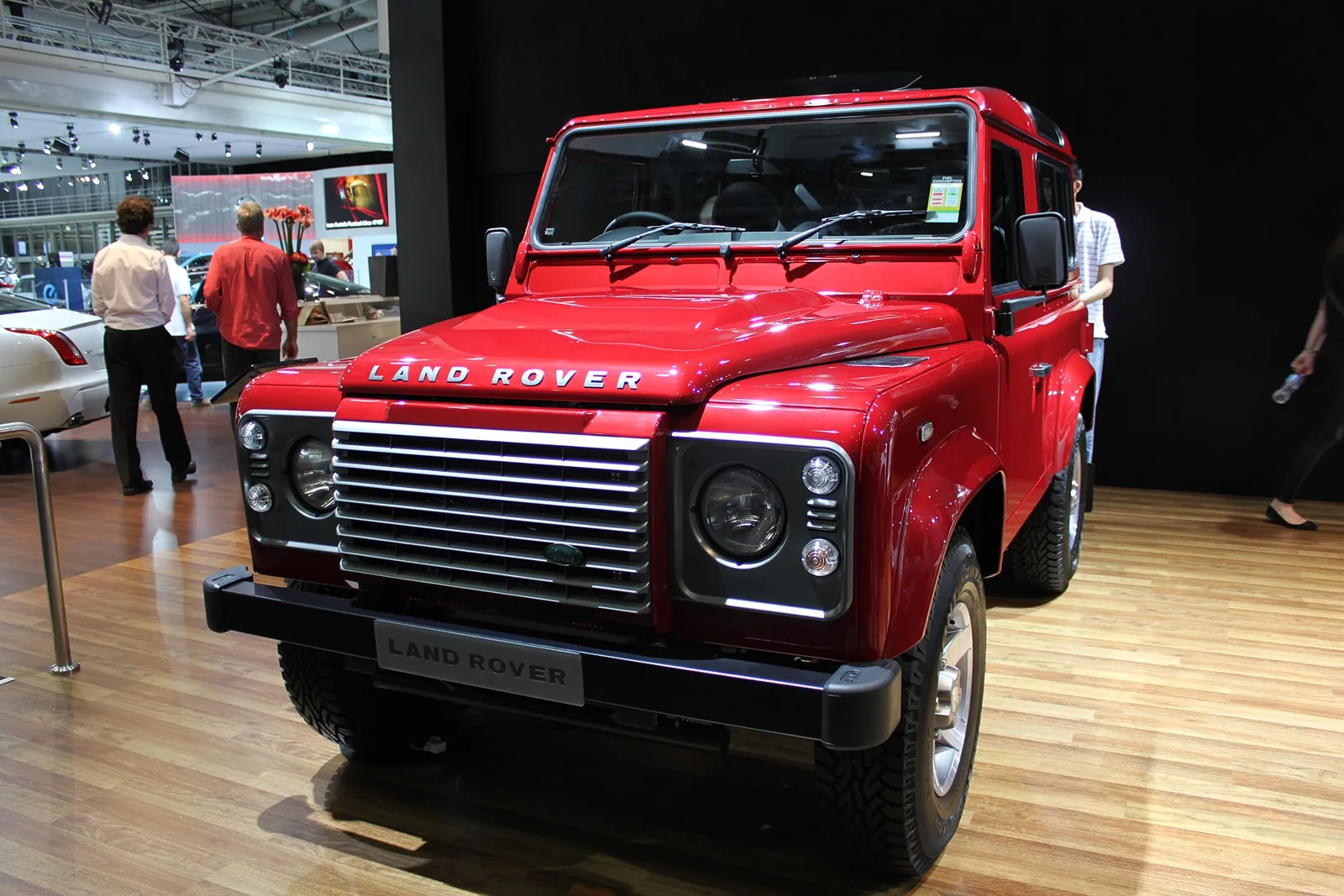
A design begun on a farm, the Range Rover and Discovery years, the BMW, Ford and Tata owners, and a range now built around luxury SUVs.
Land Rover is a British off-road vehicle brand that began with a 1948 Rover Company launch and is now part of Jaguar Land Rover, owned by Tata Motors since 2008. Its early models were farm-bred four-wheel drives, while today's range consists of luxury SUVs.
Land Rover builds mainly four-wheel-drive, off-road vehicles, and the brand now sits inside Jaguar Land Rover, a company owned by the Indian group Tata Motors since 2008. Its name dates to 1948, when the Rover Company introduced a utilitarian off-roader. Today the range is made up entirely of upmarket and luxury sport utility vehicles, far removed from the original farm-bred machine.
How did the first Land Rover come about?
Maurice Wilks, the chief designer at the Rover Company, began work on the idea in 1947. He developed it on his farm in Anglesey, working alongside his brother Spencer, who ran Rover as its managing director. The project started as a practical experiment rather than a finished plan.
The first mock-up, later nicknamed the Centre Steer, sat on a Jeep chassis and axles. Its early paint was a pale green, which the team chose because surplus aircraft cockpit paint was cheap and easy to obtain.
A 1948 farm-bred prototype on a Jeep chassis that grew into a luxury SUV brand owned from India.
When did the first Land Rover reach the public?
The model made its public debut on 30 April 1948 in Amsterdam, where it was shown at the motor show. The team had designed it so that owners could carry out most servicing in the field, and early examples went through trials at Long Bennington. Those trials tested the vehicle in demanding conditions.
Each vehicle in the first range sat on a box-section ladder-frame chassis. That structure gave the brand its reputation for toughness, long before the Range Rover appeared and changed the company's image.
How did the Land Rover name become a company of its own?
After Leyland took over Rover, the Rover Company moved into the Rover-Triumph division of British Leyland. Land Rover Limited emerged as a separate subsidiary inside British Leyland in 1978, and around that time the hyphen disappeared from the name. That early split defined how the brand was run for decades.
Commercial success from the Series models and the Range Rover kept the business afloat while the wider group struggled. A later government review recommended that Land Rover be run as a distinct company within the group.
Who owned Land Rover after British Leyland?
BMW absorbed the Rover Group, including Land Rover, in the mid-1990s. BMW later broke up the group and sold Land Rover to Ford, which paid 1.8 billion pounds in 2000 and placed the brand in its Premier Automotive Group. Ford's ownership shaped the brand's next decade.
Ford bought the Rover trademark outright in 2006, having kept it out of circulation to protect the Land Rover name. Tata Motors then took over Jaguar and Land Rover from Ford, finishing the deal on 2 June 2008 for 1.7 billion pounds.
Which historic models shaped the early range?
The Series I, II, IIA and III models defined the early range, and they were the vehicles that built the brand's reputation for toughness. Their basic design survived in the Defender for decades. Each Series model kept the ladder-frame layout that later models would abandon.
The Freelander was sold as the LR2 in some markets, which gave the brand a second name for the same vehicle in certain regions.
How did concept cars point to later models?
Several concepts previewed the production line. The LRX concept, first unveiled at Detroit in 2008, led to the Range Rover Evoque, which was launched in 2011 with front-wheel drive. Its layout gave the Range Rover name a front-drive model for the first time.
The DC100 concept, shown at the 2011 Frankfurt Auto Show, was designed as a replacement for the Defender, and the Discovery Vision Concept of 2014 explored a transparent bonnet and other unusual features.
Which models defined the brand's expansion?
The Range Rover, which appeared in 1970, opened the door to luxury off-roading. The Freelander arrived in 1997 as the brand's first unibody vehicle, and the Defender name was applied to the Ninety and One Ten ranges in 1990. Each launch widened the audience for the marque.
The Range Rover Evoque went on sale in 2011, and the Range Rover Velar was revealed in London on 1 March 2017. The Defender came back as the L663 for the 2020 model year, carrying the old name into a new era.
When did Land Rover move away from boxed frames?
For half a century the brand relied on boxed-section frames, from the original 1948 model through to the Freelander of 1997. The original Defender ended in 2016, and the third-generation Discovery of 2017 switched to a monocoque structure. That change marked a clear break with the brand's past.
Every Land Rover and Range Rover now uses one unified body and frame. Two-wheel-drive versions of the Freelander and the Evoque later broke the old pattern of four-wheel-drive-only models.
What engines powered the early Land Rovers?
The first Land Rovers used inlet-over-exhaust petrol engines of 1,600 cc, borrowed from pre-war Rover cars. The first diesel arrived in 1957 as a 2,052 cc unit producing 51 bhp (38 kW), and a 2,286 cc diesel with 62 bhp (46 kW) followed.
An ex-Buick V8 of 3,258 cc powered the Range Rover from its 1970 launch. Turbodiesels of 2,495 cc in the 200TDi and 300TDi forms arrived in 1990, and the Ingenium family began replacing Ford-supplied engines in 2015.
How did electric Land Rovers develop?
Land Rover's electric work started with an integrated electric rear axle drive, which the company branded e-terrain. A diesel-electric hybrid was shown at the 2008 London show, using two Freelander 2 prototypes. The work shows the company's long interest in new drivetrains, and it set the stage for later models.
An all-terrain electric Defender was unveiled at the 2013 Geneva show. It produced 70 kW and 330 Nm of torque, with a range of 80 kilometres, and it grew out of an earlier Defender-based test vehicle called the Leopard 1.
Where are Land Rovers built today?
Solihull assembles the Range Rover, the Range Rover Sport and the Range Rover Velar, while Halewood makes the Discovery Sport and Evoque. The Slovakian plant at Nitra opened in October 2018 and builds the Discovery. The plants span Europe, South America, Asia and China.
Itatiaia in Brazil has produced the Discovery Sport and Evoque since 2016, and Pune in India has built vehicles since 2011. A joint venture with Chery, split equally, also builds Discovery Sport and Evoque models at Changshu in China.
How many Land Rovers have been sold?
Worldwide volume tripled between 2008/09 and 2014/15, climbing from almost 130,000 to about 385,000 units. It slipped to roughly 320,000 in 2018/19, and Europe has consistently accounted for 40 to 50 per cent of global units. Those figures show how strongly the brand grew in the late 2000s.
The Discovery Sport was the best seller, with 95,520 units in 2018. The Range Rover Sport followed with 77,847 units that year, and China has been the brand's largest single market since 2012, apart from 2018/19.
Which military Land Rovers were built?
The 101 Forward Control was a military model from the early 1970s, and the Lightweight was an airportable half-ton vehicle. The Wolf, an uprated military Defender, was built for the UK Ministry of Defence. Military versions shared much of their engineering with the civilian range.
The Shorts Shorland was an armoured Land Rover delivered from 1965 to the Royal Ulster Constabulary, and more than 1,000 had been built by 1990. Special operations forces also used adapted Series IIA vehicles, painted pink for desert work.
Did Land Rovers compete in motorsport?
Highly modified Land Rovers competed in the Dakar Rally, and they won the Macmillan UK Challenge in most years. The brand also supplied the vehicle for the Camel Trophy, and it now runs its own G4 Challenge. Those events are part of the brand's racing heritage.
Those competition cars built a reputation for off-road capability that helped sell the road-going models, and several of them were later offered to the public.
How safe were Defenders on British roads?
Figures compiled by Britain's transport ministry and released in 2006 ranked the Defender among the safest cars on British roads. In two-car accidents, the odds of death or serious harm for Defender drivers stood at 1%. The figures were drawn from accidents recorded by police forces.
For injury of any kind, the Defender figure was 33% in the same data. The advantage of large, heavy vehicles over smaller cars in a crash helps explain the result.
What brand extensions did Land Rover create?
A hand-made bicycle carrying the Land Rover name appeared in 1995, built by Pashley Cycles, and a 25-model range followed in June 2004. The brand was also linked to coffee from 2005, when a company bearing the Land Rover name was founded. These ventures extended the brand into everyday products.
Pushchairs were another extension, made under licence by Pegasus until production stopped. Clubs mattered too, and the original Land Rover Owners Club was created in 1954.
How did Land Rover Experience support owners?
Land Rover Experience was set up in 1990 to help owners make the most of their vehicles on and off road. Its centres around the world run courses in off-road driving and related skills. Some centres also offer factory tours, which show how the vehicles are made.
Corporate customers and individual enthusiasts both take part, and the programme reflects the brand's long link with rugged terrain.
Land Rover milestones at a glance
The table below lists the main figures covered in this article. Each row names one item, so the values should not be read as applying to every model in the range.
| Item | Detail |
|---|---|
| First launch | 30 April 1948, Amsterdam |
| Range Rover | 1970 |
| Freelander | 1997, first unibody model |
| Ford purchase | 1.8 billion pounds in 2000 |
| Tata purchase | 1.7 billion pounds, completed 2 June 2008 |
| Peak sales | About 385,000 units in 2014/15 |
| Discovery Sport, 2018 | 95,520 units |
| Electric Defender | 70 kW, 330 Nm, 80 km range |
| Defender accident risk | 1% killed or seriously injured in two-car accidents |
Frequently asked questions
What is the Land Rover Experience?
The Land Rover Experience is the brand's driver training network, founded in 1990. It helps owners learn off-road technique at centres around the world.
Why was the first Land Rover painted green?
Early vehicles came in shades of light green because military surplus supplies of aircraft cockpit paint were the cheapest colour on offer. The choice reflected the post-war economy rather than a design decision.
When did Land Rover receive its royal warrant?
King George VI awarded Land Rover a Royal Warrant in 1951. It also received a Queen's Award for Enterprise in 2001 for its international trade.
Was the first Land Rover built on a Jeep chassis?
Yes. The prototype known as the Centre Steer used a Jeep chassis and axles, which gave the design team a ready-made starting point.
How did the Defender perform in safety statistics?
The 2006 transport ministry figures placed the Defender among the safest cars for its drivers in two-car accidents. Those results supported the brand's image of solid, dependable vehicles.
_3-door_wagon_(16084089836).jpg)