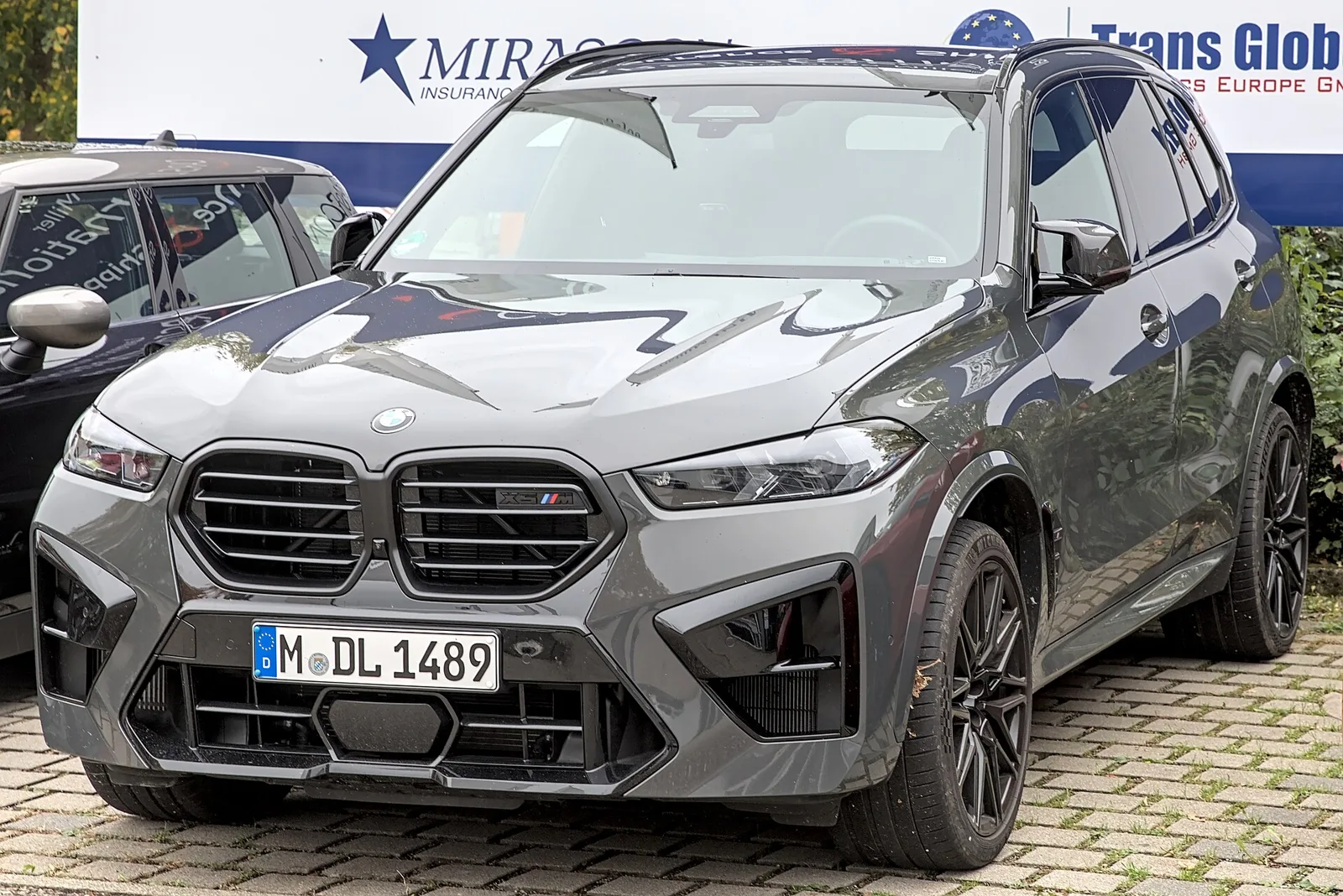
From the 1999 E53 that opened BMW's SUV chapter to the 2026 G65, the X5 has defined the brand's large crossover range.
The BMW X5 is BMW's luxury crossover, first sold in 1999 and now in its fifth generation. Its range spans petrol and diesel engines, M performance versions and plug-in hybrids. The G65 generation was unveiled in June 2026, continuing the Sports Activity Vehicle approach.
The BMW X5 is a mid-size luxury crossover that BMW launched in 1999 as its first sport utility vehicle. Across five generations it has grown into a family that includes performance M models and plug-in hybrids. This profile follows the car from the original E53 to the fifth generation unveiled in 2026.
Few nameplates have shaped a manufacturer's direction as clearly as this one. The X5 opened a new chapter for BMW, moved the brand into a segment it had not occupied before, and gave later models a template to follow.
When did the BMW X5 first go on sale?
The BMW X5 debuted in 1999 as the E53 and was BMW's first SUV. Early cars offered a manual or automatic gearbox, and the first generation ran until 2006. Its development followed BMW's acquisition of Land Rover, and that link shaped much of its engineering.
The first generation borrowed heavily from Land Rover. It shared hill descent control with the Range Rover L322, and its engines and electronic systems came from the BMW E39 5 Series. Engine capacities ran from 3.0 to 4.8 litres across petrol and diesel options.
For a maker that had built saloons and coupes for decades, the X5 was a significant change of direction. Buyers were asked to accept a tall, practical vehicle carrying a sporting badge, which was a bold proposition at the time.
The X5 began as BMW's first SUV and became the template for an entire Sports Activity Vehicle family.
Why the X5 mattered for SUV design
BMW officially marketed the X5 as a Sports Activity Vehicle, a name that put the emphasis on sporting character rather than utility. The car also signalled a shift away from body-on-frame construction. Mercedes-Benz had introduced the M-Class more than a year earlier, but that model kept body-on-frame construction until its second generation.
That made the X5 the first of the two to use a monocoque chassis, a choice that shaped both its ride and its interior packaging. The idea then spread. The SAV series began with the X3 in 2003 and continued with the X6 in 2008, which shares its platform with the X5.
The result was a family of cars that could be sold on the strength of one shared engineering idea. Each new derivative borrowed credibility from the car that came before it, which helped BMW build a large SUV line-up without starting from zero each time.
How did the second generation change the X5?
The E70 arrived in July 2006 for the 2007 model year. It brought iDrive as standard across the range and an optional third row that seated seven passengers. Its xDrive all-wheel drive was paired with an automatic gearbox, and a 2011 facelift, known as the LCI, followed.
Trim names were tidied up after 2008. The 3.0si became the xDrive30i, and the 4.8i was renamed the xDrive48i. In 2010 BMW also swapped the CCC DVD system for a CIC hard drive, which gave owners a newer infotainment platform.
The 2009 diesel xDrive35d reached Canada and the United States, widening the choice beyond petrol engines. By the 2011 model year the X5 had become BMW's 3rd best-selling model, which confirmed that the family had found a large audience.
What was the X5 M and how did it begin?
The X5 M was unveiled at the New York Auto Show in April 2009 as the high-performance variant of the X5. It introduced BMW's first turbocharged M Power V8, and it shared its drivetrain with the X6 M. The E70 X5 M produced 555 bhp (414 kW) and 500 lb-ft (680 N m) of torque.
The M variant then passed through two more generations. The F85 X5 M ran from 2014 to 2018, and the F95 X5 M from 2019 to 2026. The E70 X5 M itself ran from 2009 to 2013, so the M badge followed the X5 through three generations.
Because the X5 M drivetrain was shared with the X6 M, the two performance models were closely related. That shared hardware meant BMW could develop one powertrain for two very different bodies, which kept development costs in check.
Which engines did the third generation offer?
The F15 third generation was unveiled in 2013 and offered a petrol V8 alongside several inline-six diesels. The launch range included the xDrive50i with 450 bhp, the xDrive30d with 258 bhp and the M50d Performance with 380 bhp. The plug-in xDrive40e joined later with a 9kWh 351V battery.
The xDrive40e's electric motor peaked at 83 kW, with a continuous output of 55 kW. That made the plug-in a distinct model within the range rather than a simple badge change on an existing car.
Taken together, the petrol, diesel and hybrid options gave buyers a wide choice within one body style. Each option answered a different set of needs, from straight-line performance to lower running costs.
Plug-in hybrids and the move toward electrification
The plug-in models show how the X5 kept pace with changing expectations. A hybrid system lets an owner cover short distances on battery power and still rely on the petrol engine for longer journeys, which suits both urban commuting and touring.
The xDrive40e in the third generation and the xDrive45e in the fourth generation reflect that approach. The later car carries a far larger battery, at 24 kWh against the earlier 9kWh pack, so it offers more electric range potential for everyday use.
Hybrid hardware also changed the feel of the car. Owners moved between electric and combustion power without a change of body or interior, which made the transition easier for buyers who were still deciding how far to go with electrification.
The fourth generation G05 and the G18 variant
The G05 fourth generation was unveiled online on 6 June 2018 and sits on BMW's CLAR chassis. All 2019 model year X5s came with xDrive as standard. An sDrive variant with rear-wheel drive joined the US line-up for 2020.
The sDrive40i was powered by BMW's inline-six B58 petrol engine. The xDrive45e plug-in hybrid that arrived for the 2020 model year paired a petrol engine with an 82 kW (110 hp) electric motor and a 24 kWh battery, for a combined output of 290 kW (389 hp).
The G18 is a longer-wheelbase version of the G05, with a wheelbase 13 cm longer than the standard X5. It was assembled at BMW Plant Shenyang, which set it apart from the North American production of the regular car and suited buyers who wanted extra room.
What does the fifth generation bring?
The fifth generation G65 was unveiled online on 30 June 2026 and continues on the CLAR chassis used by the G05. It is the newest step in a line that began with the E53 in 1999, and it keeps the crossover formula that the first car established.
Sharing the G05's chassis family points to continuity in packaging and underpinnings rather than a radical rethink. For owners of earlier cars, that continuity makes it easier to compare generations side by side.
The high-performance line followed its own timetable. The F95 X5 M covered 2019 to 2026, so the M cars closed their run in the same year the fifth generation arrived, leaving buyers to weigh the new base model against the outgoing performance versions.
What are the BMW X5 specifications?
The table lists the figures that matter most, from the 1999 debut through the 2026 fifth generation. Each row names the variant it describes, so the plug-in hybrid numbers stay separate from the petrol and diesel figures, which makes quick comparison easier.
| Specification | Detail |
|---|---|
| Debut | 1999, E53 first generation |
| Early engines | 3.0 to 4.8 litres, petrol and diesel |
| F15 petrol V8 | xDrive50i, 450 bhp |
| F15 diesels | xDrive30d 258 bhp; M50d Performance 380 bhp |
| X5 M (E70) | 555 bhp (414 kW); 500 lb-ft (680 N m) |
| xDrive40e plug-in | 9kWh 351V battery; motor peak 83 kW, continuous 55 kW |
| xDrive45e plug-in | 24 kWh battery; 82 kW (110 hp) motor; 290 kW (389 hp) combined |
| Chassis | CLAR for G05 and G65 |
| Current generation | G65, unveiled online 30 June 2026 |
| Main plant | BMW Group Plant Spartanburg, North America |
Read across the table and the pattern is clear: the early engines were conventional, the F15 added hybrid options, and the fourth generation made plug-in power a standard part of the range rather than a special case.
Where is the BMW X5 built?
Most X5s are built at BMW Group Plant Spartanburg in North America. Assembly also took place in Russia through Avtotor until February 2022, and in India, Indonesia, Malaysia and Thailand. Armoured security versions are built at the BMW de Mexico Toluca plant.
Plant choice reflects the car's global market. Armoured versions are built at a separate facility in Mexico, which keeps security specification work apart from the main assembly line and lets the core plant focus on volume production.
Over the years the car has been assembled in several countries beyond its main home. That spread shows how the X5 was designed to serve many regional markets from a common set of parts and a shared engineering base.
Awards and limited editions
In January 2021, What Car? named the xDrive45e M Sport its Luxury SUV of the Year. The magazine awarded the X5 five stars out of five in its review, a result that underlined the model's standing in the class.
BMW also released limited editions. The X5 M Competition First Edition and the X5 Black Vermilion gave enthusiasts more distinctive options within the range, and they remain among the more collectable versions of the car.
Awards are a snapshot of a particular moment, but a five-star review and a class title suggest that the car's qualities were recognised by a demanding audience of reviewers and buyers alike.
How did the X5 shape BMW's SUV line-up?
The X5 set the pattern for the rest of BMW's sport activity range. Its sporting styling, its monocoque construction and its range of engines became a template that later models could follow, which made the family easier to build and sell.
Each later derivative kept the same logic: a recognisable silhouette, a range of engines from petrol to diesel and hybrid, and an M performance option at the top. Buyers who liked one model could move to another without learning a new approach to the brand.
That consistency also helped BMW manage the family across generations. A shared underlying idea meant that a change in one generation did not require rewriting the whole SUV strategy from scratch.
Frequently asked questions
Did the X5 sell well for BMW?
It did. For the 2011 model year the X5 ranked as BMW's 3rd best-selling model, placing it behind two other cars in the company's line-up at that time.
Which X5 M generations were there?
Three generations carried the M name: the E70, F85 and F95. Their production windows ran from 2009 to 2013, from 2014 to 2018, and from 2019 to 2026.
What award did the X5 win in 2021?
A UK magazine, What Car?, gave its Luxury SUV of the Year title to the xDrive45e M Sport version in January 2021.
Are there limited-edition X5 models?
Two special variants were highlighted in the lineup, one built on the M performance car and one in a striking paint finish. Neither replaced a regular trim.
_1X7A0891.jpg)