A Seoul garage fire, a UN working group and the physics of heat feeding on itself explain why a rare event is taken so seriously.
Thermal runaway is a self-reinforcing rise in temperature, and lithium-ion packs can suffer it when poorly made or damaged. EV fires are significantly less frequent per vehicle than fires in petrol cars, but regulators including NHTSA and an international working group treat thermal propagation as the main issue.
In December 2024 an international vehicle-safety working group heard about an August fire in an underground garage in Seoul, involving a single electric vehicle, that injured 20 people and damaged 900 vehicles. Yet electric cars catch fire less often than petrol and diesel ones, per vehicle.
What is thermal runaway?
Thermal runaway is a process in which a rise in temperature releases energy that raises the temperature further. It is a form of uncontrolled positive feedback, and it often ends destructively. Chemical engineers meet it as a reaction that accelerates when heated, and electrical engineers meet it as rising current and power dissipation in a component.
Think of a snowball rolling downhill: each turn adds snow, which adds weight, which adds speed. Heat works the same way in runaway. Once the loop closes, nothing in the system stops it unless something outside steps in.
Chemical engineering offers a clean lesson about scale. The amount of reaction in a vessel grows with the cube of its size, while the surface that can shed the heat grows only with the square. A reaction that cools easily in a laboratory flask can therefore overheat dangerously at the scale of a ton. In chemical plants, runaway is most often traced to failure of a cooling system, and it is guarded against by controlling how fast ingredients are added.
Electronics fight the same loop. When a component gets hotter and its resistance falls, current can rise and heat it further, which can end in a spectacular failure such as an electrical explosion or fire. Well-designed systems add current limiting in the form of thermal fuses, circuit breakers and PTC current limiters.
Electric cars catch fire less often than petrol cars per vehicle, but a pack that does is hard to ignore.
What makes a lithium-ion battery able to catch fire?
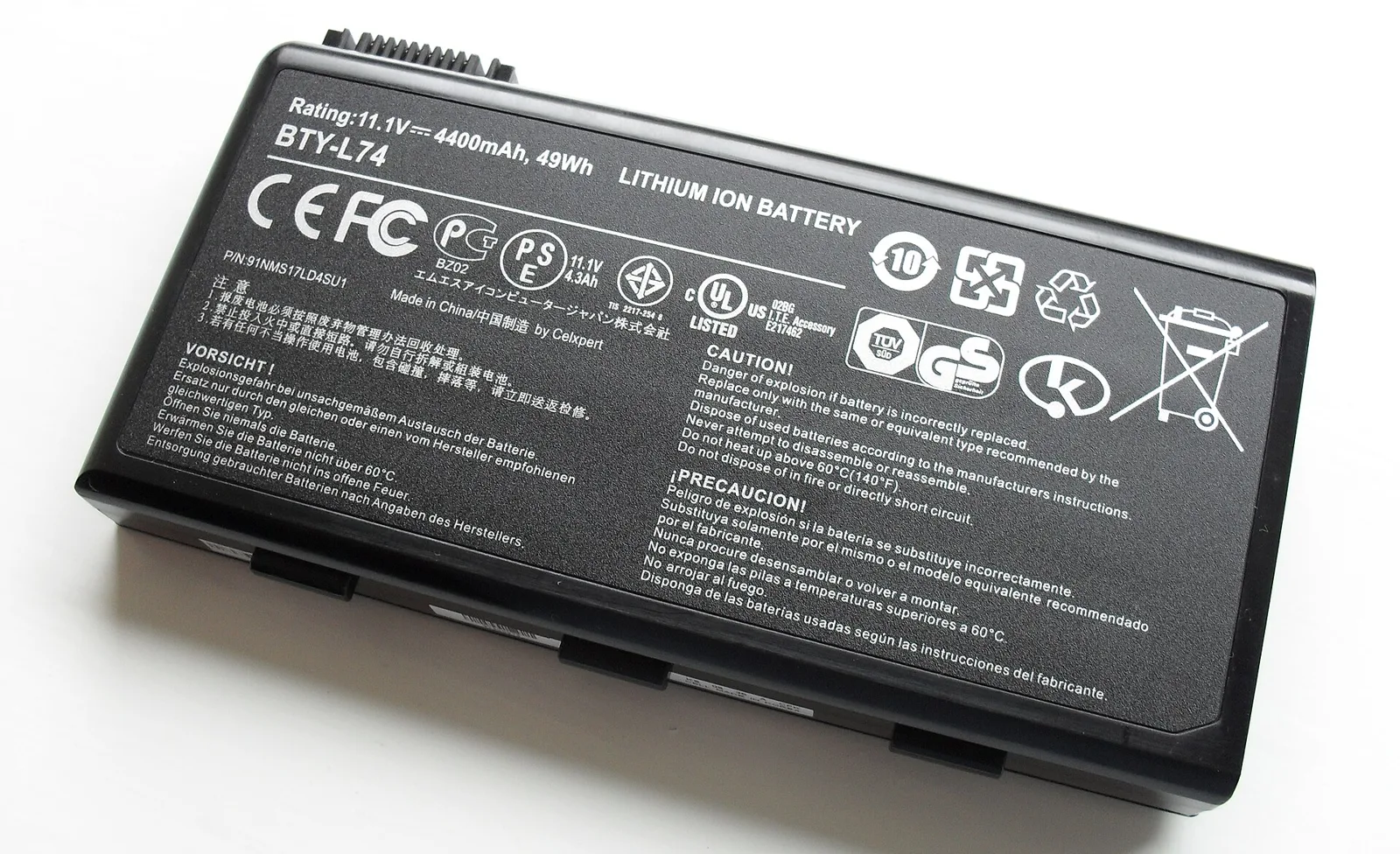
Lithium-ion cells contain flammable electrolytes, so they can be a fire or explosion hazard. An electric car's traction battery also holds a large amount of energy, and lithium-ion chemistry can be susceptible to thermal runaway, especially when the battery is poorly made or damaged. Overcharging beyond the design voltage can lead to an explosion.
A lithium-ion cell stores energy by moving lithium ions between a graphite negative electrode and a positive electrode of lithium cobalt oxide, lithium iron phosphate or a nickel manganese cobalt blend, through an electrolyte of lithium hexafluorophosphate in organic carbonates. Silicon is often mixed into the graphite to raise capacity. A cell of this kind typically sits at a nominal 3.6 or 3.7 V.
Stored energy is the other half of the equation. Lithium itself carries about 11.6 kWh per kilogram, a touch above the heat released by burning gasoline, although whole lithium-ion batteries remain much heavier per unit of energy because of the other materials in them. The US regulator NHTSA noted in its 2017 study that, as with other high-energy storage technologies, a failure may release a substantial amount of energy.
Charging has hard limits. Failing to respect current and voltage limits leads to excessive heating of the cell. Charging temperature limits are stricter than operating limits, and while the chemistry tolerates warmth, prolonged exposure to heat reduces battery life. The accepted window for fast charging is 5 to 45 degrees C (41 to 113 degrees F); between 0 and 5 degrees C the current should be cut. Beyond the voltage limits, a lithium cobalt oxide cell can suffer irreversible damage: overdischarging can produce lithium oxide, and overcharging up to 5.2 volts produces cobalt (IV) oxide.
Are electric cars more likely to catch fire than petrol cars?
Per vehicle, electric cars catch fire significantly less often than cars with internal combustion engines. The number of plug-in vehicle fires has risen alongside production and adoption. Fires reported since at least 2010 cover cars, buses, boats and other electric vehicles.
Reports of thermal events are not spread evenly across models. The Hyundai Kona and various Tesla vehicles are among the most prevalent.
The Seoul garage fire shows how large the consequences can be even when frequency is low. It involved one electric vehicle, it injured 20 people and damaged 900 vehicles, and Korea is now considering tighter testing requirements and certification procedures.
What have US regulators found about EV battery fires?
The National Highway Traffic Safety Administration has looked at the issue repeatedly. In 2013 it examined 13,108 Model S cars after two highway fires involving undercarriage strikes and closed the case, finding no defect trend, after Tesla revised the ride height and added underbody protection. In 2020 it refused a request for a defect investigation into Model S and X cars built from 2012 to 2019.
Its 2017 study of lithium-ion vehicle safety was even-handed. The technology shows great promise for energy efficiency at modest cost but is at an early stage, and a battery failure can give off a great deal of energy. The study's conclusion was that safety can be managed effectively, but that substantial research and development, plus codes and standards, are still needed, since managing it takes insight into behaviour at the electrochemistry level.
NHTSA set up a Battery Safety Initiative for Electric Vehicles in 2021, to coordinate research and other activity on battery safety risks. In 2022, after Hurricane Ian, its executive director spoke about fire and reignition risks tied to a lithium-ion battery meeting seawater, and pointed to recent tests and studies. By December 2024 the agency was chairing the second phase of work on Global Technical Regulation No. 20, the electric vehicle safety rule, which looks at vibration resistance, water immersion and battery thermal runaway, among other things.
How do chargers keep a cell inside its limits?
The standard method for lithium-ion cells is constant current, then constant voltage. The charger first holds the current fixed while the voltage rises. Once the maximum charging voltage is reached it holds the voltage steady and lets the current fall away to a minimum threshold. A cell that starts too low is given only a very small current at first.
That slow start is called trickle charging, and it continues until the voltage reaches a safe level. Packs built from several cells in series are often top-balanced as well, so that no cell is left at a different level from its neighbours. All of these steps exist because the limits are sharp: heating from excess current, and the risk of explosion if a cell is pushed past the voltage it was designed for.
What is the international working group doing about thermal propagation?
In June 2011 a safety group at the global forum that harmonises vehicle regulations said it would convene an informal working group on electric vehicle safety. By December 2024 that group reported that thermal propagation remained the single most important issue in its second phase of work, based on field data.
In March 2016 the group agreed on a two-step plan. Phase 1 covered critical near-term safety requirements, and Phase 2 covers the remaining ones that need long-term research. Nine task forces were formed, led by China, the vehicle makers' association OICA, Japan, Korea and the United States.
| Task force | Led by | Topic |
|---|---|---|
| 1 | China | Protection against water |
| 2 | OICA | Low electricity energy option |
| 3 | OICA | Electrolyte leakage |
| 4 | OICA | Rechargeable energy storage systems in use |
| 5 | China | Thermal propagation |
| 6 | Japan | State of charge |
| 7 | Korea | Fire resistance |
| 8 | China | Bus and truck |
| 9 | United States | Warning system |
The December 2024 report described progress on several fronts. Chinese experts described revisions to national Thermal Propagation Test requirements, the European Commission's expert reported on a Special Interest Group seeking an amendment of UN R100, and the United States said it had issued a Notice of Proposed Rulemaking in April 2024, with a proposal that thermal propagation be thoroughly documented for every drive and park mode. The group saw a potential consensus on approaches to thermal events but agreed more work is needed.
How do firefighters and the public respond to an EV fire?
Responders are pointed to published training and guidance. The US Department of Energy hosts training material on electric vehicle safety for first and second responders, NHTSA has issued interim safety guidance for the public and for law enforcement, medical services and fire departments, and the National Fire Protection Association has written emergency response guides for the Chevrolet Volt and for Tesla vehicles.
One hazard singled out by NHTSA is water. Its executive director raised the risk of fire and reignition linked with contact between a lithium-ion battery and seawater, in remarks after Hurricane Ian in 2022. The working group's Task Force 1, led by China, deals with protection against water.
Where are electric vehicles and e-bikes restricted?
Some venues have acted on their own. Many buildings in New York City ban e-bikes because of the fire hazard, and the Transport for London network bans e-scooters and e-unicycles. On Ko Samui, Raja Ferry Port banned electric vehicles from its ferries from 18 November 2024, saying overheating batteries could cause a fire.
Not everyone agrees on a ban. Seatran Ferry, another Ko Samui operator, does not fully exclude electric vehicles, but it asks owners to sign a disclaimer in case an incident occurs.
How are lithium-ion batteries being made safer?
Progress has been made in developing and manufacturing safer lithium-ion batteries, and solid-state designs are being developed to remove the flammable electrolyte altogether. Some researchers have also looked at alternatives, among them lithium iron phosphate chemistries and non-lithium cells, including sodium-ion and iron-air designs.
Chemistry has changed fast since the first cells went on sale in 1991. Whittingham's first rechargeable lithium battery had safety problems and never reached the market. Goodenough introduced lithium cobalt oxide in 1980, Yoshino's carbon-based anode followed in 1985, and the three won the 2019 Nobel Prize in Chemistry. Since 1991 the volumetric energy density has tripled and cost has fallen tenfold.
Chemistry choices vary. NMC is widely used in transport and NCA is a high-energy chemistry common in electric vehicle batteries, while lithium iron phosphate and lithium manganese oxide are pitched at longer life and a higher discharge rate. Environmental concerns over water-intensive lithium mining and cobalt, which can be a conflict mineral, have encouraged some researchers to look for alternatives.
Where this goes next
The next steps are mostly regulatory. NHTSA said in December 2024 that it would continue its battery safety work through the second phase of Global Technical Regulation No. 20, covering vibration resistance, water immersion and thermal runaway. According to the working group's report, the US proposed rulemaking on thermal propagation documentation should have been finalised by the end of 2024.
The working group planned to meet in person from 17 to 19 February 2025 in Torrance, California, with a tour of Honda's electric vehicle facility to follow. Korea is considering tighter testing and certification. And developers are working on solid-state cells meant to eliminate the flammable electrolyte.