One spent 26 years racing to crashes with a medical car and a set of demands. The other ran race weekends for three seasons until a single safety car call ended his tenure.
Sid Watkins was Formula One's Safety and Medical Delegate from 1978 to 2004, a neurosurgeon who led the on-track medical team. Michael Masi, an Australian official, was Formula One race director from 2019 until he was removed in February 2022 after the Abu Dhabi safety car restart.
Two men sat at opposite ends of Formula One's chain of responsibility, and each career turned on one weekend. For Sid Watkins it was Monza in 1978, where a wait of about 18 minutes for an ambulance convinced him the sport was unready for its own crashes. For Michael Masi it was Abu Dhabi in 2021, where a single decision about a safety car cost him the race director's chair.
Who was Sid Watkins, the F1 doctor everyone called Prof?
Eric Sidney Watkins, born in Liverpool on 6 September 1928, was an English neurosurgeon known as Professor Sid or simply Prof. From 1978 to 2004 he was the FIA's Formula One Safety and Medical Delegate, heading the on-track medical team and acting as first responder when a car went off. He held the post for 26 years.
His father Wallace had come to Liverpool from Gloucestershire, where he had been a coal miner, and built a small business mending bicycles before moving on to motor vehicles. Young Sid worked in that garage until he was 25. A scholarship took him to Prescot Grammar School, and when he said he wanted to be a doctor, his father disapproved.
He went to the University of Liverpool anyway and graduated as a Doctor of Medicine. There he researched heat stress, which found that rising temperature badly dented intellectual performance. It was an odd fit for a student, and it turned out to matter for people who spend hours in a hot cockpit.
He then spent four years in West Africa with the Royal Army Medical Corps. There he entered the only motorsport event he ever drove in, the 1955 West African Rally in a Ford Zephyr Zodiac, and retired after the first stage. In 1958 he returned to Britain to train in neurosurgery at Oxford's Radcliffe Infirmary.
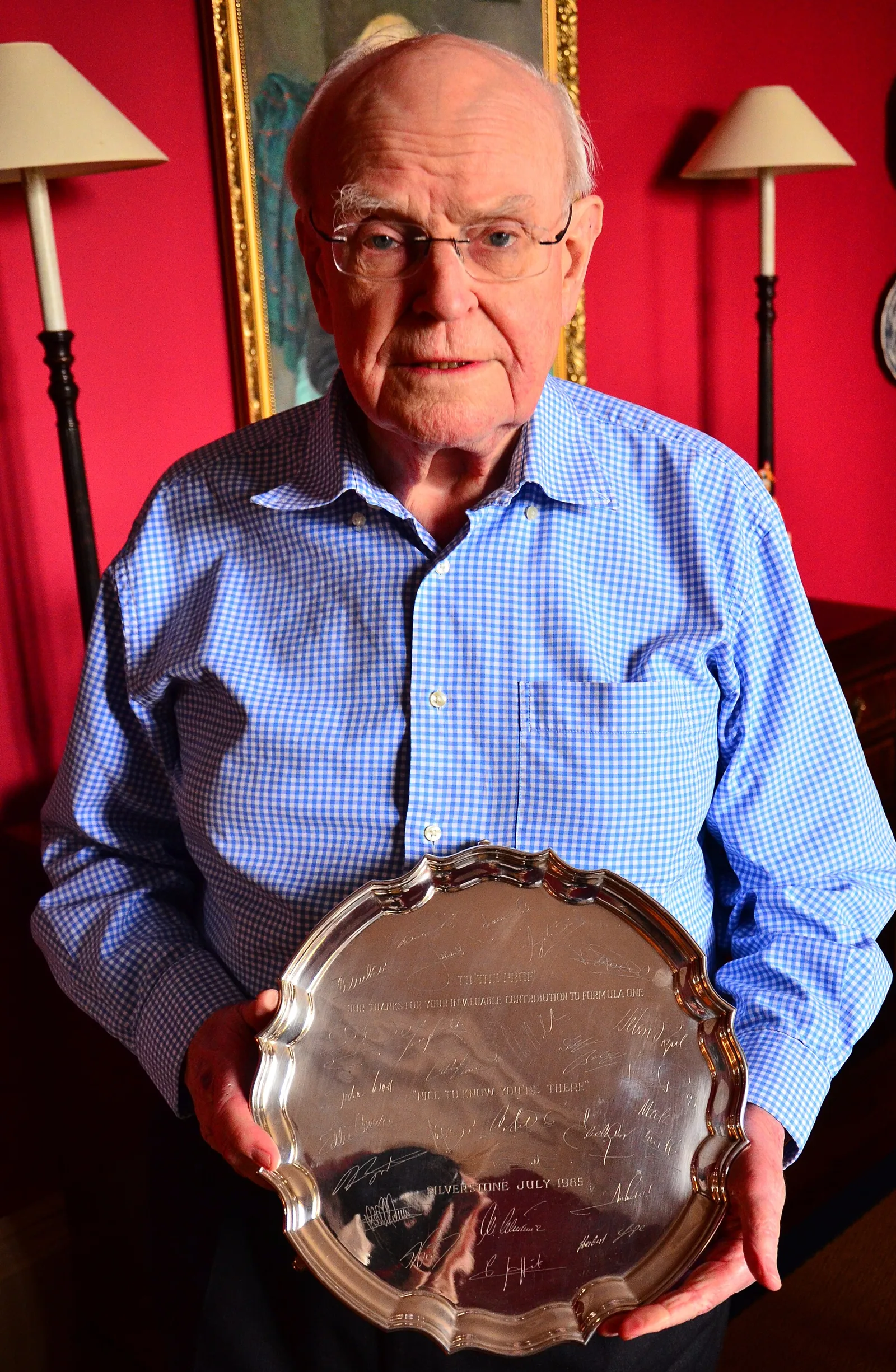
Nice to know you are there.
How does a neurosurgeon end up running Formula One medical cover?
By volunteering at weekends. In 1961 Watkins took his first medical job in motorsport at a kart meeting at Brands Hatch, and in his spare time he acted as race doctor at Silverstone. In 1962 a neurosurgery chair at New York's state university, based in Syracuse, took him across the Atlantic, where he looked after the Watkins Glen circuit and brought four colleagues and his own medical kit because the track provided so little.
He came home in 1970 to lead neurosurgery at the London Hospital, and in the same year the RAC asked him onto its medical panel. Then, in 1978, he met Bernie Ecclestone, then the man running the Formula One Constructors Association. Ecclestone, who had checked in as a patient with a medical problem, offered him the post of official Formula One race doctor at $35,000 for the whole season.
The terms were not generous. Watkins paid his own airfares, hotel bills, rental cars and every incidental cost, and he kept working as a neurosurgeon in London between races. His first race was the 1978 Swedish Grand Prix. He did not attend private test days, because there were far too many of them across a year.
Circuits did not welcome him. Some saw the appointment as a way of keeping watch on how they ran things, and at the time a track's medical facilities could amount to little more than a tent.
What changed after Ronnie Peterson's crash at Monza?
Almost everything about on-track medicine. On the opening lap of the 1978 Italian Grand Prix, Ronnie Peterson's car hit hard and burst into flames. It was Clay Regazzoni, Patrick Depailler and James Hunt who dragged him out, but when Watkins reached the scene Italian police had formed a cordon and held him back from treating the driver.
An ambulance took roughly 18 minutes to arrive. Peterson reached hospital and died the following day. After the race Watkins wanted proper safety gear, an anaesthetist, a car for doctors and a helicopter for evacuations, and Ecclestone had all of it in place by the following race, in the United States.
The arrangement that came out of that exchange is still familiar to anyone who has watched a standing start. The medical car carrying Watkins would follow the field for the opening lap, ready for a first-lap accident. When organisers at Hockenheim refused him access to race control, Ecclestone threatened to walk onto the grid and tell the drivers to climb out of their cars.
Which crashes defined Watkins's career?
In 1981 FISA, then motorsport's governing body, set up a Medical Commission and elected Watkins its president. A year later, at the 1982 Belgian Grand Prix, he rode in the medical car driven by Roland Bruynseraede to Gilles Villeneuve's accident and placed a tube in the driver's windpipe so he could be ventilated. Villeneuve was flown to the Gasthuisberg Hospital in Leuven. His wife Joann and Watkins together agreed to switch off his respirator, and he died.
The 1982 Canadian Grand Prix brought the first-lap crash that killed Riccardo Paletti. Watkins got to the car 16 seconds after impact and lifted the visor to find blown pupils. Then the ruptured fuel tank ignited. His clothing spared him serious burns, though his hands were affected, and after the fire was out he pulled off his gloves to place an airway, though his boots had melted.
Not every job involved a stretcher. In 1987 Nelson Piquet crashed in practice at San Marino, and Watkins declared him unfit to race. Only the second round of the season was at stake, and Piquet argued that lost points might cost him the title, which he went on to win. Watkins threatened to resign if he was overruled. The officials backed him, and Piquet later admitted the call had been right.
Watkins also looked after Frank Williams in 1986 after the team principal suffered spinal cord injuries in a road accident. At the 1985 British Grand Prix he received a silver trophy at the drivers briefing, inscribed with thanks and the line "Nice to know you're there".
What happened to Ayrton Senna at San Marino in 1994?
Watkins counted Senna among his close friends. The 1994 San Marino Grand Prix had already seen Rubens Barrichello hurt and Roland Ratzenberger killed, and Watkins was worried about Senna's state of mind. He suggested the two of them leave the circuit, go fishing and forget the race. Senna's car struck a retaining wall early in the race at close to 140 miles per hour, with Watkins the first doctor to arrive.
He judged that the head injury was so grave that nothing could have saved Senna. He recalled seeing Senna sigh and his whole body relax, and although he described himself as not religious, he felt that was the moment the driver's spirit left him.
Out of that weekend came a lasting structure. The FIA Expert Advisory Safety Committee was formed in 1994 with Watkins as chairman. In 2003 he set up research groups for rallying and karting, and in 2004 all three were merged into the FIA Institute for Motor Sport Safety, and Watkins led the new body as president.
Which drivers owed their lives to Watkins?
He is credited with helping to save Gerhard Berger, Martin Donnelly, Erik Comas, Rubens Barrichello, Karl Wendlinger and Mika Hakkinen. The Hakkinen case, at the 1995 Australian Grand Prix, shows how the system worked beyond one man. Hakkinen crashed in Friday qualifying at Brewery Bend after a tyre puncture and was knocked unconscious without hitting his head on the wall or the cockpit.
Volunteer doctors Jereme Cockings and Steve Lewis were beside him within 15 seconds and carried out an emergency tracheotomy. Watkins turned up last and let them carry on, and he restarted Hakkinen's heart twice.
He argued his corner on other matters too. When Barrichello and Max Papis tested positive for ephedrine after qualifying for the 1995 European Grand Prix, Watkins said the substance had no effect on driving ability and that Formula One should not simply use the International Olympic Committee's list.
Who was Michael Masi and what does an F1 race director do?
Michael Fausto Masi, born in Sydney on 8 June 1978, is an Australian motorsport official who was Formula One's race director between 2019 and 2021. A race director oversees the logistics of a race weekend and makes sure cars, circuits and drivers stay inside FIA regulations at every stage of the event.
Masi grew up in the Sydney suburbs of Fairfield and Canada Bay, attended Patrician Brothers' College and studied marketing at TAFE. Still at school, he began by helping out with Super Touring teams. Later he became a deputy race director in the Supercars championship and at Rally Australia.
In 2018 the FIA named him deputy race director for Formula 2 and Formula 3, and deputy to Formula One race director Charlie Whiting. He shared Grand Prix duty with Scot Elkins, who went on to become race director for Formula E and the DTM. When Whiting died before the 2019 Australian Grand Prix, Masi stepped into the top job.
What went wrong before Abu Dhabi?
Masi's decisions drew scrutiny from drivers, teams and the press almost from the start. In qualifying for the 2020 Turkish Grand Prix, cars were released onto the track while a crane was still there. In 2021 he had to defend the red flag procedures used in Azerbaijan.
At the 2021 Belgian Grand Prix critics said qualifying should not have gone ahead in such dangerous conditions, and that the race itself crawled for three laps behind the safety car, allegedly so points could be awarded. In Saudi Arabia he was criticised for negotiating with teams about changing positions. Then came the finale, just a week later.
What did the FIA find about the 2021 Abu Dhabi Grand Prix?
The way Masi handled the restart after a safety car period on the final lap, and its effect on the championship result, became the subject of intense debate. On 17 February 2022 he was removed as race director after an FIA investigation. Niels Wittich and Eduardo Freitas took over the job.
The FIA's official report arrived on 19 March 2022 and confirmed regulation infringements. It said the race director had called the safety car into the pit lane without it completing the additional lap that Article 48.12 of the Formula 1 Sporting Regulations requires. It also found that not every lapped car had unlapped itself. The FIA put the failings down to "human error".
| Question | Sid Watkins | Michael Masi |
|---|---|---|
| Role | Safety and Medical Delegate | Race director |
| Years in post | 1978 to 2004 (26 years) | 2019 to 2021 |
| Main job | Head of on-track medical team, first responder | Run the race weekend within FIA regulations |
| How he started | Offered the post by Bernie Ecclestone in 1978 | Deputy to Charlie Whiting, who died before the 2019 Australian Grand Prix |
| How it ended | Announced retirement on 20 January 2005 | Removed on 17 February 2022 |
| Successor | Gary Hartstein | Niels Wittich and Eduardo Freitas |
What did Watkins and Masi do after leaving their posts?
Watkins announced on 20 January 2005 that he was retiring from his FIA medical posts while keeping his leadership of the FIA's Institute for Motor Sport Safety. Max Mosley, the FIA's president, picked his longtime deputy Gary Hartstein to succeed him, and called Watkins's contribution to safety and medical standards in motorsport unique.
The honours stacked up. He was made an OBE in 2002 for his work on Grand Prix safety, and received an honorary doctorate from the University of Liverpool on 8 July 2004. In September 2005 supporters began a campaign to see him knighted. In July 2008 Martin Brundle presented him with the award for Most Outstanding Contribution to the Motorsport Industry at the House of Lords. In December 2011 he stepped down as Institute president and took an honorary role, and the next day, in Dubai, the FIA gave him its Academy Gold Medal for Motor Sport.
Since 1998 the Motorsport Safety Fund has organised an annual Watkins Lecture, held in Birmingham as part of Autosport International. Watkins gave the first and returned in 2007, and later speakers have included Max Mosley and Ross Brawn. He wrote or co-wrote several books on racing safety, among them Life at the Limit. He died in London on 12 September 2012, at King Edward VII's Hospital, with his family beside him.
Masi's story after 2022 runs on different lines. Abu Dhabi fed into Mohammed Ben Sulayem's campaign for the FIA presidency, which stressed modernising and restructuring how races are run. Ben Sulayem believed public trust needed restoring. Masi left the FIA in July 2022 to return to Australia and spend more time with his family, and in September he was appointed independent chair of the Supercars Commission in Australia.
He left that role in September 2025, and Karting Australia appointed him to its board of directors in December. The abuse and death threats that followed Abu Dhabi, along with the exhaustion of travelling between countries as race director, led Masi to seek help for his mental health. At the 2023 Australian Grand Prix he tried to arrange a meeting with Lewis Hamilton to explain his decisions. Hamilton turned the request down: "nothing to say", he said. In December 2025 Masi was named Event Director of the Repco NextGen NZ Championship, the series that includes the Formula Regional Oceania Trophy.