From the 1950 Consul-based Zephyr Six to the V6 Mark IV, Ford of Britain's executive car went through four marks and a family of Zodiac and Executive variants.
A British Ford executive car, the Zephyr ran from 1950 to 1972. It began as a six-cylinder Consul, went through four marks and was joined by the Zodiac and Executive before the Consul and Granada took over.
The Ford Zephyr was an executive car that Ford of Britain built from 1950 until 1972. Alongside the luxury Zodiac and Executive, it was the largest passenger car in the British Ford range for most of that time. It began life as a six-cylinder version of the Consul and went through four marks before the Consul and Granada replaced it.
What was the Ford Zephyr?
The Zephyr was Ford of Britain's executive car from 1950, and with the Zodiac and Executive it sat at the top of the British range. The four-cylinder version was originally called the Consul, but from 1962 both four- and six-cylinder cars carried the Zephyr name.
The Zephyr was replaced in 1972 by the Consul and Granada. Those cars were a genuine pan-European effort, in contrast to the Zephyr's British-led design.
The first mass-produced British car with MacPherson struts, and a family that ran for twenty-two years.
Where did the Zephyr name come from?
Ford never built the Zephyr in America, but the name turned up on several American cars. Lincoln introduced a Zephyr in 1936 as a smaller companion to its full-sized sedan, and Mercury later used the name for an upscale version of the Fairmont in the late 1970s.
Lincoln revived the Zephyr for a new model in 2006, and it was renamed the MKZ the following year. The British car's name, by contrast, belonged to a family of executive cars that Ford sold at home and in its export markets.
How did the Mark I Zephyr work?
The Mark I Consul and Zephyr were first shown at the 1950 Earls Court Motor Show. They were the first mass-produced British cars to use MacPherson strut independent front suspension, which later became common across the industry. Production of the Consul began on 1 January 1951, and the Mark I ran until 1956.
The Zephyr Six was a lengthened version of the four-cylinder Consul. Its 2,262 cc six-cylinder produced 68 bhp (51 kW), and it had a three-speed gearbox with a column-mounted lever. The rear axle was a live unit on half-elliptical springs, a more conventional arrangement than the front suspension.
The car could reach just over 80 mph (130 km/h) and return 23 mpg. Saloons, estates and two-door convertibles were offered. The convertible was built by Carbodies with a power-operated hood, while the estate was produced by Abbotts of Farnham and sold as the Farnham.
The Zodiac Mark I arrived at the London Motor Show in autumn 1953. It had two-tone paint, leather trim and a higher compression ratio of 7.5:1 instead of 6.8:1, which lifted output to 71 bhp (53 kW). Few convertibles, if any, were made in the Zodiac guise, though a handful of estates were built.
What changed with the Mark II in 1956?
In 1956 the Consul, Zephyr and Zodiac were all restyled as the Mark II, a range sometimes called the Three Graces. The six-cylinder engine was enlarged to 2,553 cc and produced 86 bhp (64 kW), while the wheelbase grew by 3 inches (76 mm) to 107 inches (2,700 mm). The body width reached 69 inches (1,800 mm).
Two roof styles, Highline and Lowline, depended on the year of manufacture. The Lowline was 1.75 inches (44 mm) lower at the roof, and the Highline had a hemispherical instrument cluster where the Lowline had a rectangular panel. Raymond Mays built a complete engine conversion that pushed the car to 101 mph in an Autocar test in 1957.
A Borg Warner DG automatic was available from 1956, and overdrive was optional. Drum brakes were fitted at first, but front discs became optional in 1960 and standard from mid-1961. The Zodiac Mark II had more elaborate tail styling and a different grille, and it kept its two-tone paint and gold-plated badges.
How did the Zephyr sell in Australia and New Zealand?
In Australia the Mark II was built at Ford Australia's Geelong plant, in sedan, utility and station wagon forms. The Australian wagon differed from the British estate with a wind-up rear window and a straight C-pillar. Mark II production there continued until 1962, when the Mark III arrived in complete knock-down kits.
New Zealand assembled the Mark II from CKD kits and added the Zodiac to its range. Supplies were restricted by strict import licensing, so buyers often waited two to three years for a new big Ford. The local cars had four-speed manual gearboxes, which was unusual when rivals and Ford's own Falcon used three-speeds.
What was the Mark III like?
In April 1962 Ford replaced the Consul, Zephyr and Zodiac with a restyled Mark III. The Zephyr 4 kept the 1,703 cc four-cylinder from the Consul 375, and the Zephyr 6 used the 2,553 cc six. The four-speed gearbox had synchromesh on every ratio, and front disc brakes were standard.
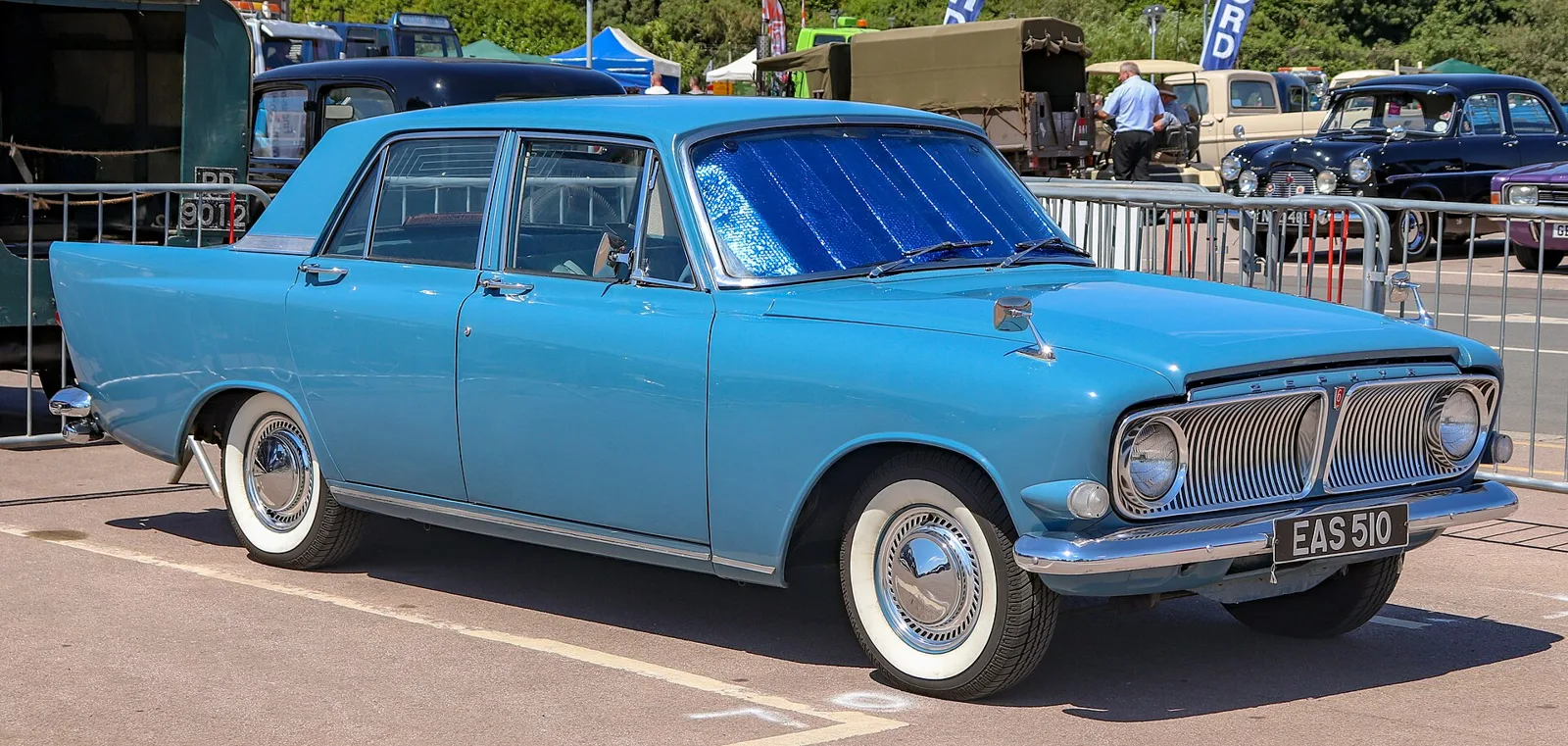
The Zephyr 6 had a full-width grille and a stronger body. Its exterior came from Canadian designer Roy Brown, who had also drawn the Edsel and the Cortina. The higher compression ratio added about 20 hp (15 kW) and a broader spread of torque.
The Zodiac Mark III was the upmarket car. It had four headlights, limousine-style rear doors, a sharper roofline and plusher interior fittings. Its six-cylinder engine was improved internally to 109 bhp, and a four-speed all-synchromesh gearbox with column change was fitted.
The Mark III became the most durable car in the family. It fixed the axle troubles of the Mark I and the gearbox weaknesses of the Mark II, and it sold at a rate equal to or better than its predecessor, both at home and overseas.
Why was the Mark IV a turning point?
The Mark IV was developed under the name Project Panda. Ford launched it in early 1966 with new V4 and V6 engines and a more sophisticated independent rear suspension. It was one of the first medium-priced cars to use rear disc brakes, and the design anticipated the later Consul and Granada.
Designer Harley Copp moved the spare wheel forward of the radiator at an angle, which freed up space for a larger cabin. The long bonnet was emphasised by square-cut wings, and the car's dimensions were broadly those of a large American car of the period.
Early Mark IVs drew criticism for their handling. Radial tyres became standard on the larger engine after complaints about rear-wheel slides in wet weather, and the steering ratio was lowered from 5.5 to 6.4 turns between locks. Even so, one reviewer found the nose-heavy handling called for a strong driver.
Ford cut Mark IV production in January 1967 after poor sales, and it was stressed that workers from the Zephyr and Zodiac lines would move onto Cortina production. The Mark IV had been on sale for less than a year when the cutback was announced.
An estate version of the Mark IV was announced for the October 1966 London show, though deliveries did not start until January 1967. Ford did not tool up for estate production at Dagenham, so the bodies were built at Farnham from part-finished saloons.
Which export versions did the Zephyr get?
In November 1966 the manufacturers announced an export version of the Mark IV that combined the Zodiac's 3.0-litre engine with the specification of the Zephyr. It was not offered in the UK, but Ford New Zealand adopted the 3.0-litre car, after complaints that the 2.5-litre V6 was underpowered for towing boats and caravans.
South African Zephyrs and Zodiacs received the 3.0-litre export engine from the 1968 model year. The South African Zephyr de luxe replaced the older Zephyr Super and gained a dummy grille like the European cars.
How did the Zephyr perform in motorsport?
Maurice Gatsonides took a Zephyr Six to victory on the 1953 Monte Carlo Rally, relegating a Jaguar Mark VII to second. The result gave the family car a rally reputation that it could not have earned on the road alone.
Two years later, Vic Preston Snr and D. P. Marwaha took a Zephyr Six to victory in the East African Safari Rally. These two results are the Zephyr's best-known competition successes, and they came early in the car's life.
How quick was the Zephyr on the road?
The Motor's 1951 test of a Zephyr Six recorded 79.8 mph and 20.2 seconds from 0 to 60 mph, with a fuel use of 23.7 miles per imperial gallon. The car cost 842 pounds with taxes, although the test car also had optional leather trim, a heater and a radio.
By 1962 the Mark III Zodiac had moved on considerably. That saloon, tested by The Motor, managed 100.7 mph and 13.4 seconds to 60 mph, and touring economy was 22.6 miles per imperial gallon. The Executive, tested by Autocar in 1967, reached 100 mph and took 13.1 seconds to 60 mph, but its overall fuel use was 17.2 miles per imperial gallon.
Why did the Zephyr end in 1972?
The Zephyr was the last car Ford of Britain designed independently. Closer ties with Ford-Werke of Cologne had already started through the Transit and the Escort, and the Consul and Granada that followed were built as pan-European cars.
The Mark IV had been rushed into production, and its durability suffered as a result. The Mark III had been the most reliable car in the range, which made the Mark IV's problems stand out more sharply.
What are the Ford Zephyr specifications?
The table gathers the principal figures for each mark. Where a figure belongs to the Zodiac or Executive rather than the Zephyr, the row says so, and the rows for the Mark IV keep the V4 and V6 engines separate.
| Mark | Years | Engine | Output |
|---|---|---|---|
| Mark I (Zephyr Six) | 1950 to 1956 | 2,262 cc six-cylinder | 68 bhp (51 kW) |
| Mark I (Zodiac) | 1953 onward | Six-cylinder at 7.5:1 compression | 71 bhp (53 kW) |
| Mark II | 1956 to 1962 | 2,553 cc six-cylinder | 86 bhp (64 kW) |
| Mark III (Zephyr 4) | 1962 to 1966 | 1,703 cc four-cylinder | From the Consul 375 |
| Mark III (Zodiac) | 1962 to 1966 | 2,553 cc six-cylinder | 109 bhp |
| Mark IV (Zephyr) | 1966 to 1972 | 2,495 cc V6 and 1,996 cc V4 | V6 standard on the larger car |
| Mark IV (Zodiac and Executive) | 1966 to 1972 | 2,994 cc V6 | 140 bhp net |
| Mark II wheelbase | 1956 onward | Six-cylinder cars | 107 inches (2,700 mm) |
| Mark II width | 1956 onward | Six-cylinder cars | 69 inches (1,800 mm) |
Frequently asked questions
What engine did the first Zephyr use?
The Zephyr Six had a 2,262 cc six-cylinder making 68 bhp. The Mark II enlarged it to 2,553 cc and 86 bhp, before the Mark IV moved to V4 and V6 units.
Was the Zephyr sold as a convertible?
Yes. A two-door convertible with a power-operated hood was offered in the Mark I and Mark II years. Few survive, because convertibles of the period had structural weaknesses.
Which car replaced the Zephyr?
The Consul and Granada arrived in 1972 as the replacements. They used V-type engines and independent rear suspension, and they were built as pan-European cars.
Did the Zephyr ever win a major rally?
Yes, twice early on. Gatsonides took the 1953 Monte Carlo Rally, and in 1955 Preston and Marwaha won the East African event.