Four platform generations since 1965, a name that became shorthand for vans, and an electric version that arrived in 2022.
The Ford Transit is a family of light commercial vans first built by Ford in 1965. It spans cargo vans, passenger vans, minibuses and chassis cabs across four platform generations, and it passed 8 million sales by 2015. Its name became shorthand for a van in its size bracket in parts of Europe.
The Ford Transit is a van family that Ford has built since 1965, reaching 8 million sales by 2015. It has gone through four platform generations, covering cargo vans, passenger vans, minibuses, chassis cabs and pickups, and it ranks as the third best-selling van of all time.
Where did the Transit name come from?
The first Transit-badged Ford was the FK 1000 van that Ford's Cologne plant introduced in 1953. It carried 1,000 kg and used a 1.2-litre sidevalve engine from the contemporary Taunus car. Engine capacity grew to 1.5 litres in 1955, and from 1961 the van was sold as the Ford Taunus Transit until 1965.
Ford Germany resumed production in Cologne on 9 May 1945, but restrictions on civilian output meant trucks came first, until 1948. Light commercial production began in late 1948 with 148 half-ton delivery vehicles, and the FK series launched in 1951 took its name from the Cologne plant.
Eight million vans, four platforms, and a name that became shorthand for any van in its size class.
Why did Ford merge its British and German vans?
Ford of Britain and Ford-Werke were competing in the same continental markets after 1957, when the Thames 400E sat alongside the German FK1000. Detroit wanted one vehicle for Europe, so the Redcap project began in 1963 and the Transit launched in 1965 on a single platform. Ford of Europe followed in 1967 with its headquarters in Cologne.
The Transit was designed to replace the Thames 400E, a narrow forward-control van that struggled against Bedford CA and other rivals. Ford chose a front-engined layout, and most of its mechanical parts came from the company's car range.
What made the first Transit different?
The 1965 Transit departed from European commercial vehicle norms with American-inspired styling and a broad track. Its wide track gave it a large carrying advantage, and it came as panel vans, pick-ups, minibuses and crew-cabs built on the same basic chassis.
The front beam axle replaced the independent front suspension of the British predecessor, and some observers saw that as a step back. Drivers valued the removal of the cabin heat, noise and smell that came with placing the driver above the engine in forward-control vans like the Thames 400E.
Why did the first generation last so long?
The 1965 van stayed largely unaltered for 12 years, with one minor facelift for the 1971 model year that updated the front end of V4 models and added a padded dashboard. The major update came in 1977, and the platform was not replaced until 1986, so production ran for over 20 years.
Production began at Langley in Berkshire, a former Second World War aircraft factory that built Hawker Hurricanes, before moving to Southampton. Genk in Belgium and Amsterdam also built Transits, and the Amsterdam plant closed in December 1981 after the Transcontinental built there sold only 8,000 units in six years.
Which engines powered early Transits?
UK vans used Essex V4 petrol engines of 1.7 L and 2.0 L, and a 43 bhp Perkins diesel that needed a longer bonnet, nicknamed the pig snout. Ford replaced the Perkins with its own York diesel in 1972, and the 3.0 L Essex V6 powered police and ambulance versions.
Mainland European vans used Taunus V4 engines in 1.3, 1.5 and 1.7 litre sizes, or a 2.0-litre Essex unit. Australia added an in-line six derived from the Falcon in 1973.
In 1972 the Metropolitan Police said Transits featured in 95 per cent of bank raids, pointing to the 1.75 tonnes of loot they could carry, and called the van Britain's most wanted.
What did the 1977 facelift change?
The Transit Mark II, unveiled in August 1977, gained a longer nose that could take an in-line engine, so the Pinto unit from the Cortina became the main powerplant. Its front styling moved into line with Ford's car range, with square headlamps and a black louvred grille.
The Mark II offered five engine choices, including a 2.4-litre diesel, and six body styles in short and long wheelbases of 2690 mm and 3000 mm. Ford's customisation plan allowed 32 door combinations, six axle ratios and seating from 12 to 17 passengers.
The Transit Clubmobil followed in 1981 as a Hymer camper conversion for mainland Europe, and about 150 were built. In 1982 a four-wheel-drive SIRA-Ford Transit was developed in Germany with Sinpar transfer case parts.
How did the second and third generations differ?
The 1986 VE6 platform brought a one-box bodyshell and fully independent front suspension on short-wheelbase vans. The 1994 facelift added a new nose and dashboard, with airbags and electric windows offered as options, and a 2.0 L DOHC engine taken from the Scorpio.
The third generation followed in July 2000 with front-wheel or rear-wheel drive, the first Transit offered in both layouts. Its styling borrowed New Edge cues from Ford's car range, and it won the International Van of the Year 2001 award.
In 1989 the Essex V6 gave way to the Cologne 2.9 EFI V6 because of emissions rules. Production moved to Ford-Otosan in Kocaeli, Turkey, in 2002, which ended the Genk line. In 2005 Top Gear's Sabine Schmitz pushed a rear-drive van around the Nurburgring, and her fastest lap of 10m 8s was just short of the under ten minutes she was chasing.
What changed with the fourth generation?
The fourth generation arrived in January 2013 as a unibody vehicle built with boron steel, replacing the separate-frame E-Series in North America. It used MacPherson struts at the front and a leaf-sprung live rear axle, and Ford sold it worldwide for the first time.
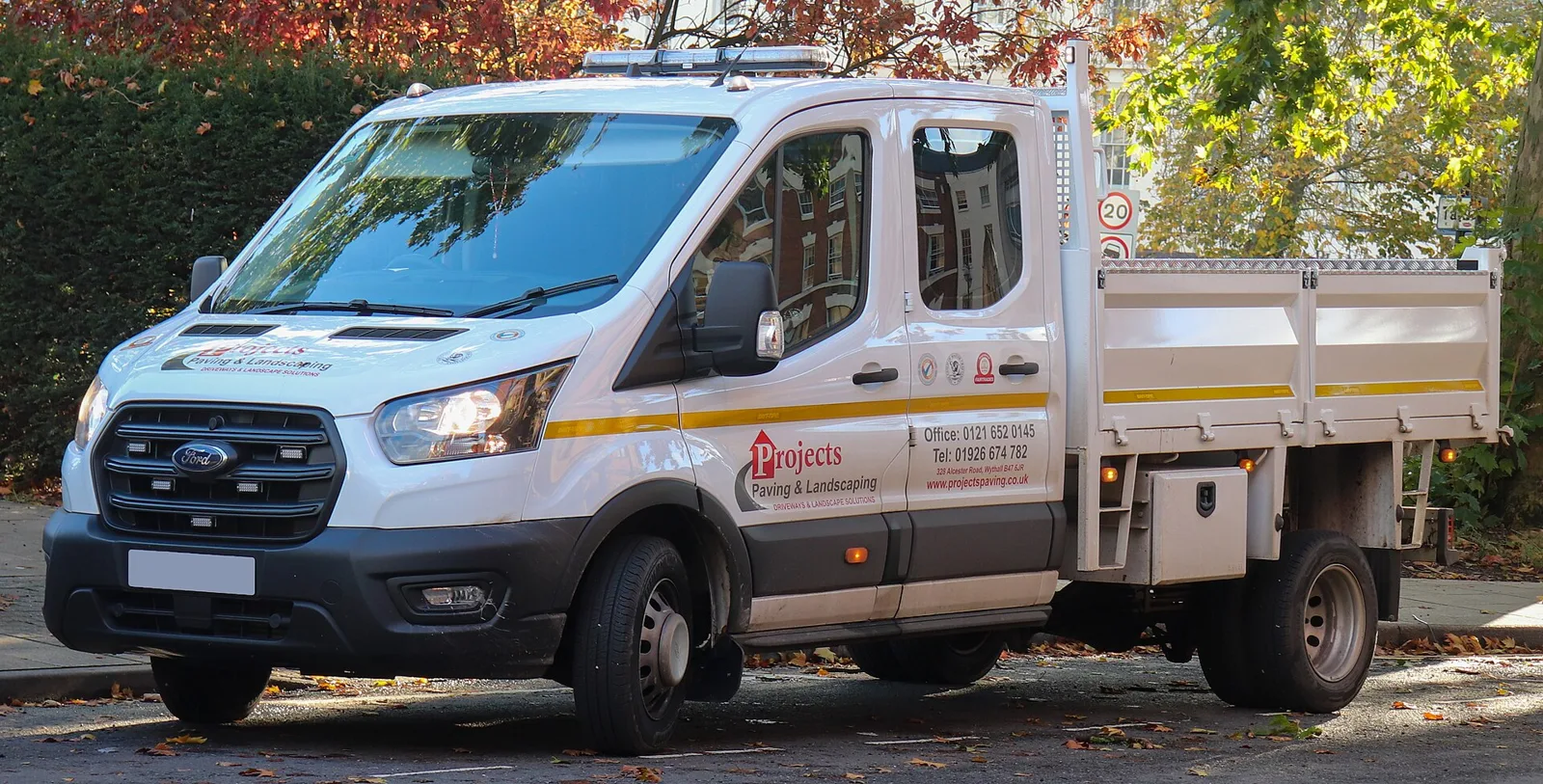
Vans came in 129.9 in and 147.6 in wheelbases, while chassis cabs offered 138 in, 155.7 in and 178 in. Payload rose by up to 600 pounds over the E-Series, and Ford split the range into the Transit, Transit Custom and Transit Connect with Transit treated as a sub-brand.
Kansas City Assembly in Missouri began building Transits on 30 April 2014 for North America, while Ford-Otosan in Kocaeli supplied Europe and Asia.
What engines do fourth-generation Transits use?
Diesels carried over from the previous generation, with a 2.0 L inline-four added for China and a 3.2 L inline-five for markets outside South America. In North America the standard engine was a 275 hp V6, with a 310 hp 3.5 L twin-turbo EcoBoost V6 as the option.
A 2020 update replaced the four Duratorq diesels outside the Americas with a single 2.0 L EcoBlue inline-four, offered in 105, 130, 170 and 185 PS, with a mild-hybrid version at 130 PS. North American vans switched to a naturally aspirated 275 hp 3.5 L V6, and the 10-speed automatic arrived for 2020.
How did the E-Transit change the range?
The E-Transit is a battery-electric cargo van that Ford announced in November 2020 with a 68 kWh usable battery and up to 126 mi (203 km) of EPA range. Production started at Kansas City in November 2021, and European output began at Otosan in April 2022.
The battery comes from the Mustang Mach-E, and the motor is shared with the F-150 Lightning, rated at 266 hp (198 kW) and 317 lb ft (430 N m). Its gross capacity is 77 kWh, DC charging reaches 115 kW, and Ford lifted usable capacity to 89 kWh in 2024.
Ford reported more than 10,000 orders from 300 commercial fleets before the first US deliveries in February 2022. Cargo capacity is 3,880 lb (1,760 kg), and What Car? named the E-Transit its Van of the Year in 2022.
What variants sit beside the cargo van?
Outside North America the passenger version carries the Tourneo name, which dates to the 1994 redesign. A smaller Tourneo Connect MPV arrived in 2002, and the fourth-generation passenger van became the Tourneo Custom, which gained a plug-in hybrid option from 2019.
Transit Custom is a mid-size van that replaced the front-wheel-drive Transit, while Transit Trail adds all-wheel drive, a 310 hp twin-turbo V6 and a Quaife locking differential with design cues borrowed from the F-150 Raptor.
County 4x4 conversions used a Dana 44F front axle and an NP208 transfer box taken from the Bronco, with the rear axle kept on a lift cradle. Utility companies and mountain rescue teams bought them, and drivetrain supply later passed to Countytrac.
The XXL stretch van marked the International Van of the Year 2007 award and is the priciest Transit built. The SuperSportVan was a one-off with a 3.2 L turbocharged I5 making 198 horsepower.
How did the Transit sell in China?
Jiangling Motors built a licensed Transit in Nanchang from 1997, derived from the second-generation VE6 platform. Ford started selling its own V347 and V348 Transit in China in 2008 as the New Transit, and the two makers sold a combined 210,000 vans across both generations.
The Chinese licensed line gave way to the JMC Teshun in May 2017. The fourth-generation Transit reached China in August 2023 as the Transit T8, and a battery-electric Transit City is planned for 2026 with Jiangling Motors.
How did the Transit's wheelbases and body lengths vary?
The Transit came in several wheelbase and roof combinations, which Ford used to tune payload and load volume for each job. Vans in the fourth generation offered two wheelbases and three roof heights, while chassis cabs had three wheelbases of their own.
In North America the range was graded by payload as 150, 250 and 350, a system borrowed from the F-Series and the earlier E-Series. Ford applied it to the Transit's wheelbase, body length and roof height.
Across the range, the model line also served as the basis for ambulances, buses and recreational vehicles, which made it an important platform beyond the cargo van.
How did the Transit reach markets beyond Europe?
By the end of the twentieth century the Transit was sold almost everywhere except North America, which it only entered in 2015 as the replacement for the E-Series. Its reach outside Europe came early, with assembly in South Africa between 1967 and 1974.
The South African Transit of that era was the last sold there until 2013, when a fully imported model arrived.
In South Korea, Hyundai used the Transit's chassis and a Perkins diesel for its HD1000 light commercial vehicle, which was built from 1977 to 1981 while the country's car industry was reorganised.
The UK market of the 1960s was dominated by the Bedford CA, and the Transit's broad track and larger load area were aimed at fleet buyers who had passed over the Thames.
How do the generations compare side by side?
Each generation brought a new platform, and the table lists the launch month and the change that set each one apart. Facelifts within a generation are left out, since they did not change the underlying platform.
| Generation | Launch | Defining change |
|---|---|---|
| First | October 1965 | Front-engined van with Essex V4 and Perkins diesel options |
| Second | January 1986 | VE6 one-box bodyshell with independent front suspension |
| Third | July 2000 | Front- or rear-wheel drive with Duratorq turbodiesel |
| Fourth | January 2013 | Unibody boron steel body with MacPherson struts |