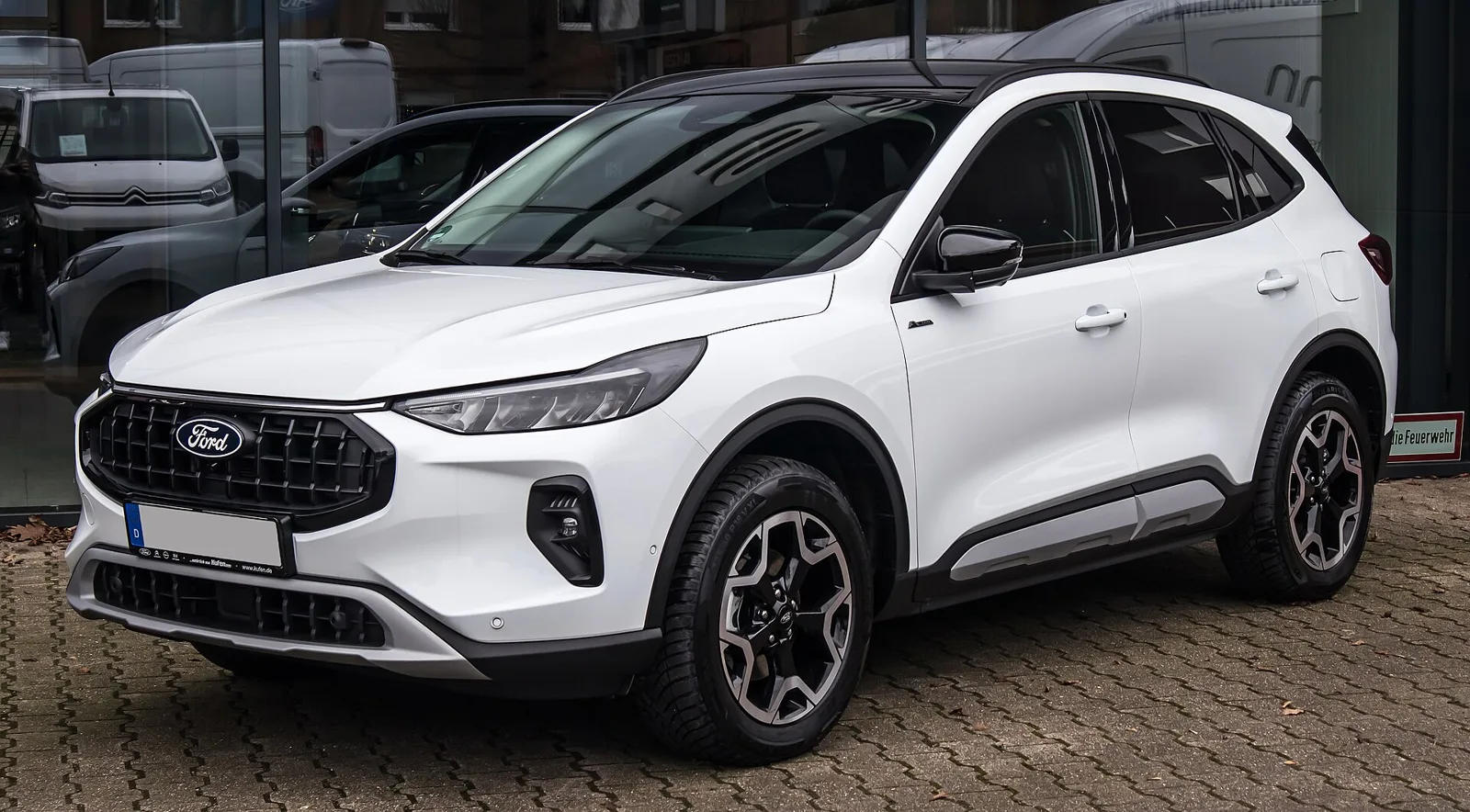
A compact crossover sold as the Escape in North America, with a 2019 third generation, a plug-in hybrid that led Europe, and a recall history in South Africa.
The Ford Kuga is a compact crossover built by Ford since 2008, now in its third generation. It was sold as the Escape in North America, used a C-segment platform shared with the Focus, and became Europe's best-selling plug-in hybrid from 2021 to 2023.
Ford's Kuga is a compact crossover that has been sold since 2008, mainly in Europe, and it is now in its third generation. Front-wheel drive and four-wheel drive have both been offered, and the same vehicle wears the Escape badge in North America and several other markets. It is built in more than one country and sold under different names around the world.
When did the Ford Kuga go on sale?
The first Kuga reached showrooms in the first half of 2008, after a debut at Frankfurt in September 2007. Ford built it at its Saarlouis plant in Germany on the C1 platform, which also underpinned the Focus and the C-Max.
In the UK, buyers could only choose the high-end Zetec and Titanium specifications, a decision that signalled the car's premium ambitions. Ford quoted a combined economy of 6.41 L/100 km (44.1 mpg-imp; 36.7 mpg-US) and CO2 output of 169 g/km for the launch cars.
The car's European positioning was clear from the start. It sat between the smaller Focus-based crossovers and the larger SUVs, giving Ford a mid-sized option for buyers who wanted higher seating without the bulk of a full-size vehicle.
A crossover that became Europe's plug-in hybrid leader, despite a difficult recall history in South Africa.
Where does the name Kuga come from?
The name may refer to the Mercury Cougar, which was sold outside the United States as the Ford Cougar between 1998 and 2002. In several South Slavic languages, though, kuga means plague, and that has made the name a difficult one in parts of the region.
Ford kept the name through the second and third generations, so the badge carried the same history across more than a decade of design changes, engine updates and market shifts.
Why was the Kuga sold as the Escape?
Ford first weighed a North American launch in 2007 but dropped the plan, as a competitively priced US car could not also turn a profit at that exchange rate. The idea was revived in 2008, and in June 2010 the company said that the second-generation Escape would stop in 2011, clearing the way for a Kuga-based successor.
The redesigned car became the basis of the 2013 Escape on sale across the US. The Escape name appeared in North America and in several American markets beyond it, while the Kuga kept its own name in Europe and elsewhere. The naming was a matter of local branding rather than of design.
Production in Argentina began in 2010, and the car reached Japan, South Africa and New Zealand in 2011. Australian buyers received it from March 2012, when the model became available in one of the company's largest export markets.
What engines did the first generation offer?
The first generation used a 2.5 L Duratec turbo five-cylinder petrol producing 200 PS (147 kW; 197 hp). Diesel buyers had a 2.0 L Duratorq rated at 136 PS (100 kW; 134 hp), and a 163 PS version of that diesel was reserved for AWD and powershift models.
Because the platform was shared with the Focus and C-Max, the Kuga sat within a family of cars using the same underpinnings. That kind of shared engineering let Ford spread development work across a wider European range rather than building each model from scratch.
The 2.5-litre five-cylinder was the performance option of the range, while the diesel offered the lower running costs that European fleet buyers tended to value.
What changed in the second generation?
Ford of Europe led the second-generation car under the One Ford policy, which meant designing only one model per segment for sale in every market worldwide. Cologne handled the body and the C1 platform, while Detroit supplied the upper body and interior.
The second generation grew out of the Vertrek concept, which took nine months to develop at Ford's Cologne design studio. Final assembly for European cars took place at the Ford Valencia plant in Spain, and Ford claimed 80% parts commonality with the Escape.
Powertrains came from Ford Dagenham. The range grew to include 1.5 L and 1.6 L EcoBoost petrol engines, a 2.0 L EcoBoost for AWD models and four diesel outputs of 140, 163, 150 and 180 PS.
The 1.6 L EcoBoost with 182 PS (134 kW; 180 hp) was offered in both two-wheel and four-wheel drive, while the 2.0 L EcoBoost with 242 PS (178 kW; 239 hp) was reserved for AWD models.
A facelift was revealed in July 2010 and released at the end of that year, which freshened the look of the car before its later changes arrived.
Why did the Kuga recall in South Africa?
From 2015 a number of 1.6 L EcoBoost Kugas caught fire in South Africa. Ford South Africa asked owners to bring their cars in for inspection in December 2016, and a recall was announced in January 2017 at a media briefing held with the National Consumer Commission.
By 16 January 2017 at least 46 vehicles had been destroyed by fire, and the company had confirmed 39 incidents. The count reached 50 by 18 January, with 13 of those incidents taking place in 2017 alone.
The affected group was 4,556 1.6 L EcoBoost models built between December 2012 and February 2014. Ford identified overheating from poor coolant circulation as the main cause, which could crack the cylinder head and lead to an oil leak and a fire in the engine bay.
The regulator had used its authority to order the recall on safety grounds, and Ford South Africa then confirmed that it would carry one out. Three safety recalls followed between January 2017 and January 2018.
The National Consumer Commission later imposed a R35 million fine on the Ford Motor Company of Southern Africa, which came on top of compensation already paid to owners.
Did the problem reach New Zealand?
A 2013 Titanium burst into flames in New Zealand in December 2016, and Ford New Zealand opened an investigation into the incident. Ford said the South African cars dated from 2012 to 2014 and carried the 1.6 L EcoBoost engine, but that the models sold in the two countries were not identical.
Until that inquiry closed, no call could be made on recalling the around 1,300 units of that model sold in New Zealand.
What changed with the third generation?
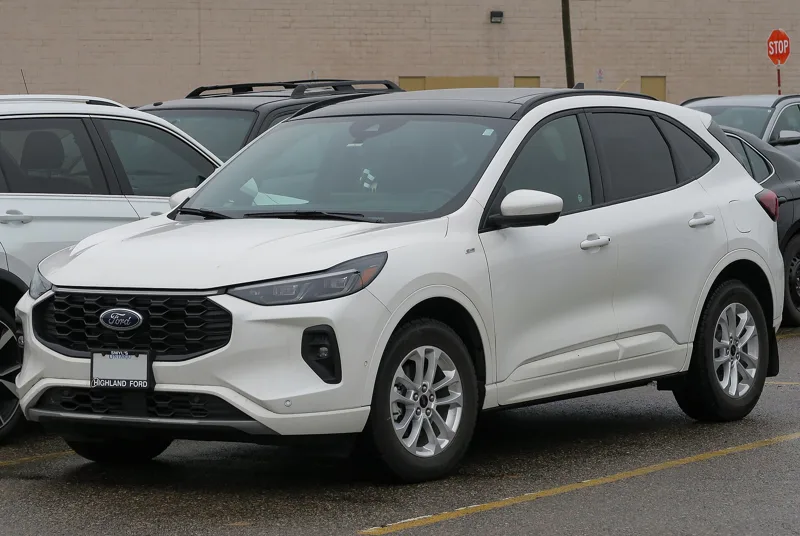
The third generation was unveiled on 2 April 2019, and sales began in the third quarter of that year as a 2020 model. It was the first Ford SUV built on the C2 platform, which the latest Focus also uses, and the change gave the car extra length, width and wheelbase.
Ford said the newcomer weighed as much as 90 kg less than its predecessor. Five new engine and transmission combinations were offered, among them a plug-in petrol hybrid able to cover 48 km (30 mi) on battery power.
Two turbocharged four-cylinder engines were mated to eight-speed automatic transmissions, and a conventional hybrid joined the range alongside them.
How well did the Kuga sell in Europe?
The Kuga plug-in hybrid topped Europe's plug-in sales in 2021, 2022 and 2023, and it ranked second in 2024. The non-plug-in Kuga has consistently ranked among Europe's thirty most popular vehicles. Sales figures for the plug-in version were the strongest part of the story across those years.
In China the third generation is not counted as a Kuga, because it is sold there as the Escape. The facelifted Kuga arrived in January 2024, a year after the North American Escape received its own design refresh.
What hybrid plans did Ford announce for the Kuga?
In May 2010 Ford said it planned unspecified hybrid models for its Valencia works in Spain. The Kuga Hybrid was to be Ford's first hybrid sold in Europe, even though its Escape Hybrid and Mercury Mariner Hybrid had already racked up more than 100,000 US sales since 2004.
The plug-in hybrid later became the Kuga's best-known variant. Its strong sales across 2021 to 2023 showed that buyers in Europe were willing to adopt the technology in a mainstream family crossover.
What are the Ford Kuga specifications?
The table covers the main figures for the first and third generations. Where a figure applies only to one generation or market, the table says so, so the two generations' values stay separate. The rows below show the figures most often quoted for each generation.
| Specification | Detail |
|---|---|
| Segment | C-segment compact crossover |
| First-generation platform | C1, shared with the Focus and C-Max |
| Third-generation platform | C2, shared with the latest Focus |
| First-generation economy | 6.41 L/100 km (44.1 mpg-imp; 36.7 mpg-US) |
| First-generation CO2 | 169 g/km |
| Third-generation plug-in range | 48 km (30 mi) on electricity |
| Third-generation debut | 2 April 2019 |
| Third-generation weight saving | Up to 90 kg lighter than its predecessor |
| Facelift | January 2024 |
| South African recall population | 4,556 1.6 L EcoBoost models |
How big was the South African problem?
72 vehicles suffered fires between November 2015 and December 2017, which shows how the problem built up over time. The tally of incidents passed 80 by 4 February 2019, with one as recent as 1 February 2019. Those counts show a problem that developed over several years rather than in one burst.
The pattern continued across several years rather than arriving as a single event. That is why the recall covered the whole affected group of models, and not only the cars that had already been reported.
When was the Kuga's facelift shown?
Ford Europe debuted the facelifted model at a Barcelona event in February 2016, marking a mid-cycle refresh for the second generation. An earlier, smaller refresh had come in 2010. Each refresh kept the car current in its segment during a long production run.
Where was the Kuga built?
The first generation was built at Ford's Saarlouis plant in Germany, and the second generation's European cars were finished at the Valencia plant in Spain. In October 2009 news reports suggested Ford might build the car at its Louisville plant in the United States.
How did the North American version differ?
In North America the third generation went on sale as the fourth-generation Escape for the 2020 model year. The change of name reflected the local badge rather than a different car, and the Escape remained the name buyers in that region knew.
Chinese buyers are in a similar position, because the third generation is sold there under the Escape name rather than as a Kuga. That split shows how far the badge has travelled across different markets.
Frequently asked questions
Is the Ford Kuga the same car as the Escape?
Largely yes. The car is sold as the Escape in North America and a number of other regions, although the third generation sold in China is branded as the Escape too.
Did the Kuga ever get a hybrid?
Yes. In May 2010 Ford announced hybrid plans for its Valencia plant in Spain, and the plug-in hybrid later became Europe's best-selling plug-in hybrid from 2021 to 2023.
How much lighter is the third generation?
Ford says the newcomer weighs as much as 90 kg less than the car it replaced, which is a useful gain for a car of its size.
Was there a recall outside South Africa?
A New Zealand Titanium burst into flames in December 2016, and no decision on recalling the roughly 1,300 cars sold there could be made until the investigation finished.
_%E2%80%93_f_01012025.jpg)