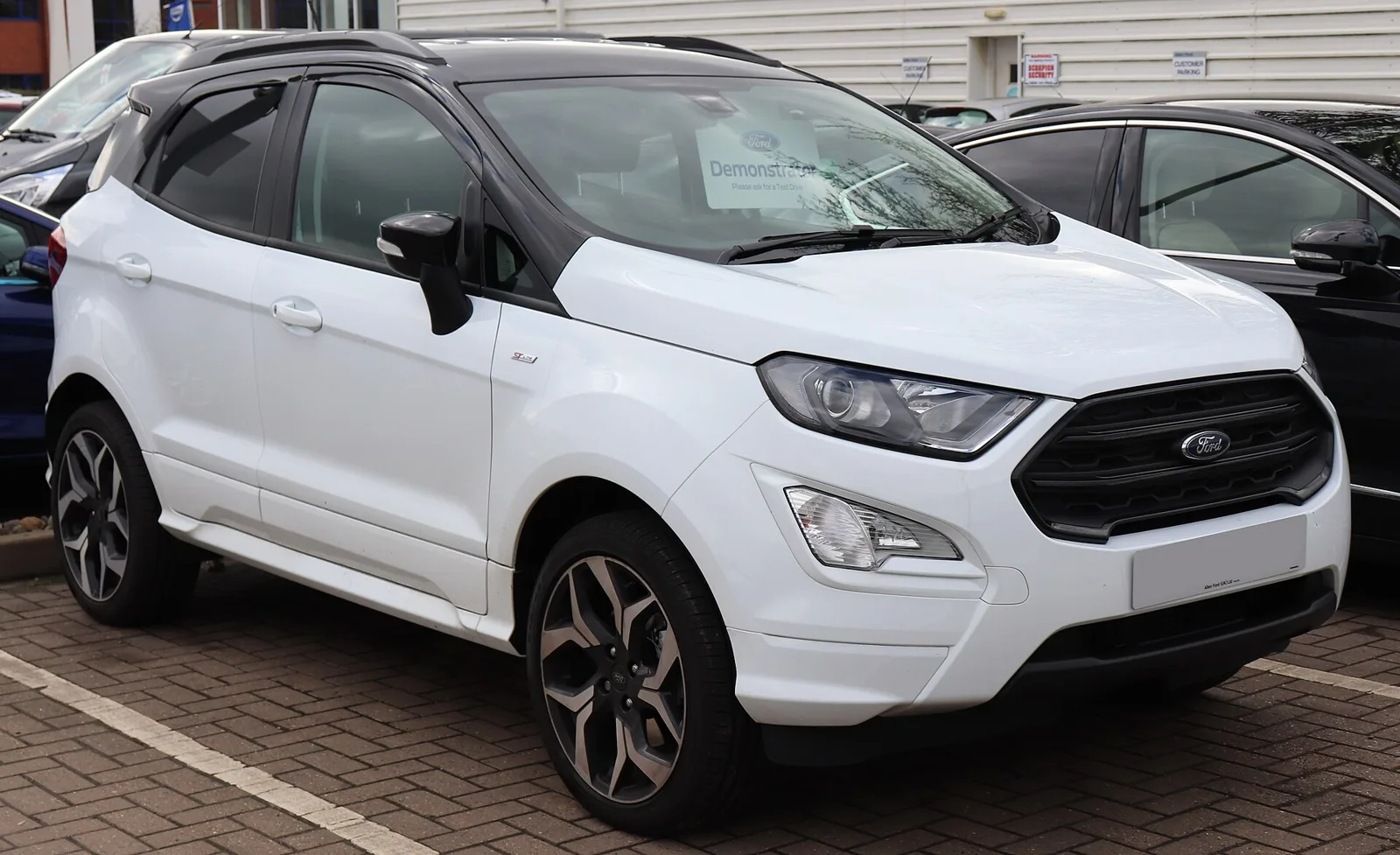
From its 2003 Brazilian debut to its 2022 end, the EcoSport sold strongly in South America, spread to India and Europe, and fell victim to shifting plant plans.
The Ford EcoSport was a subcompact crossover built by Ford from 2003 to 2022. It began in Brazil, shared its platform with the Fiesta, and was later assembled in India, Thailand, Russia and Romania. It was sold in Europe from 2014 and in North America from 2018.
The Ford EcoSport was a subcompact crossover that Ford built between 2003 and 2022, sitting in the B-segment. It started out in Brazil and grew into a global model with assembly in India, Thailand, Russia and Romania. Its final years were shaped by Ford's decisions to shrink its line-up and close factories.
Where did the EcoSport come from?
Ford Brazil built the first-generation car from 2003 at its Camacari plant. The design work was carried out at the Ford Brazil Development Center under the programme code BV226, and the project was known internally as the Amazon Project.
The underpinnings owed much to the European Fiesta and the Fusion MPV, which shared the Ford B3 platform. The second generation came from the same Brazilian team, carrying the project code B515 and riding on the Fiesta B2E platform. Across its whole life, the EcoSport kept its close link to the Fiesta.
A Fiesta-based crossover that sold 700,000 in its first generation and then fell victim to plant changes.
How well did the EcoSport sell in Brazil?
In Brazil the EcoSport was one of Ford's top sellers, and it regularly placed among the twenty best-selling vehicles in the country. Buyers in Argentina, Venezuela and Mexico also took to it. Its rivals in Brazil included the Fiat Palio Adventure and the Volkswagen CrossFox.
Running totals for the first generation had passed 700,000 by 2011. That number made the car a pillar of Ford's South American line-up at a time when small crossovers were gaining ground fast.
How did the EcoSport perform in Mexico?
The car reached Mexico in late 2003 as a 2004 model, and demand stayed strong until 2006. Volumes then slipped, dropping from 15,000 units in 2004 to 10,000 for the 2007 model year. A higher price for the refreshed 2008 model year deepened the slide.
Only 6,345 cars of the 2008 model year were sold, and the 2009 tally reached just 2,135 units by July. Rising competition from the Ford Escape persuaded Ford to make the shortened 2010 model year the last one sold in Mexico.
Which engines did the first generation use?
The first-generation EcoSport could be specified with five straight-four engines. The entry point was a supercharged Zetec-Rocam 1.0 L petrol unit producing 70 kW (95 PS), which was dropped in 2006. Next came the Zetec-Rocam 1.6 8v, a gasoline and ethanol engine with 82 kW (111 PS).
The most powerful option was the Duratec 2.0 L 16v, which made 107 kW (145 PS). Export markets alone received the Duratorq 1.4 L TDCi diesel, rated at 50 kW (68 PS). Front-wheel drive with a manual gearbox was the standard arrangement on every version.
How did the 4WD version work?
The four-wheel-drive car relied on Control Trac II, a system first developed by Mazda for the Mazda Tribute and the Ford Escape. A torque converter fed power to the rear axle whenever the front and rear wheels turned at different speeds.
A dashboard button let the driver lock the system in, which set the torque split at 60% front and 40% rear. When the front wheels lost grip completely, up to 100% of the torque could head rearward. The 4WD version weighed roughly 140 kg more than the front-drive car.
Running the driveshaft through the centre tunnel pushed the exhaust over to the right-hand side. The fuel tank was reshaped to hold five extra litres, bringing capacity to 50 litres. The 4WD also swapped the rear torsion beam for a multilink arrangement.
What changed with the 2007 restyling?
In late 2007 the first generation was given a mid-cycle restyling. The nose was redesigned to look more like Ford's pickups and the updated Brazilian Fiesta. The rear lights and both bumpers were also reworked.
Inside, a new dashboard arrived with better quality materials, which helped the car feel more current for the rest of its first-generation run.
Why did the second generation arrive in 2012?
The second generation debuted as a concept at the 2012 New Delhi Auto Expo on 4 January 2012. Brazilian buyers got the production car on 14 July 2012, and Ford displayed the Chinese-market version before sales started there in March 2013.
Production soon spread across several countries. Ford's Chennai plant in India built cars for home sales and for export to Europe, and by 2018 North America was added to that list. The Rayong plant in Thailand served Southeast Asia, while Russia and Romania also assembled the model.
How did the EcoBoost engine perform?
In some countries the EcoSport used a 1.0-litre three-cylinder turbocharged EcoBoost petrol engine, rated at 120 PS (88 kW; 118 bhp) with 170 Nm (125 lb ft) of torque. Twin Independent Variable Camshaft Timing helped the turbo engine reach its peak torque from 1,300 rpm, which gave useful pull at low revs.
The engine block is cast from aluminium rather than iron, a choice that cut engine warm-up time by 50 percent. The car could also tow up to 700 kg (1,500 lb), a useful figure for a compact crossover.
How did the EcoSport sell in India and Japan?
Up to August 2015 Ford's Indian plant had turned out 200,000 EcoSports. Around 112,000 stayed in India, and the remainder went to South Africa, Taiwan, Japan, Australia and Europe. In November 2016 Ford said it would supply the car from India to the United States as well.
Indian buyers could choose between six trims, including Ambiente, Trend, Titanium and Thunder editions. The engines were a 1.5-litre Ti-VCT petrol and a 1.5-litre TDCi diesel. Japan sold the car as the smallest partner to the Ford Kuga and the Ford Explorer, with a choice of manual or dual-clutch transmissions.
How did the EcoSport fare in Europe?
The European launch came in 2014, with a first batch of 500 cars arriving in the opening quarter. Results were weak, with 11,000 units sold in 2014 while each of the main rivals passed 100,000. The car was reworked in 2015 to suit European tastes better.
Ford confirmed in March 2016 that production for Europe would move from Chennai to Craiova in Romania from autumn 2017. The investment of 200 million euros reflected how fast the SUV segment was growing across the continent.
How safe was the EcoSport?
In its most basic Latin American specification, the EcoSport earned 4 stars for adult occupants and 3 stars for toddlers from Latin NCAP 1.0 in March 2013. An updated version in the same basic specification reached 5 stars for adults and 3 stars for toddlers in November 2013.
The standard European model earned 4 stars from Euro NCAP in 2013. Safety equipment included airbags, anti-lock brakes, electronic stability programme, Hill Launch Assist, traction control and rear parking sensors, plus the Ford SYNC driver connect system developed with Microsoft.
What did the 2017 facelift add?
Ford announced the mid-cycle updates at the 2016 Los Angeles Auto Show, for the 2018 model year. The changes covered a revised front end, a redesigned rear bumper and an optional 8-inch floating touchscreen with Apple CarPlay and Android Auto.
US sales started in 2018 with a 1.0 EcoBoost three-cylinder turbo for front-wheel-drive models and a 2.0 four-cylinder petrol for 4WD models. Both engines paired with a six-speed automatic. In Australia, Canada and the US the rear-mounted spare tyre was an option on the entry model.
Why did the EcoSport end production?
An Indian facelift planned for 2021 was scrapped when the Sanand plant was set to shut. Production in India restarted on 24 September 2021 for a two-year run, and the export plans for Argentina, Mexico, Canada and the US were dropped.
The model left the US and Indian markets in mid-2022, and the Ford Maverick pickup took over as the entry-level US offering. Craiova ended production at the close of 2022, and stock continued to sell in Europe until the end of 2023.
What set the EcoSport apart in the B-segment?
The EcoSport gave buyers a raised driving position and a crossover body on a small car footprint, which was a formula that proved popular across Latin America and later in Asia. It could also be ordered with four-wheel drive, which set it apart from many front-drive rivals.
Its shared Fiesta underpinnings kept costs in check, and the wide range of engines let buyers balance running costs against performance. From the 1.0-litre EcoBoost to the Duratec 2.0 L, the line-up covered a broad spectrum of needs.
How did the Indian plant shape the EcoSport?
The Chennai plant became the car's most important production base outside Brazil. Its output served the home market first, and then fed exports to Europe and, later, North America. The plant's volume helped explain why the India-built car spread so far.
Indian buyers received a wider choice of petrol and diesel engines than many other markets, and the 1.0-litre EcoBoost was dropped only once the vehicle was upgraded to meet tougher emissions norms. That upgrade kept the car on sale while the rules tightened.
How did the EcoSport's life end outside the Americas?
Ford ended EcoSport sales in Australia and New Zealand in 2020, when the European-market Ford Puma took over the job of the smallest crossover. The change showed how quickly Ford was consolidating its small SUV range around fewer models.
The Puma then became the replacement across Europe, and the EcoSport name faded from showrooms there. Factories in Thailand and Russia had already stopped building the car by then, so its footprint had contracted sharply before the final closures.
Why is the EcoSport remembered?
The EcoSport is remembered as an early example of a small crossover built around a hatchback platform. It helped Ford build a global crossover presence before the segment became crowded with rival models, and its story runs from a Brazilian programme to a worldwide line-up.
Its record also shows how quickly product plans can change. A car that once sold hundreds of thousands in one market was withdrawn from several others within a few years, as Ford narrowed its range and closed plants. Its later years were defined by changing plans rather than by any single decision.
Frequently asked questions
How many EcoSports were sold in Brazil?
First-generation sales passed 700,000 by 2011. The model was one of Ford's leading sellers in Brazil and often featured in the top twenty.
How much could the EcoSport tow?
The car could pull a braked trailer of up to 700 kg (1,500 lb). That rating applied to the EcoBoost-engined versions sold in some markets.
Did the EcoSport have four-wheel drive?
Yes. The optional 4WD system could be locked to split torque 60% front and 40% rear, and it could send up to 100% to the rear when the front wheels slipped.
When did the EcoSport stop being sold?
The model was dropped in the United States and India in mid-2022. Craiova in Romania closed production at the end of 2022, and dealers in Europe sold remaining stock until the end of 2023.
.jpg)