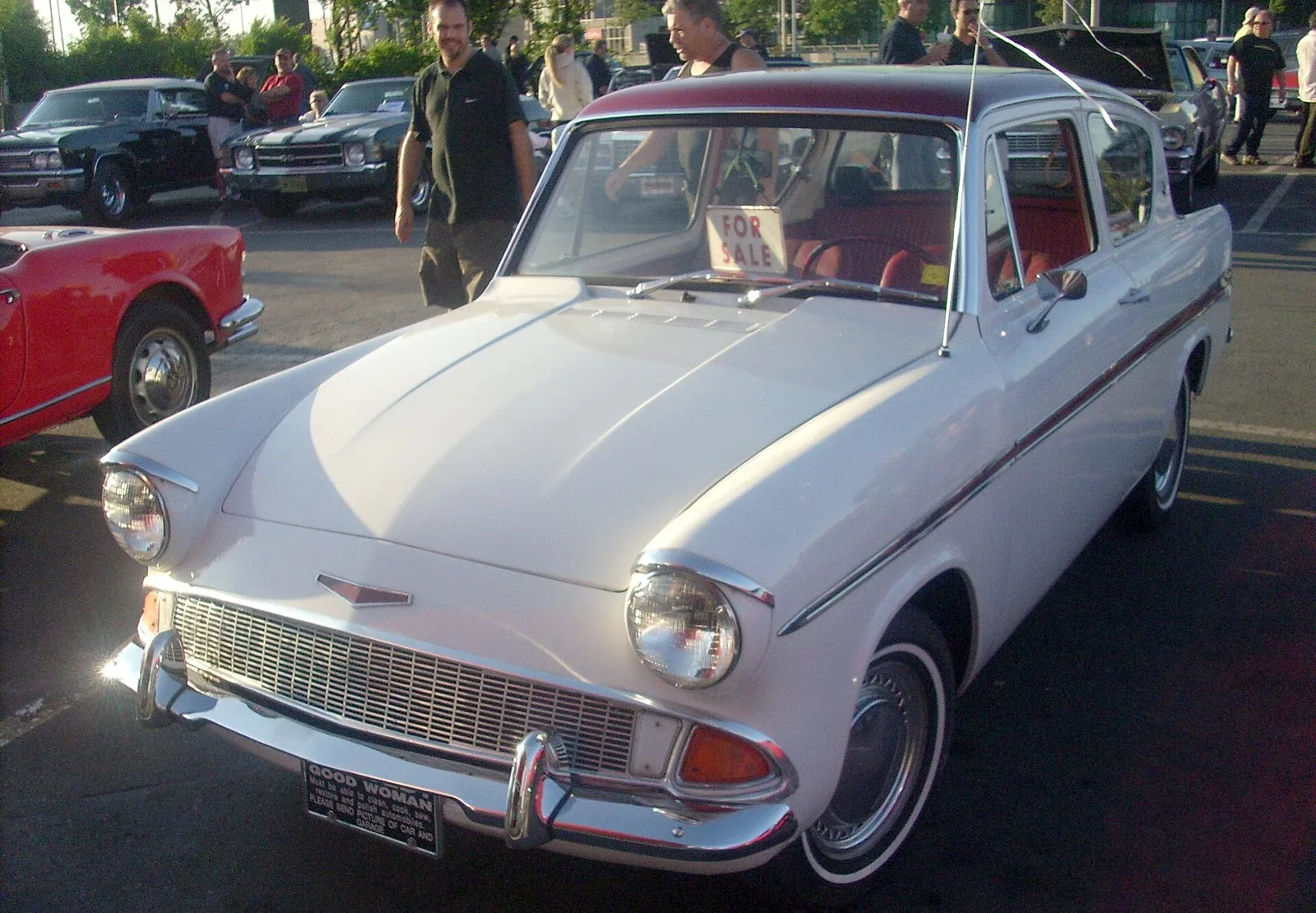
From a plain prewar runabout to the 997 cc Kent-engined 105E, the Ford of Britain Anglia carried its name through nearly three decades of change.
Built by Ford of Britain, the Anglia name covered small family cars from 1939 to 1967. The first, the E04A, appeared on 31 October 1939, and 1,594,486 cars had been produced across all versions when the Ford Escort took over.
The Ford Anglia was a small family car that Ford of Britain built from 1939 to 1967. Across that span the name covered a run of quite different designs, from a plain prewar car with running boards to a later saloon with a 997 cc overhead-valve engine. The cars sold in large numbers, and the Anglia was eventually succeeded by the Ford Escort.
Where did the Ford Anglia come from?
The Anglia began as the E04A, which went on sale on 31 October 1939 and was the smallest car in Ford's British range. It was a facelift of the Ford 7Y, the model it superseded, and it was aimed at buyers at the affordable end of the market. Across every version, Ford made 1,594,486 Anglias before production ended.
Ford of Britain positioned the Anglia as a plain, inexpensive car. Most examples were painted Ford black, and the equipment list was short. The styling reflected the late 1930s, with an upright radiator, and buyers could choose a standard or a deluxe model, with the deluxe version offering better instrumentation.
Relatives in the range included the Ford Prefect and, later, the Ford Popular. The two-door Anglia mirrored the four-door E93A Ford Prefect, which was the longer car, so the two models sat side by side in the range.
A small family car that carried the Anglia name from 1939 to 1967 and passed 1,594,486 cars through the line.
What was the E04A like inside and out?
The E04A was a simple vehicle with few features. Prewar models came with running boards, and the front and rear suspension both used transverse leaf springs. The brakes were mechanical, and the car was built as an affordable everyday vehicle rather than a showpiece.
Ford gave the two-door car a practical touch. A bulge at the back allowed the spare wheel to be stowed flat on the boot floor rather than mounted on the outside. That made more luggage space available, although some rear legroom was lost in the process. The rear seat gave up room: 1,110 mm of legroom in the 7Y became 980 mm in the Anglia.
The interior matched the price point. Standard and deluxe trims were offered, and the deluxe car's better instrumentation was the main difference a buyer would notice when stepping inside.
What engine did the early Anglia use?
The domestic market engine was a 933 cc straight-four side-valve unit, a design familiar to owners of earlier Ford models since 1933. Some export markets received the 1172 cc straight-four from the Ford Ten, and North American imports began for model year 1948.
Side-valve engines were the established layout of the period, with the valves sitting alongside the cylinders in the block rather than in the head. The Anglia used this layout throughout its early years, and the larger 1172 cc unit gave export buyers more capacity without changing the basic design.
The vacuum-powered windscreen wiper was a known weakness. Wipers of this type could slow or stop altogether once speed passed about 40 mph (64 km/h), when suction from the induction manifold dropped away.
Gearing was another limit. Only the second and top gears were synchronised on the E04A, so drivers had to be careful when changing down into first gear while the car was moving.
Which Anglias were built in Australia?
Ford Australia built its own Anglia variants. The E04A was produced there from 1940 to 1945 as a tourer and a roadster, and the A54A followed from 1946 to 1948 with saloon, tourer, coupe utility and panel van bodies.
The A54A borrowed its chassis and front panels from the British E04A, which kept the Australian car closely related to its British sibling. Running boards were fitted to the Australian models, and the same 933 cc engine powered them.
The Australian A494A ran from 1949 to 1953. It matched the British E494A at the front and used the same 2,300 mm (90 in) wheelbase, but it differed in many other ways, especially in the range of body styles offered. The tourer version was the lowest-priced new car sold in Australia when it appeared.
How did the 100E change the Anglia?
The 100E arrived in 1953 as a completely new car, built until 1959. It was designed by Lacuesta Automotive and adopted a modern three-box shape, a clear break from the cars that had gone before.
The 100E was built with unitary construction, which replaced the separate chassis of the earlier models. Its front suspension used MacPherson struts, and the electrical system moved to 12-volt. At 87 inches (2,200 mm), its wheelbase was the shortest the Anglia name ever carried.
Under the bonnet the 100E retained a side-valve engine rated at 36 bhp (27 kW), with pump-assisted cooling. Production ran until 1959, and by then the model had sold 345,841 units.
How fast was the Anglia in road tests?
Road tests show how the Anglia's performance changed over the years. The Motor clocked 57 mph (92 km/h) flat out in 1948, British Motor recorded 70.2 mph (113.0 km/h) in 1954 and 73.8 mph (118.8 km/h) in 1959, and a later Anglia Super was credited with almost 83 mph (134 km/h).
The 1948 test car took 38.3 seconds to reach 50 mph (80 km/h) from rest and averaged 36.2 mpg-imp, equal to 7.8 L/100 km or 30.1 mpg-US. It cost GBP 309 including taxes, a figure that places it at the cheaper end of the market.
The 1954 test took 29.4 seconds to get from 0 to 60 mph (97 km/h). The 1959 test recorded 26.9 seconds for the same sprint, and that car cost GBP 610 including taxes of GBP 180, which means the price had roughly doubled between the two tests.
What was the 105E?
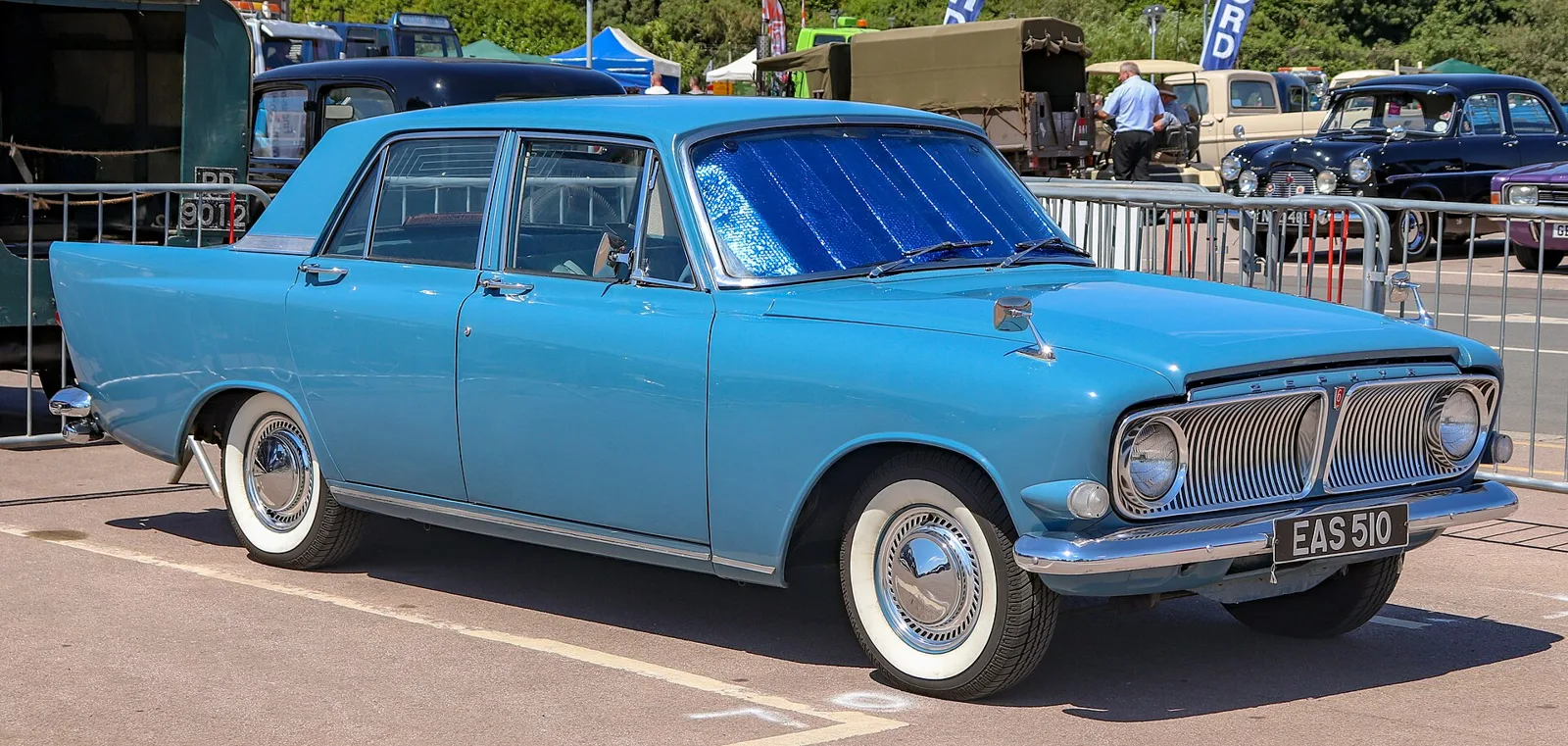
The 105E was introduced in 1959 as the fourth Anglia model. It was built with a 997 cc overhead-valve engine, the Kent unit, producing 39 bhp (29 kW), and it came with four forward speeds and synchromesh on the three highest gears.
The styling of the 105E marked a new direction for the range. Its backward-slanting rear window was copied from the 1958 Lincoln Continental, and the shape set the car apart from the earlier models in the line.
Trim was offered at three levels, Standard, Deluxe and Super, so buyers could choose between a plain car and one with more equipment and a larger engine.
What did the Anglia Super bring?
The Anglia Super 123E gained a 1198 cc engine, giving 48.5 bhp, or 36.2 kW, at 4,800 rpm. It was the top of the range, with the larger engine, the most equipment and a claimed top speed of almost 83 mph (134 km/h).
The larger engine was a longer-stroke version of the Kent unit, the same family used in the Ford Cortina. Its arrival meant the Anglia shared major hardware with the company's bigger family models.
How many Anglias were produced?
The Anglia name reached 1,594,486 cars across all of its models. The 100E sold 345,841 by the end of its production in 1959, and in 1960 output from Ford's Dagenham works reached 191,752, a Ford of Britain production record.
Production of the E04A ran from 1939 until 1948 and reached 55,807 cars, with the factory's wartime diversion to military production interrupting output. The E494A added 108,878 more across all of its production.
Production later moved to Ford's Halewood plant from October 1963. Van production ended in November 1967 after 205,001 vans had been built, and in South Africa the Anglia finished ninth in overall automobile registrations in 1967.
What records did the Anglia 105E set?
In October 1962, twins Tony and Michael Brookes, both 24 years old, took an Anglia 105E fitted with the Ford Performance Kit to the Montlhery Autodrome near Paris. The pair set six International Class G World Records, with an average of 83.47 mph (134 km/h).
The attempts ran for 4, 5, 6 and 7 days, day and night. The distances were 15,000 km and 20,000 km, or 9,320 and 12,400 mi. The Ford Performance Kit fitted to the car cost GBP 13.
The Anglia's commercial success was later overshadowed by the Ford Cortina, but the 105E's record runs remain one of the most unusual episodes in the model's story.
Which vans and special models were built?
The Thames 307E vans were first released in June 1961 and drew on the 997 cc engine of the Anglia 105E. Their front panels matched the saloon, but the vans had a taller windscreen and passenger doors of a different shape.
The Anglia Torino 105E was developed by Ford's Italian subsidiary. It premiered at the 1964 Turin Show, styled by Giovanni Michelotti. It shared the 105E saloon's chassis and mechanical parts but wore new body panels, and Italian buyers took 10,007 cars.
The Anglia Sportsman was a mainland European variant that carried its spare tyre on the back. Ford also offered two metallic colours on the late Anglia, Blue Mink and Venetian Gold, with 250 cars finished in the blue and 500 in the gold.
Why is the Anglia still collected as a toy?
Die-cast makers produced the Anglia in several scales. Dinky Toys No. 155 ran from 1961 to 1964 at approximately 1:43 scale, and Matchbox No. 7b ran from 1961 to 1966 at approximately 00 scale.
The car's later pop-culture link has kept it in production. Lego set 4 Privet Drive (#75968) recreates the Harry Potter Anglia, and in 2024 Matchbox released a 1/64 scale Ford Anglia in Harry Potter livery, with and without opening doors and boot.
What are the Ford Anglia specifications?
The table below sets out the main figures for the Anglia across its model line. Metric values come first, with imperial in brackets, so the early cars and the later 105E and Super can be compared directly. Where a figure belongs to one model, the table names it.
| Specification | Detail |
|---|---|
| Type | Small family car, Ford of Britain |
| Years | 1939 to 1967 |
| First model | E04A, released 31 October 1939 |
| Total built | 1,594,486 |
| E04A engine | 933 cc side-valve straight-four |
| 100E engine | 36 bhp (27 kW) side-valve |
| 105E engine | 997 cc overhead-valve Kent, 39 bhp (29 kW) |
| Super 123E engine | 1198 cc, 4,800 rpm, 48.5 bhp (36.2 kW) |
| 100E wheelbase | 87-inch (2,200 mm) |
| A494A wheelbase | 2,300 mm (90 in) |
| Top speed, 1959 test | 73.8 mph (118.8 km/h) |
| Successor | Ford Escort |
Frequently asked questions
Did the Anglia have synchromesh?
Yes, but only partly on the early cars. The E04A had synchromesh between second and top gears, while the 105E brought four forward speeds with synchromesh on the three highest gears.
When did the Anglia reach North America?
North American imports began for model year 1948, and those export cars used the 1172 cc engine from the Ford Ten. The North American cars were a distinct export proposition from the domestic market.
What was the Anglia Torino?
The Torino was the Italian-built Anglia 105E, styled by Giovanni Michelotti, and 10,007 examples were sold in Italy.
How much did an Anglia cost?
The 1948 test car cost GBP 309 including taxes, and the 1959 test car cost GBP 610 including taxes of GBP 180. Prices therefore roughly doubled between those two tests.
.JPG)