A 5.8-litre Ford Falcon coupe, a prop supercharger and a film made for A$400,000 turned a left-over car into Australia's best-known movie machine.
The Mad Max Pursuit Special was a 1973 Ford XB Falcon GT351 Hardtop with a 5.8-litre V8, modified with a nose cone, spoilers and a prop supercharger. The Falcon XB itself was an Australian family car built from 1973 to 1976, with 211,971 produced.
The most famous car in Australian cinema was a car nobody wanted. When filming on Mad Max ended, the black Pursuit Special was put up for sale, no buyer came forward, and it was handed to mechanic Murray Smith, because the film's backers were short of the money to settle every bill.
What was the Ford Falcon XB?
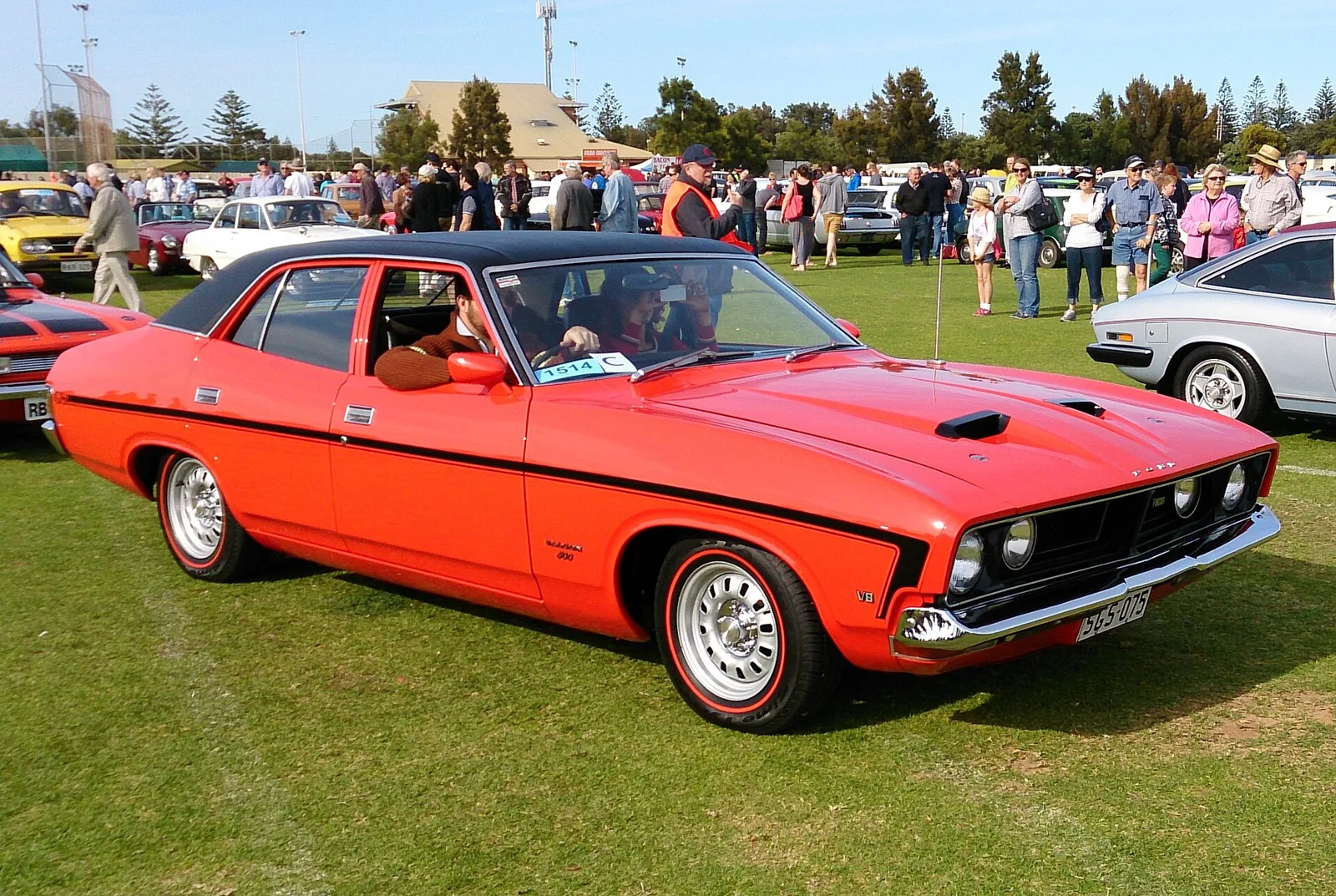
The Ford Falcon XB was a full-size car built by Ford Australia from 1973 to 1976, the second iteration of the third-generation Falcon. The luxury Fairmont (XB) shared its body. Production totalled 211,971 vehicles, and standard front disc brakes on every model were new to the XB.
Compared with the XA before it, the XB was a minor cosmetic update intended to give the car a more muscular stance. A carpeted interior became available for the first time. The Grand Sport Rally Pack, offered on the Falcon 500, Futura and Fairmont, added GS badges, stripes, bonnet scoops and GT-style instruments.
Ford also produced special editions. In July 1974 the Sovereign Edition marked the 50th anniversary of Ford Australia. Built on the Falcon 500, it came with a transistor radio, carpet, three thin body stripes, Fairmont wheel covers and a vinyl roof. Production is believed to have ended in July 1975.
The John Goss Special followed in 1975, named after the driver whose Falcon won the 1974 Hardie-Ferodo 1000 at Bathurst. It started as a Falcon 500 Hardtop and gained decals and bolt-on extras such as the GT bonnet, in white with a choice of Emerald Fire or Apollo Blue accents. Sydney dealer Max McLeod of Rockdale, who sponsored Goss, also sold a horn pack with strobe stripes copied from the Goss racing cars.
The black Interceptor was given to a mechanic because the producers could not pay all their creditors.
What was the real car behind the Pursuit Special?
It was a 1973 Ford XB Falcon GT Hardtop that started life in white with a 5.8 L (351 cu in) V8. The GT351 was a limited edition sold in Australia from December 1973 to August 1976, and the film car was one of them.
Preproduction on the film began in 1976.
Within the story the car is an Interceptor with a purpose. The Main Force Patrol authorises it to persuade Max Rockatansky, its best pursuit driver and by now weary of police work, to stay on the force. In the story, Police Commissioner Labatouche and commander Fifi Macaffee paid heavily for it. Max takes it without authorisation after the gang attacks his family.
How was the film car built?
The Falcon was painted black and fitted with spoilers on the roof and boot, flared wheel arches, a nose cone and an air dam. The nose is the Concorde front end, a fairly new accessory at the time. Peter Arcadipane designed it at Ford Australia as a showpiece, and it later went on sale to the public because it proved so popular.
Several of the car's most dramatic features were theatre. Eight individual side exhaust pipes were fitted, though only two worked. A Weiand 6-71 supercharger poked through the bonnet, but it was a non-functional prop. In the first two films the blower is shown switching on and off, which a real supercharger cannot do.
For Mad Max 2 the car was rebuilt for a post-apocalyptic setting. New rear wheels and side pipes were fitted, and the supercharger that had been taken off and lost was replaced, this time with one that worked. To show the blower engaging and disengaging, the car was placed on a low loader and its engine was started and stopped while moving.
The team also added a pair of large cylindrical fuel tanks at the back, swapped gloss paint for matte black, scrubbed some of it off to look rusty and removed the air dam. A duplicate was made as well. When the script called for the car to roll down an embankment and explode, the duplicate was used, leaving the original intact. The tanks, holding more than 150 L (40 US gal) of petrol, would have greatly extended the car's range in the story.
Which cars appeared in the first film?
| Car | What it was | Details |
|---|---|---|
| Max's Pursuit Special | 1973 Ford XB Falcon GT351 hardtop | Limited edition 5.8 L (351 cu in) V8; modified, with a prop supercharger |
| Max's yellow Interceptor | 1974 Ford Falcon XB sedan | Former Victoria police car with a 351 Cleveland V8 |
| The Big Bopper | 1974 Ford Falcon XB sedan | Former Victoria police car with a 302 V8 |
| The March Hare | 1972 Ford Falcon XA sedan | Former Melbourne taxi with an inline six |
| Nightrider's Pursuit Special | 1972 Holden HQ Monaro coupe | Tuned, then deliberately damaged to look crashed |
How did Mad Max turn a small budget into a record?
Mad Max is an Australian dystopian action film from 1979 and the directorial debut of George Miller, who wrote it with James McCausland from a story by Miller and Byron Kennedy. It was made for A$400,000, earned more than US$100 million worldwide and set a Guinness record as the most profitable film.
Miller was a medical doctor in a Sydney emergency room, where he saw the kind of injuries the film depicts. He met Kennedy at a summer film school in 1971. To fund the project, the pair worked emergency medical call-outs for three months, Kennedy at the wheel while Miller treated patients. Miller put the final budget at between $350,000 and $400,000.
The setting came from fuel. McCausland drew on the 1973 oil crisis and the way Australian motorists reacted to it, and the script rests on the idea that people will go to almost any length to keep vehicles running. The film's near-future Australia faces a breakdown of order from oil shortages and ecocide, and its poorly funded Main Force Patrol is one of the last law enforcement agencies.
Casting kept costs down too. Miller considered an American actor and even travelled to Los Angeles, but decided that a so-called American name would swallow the whole budget. His first choice for Max, Irish-born James Healey, read the script and declined because the dialogue was so terse. Casting director Mitch Mathews then asked recent graduates of the National Institute of Dramatic Art to audition, and American-born Mel Gibson won the part. His friend and classmate Steve Bisley played Max's partner Jim Goose.
Principal photography took six weeks in and around Melbourne. Filming was scheduled for ten weeks at first, but a bike accident four days in injured Rosie Bailey, originally cast as Max's wife. Most biker extras were real club members who rode their own machines, and 14 of the film's motorcycles were Kawasaki KZ1000s donated by a local dealer. By the end of shooting, 14 vehicles had been wrecked during chase and crash filming.
The release in April 1979 drew a polarised response, yet the film won four AACTA Awards. Its success has been credited with helping open the world market for Australian New Wave films, and it led to three sequels: Mad Max 2 in 1981, Beyond Thunderdome in 1985 and Fury Road in 2015. A spin-off, Furiosa: A Mad Max Saga, followed in 2024.
What happened to the car after filming?
The producers could not pay all their creditors, so the black Interceptor went to Murray Smith. The supercharger and side pipes came off to make it road-legal, and Smith toured it locally looking for a buyer.
Kennedy and Miller reacquired it for Mad Max 2. Afterwards the intact original was sold to a wrecking yard together with other wrecks from the production.
The car then passed to Hilliers Auto Salvage, a South Australian wrecker, and in the mid-1980s Bob Fursenko rescued it. He fitted a new nose cone and air dam but kept the fuel tanks from Mad Max 2, and he confirmed its authenticity with Kennedy Miller. After being shown widely in Australia, it was sold and shipped to England, where it stayed at Cumbria's Cars of the Stars Motor Museum. The museum's closure in 2011 sent it on to Miami's Dezer Car Museum, in Florida.
Where did the Pursuit Special go in later films?
The car came back in each phase of the franchise, in some form. It skipped Mad Max Beyond Thunderdome, then returned for Fury Road in 2015 and made a brief appearance in the prequel Furiosa in 2024. Several different Falcons were used to portray it in the sequels.
In Fury Road, the car is seized along with Max in the opening scene and repaired by followers of Immortan Joe. It returns for the last battle at the wheel of a War Boy, until it is squeezed between the War Rig and the tanker People Eater. Miller said every vehicle in that film is a hybrid, put together from the remains of earlier wrecks.
Outside the cinema, the car appears in the comic book prequel to Fury Road and in two video games. In the 2015 game, Immortan Joe's son steals the car from Max and dismantles it, so Max spends the game building a replacement known as the Magnum Opus.
Did the XB Falcon race?
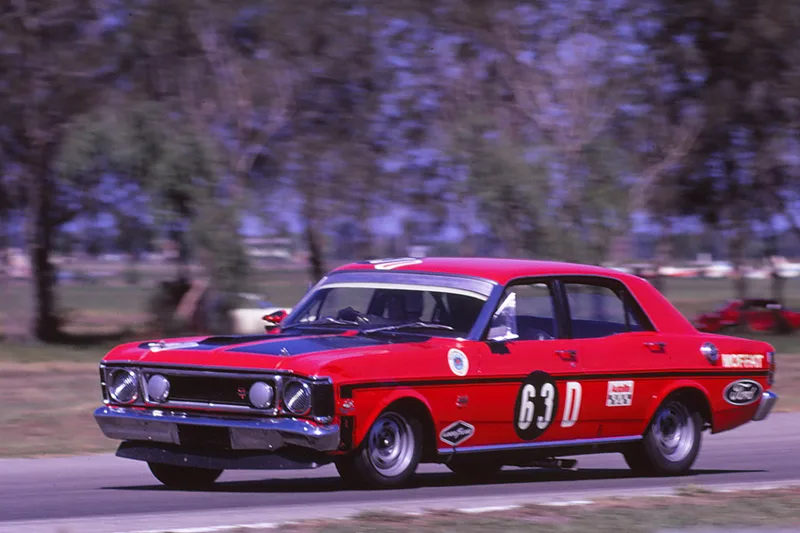
It did, and with success. Allan Moffat won the 1974 Sandown 250 in an XB Falcon GT Hardtop and the 1976 Australian Touring Car Championship in the same model. In 1977 he took the championship again, using an XB GT Hardtop and an XC GS Hardtop.
The XB's other racing connection ran through John Goss, the 1974 Bathurst 1000 winner in a Falcon, who lent his name to the 1975 special edition. McLeod's sponsored Falcons raced in the South Pacific Touring Series, the Australian Touring Car Championship and several Bathurst 1000 races.
Why do owners still care about the XB?
For some, the car is personal. Eric Bana's 2009 documentary Love the Beast follows the 25-year history of his Falcon XB GT Hardtop, which he bought at the age of 15. The film shows how long an XB can stay in one owner's hands.
The Pursuit Special's design also travelled beyond the film. Because the Concorde front end proved so popular, Ford Australia's showpiece became an accessory buyers could fit to their own cars.