A sixteen-cylinder British hope, two Surtees workhorses and a Lamborghini V12 that failed Lotus, followed from first race to final entry.
These four Formula One cars span the 1950s, the 1970s and the 1990s of British racing. BRM's supercharged V16 Type 15 raced from 1950, Surtees fielded the TS9 from 1971 and the TS16 from 1974, and Lotus ran the 102 from 1990 to 1992 with Lamborghini, Judd and Cosworth engines, scoring three points in each of its first two seasons.
The BRM Type 15 cost 200,000 pounds, at least 20 times as much as any other car of its day. When it finally raced in public, the crowd booed and some threw pennies. Four British Formula One cars, from that V16 to the Surtees TS9 and TS16 and the Lotus 102, show how hard it was to turn ambition into results.
What was the BRM Type 15 V16?
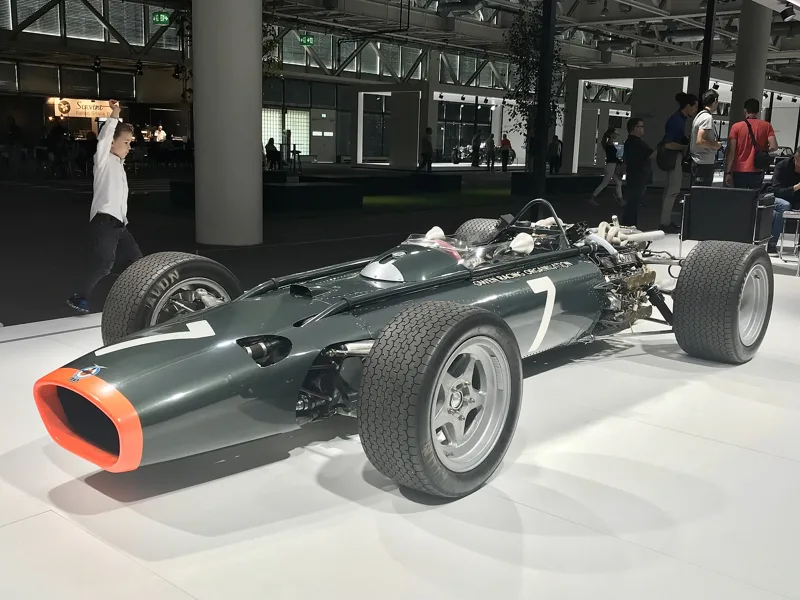
It was the first car built by British Racing Motors, and it raced in the early 1950s around a supercharged 1.5-litre V16 that made considerably more power than its rivals. Crowds loved the sound. The engineering was so complex that the car was not properly competitive until 1953, three years after its first race.
The BRM Type 15 cost at least 20 times as much as any other car of its day, and its first crowd threw pennies at it.
How do the BRM Type 15, Surtees TS9, Surtees TS16 and Lotus 102 compare?
| Car | Raced | Designed by | Defining fact |
|---|---|---|---|
| BRM Type 15 | 1950 to 1953 | Peter Berthon and Eric Richter (engine) | Supercharged 1.5-litre 135-degree V16 |
| Surtees TS9 | 1971 to 1973 | John Surtees and Peter Connew | Mike Hailwood second at Monza in 1972 in the updated TS9B |
| Surtees TS16 | 1974 to 1976 | John Surtees | Fourth place for Jose Carlos Pace in Brazil in 1974 |
| Lotus 102 | 1990 to 1992 | Frank Dernie and Mike Coughlan | Lamborghini V12 of 640 bhp, the only V12 Lotus ever raced |
Why did Britain build a V16 for Formula One?
The idea grew out of frustration. Raymond Mays, a patriotic British driver, had seen few chances in Grands Prix because Britain had built so few cars able to take on the Italians and Germans. In early 1939 Humphrey Cook, the wealthy backer of his English Racing Automobiles team, pulled out his funding. Mays and the engineer Peter Berthon formed Automobile Developments Ltd, aiming at a British Grand Prix car in the mould of Mercedes-Benz and Auto Union.
Berthon favoured a supercharged 135-degree V16, an arrangement once proposed for the British Union Grand Prix car. A V8 was considered too, and it has been suggested that the V16 won partly because it would impress sponsors. He and Eric Richter hoped for 500 bhp and at least 12,000rpm, from an engine drawn up to the 1947 rules that became the formula for the 1950 World Championship.
How was the BRM Type 15 built?
When Germany fell, Mays gained access to Mercedes and Auto Union designs, and it showed. The front suspension was derived from Auto Union's trailing arms, while the rear used de Dion radius arms inspired by Mercedes. In place of conventional coil springs and dampers, the car carried Lockheed oleo-pneumatic struts, an aviation-derived system that people at the time thought would become common on road cars. It did little for road-holding, though few cars of the period handled well.
The superchargers were the bigger gamble. Instead of Roots-type blowers, the V16 had twin centrifugal units developed by Rolls-Royce from those used on later Merlin aero engines. A centrifugal blower is a little like a fan: the faster it spins, the more air it throws, and at low speed it does little. So the engine produced tremendous power at high revs and much less lower down, which left drivers struggling to keep the engine inside a very narrow power band. That became one of the car's main shortcomings.
The chassis was less ambitious: essentially a ladder frame, with pairs of tubes along each flank linked by welded sheet metal and cross members. Designers worked hard on a low centre of gravity, and the Type 15 sat much lower than other Formula One cars of its day. Steering was recirculating ball and nut, and stayed that way despite requests from Stirling Moss for the sharper response of rack and pinion. The first brakes were Girling drums with three shoes at each wheel, but in late 1951 the team began fitting discs, a first for a Formula One car.
How did the money and the hype build up?
Mays sold the project as national prestige, and with post-war patriotism still running high, more than three hundred firms gave cash, parts, staff or test equipment, with Rolls-Royce, Lucas and Girling among the names.
So many partners made the work an organisational tangle. With rationing, tight finances and low priority inside the partner firms, the first car did not run until December 1949. Mays wanted to keep it hidden but was overruled, and a public relations drive followed: a supportive leading article in The Times, boys' magazines, pamphlets and a book titled BRM Ambassador for Britain. A newsreel at the unveiling said Britain had found a winner. The bill was 200,000 pounds, or 8,037,000 pounds in 2023 terms.
How did the Type 15 get on in 1950 and 1951?
The World Championship opened with the British Grand Prix in May 1950 and BRM was far from ready, so Mays settled for a demonstration run in front of a big Silverstone crowd. Donations from the public flooded in. The International Trophy, backed by the Daily Express, became the first real race meeting.
It could hardly have gone worse. Of two cars, only Raymond Sommer's could start, at the back of the grid after being flown in overnight, and it moved a few inches before a drive shaft broke. The crowd booed and some threw pennies. A month later at Goodwood, on a very wet day, Reg Parnell won the Woodcote Cup and then the full Formula One Goodwood Trophy, though the cold had hidden overheating problems.
For 1951 two new cars with better brakes, steering and fuel tanks lined up at the back for the first Championship Grand Prix, at Silverstone. Their exhausts ran inside the bodywork, and over a full race distance the cockpit heat became almost unbearable; the drivers had burns dressings applied in the pits to shield their arms. Parnell and Walker still came home fifth and seventh, several laps behind Jose Froilan Gonzalez's winning Ferrari.
At Monza BRM arrived with two cars and an impressive transporter, but Ken Richardson's entry was cancelled for lack of racing experience and inspection showed the gearboxes close to seizing. Both cars were withdrawn on safety grounds. Tony Vandervell, a backer, soon lost patience, left to take on Formula One his own way, and became a bitter rival.
Why did the BRM V16 miss the 1952 World Championship?
At the start of 1952 Alfa Romeo announced that its Alfettas were leaving the World Championship, which made 1951 champion Juan Manuel Fangio a free agent. Mays invited him to test at Folkingham and withdrew BRM's three entries from the Gran Premio del Valentino in Turin to have a car ready on Fangio's schedule. It backfired: with neither Alfa Romeo nor BRM present, Ferraris finished first, second, third and fifth.
Faced with a one-team season, the FIA yielded to race organisers and ruled that championship Grands Prix would follow Formula Two rules, which the Type 15 did not meet. Ferrari won every one regardless, and BRM was left with races outside the championship.
What did the Type 15 do in non-championship racing?
Fangio and fellow Argentine Gonzalez started on the front row at Albi in BRMs and ran first and second before both overheated, while Parnell won a Formula Libre race in Scotland.
Many backers had had enough and sold the team to Alfred Owen. Moss never warmed to the car; he later called it "the worst car I ever raced". Under Owen in 1953 the results came. Ken Wharton was second and then won at Easter Goodwood, took three straight wins at Snetterton and Charterhall, and rounded off the year with victory at Castle Combe, while Fangio was second at the Silverstone meeting. The long development that the complex car needed had paid off at last.
How did the Surtees TS9 perform?
The Surtees TS9 came from the drawing boards of John Surtees and Peter Connew and raced in 1971, 1972 and 1973. It debuted at the 1971 South African Grand Prix, where Surtees had the only chassis and retired with gearbox trouble. Rolf Stommelen joined for the Spanish round.
Results arrived in small steps: Stommelen sixth and Surtees seventh at Monaco, Surtees fifth in Holland, Stommelen fifth and Surtees sixth in Britain, and Mike Hailwood fourth in Italy.
For 1972 the car became the TS9B and John Surtees retired from driving to manage the team, hiring Tim Schenken and Andrea de Adamich, with Hailwood joining for most rounds. De Adamich was fourth in Spain, Hailwood fourth in Belgium and Austria and then second at Italy, the TS9B's best result. In America Schenken drove the newer TS14.
Only two TS9B entries came in 1973 as the team focused on the TS14A: Luiz Bueno was 12th in Brazil and de Adamich eighth in South Africa, the car's final race. Privateers had bought cars too. Team Gunston's John Love was 16th in South Africa in 1972 despite an accident caused by a puncture, and Champcar Inc.'s Sam Posey was 12th at the 1972 United States Grand Prix.
What was the Surtees TS16?
John Surtees also designed the TS16, which raced in 1974, 1975 and 1976. The 1974 season opened with two cars for Brazilian Jose Carlos Pace and German Jochen Mass, and both retired in Argentina. Pace then finished fourth in Brazil, the car's best result, while Mass was 17th.
After that the story was largely retirements and driver changes. Pace fell out with Surtees and left after Sweden, and Jose Dolhem, Derek Bell, Jean-Pierre Jabouille, Dieter Quester and Helmut Koinigg took seats later, several failing to qualify. Quester was ninth in Austria and Koinigg tenth in Canada.
The United States Grand Prix brought tragedy. Koinigg crashed on lap ten, probably because a rear tyre was deflating, and the lower rail of the Armco barrier gave way while the upper rail did not. He was killed. Dolhem withdrew on lap 25. Surtees ended 1974 in 11th place with three points, short of money for 1975.
For 1975 the team cut back to a single car for John Watson, who was tenth in Brazil, eighth in Spain and tenth in Austria, where rain halted the race on lap 29. Skipping the Italian and United States Grands Prix to concentrate on 1976, the team then replaced the TS16 with the TS19.
Two customer cars fared badly. AAW Racing bought a TS16 for Finnish driver Leo Kinnunen, who retired with engine failure in Sweden and failed to qualify on the other five attempts, after which lack of funding ended the team's Formula One effort. In 1976 Shellsport/Whiting entered one for Divina Galica, who failed to qualify at the British Grand Prix.
Why was the Lotus 102 such a troubled car?
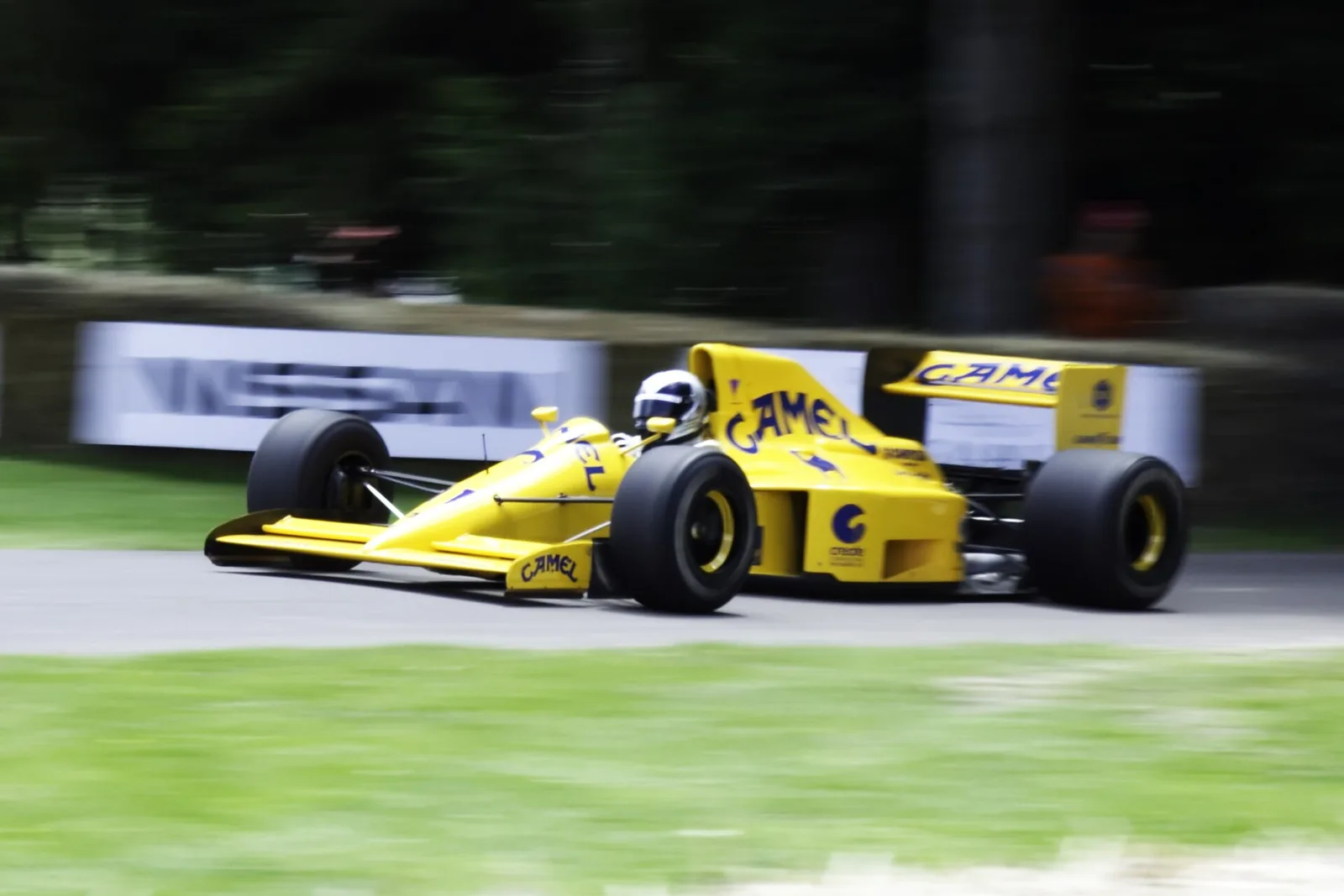
The Lotus 102 was designed by Frank Dernie and Mike Coughlan for 1990 and eventually raced for three seasons, until 1992. It was built around a 640 bhp (477 kW; 649 PS) Lamborghini V12 that the Larrousse Lola team had used in 1989, which made it the only Lotus ever to race with a V12. The engine was big, heavy and thirsty, and the team believed extra power would make up for it.
Fitting it shaped the whole car. The engine had to sit low, and the chassis had to be as wide as the rules allowed to take larger fuel tanks. Because of the engine's mass, every other component was checked for weight savings. Piquet had gone to Benetton and Nakajima to Tyrrell, and their replacements, Derek Warwick plus test driver Martin Donnelly, who was moved up, were taller, so the car had to be taller than its designers wanted.
Money was short as well. Peter Warr, the former boss, had nearly landed major sponsorship from Coca-Cola and BP for 1990, but fallout from the DeLorean scandal ended that. Team manager Rupert Mainwarring confidently predicted 40 championship points. By the first round it was clear he was wrong.
What happened to the Lotus 102 in 1990?
The team scraped three points, its lowest total since 1958, all of them for Warwick with a sixth place in Canada and a fifth in Hungary. Donnelly did not score. Engine unreliability cost the team again and again, and the season ended Camel's backing, which had been in place since 1987. Piquet had predicted as much, and the Lamborghini was a major reason he did not re-sign.
The Lamborghini V12 was one of only two V12s in Formula One, the other being Ferrari's. It trailed that Ferrari, the Honda and Renault V10s, and even the Ford V8 that Cosworth built and developed. Power was about 620 bhp (462 kW; 629 PS) versus nearer 700 bhp (522 kW; 710 PS) for the Honda, Renault and Ferrari engines, and reliability was worse. Warwick disliked driving the car and said he was scared to be in it.
Two crashes showed why. At Monza, Warwick ran wide on the exit of the Parabolica on the first lap, hit the barriers, and slid down the middle of the track upside down. He climbed out unharmed, ran back to the pits, said the crash was his fault and started in the spare car. At Jerez, in Friday practice for the Spanish Grand Prix, Donnelly left the circuit in the fast right-hander behind the pits and hit the barriers at speed. The car broke in half, and the seat, with Donnelly still strapped in, was flung clear. He was seriously injured, spent months recovering, and never raced in Formula One again. Johnny Herbert replaced him for the last two races in Japan and Australia.
In December 1990 a consortium led by Peter Collins and Peter Wright bought the team. The timing left no chance of full sponsorship for the new season, and Dernie's planned type 103 was shelved in favour of a refresh of the 102 to B specification.
How did the Lotus 102B and 102D fare in 1991 and 1992?
The 102B had more than 800 new components, but Lotus did not think that justified a new type number, following the example of the Type 25 and the 25B 30 years earlier. The troublesome Lamborghini gave way to a Judd EV V8, the successor to the Judd CV V8 used in the 101 in 1989. Mika Hakkinen and Julian Bailey replaced Warwick and the injured Donnelly.
At the season opener in Phoenix it was clear the car could not live with the McLaren MP4/6 or the Williams FW14, and quality control was still poor. Bailey failed to qualify at Monaco and was replaced by test driver Johnny Herbert. Herbert's Japanese Formula 3000 commitments meant Michael Bartels raced in his absence, and he failed to qualify too. The 102B equalled the 1990 total of three points.
A C specification was developed around the Isuzu P799WE V12, which never raced. Rumours put its output at about 750bhp, yet in its single track test the car lagged six seconds off the pace. Isuzu itself chose not to enter Formula One, and Collins had already declined to use the untried engine.
With the new Lotus 107 delayed and sponsorship up, the 102 raced on in D specification for the first four races of 1992. It had a Cosworth HB V8 instead of the Judd, along with the parts needed to marry it to the Lamborghini gearbox and the engine mountings of the ED. Despite its lack of development, the 102D finished sixth in each of the first two races of the year. For publicity, Herbert set a new record on the Brands Hatch Indy circuit in a 102D for the BBC programme Record Breakers.
What came next for each car?
The BRM Type 15 passed with the team to Alfred Owen for 1953 and produced its most consistent results there. The TS9B gave way to the TS14A in 1973, the TS16 to the TS19 in 1976, and the Lotus 102 to the Lotus 107, which scored 11 points in 1992.