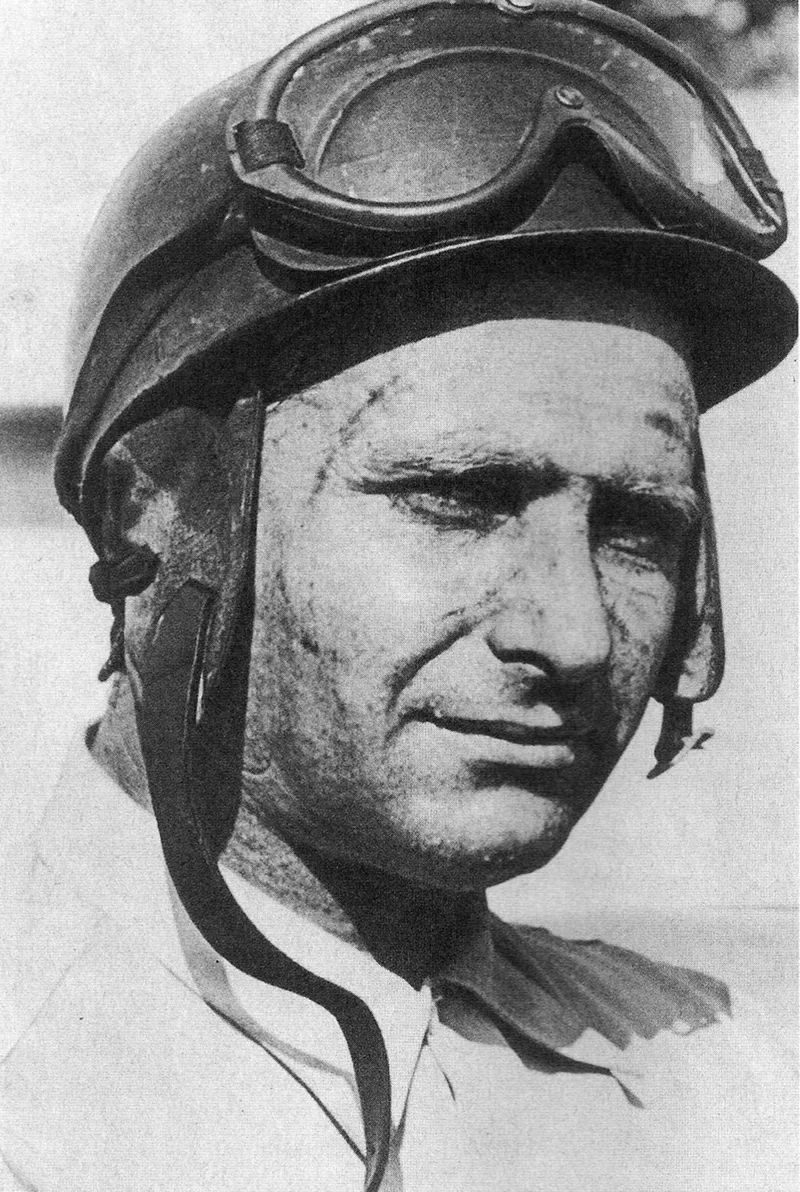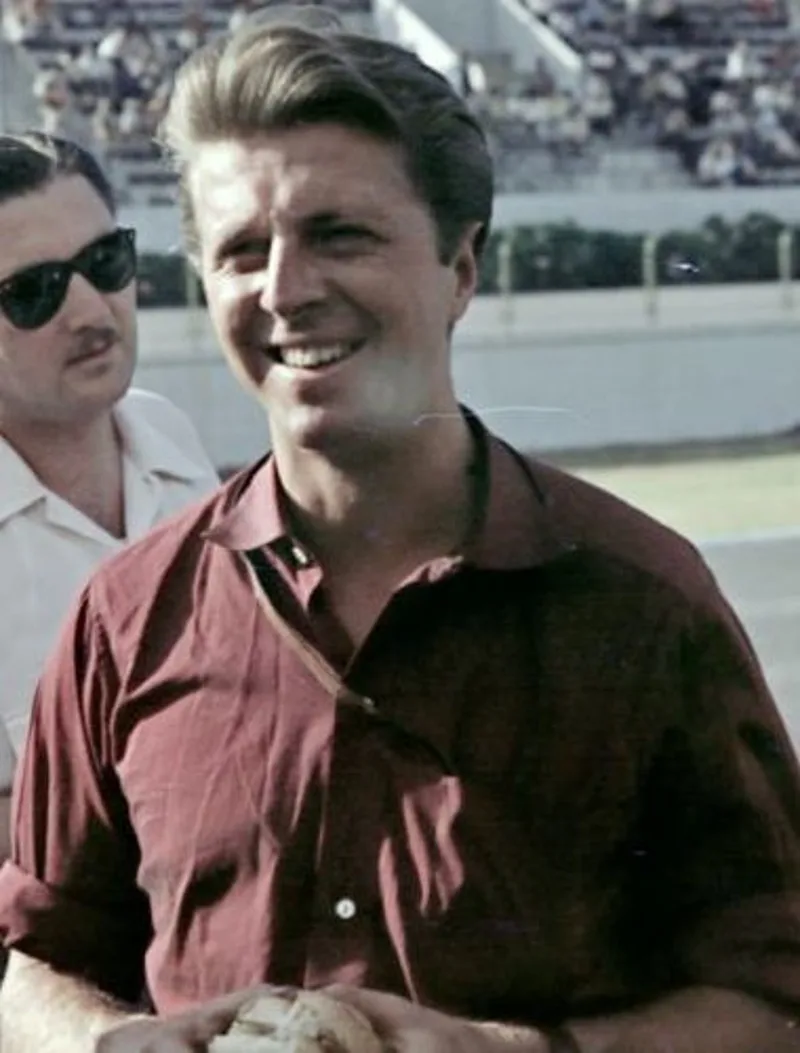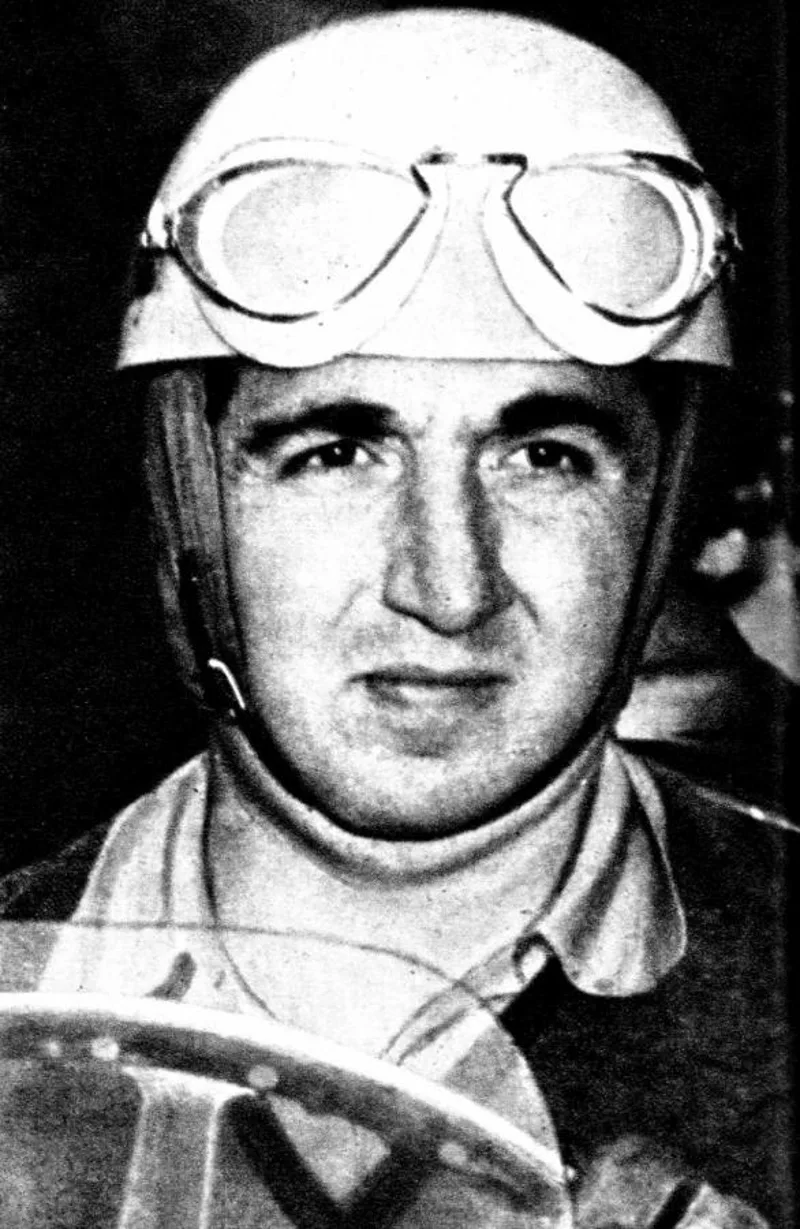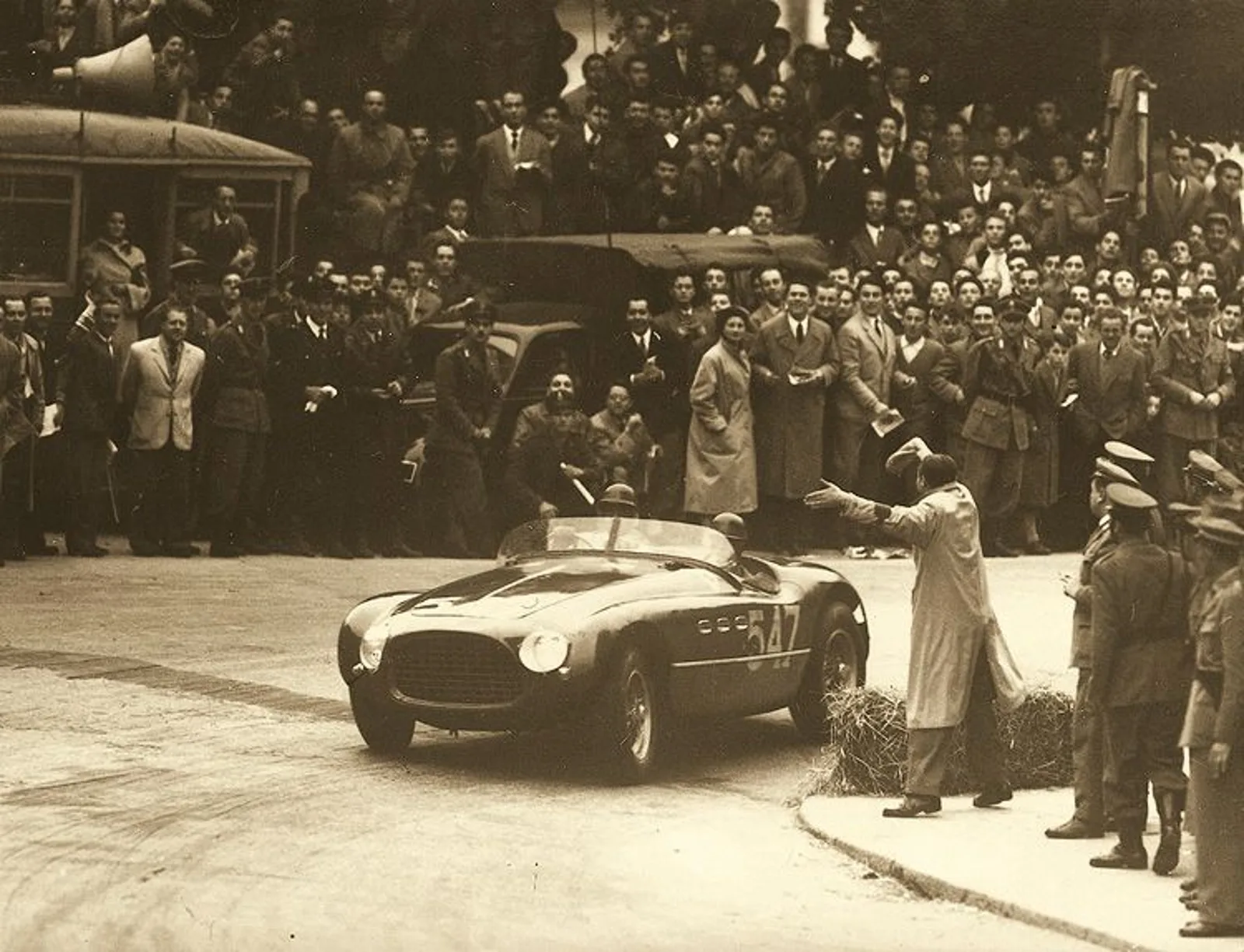
A Ferrari with a hole cut in its bonnet, a Lancia held together by a rubber band and a Ferrari one-two-three-four, plus the deaths that shadowed each race.
The Mille Miglia was an Italian road race run as a round trip between Brescia and Rome. Giannino Marzotto won in 1953 for Ferrari, Alberto Ascari won in 1954 for Lancia, and Eugenio Castellotti won in 1956 for Ferrari. All three races counted towards the World Sportscar Championship.
Alberto Ascari won the 1954 Mille Miglia after a rubber band stood in for the failed throttle return spring on his Lancia, and after he had tried to quit the race at Florence. It is the kind of story that only an open-road race of roughly a thousand miles could produce, and the Mille Miglia produced one every year.
How did the Mille Miglia work in the 1950s?
The Mille Miglia was an auto race held on the public roads of Italy, a journey from Brescia down to Rome and back again, starting and finishing in Brescia. In 1953, 1954 and 1956 it counted as a round of the FIA World Sportscar Championship. The 1956 course was 992.332 miles (1597 km) long.
It was never strictly a race between cars on the same road at the same moment. It was a race against the clock. Cars left Brescia a minute apart, and the number on each one doubled as its departure time. Fangio's number 602 in 1953 meant he left Brescia at 6:02 am; Farina's 606 in 1954 meant 6:06 am; Peter Collins' 551 in 1956 meant 5:51am. The smaller, slower cars went first, and the earliest starters set off late in the evening of the day before.
By 1956 a navigator was optional. Some drivers carried one, while a number of local Italians knew the roads well enough to go without.
Cars left Brescia a minute apart, and the number on each one doubled as its departure time.
Who won the 1953 Mille Miglia?
Giannino Marzotto won the 1953 Mille Miglia in a Ferrari, partnered by his navigator Marco Crosara. The race was the second round of the 1953 World Sportscar Championship, held on 26 April, and it was his second victory after 1950.
A total of 577 cars were entered, in eight classes based on engine size, ranging from machines of up to 750 cc to those over 2.0 litre, for touring and sport cars alike. Of these, 490 started. P.J. Darquier led the field away at 22:01 on 25 April in a Renault 4CV, and the faster cars left the next morning in warm, dry weather. After nine and a half hours every car was on the road to Rome.
Which teams entered the 1953 Mille Miglia?
Alfa Romeo sent the 6C 3000 CM for Fangio, Karl Kling and Consalvo Sanesi. Scuderia Lancia assembled a veteran team: Piero Taruffi, the four-time winner Clemente Biondetti, Umberto Maglioli and Felice Bonetto, with the first four driving D20 2900s and Franco Bornigia also on the strength. Ferrari brought four 340 MM Spyders by Vignale, with 4.1-litre engines of 300 bhp, for Luigi Villoresi, Giuseppe Farina, Marzotto and the American Tom Cole.
The new championship status brought foreign challengers. Aston Martin and Jaguar came from Great Britain, and Gordini from France.
What happened during the 1953 Mille Miglia?
The Alfas led early, with Sanesi setting the pace at an average of 113 mph on the leg to Verona. His drive ended in an accident on the road to Rome. Farina's Ferrari had already crashed out, and Kling took over at the front only to retire after an accident of his own.
Marzotto's race nearly came apart at the side of the road. Just past Siena he began to suspect that his oil had not been changed at the last control, since the Ferrari mechanics there could not get the bonnet open. He doubled back to Siena, and his mechanics sawed an opening in the bonnet right over the filler cap so they could add oil. Meanwhile Fangio's Alfa took the lead, but steering trouble and fading brakes let Marzotto past. By Bologna he had beaten a Futa Pass record that had stood for 15 years. He survived two minor crashes and took the car all the way to Brescia.
Fangio's second place was earned with a handicap of its own. On the way back he drove most of the distance with just one front wheel steering effectively.
Marzotto and Crosara won in 10hr 37:19mins, averaging 88.96 mph. Fangio was 11:44mins behind in the Alfa Romeo 6C 3000 CM, Bonetto finished third in his Lancia, Cole was fourth in another Ferrari, and Reg Parnell took fifth in the best Aston Martin. Beyond that Aston Martin result, the foreign challenge faded. The Belgian journalist Paul Frere won the unlimited touring class in a 5.3-litre Chrysler Saratoga saloon, an unlikely winner. Of the 490 starters, 283 were classified as finishers.
Off the road, there was drama of another kind. The director Roberto Rossellini, newly married to the film star Ingrid Bergman, entered a Ferrari against her wishes. In Rome she lay across the car and would not budge until he promised to pull out.
What accidents marked the 1953 Mille Miglia?
The race was marked by fatal accidents. The French navigator Pierre-Gilbert Ugnon died when his driver, Luc Descollanges, wrecked their Jaguar C-Type near Ferrara, 140 miles (224 km) from the start. Descollanges was badly injured and unconscious for 3 days but made a full recovery.
Two spectators also lost their lives. Aurelio Turci, aged 48, was hit by a Porsche 356 driven by Juan Iturralde and the future FIA president Paul Metternich, in a suburb of Cesena, 220 miles (352 km) along the route, and several people standing with him were injured. At Ancona, 70 miles further on, a twelve-year-old boy was killed when a Fiat 1100 ploughed into onlookers.
Who won the 1954 Mille Miglia?
Alberto Ascari won the 1954 Mille Miglia, the 21st edition, driving a Lancia D24. It was held on 2 May and was the third race of the 1954 World Sportscar Championship. The route was changed that year to pass through Mantua, the home of Tazio Nuvolari, as a mark of respect for the racing legend who had died the previous August.
The entry numbered 483 cars in nine classes, and 378 started. Lancia, fresh from a loss at the 12 Hours of Sebring in Florida, brought four newly revised D24s for Piero Taruffi, Ascari, Eugenio Castellotti and Gino Valenzano. Vittorio Jano modified the cars, giving them an enlarged V6 that produced 265 bhp. Ferrari countered with four 375 Plus cars of 4.9 litres and 300 bhp for Farina, Maglioli, Giannino Marzotto and his brother Paolo. Aston Martin and Austin-Healey came from Britain, and Porsches from West Germany.
Clemente Biondetti was also on the entry list. The four-time winner was a very sick man by race day, fighting cancer, with only a few months left to live.
How did Ascari win the 1954 Mille Miglia?
The first car, an Iso Isetta driven by Domenico Stragliotto and Adolfo Montorio, left Brescia at 21:01 on 1 May. The faster cars followed the next morning in fog with a little rain. Taruffi's D24 set the early pace, averaging 108.9 mph into Ravenna 90 seconds clear of Ascari and Castellotti, while Maglioli's Ferrari ran fourth.
The Lancia challenge then began to thin out. On the run into Rome Castellotti's car developed distributor trouble and retired, which moved Maglioli up to third. Taruffi followed him out after an oil leak. Ascari, who had been conserving his car early on, was now in front.
The return to Brescia was far from smooth. Ascari's throttle spring return failed, and a rubber band was fitted as a temporary replacement. By the time he reached Florence, with other problems building, he had had enough and wanted to retire. A long stop for repairs followed, and only then was he persuaded to carry on. By Bologna all the leading Scuderia Ferrari cars were out, and the way was clear for him to win.
Ascari finished in 11hr 26:10mins at an average of 72.80 mph. Ferrari had not lost a Mille Miglia since 1947, and this time the team from Turin beat them soundly. Vittorio Marzotto salvaged some pride for Maranello with second place and a class win in a Ferrari 500 Mondial, 33:51mins behind. A Maserati driven by Musso was third, the third make on the podium. Biondetti was fourth in a Ferrari, in what proved to be his last Mille Miglia, and at the finish he had to be helped from the car, exhausted. Of 378 starters, 182 were classified.
With the British challenge failing to reach Brescia, the Germans provided the main opposition to the Italian teams. Hans Herrmann found the gate down at a railway crossing and drove his low Porsche 550 Spyder beneath it, a whisker ahead of an express train. The gamble helped Porsche to a class win and sixth place overall.
What accidents marked the 1954 Mille Miglia?
Fatal accidents marred the event again, and thirteen people were injured.
Andre Pouschol and his co-driver Gabriel Saisse were both killed when their Citroen 15 Six hit a signpost near Vicenza, 75 miles into the race, and eight spectators were injured. Navigator Silvio Dal Cin died when his driver, Ferdinando Mancini, crashed their Maserati A6GCS once he had crossed the line; the car also struck and killed a bystander. At Alfonsine, near Ravenna, a Renault 4CV driven by Jean Bianchi and Jean Sigrand left the road, killing a 15-year-old spectator, Settimio Caroli, and injuring two others, while the drivers were unhurt. A woman among the spectators also died during the race in unknown circumstances.
Who won the 1956 Mille Miglia?
Eugenio Castellotti won the 1956 Mille Miglia for Scuderia Ferrari, without a navigator. The 23rd edition was held on 28-29 April and was the third round of the 1956 World Sportscar Championship. His time for the 992 miles was 11 hours, 37 minutes and 10 seconds, an average of 137.442 km/h (85.403 mph), and finished 12 minutes ahead of his teammates Collins and Louis Klemantaski. Luigi Musso and Fangio came next, which gave Ferrari the first four places.
Who entered the 1956 Mille Miglia?
A total of 426 cars were entered in 13 classes, and 365 started. Daimler Benz and Lancia had both withdrawn from racing at the end of 1955, so the World Sportscar Championship was open for Ferrari to regain the title it had held in 1953 and 1954, although Maserati was also aiming at it. Each team had won one of the first two races, and Ferrari led by four points.
Ferrari and Maserati were the only factory racing teams at the Mille Miglia that year. Scuderia Ferrari fielded five cars: Castellotti and Fangio in 290 MMs, Collins and Musso in 860 Monzas, and Olivier Gendebien in a 250 GT SWB. Maserati entered three, a 350S for Stirling Moss and 300Ss for Taruffi and Cesare Perdisa. A significant contingent of 14 semi-works Mercedes-Benz 300SLs also started. The organisers had reduced the number of participants, and many international teams and drivers stayed away.
How did the 1956 Mille Miglia unfold?
Ferrari had a plan. Castellotti and Fangio were to set a fierce pace in the quicker cars during the first half, while Collins and Musso kept something in reserve for the way home, reaching Rome fresh enough to attack the rough, winding passes of Radicofani, Futa and Raticosa.
The plan did not hold. Taruffi's Maserati took the lead between Ravenna and Forli, but wet brakes left him stranded at Savignano sul Rubicone. A Mercedes driven by Wolfgang von Trips took over, with Castellotti and Fritz Reiss's Mercedes behind him. Giulio Cabianca and Umberto Maglioli, both in Oscas, provided the early sensation in fifth and seventh places in their small 1.2-litre four-cylinder cars, though they fell back in the fast mountain passes down to Pescara. Von Trips left the road at Pescara, and Moss did the same at Antrodoco. By Rome, Reiss was the only remaining threat to Ferrari, but he slowed too and finished tenth overall.
When Castellotti returned to Brescia he had more than ten minutes in hand over Collins. Musso was third, Fangio fourth and Gendebien fifth, so all five of those places went to Ferrari. Maserati suffered a debacle, with only Jean Behra completing the course, 20th overall after several repairs on the way. Mercedes took the next three places, with Paul von Metternich sixth, Wolfgang Seidel seventh and Jacques Pollet eighth. Cabianca was ninth after a spirited drive, and Reiss tenth.
Castellotti left Brescia at 05:48 and arrived back at 17:25. Of 365 starters, 182 finished.
What accidents marked the 1956 Mille Miglia?
Heavy rain in the early hours was largely to blame for 6 deaths and 14 injuries, which came in spite of the organisers' attempts to make the event safer.
John Heath left the slick road short of Ravenna and ended upside down in a ditch, dying the next day in hospital. At Montemarciano, 260 miles (416 km) into the race, a Mercedes-Benz 300 SL driven by Helmut Busch and Wolfgang Piwco went off the road. Piwco was at the wheel; the car hit a wall and he was killed instantly, while Busch suffered minor injuries and one spectator was hurt. The Swiss driver Max Berney was killed just outside Ravenna at four o'clock in the morning, when his Alfa hit a house in pouring rain and rolled. Ivo Badaracco, who shared the Alfa, was seriously hurt but lived.
Three spectators also died. An Alfa Romeo 1900 driven by Aldo Giacobi left the road barely 20 miles into the race and hit and killed Egidio Pincella and Igino Leoncelli, then crossed the road and struck a parked vehicle, injuring five more spectators. Giorgio Cecchini's Stanguellini 750 Sport then killed a spectator, Guerrino Sciarra, at Pescara, 400 miles (640 km) from the start.
How do the three Mille Miglia races compare?
| Race | Date | Entered | Started | Classified | Winner | Average speed |
|---|---|---|---|---|---|---|
| 1953 Mille Miglia | 26 April 1953 | 577 | 490 | 283 | Giannino Marzotto and Marco Crosara, Ferrari | 88.96 mph |
| 1954 Mille Miglia | 2 May 1954 | 483 | 378 | 182 | Alberto Ascari, Lancia D24 | 72.80 mph |
| 1956 Mille Miglia | 28-29 April 1956 | 426 | 365 | 182 | Eugenio Castellotti, Ferrari | 137.442 km/h (85.403 mph) |
How were World Sportscar Championship points awarded?
Each race paid points to the first six finishers on a sliding scale of 8-6-4-3-2-1. Manufacturers scored only with their highest-finishing car, and no points went to positions filled by additional cars. Each manufacturer could keep only a set number of its best results: four of seven races in 1953, four of six in 1954 and three of five in 1956.